
Students Centric
Placements Report
Trackable results, real numbers
Reviews
Proven success, real voices
Trainers
Expert-led, Industry-Driven Training
Life at IIDE
Vibrant Spirit student life
Alumni
Successful Journeys, Inspiring Stories
Learning Centre
Webinars
Blogs
Case studies
Live, Interactive Masterclasses
Fresh Insights, quick reads
Real-life, Industry relevant
More
Hire from us
Hire Top Digital Marketing Talent
Work with us
Join Our Team, Make an Impact
Customised Training
Personalised digital marketing training for your company
Refer & earn
Simple, easy rewards
Contact us
Get the answers you need
About us
Know more about IIDE
Explore all course options

FOR FRESH GRADUATES
Post Graduation Program in Digital Marketing & Business Strategy- Ideal for Age: 20–25 Years

Can’t decide? Explore all our
Digital Marketing Courses
COMPARE BOTH OUR PROGRAMSOffline
Offline AI Courses with Dual CertificationsIndustry-Aligned TRACKMost Popular
UG Program in Digital Business & Entrepreneurship- Ideal for 12th Pass out / FY Degree Student

PARTNER PROGRAMS






Can’t decide? Explore all
BBA In Digital Marketing Colleges
Orginally Written by Aditya Shastri
Updated on Jun 16, 2026
Share on:


Amul started with just two dairy cooperatives and 247 litres of milk. Today, it is a ₹1 lakh crore brand that sits in nearly every Indian kitchen. How did a farmers' cooperative become India's most loved dairy brand? The answer is in how Amul sells at affordable prices, a distribution network that reaches every corner of India, and an advertising campaign so iconic it has been running for over 60 years. In this case study, we break down the complete marketing mix of Amul across all 4Ps: Product, Price, Place, and Promotion.
About Amul
Amul, short for Anand Milk Union Limited, is India's largest dairy cooperative, founded in 1946 in Anand, Gujarat. It is owned and operated by Gujarat Co-operative Milk Marketing Federation Ltd. (GCMMF), which today represents 36 lakh farmers across 18,600 villages in Gujarat.
The brand was born out of a farmers' revolt against exploitation by local milk traders. Inspired by Sardar Vallabhbhai Patel and built under the leadership of Dr. Verghese Kurien, Amul gave farmers direct control over milk production, pricing, and distribution, a model that changed Indian dairy forever.
Today, Amul is no longer just a dairy brand. With a product portfolio of 450+ SKUs, a turnover of ₹65,911 crore in FY2024-25, and a group turnover crossing ₹1 lakh crore in FY2025-26, it is the world's strongest food and dairy brand as ranked by Brand Finance, UK. The current Chairman of GCMMF is Shri Ashok Chaudhary.
From a small cooperative in Gujarat to 50+ export markets globally, Amul's journey is nothing short of extraordinary.
| Quick Stats | |
|---|---|
| Stats | Detail |
| Founded | 1946, Anand, Gujarat |
| Parent Organisation | GCMMF |
| Group Turnover FY26 | ₹1 lakh crore |
| Farmers | 36 lakh across 18,600 villages |
| Milk Procurement | 300 lakh litres/day |
| Product Portfolio | 450+ SKUs |
| Export Markets | 50+ countries |
| Brand Ranking | World's strongest food & dairy brand |
What’s new with Amul?
Amul has had a big couple of years. Here is what the brand has been up to recently:
- GCMMF crossed a turnover of ₹65,911 crore in FY2024-25, recording 11% growth driven entirely by volume, not price hikes.
- In FY2025-26, Amul crossed the historic ₹1 lakh crore group turnover milestone, a first for any Indian dairy cooperative.
- Amul entered the US market with fresh milk variants, targeting the Indian diaspora and Asian population.
- The brand is setting up a new dairy plant in Rajkot with a capacity of 20 lakh litres per day.
- Amul plans to invest ₹4,000–5,000 crore over the next 2-3 years in milk processing plants across India.
- Amul now exports to 50+ countries and aims to become the world's largest dairy brand globally.

Is Digital Marketing the Right Career for You?
Find out in a free 45-min masterclass · Career paths, roles and growth explained · By Karan Shah, Founder & CEO, IIDE

Is Digital Marketing the Right Career for You?
Find out in a free 45-min masterclass · Career paths, roles and growth explained · By Karan Shah, Founder & CEO, IIDE
Marketing Mix of Amul
A marketing mix is a framework that helps businesses plan how to sell their products effectively. It covers four key elements: Product, Price, Place, and Promotion, commonly known as the 4Ps.
For a brand like Amul, the marketing mix is particularly interesting. It is not a typical corporate brand with a massive advertising budget. It is a cooperative owned by farmers, built for the common man. Yet its 4Ps are so well-designed that it has outlasted, outpriced, and outmarketed competition for nearly eight decades.
Let's break down each element of Amul's marketing mix and understand what makes it work.
1.Product Strategy
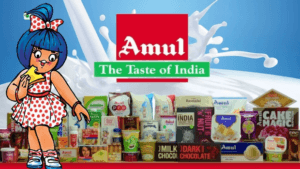
Amul has one of the widest product portfolios in the Indian FMCG space, with over 450 SKUs across dairy and food categories. What started with just milk and butter has today expanded into almost every food segment an Indian household needs.
The product strategy is built on one simple idea offer something for everyone, at every price point, without compromising quality.
Amul's current product portfolio includes:
- Milk & Cream: Amul Taaza, Amul Gold, Amul Slim & Trim, A2 Cow Milk
- Butter & Ghee: India's most trusted butter brand for over 70 years
- Cheese & Spreads: Amul Cheese, Cheese Spread, Garlic Butter
- Ice Cream & Desserts: one of India's top 3 ice cream brands
- Beverages: Amul Kool, Lassi, Chaach, flavoured milk
- Health & Nutrition: Amul Whey Protein, Memory Milk, Immunity Shots
- Ready-to-Cook: Paneer, Shrikhand, Greek Yoghurt, Pro-Biotic Yoghurt
Amul keeps investing in R&D to bring new products to market every year, a habit that has kept the brand relevant across generations.
2. Price Strategy
Amul's pricing philosophy has never changed in 80 years, giving the best quality at a price every Indian can afford. This is not just a marketing tagline. It is built into the cooperative structure itself, where farmer profits, processing costs, and consumer affordability are all balanced together.
Amul follows two main pricing approaches:
- Low-cost pricing: for everyday essentials like milk, butter, and ghee, priced lower than most private competitors to ensure mass accessibility.
- Competitive pricing: for premium products like Amulspray, Prolite, condensed milk, and whey protein, priced similarly to market competitors.
A few things that make Amul's pricing stand out:
- In January 2025, GCMMF actually reduced milk prices for 1-litre packs to encourage larger pack purchases, a rare move in the FMCG sector.
- Despite ₹1 lakh crore in turnover, Amul spends less than 1% of its revenue on advertising, keeping costs low and passing savings to consumers.
- Value packs and combo offers make premium products accessible to middle-income households across India.
3. Place & Distribution Strategy
Amul's distribution network is one of the most remarkable in Indian FMCG history. It connects 36 lakh farmers in Gujarat to consumers across every pin code in India and increasingly, across the world.
The distribution works through two parallel channels:
- Procurement Channel: Farmers supply milk to village cooperatives, which is then collected, chilled, and transported to processing plants across India.
- Distribution Channel: Finished products move from processing plants through carrying & forwarding agents, distributors, dealers, and finally to retailers and consumers.
What makes this network exceptional:
- Amul products are available in 1 million+ retail outlets across India, from modern supermarkets to small kirana stores in tier 3 cities and villages.
- Amul has expanded aggressively into tier 2 and tier 3 cities in recent years, deepening rural penetration.
- Internationally, Amul now exports to 50+ countries and recently entered the US market with fresh milk variants.
- The brand also sells directly to consumers through the Amul online app and major e-commerce platforms.
To see how Amul's business model supports this massive distribution network, check out the Business Model of Amul.

4. Promotion Strategy
Amul's promotion strategy is one of the most unique in Indian advertising history. While most FMCG brands spend heavily on celebrity endorsements and mass media campaigns, Amul has built its entire brand identity around one tiny cartoon girl, the Amul Girl.
Created by artist Eustace Fernandes in 1966, the Amul Girl has been commenting on Indian current events through witty topical ads for over 60 years, making her one of the longest-running advertising campaigns in the world.
Amul's promotional mix includes:
- Topical Advertising real-time witty creatives on current events across hoardings, print, and social media.
- Television & Radio mass media campaigns for product launches and seasonal promotions.
- Digital & Social Media active presence on Instagram, Facebook, and YouTube with recipe content, moment marketing, and user engagement.
- Cricket Sponsorships official sponsor of Afghanistan, Sri Lanka, and South Africa cricket teams.
- E-commerce & App Amul's own online app for direct-to-consumer sales and promotions.
Amul intentionally keeps its advertising budget under 1% of turnover, proving that a strong brand idea beats a big budget every time.
To understand the challenges and opportunities Amul faces today, read the detailed Marketing Strategy of Amul.

Top Competitors of Amul
Amul dominates the Indian dairy market, but it does face strong competition across different product categories. Here are its key competitors:
- Mother Dairy: Delhi-based dairy cooperative and Amul's closest rival in fluid milk and ice cream across North India.
- Nestlé India: competes directly in cheese, dairy whiteners, and nutrition products like Milo and Milkmaid.
- Britannia Industries: strong competition in dairy products like cheese, butter, and flavoured milk.
- Parag Milk Foods: fast-growing challenger brand with Go Cheese and Gowardhan Ghee targeting urban consumers.
- Nandini (KMF): dominant dairy cooperative in South India, especially Karnataka.
- Kwality Wall's: competes in the ice cream and frozen desserts segment.
- Havmor: regional ice cream brand with a strong presence in Gujarat and West India.
Marketing Mix of Mother Dairy, a Delhi-based dairy cooperative and Amul's closest rival in fluid milk and ice cream across North India.
Conclusion
Amul's marketing mix is a masterclass in simplicity. No complicated strategies, no over-the-top advertising budgets, no celebrity-driven campaigns. Just a deep understanding of the Indian consumer, what they need, what they can afford, and what makes them feel connected to a brand.
From a small farmers' cooperative in 1946 to a ₹1 lakh crore brand in 2026, Amul has proved that the best marketing strategy is one that never loses sight of its people, whether that is the farmer who produces the milk or the family that buys it every morning. The 4Ps of Amul's marketing mix, affordable products, accessible pricing, an unmatched distribution network, and an iconic 60-year-old advertising campaign together tell the story of a brand that has earned its place in every Indian household.
Want to Know Why 2,50,000+ Students Trust Us?
Dive into the numbers that make us the #1 choice for career success



MBA - Level
Post Graduate in Digital Marketing & Business Strategy

Best For
Fresh Graduates

Mode of Learning
On Campus (Mumbai & Delhi)

Starts from
Nov 27, 2026

Duration
11 Months

Live & Online
Advanced Online Digital Marketing Course
Best For
Working Professionals
Mode of Learning
Online
Starts from
Nov 2, 2026
Duration
4-6 Months

Offline
Top AI Courses to Make You Future Ready!
Best For
AI Enthusiasts
Mode of Learning
2–5 Month Program
Starts from
Nov 24, 2026
Duration
Flexiable

Offline
Undergraduate Program in Digital Business & Entrepreneurship
Best For
12th Passouts
Mode of Learning
On Campus (Mumbai)
Duration
3 Years

Offline
Degree In 2026 ≠ Enough Degree + Digital Skills = Future-Ready
Best For
12th Passouts
Mode of Learning
At IIDE Campus
Duration
3 Years
Recent Post
The marketing mix of Amul is based on the 4Ps: Product, Price, Place, and Promotion. Amul offers a wide range of dairy products, including milk, butter, cheese, ice cream, and chocolates. It follows a low-cost and competitive pricing strategy to stay affordable. Its distribution network covers over 500,000 retail outlets across India. Promotion is driven by its iconic Amul Girl campaign and moment marketing on social media.
Amul uses a combination of low-cost pricing and competitive pricing. For everyday products like milk, butter, and ghee, Amul keeps prices lower than competitors to stay accessible to all income groups. For premium products like Amulspray and condensed milk, it uses competitive pricing similar to rivals. Amul also offers value packs and discounts to attract budget-conscious buyers.
Amul targets a very wide audience from children and homemakers to working professionals and businesses. Its primary buyer persona is a middle-class Indian household looking for affordable, high-quality dairy products. Amul also targets institutional buyers like hotels, bakeries, and restaurants through its B2B distribution. In recent years, it has expanded focus to health-conscious consumers with products like Greek Yogurt, A2 Cow Milk, and Immunity Shots.
Amul's promotion strategy is unique because of its iconic Amul Girl mascot, which has been running since 1966 making it one of the longest-running ad campaigns in the world. Amul regularly uses moment marketing by creating witty topical ads based on current news and trending events. It also keeps its advertising spend below 1% of its total turnover, making it one of the most cost-efficient marketing strategies in the FMCG industry.
Amul uses a two-channel distribution system. The first is the procurement channel where farmers supply milk to local cooperatives, which is then sent to processing plants. The second is the distribution channel where finished products reach consumers through carrying and forwarding agents, distributors, dealers, and retailers. This network covers both urban and rural India, with over 500,000 retail outlets and a growing presence on e-commerce platforms and the Amul app.

Lead Trainer & Business Development Head at IIDE
Aditya Shastri leads the Business Development segment at IIDE and is a seasoned Content Marketing expert. With over a decade of experience, Aditya has trained more than 20,000 students and professionals in digital marketing, collaborating with prestigious institutions and corporations such as Jet Airways, Godrej Professionals, Pfizer, Mahindra Group, Publicis Worldwide, and many others. His ability to simplify complex marketing concepts, combined with his engaging teaching style, has earned him widespread admiration from students and professionals alike.
Aditya has spearheaded IIDE’s B2B growth, forging partnerships with over 40 higher education institutions across India to upskill students in digital marketing and business skills. As a visiting faculty member at top institutions like IIT Bhilai, Mithibai College, Amity University, and SRCC, he continues to influence the next generation of marketers.
Apart from his marketing expertise, Aditya is also a spiritual speaker, often traveling internationally to share insights on spirituality. His unique blend of digital marketing proficiency and spiritual wisdom makes him a highly respected figure in both fields.