
Students Centric
Placements Report
Trackable results, real numbers
Reviews
Proven success, real voices
Trainers
Expert-led, Industry-Driven Training
Life at IIDE
Vibrant Spirit student life
Alumni
Successful Journeys, Inspiring Stories
Learning Centre
Webinars
Blogs
Case studies
Live, Interactive Masterclasses
Fresh Insights, quick reads
Real-life, Industry relevant
More
Hire from us
Hire Top Digital Marketing Talent
Work with us
Join Our Team, Make an Impact
Customised Training
Personalised digital marketing training for your company
Refer & earn
Simple, easy rewards
Contact us
Get the answers you need
About us
Know more about IIDE
Explore all course options

FOR FRESH GRADUATES
Post Graduation Program in Digital Marketing & Business Strategy- Ideal for Age: 20–25 Years

Can’t decide? Explore all our
Digital Marketing Courses
COMPARE BOTH OUR PROGRAMSOffline
Offline AI Courses with Dual CertificationsIndustry-Aligned TRACKMost Popular
UG Program in Digital Business & Entrepreneurship- Ideal for 12th Pass out / FY Degree Student

PARTNER PROGRAMS






Can’t decide? Explore all
BBA In Digital Marketing Colleges
Orginally Written by Aditya Shastri
Updated on Jun 24, 2026
|2,755K+ views
Mastakala's main strengths are emotional personalisation, genuine Made-in-Nepal craftsmanship, and a strong Instagram following. Its biggest weaknesses are hard-to-scale handmade production and seasonal demand. The largest opportunity is corporate and diaspora gifting, while a crowded, easy-to-copy market is its sharpest threat. Founded in 2018 in Kathmandu, Mastakala is a private, direct-to-consumer handcrafted gifting brand.
Before diving into the article, I'd like to inform you that the research and initial analysis for this piece were conducted by Nikhil Patwa. He is a student of IIDE's Online Digital Marketing Course of the December 2025 Batch.
If you found this helpful, feel free to reach out to Nikhil to send a quick note of appreciation for his fantastic research. He will appreciate the kudos!
| SWOT TABLE | |
|---|---|
| STRENGTHS | WEAKNESSES |
| Deep emotional connection drives margins | Hard to scale manual crafting |
| Artisanal branding beats generic items | Highly vulnerable to seasonal dips |
| Organic reach via visual content | Weak presence in global markets |
| Strong direct-to-consumer relationship control | Competitors easily mimic original designs |
| OPPORTUNITIES | THREATS |
| Rising demand for customised items | Crowded market of social storefronts |
| Boom in local digital shopping | Risks from shifting platform algorithms |
| Huge potential in corporate accounts | Price-sensitive buyers favour cheap imports |
| Untapped revenue from the overseas diaspora | Import cost and currency exposure |
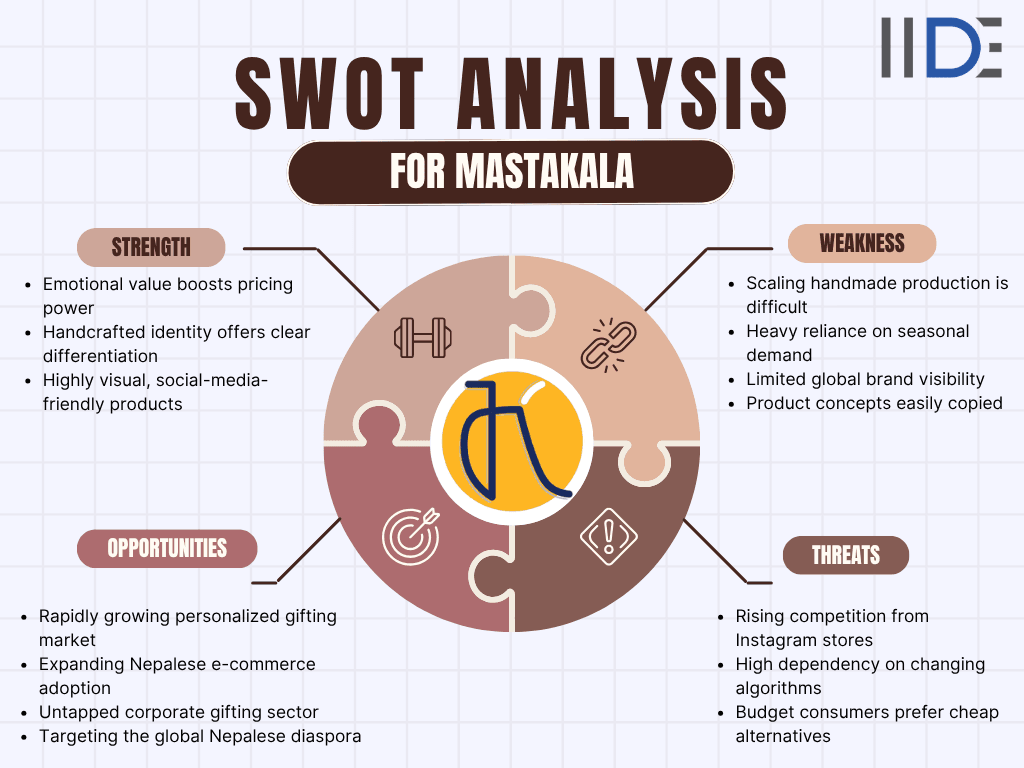
Here's a quick visual snapshot of MastaKala's SWOT Analysis to make it easier to scan at a glance.

Is Digital Marketing the Right Career for You?
Find out in a free 45-min masterclass · Career paths, roles and growth explained · By Karan Shah, Founder & CEO, IIDE

Is Digital Marketing the Right Career for You?
Find out in a free 45-min masterclass · Career paths, roles and growth explained · By Karan Shah, Founder & CEO, IIDE
What Are the Strengths of Mastakala?
Mastakala's core strength is emotional personalisation. It sells handmade wooden gifts for birthdays, weddings, anniversaries, and relationship milestones, where sentiment matters more than function. That emotional pull, paired with real Made-in-Nepal craftsmanship and a strong Instagram presence, lets the brand charge premium prices and stand apart from mass-produced gift stores.
1. Emotional personalisation creates higher perceived value
- Most Mastakala purchases are tied to an occasion or a relationship, not a practical need.
- In gifting, buyers weigh emotional meaning over utility, so a personalised wooden keepsake feels worth more than a generic mug.
- That psychology lets the brand price above commodity gift stores without losing customers.
2. Genuine handmade craftsmanship is hard to fake
- Mastakala does not just relabel imported stock. Co-founder Arun Agrawal has explained that machines handle around 60% of the work, while finishing is done by hand, which leaves room for human care and the occasional flaw.
- The brand imports only raw wood and keeps designing, cutting, finishing, and packaging inside Nepal.
- That makes its "handmade in Nepal" claim real, not marketing.
3. First-mover edge in a niche it helped create
- Mastakala started with wooden cake toppers and set an early trend before widening into notebooks, calendars, decor, and custom keepsakes.
- Being early gave it a recognised name and a loyal repeat base, while later sellers were still copying the format.
4. A strong, visual-first social presence
- The products are built to be photographed and shared.
- Mastakala's main Instagram account (@mastakalanepal) has roughly 12,000 followers and over 1,000 posts, and customers regularly post the personalised gifts they receive.
- That user-generated content gives the brand organic reach without heavy ad spend.
5. Two revenue streams, not one
- Beyond individual gifting, Mastakala runs an active corporate gifting line (a separate account, @mastakala_corporate) selling customised kits, calendars, and wooden clocks to companies.
- B2B corporate orders are larger, more repeatable, and less tied to festival spikes, which steadies the business.
6. A tight founder-led model
- The two co-founders split the work cleanly. Nikhil Agrawal, trained in architecture, leads design and social media, while Arun Agrawal, an engineer from Pulchowk Campus, runs operations and the business side.
- That keeps creative control and quality decisions close to the founders.
What Are the Weaknesses of Mastakala?
Mastakala's biggest strength, handmade production, is also its biggest constraint. Hand-finished wooden products are slow and tricky to scale without quality slipping. On top of that, the brand leans on imported raw wood that raises costs, depends on seasonal occasions for sales, and works in a category where designs are easy to copy and rarely protected by patents in Nepal.
1. Handmade production is difficult to scale
- As orders rise, keeping every piece consistent gets harder.
- Hand-finished wood carries a real risk of mistakes, and artisan-led businesses often struggle with inventory, delivery timelines, and quality control.
- Scaling up without turning the product generic is a genuine operational problem.
2. Imported raw material raises the cost base
- Mastakala sources processed wood from European countries through India and natural wood from Nepal.
- Importing a core input exposes the brand to shipping costs, customs, and currency swings, which squeeze margins and limit how cheaply it can ever price.
3. Heavy dependence on seasonal demand
- Sales cluster around Valentine's Day, weddings, festivals, and anniversaries.
- That creates uneven cash flow across the year and makes planning production and staffing harder during quiet months.
4. Designs are easy to copy
- This is a weakness the founders have named themselves.
Because product designs are rarely patented in Nepal, competitors have inquired about Mastakala's products and then replicated them at lower prices or in cheaper materials. - Without stronger brand and design moats, the niche stays crowded.
5. Limited international recognition so far
- Mastakala has strong local pull and has begun selling some products in India, but it is still early in building a wider global audience.
- That caps export potential and international collaborations for now.
6. Key-person and small-team risk
- Design, social media, and operations all sit close to the two founders.
- That keeps quality high but concentrates the brand's creativity and decision-making in very few people, which is fragile as the business grows.
To see how a global confectionery giant dominates the premium holiday gifting market, you can explore our detailed Swot Analysis of Ferrero Rocher.
What Are the Opportunities for Mastakala?
Mastakala sits in a market that is moving its way. Demand for personalised, emotionally meaningful gifts is rising, Nepal's online shopping habits are expanding, and corporate gifting budgets are shifting toward custom, locally made products. Add a large Nepali diaspora that wants culturally connected gifts and recent national exposure from Shark Tank Nepal, and the brand has several clear paths to grow.
1. Personalised gifting is growing
- Younger buyers increasingly treat gifting as self-expression and prefer unique, custom items over mass-produced ones.
- That behaviour shift directly favours a brand built on personalisation, and it is the trend most aligned with Mastakala's core product.
2. Corporate gifting has real room to expand
- Companies are moving away from generic corporate gifts toward personalised kits, employee-appreciation hampers, and custom-branded merchandise.
- Mastakala already serves this market, so the opportunity is to scale an existing line into a steady, higher-value B2B channel rather than start from scratch.
3. The Nepali diaspora is an underserved market
- Large Nepali communities in India, the Gulf, the US, Australia, and beyond actively look for culturally connected, handmade products and gifts to send home or keep.
- Cross-border gifting and shipping to this audience could open a sizeable customer base.
4. Geographic expansion inside and outside Nepal
- The founders have said they want to expand first across major Nepali cities and then toward Western markets.
- Wider domestic delivery and a careful international push are both available growth levers.
5. National exposure from Shark Tank Nepal
- Mastakala's co-founders pitched on Shark Tank Nepal's first season, which aired in 2025.
- That kind of mainstream visibility builds brand credibility and trust that a small business usually cannot buy, and it can be used to pull in new customers and partners.
What Are the Threats to Mastakala?
Mastakala faces a crowded and fast-moving market. Established players like Giftmandu have far larger scale and delivery reach, countless Instagram craft stores compete on similar handmade looks, and mimics undercut on price. The brand also leans heavily on Instagram for discovery, which exposes it to algorithm changes, and gifting itself is discretionary spending that softens whenever the economy slows.
1. Rising competition across the gifting market
- The space is packed with mainstream gift platforms, imported decor sellers, and handmade marketplaces.
- Giftmandu alone has operated since 2010 with broad nationwide delivery, and standing out against both bigger players and a swarm of small Instagram sellers gets harder every year.
2. Heavy dependence on social media discovery
- A large share of Mastakala's reach comes through Instagram.
- Platform algorithms change often, and a brand that relies mostly on one channel for visibility can see traffic and sales swing without warning.
3. Mimics competing on price
- Because designs are easy to replicate and rarely patented in Nepal, cheaper imitations appear quickly.
- Price-sensitive buyers may pick a factory-made lookalike over the handmade original, pulling away the value-conscious end of the market.
4. Import cost and currency exposure
- With processed wood imported through India and Europe, raw material costs are tied to exchange rates and import conditions.
- Currency weakness or import disruptions would hit margins directly.
5. Discretionary spending is fragile
- Personalised gifts are a want, not a need.
- In a slowdown, customers cut discretionary purchases first, which can shrink Mastakala's order volume faster than for essential-goods sellers.
6. Larger players moving into personalisation
- Bigger platforms such as Giftmandu already advertise personalised gifts.
- If well-funded competitors scale customisation with faster delivery and lower prices, they could squeeze Mastakala's niche from above.
If you are interested in how ultra-luxury heritage brands master emotional packaging and high-end gifting experiences, check out our in-depth Swot Analysis of Tiffany & Co.
About Mastakala
Mastakala (styled Masta Kala) is a Nepal-based handcrafted gifting and decor brand founded in 2018 in Kathmandu by brothers Arun and Nikhil Agrawal. It designs and makes personalised wooden gifts, notebooks, calendars, decor, and corporate gifting kits, with all designing, cutting, finishing, and packaging done in Nepal. The brand sells direct to consumers and to companies, and has built its name on emotional, occasion-based personalisation.
| Field | Details |
|---|---|
| Company name | Masta Kala (Mastakala) |
| Founded | 2018, Kathmandu |
| Founders | Arun Agrawal and Nikhil Agrawal |
| Headquarters | Khusibu (Shahamati Marga), Kathmandu, Nepal |
| Industry | Handcrafted and personalised gifting, decor, and corporate gifting |
| Key products | Personalised wooden gifts, notebooks, calendars, wooden clocks, decor, and corporate kits |
| Business model | Direct-to-consumer (D2C) plus B2B corporate gifting |
| Main competitors | Giftmandu, Urban Girl, independent Instagram craft stores |
| Notable | Co-founders featured on Shark Tank Nepal, Season 1 (2025) |
What Is Happening With Mastakala in 2026?
Mastakala has moved from a small workshop project into a recognised Nepali gifting brand with national visibility. Its co-founders pitched on the first season of Shark Tank Nepal, which aired in 2025, giving the brand mainstream exposure beyond its social following.
The founders have also signalled a clear next phase: expanding across major Nepali cities first, then pushing toward Western markets, while growing the corporate gifting side of the business. The open question is whether the brand can scale that ambition without losing the handmade quality that made it distinctive.
Key Takeaways and Strategic Recommendations
Mastakala's SWOT comes down to one core tension: the handmade, personal quality that makes it special is the same thing that makes it hard to scale. Its strengths are genuine, its risks are equally real. To strengthen long-term growth, Mastakala should focus on:
- Building stronger SEO visibility so the brand can be discovered through search and not just Instagram, reducing its dependence on one algorithm.
- Scaling the corporate gifting line, since B2B orders are larger, more repeatable, and less seasonal than individual gifting.
- Targeting the international Nepali diaspora with cross-border shipping and culturally connected products.
- Investing in Pinterest and search-led content to capture gifting and decor intent that Instagram alone misses.
- Leaning into founder-led storytelling and behind-the-scenes craft content, turning the two founders and the handmade process into a defensible brand story.
- Building repeat-customer systems, such as loyalty perks and occasion reminders, so revenue is less dependent on one-off festival spikes.
Future outlook: If Mastakala can grow volume and channels while keeping its craft and personalisation intact, it has a realistic path to becoming one of Nepal's most recognisable modern gifting brands over the next few years.
Want to Know Why 2,50,000+ Students Trust Us?
Dive into the numbers that make us the #1 choice for career success



MBA - Level
Post Graduate in Digital Marketing & Business Strategy

Best For
Fresh Graduates

Mode of Learning
On Campus (Mumbai & Delhi)

Starts from
Nov 27, 2026

Duration
11 Months

Live & Online
Advanced Online Digital Marketing Course
Best For
Working Professionals
Mode of Learning
Online
Starts from
Nov 2, 2026
Duration
4-6 Months

Offline
Top AI Courses to Make You Future Ready!
Best For
AI Enthusiasts
Mode of Learning
2–5 Month Program
Starts from
Nov 24, 2026
Duration
Flexiable

Offline
Undergraduate Program in Digital Business & Entrepreneurship
Best For
12th Passouts
Mode of Learning
On Campus (Mumbai)
Duration
3 Years
Offline
Degree In 2026 ≠ Enough Degree + Digital Skills = Future-Ready
Best For
12th Passouts
Mode of Learning
At IIDE Campus
Duration
3 Years
Recent Post
You May Also Like
Its biggest strength is emotional personalisation. Mastakala makes handmade wooden gifts for birthdays, weddings, and anniversaries, where sentiment matters more than function. This lets the brand charge premium prices and stand apart from mass-produced gift stores.
Its handmade production is difficult to scale without losing quality. Hand-finished wooden products are slow to make and hard to keep consistent at higher volumes, which limits how fast the brand can grow while staying distinctive.
The largest opportunities are scaling its existing corporate gifting line, reaching the international Nepali diaspora with cross-border shipping, and riding the rising demand for personalised, emotionally meaningful gifts. National exposure from Shark Tank Nepal also adds credibility it can build on.
The main threats are a crowded gifting market led by larger players like Giftmandu, copycats undercutting on price, heavy dependence on Instagram for discovery, and import-linked costs. Gifting is also discretionary spending that drops during economic slowdowns.
Its main competitors are Giftmandu and Urban Girl, along with many independent Instagram-based handmade gift stores. Giftmandu is far larger and more mainstream, while Instagram craft sellers compete on similar handmade looks at smaller scale.
Yes. Mastakala's co-founders pitched on the first season of Shark Tank Nepal, which aired in 2025. The appearance gave the brand national exposure well beyond its social media following.
The outlook is promising but depends on balance. If Mastakala can scale its volume, channels, and corporate line while protecting the handmade quality that makes it distinctive, it has a realistic path to becoming one of Nepal's most recognisable modern gifting brands.


Lead Trainer & Business Development Head at IIDE
Aditya Shastri leads the Business Development segment at IIDE and is a seasoned Content Marketing expert. With over a decade of experience, Aditya has trained more than 20,000 students and professionals in digital marketing, collaborating with prestigious institutions and corporations such as Jet Airways, Godrej Professionals, Pfizer, Mahindra Group, Publicis Worldwide, and many others. His ability to simplify complex marketing concepts, combined with his engaging teaching style, has earned him widespread admiration from students and professionals alike.
Aditya has spearheaded IIDE’s B2B growth, forging partnerships with over 40 higher education institutions across India to upskill students in digital marketing and business skills. As a visiting faculty member at top institutions like IIT Bhilai, Mithibai College, Amity University, and SRCC, he continues to influence the next generation of marketers.
Apart from his marketing expertise, Aditya is also a spiritual speaker, often traveling internationally to share insights on spirituality. His unique blend of digital marketing proficiency and spiritual wisdom makes him a highly respected figure in both fields.