
Students Centric
Placements Report
Trackable results, real numbers
Reviews
Proven success, real voices
Trainers
Expert-led, Industry-Driven Training
Life at IIDE
Vibrant Spirit student life
Alumni
Successful Journeys, Inspiring Stories
Learning Centre
Webinars
Blogs
Case studies
Live, Interactive Masterclasses
Fresh Insights, quick reads
Real-life, Industry relevant
More
Hire from us
Hire Top Digital Marketing Talent
Work with us
Join Our Team, Make an Impact
Customised Training
Personalised digital marketing training for your company
Refer & earn
Simple, easy rewards
Contact us
Get the answers you need
About us
Know more about IIDE
Explore all course options

FOR FRESH GRADUATES
Post Graduation Program in Digital Marketing & Business Strategy- Ideal for Age: 20–25 Years

Can’t decide? Explore all our
Digital Marketing Courses
COMPARE BOTH OUR PROGRAMSOffline
Offline AI Courses with Dual CertificationsIndustry-Aligned TRACKMost Popular
UG Program in Digital Business & Entrepreneurship- Ideal for 12th Pass out / FY Degree Student

PARTNER PROGRAMS






Can’t decide? Explore all
BBA In Digital Marketing Colleges
Orginally Written by Aditya Shastri
Updated on May 13, 2026
Share on:


HubSpot is no longer just the inbound marketing brand many marketers first learned about.
What began as a content-led marketing platform has evolved into a global customer platform powering marketing, sales, service, and AI-driven growth for businesses worldwide.
Search traffic is shifting, AI tools are rising, and software buyers now expect automation, outcomes, and simplicity together.
So the real question is: Can HubSpot stay ahead in the AI era, or is the category becoming too crowded?
Before diving into the article, I would like to acknowledge that the research and initial analysis for this piece were conducted by Gajendra Prajapat, a current student of IIDE’s Post Graduation in Digital Marketing and Business Strategy, August Batch 2025.
If you found this helpful, feel free to reach out to Gajendra Prajapat to send a quick note of appreciation for his fantastic research, he will appreciate the kudos!
About HubSpot
HubSpot was founded in 2006 by Brian Halligan and Dharmesh Shah while they were connected to Massachusetts Institute of Technology.
They recognised that traditional advertising was becoming less effective, as consumers were increasingly ignoring cold calls, banners, and interruptive marketing.
This insight led to the creation of inbound marketing, a model where businesses attract customers through valuable content, trust, and helpful experiences.
Over time, HubSpot evolved from a marketing tool into a full customer platform combining CRM, marketing automation, sales tools, service systems, Data Hub, operations, and AI capabilities.
By INBOUND 2025, the company had declared the traditional inbound model dead and reframed its entire growth philosophy around hybrid human-AI teams and The Loop Framework.
Today, HubSpot serves 288,706 paying customers in more than 135 countries (Q4 2025), generating Q4 2025 revenue of $846.7 million, up roughly 20% year over year.
Its major competitors include Salesforce, Microsoft, Zoho, ActiveCampaign, and GoHighLevel.
Why This SWOT Matters in 2026
The SaaS industry is changing rapidly, and the pace of that change is unlike anything the sector has seen before.
Earlier, software buyers mainly looked for features and integrations.
Today businesses also demand:
- AI automation
- Faster ROI
- Lower software complexity
- Better data visibility
- Outcome-based pricing
- Connected customer experiences
At the same time:
- Competition is intensifying
- Search traffic is declining 27% year over year based on HubSpot's own customer data, not an industry-wide average
- AI-native startups are emerging faster than ever
- Pricing pressure is increasing
- Buyers switch tools faster than before
That makes 2026 a defining year for established SaaS leaders like HubSpot, where standing still is simply not an option.

Is Digital Marketing the Right Career for You?
Find out in a free 45-min masterclass · Career paths, roles and growth explained · By Karan Shah, Founder & CEO, IIDE

Is Digital Marketing the Right Career for You?
Find out in a free 45-min masterclass · Career paths, roles and growth explained · By Karan Shah, Founder & CEO, IIDE
SWOT Analysis of HubSpot
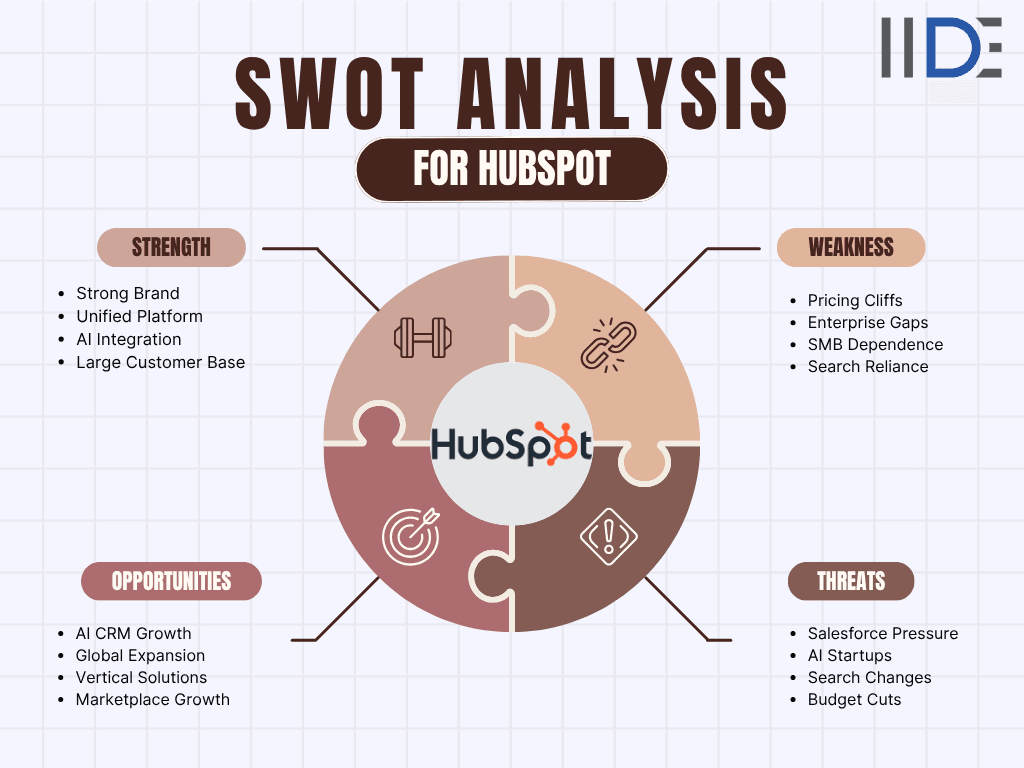
1. Strengths
If you had to describe HubSpot in one line, it would be this: it made growth software easier for businesses.
Its biggest advantage is combining powerful capabilities with user-friendly execution.
Key Strengths:
- Strong global brand recognition: HubSpot is one of the best-known names in CRM and marketing software, now serving 288,706 customers across 135+ countries (Q4 2025).
- Unified platform model: Marketing, sales, service, CRM, and the newly launched Data Hub work together in one connected ecosystem.
- Industry-leading AI integration: Breeze AI now includes 15+ agents across marketing, sales, and service, with Customer Agent resolving 65% of conversations and cutting resolution time by 39%.
- Outcome-based pricing leadership: In April 2026, HubSpot charges $0.50 per resolved conversation and $1 per qualified lead, directly tying cost to value delivered.
- Strong financial performance: Q4 2025 revenue of $846.7 million reflects 20% year-over-year growth and sustained market confidence.
- Easy usability advantage: Simpler to use than many enterprise-heavy competitors, with AI embedded directly rather than bolted on.
- First-mover on AEO: HubSpot launched Answer Engine Optimization in April 2026, helping brands track and improve visibility across ChatGPT, Gemini, and Perplexity.
2. Weaknesses
Now this is where the challenge appears. As HubSpot grows bigger, it must balance simplicity with deeper enterprise power.
Key Weaknesses:
- Pricing jump between tiers: Growing customers often face steep upgrades that feel disconnected from the value received.
- Enterprise limitations: Some global businesses still need deeper customisation than HubSpot currently offers.
- Dependence on the SMB segment: Smaller businesses can be more price-sensitive, especially during economic uncertainty.
- Organic traffic collapse: HubSpot's own data shows customer organic traffic fell 27% year over year as AI search reshapes discovery.
- Identity transition risk: Declaring inbound dead creates a perception gap with customers who built entire strategies around it.
- AI trust concerns: Sensitive industries may hesitate to hand mission-critical workflows to AI agents.
- Growing complexity: With 15+ Breeze agents and multiple hubs, the original simplicity promise is harder to keep.
3. Opportunities
Now here's the exciting part, HubSpot still has major growth potential. The AI era may actually expand demand for platforms that simplify work.
Key Opportunities:
- AEO category leadership: As the first major CRM to launch Answer Engine Optimization, HubSpot can own an entirely new search category before competitors catch up.
- Outcome-based pricing expansion: Charging for results rather than seats can unlock new buying interest across budget-conscious mid-market companies.
- Enterprise expansion: Stronger agentic AI capabilities can grow deal sizes beyond the SMB core.
- International growth: With 47% of revenue already coming from international markets, many global regions remain underpenetrated.
- The Loop Framework adoption: HubSpot's new four-stage growth model replaces the linear funnel, creating a new consulting and certification ecosystem around it.
- Industry-specific AI agents: Vertical Breeze agents can attract premium customers willing to pay for specialised automation.
- Ecosystem marketplace growth: Third-party agents and apps can increase platform stickiness and revenue per customer.
4. Threats
Of course, not everything is in HubSpot's control. Software markets move quickly, and leaders can lose momentum fast.
Key Threats:
- Salesforce and Microsoft competition: Both are investing aggressively in agentic AI and enterprise CRM with resources HubSpot cannot match.
- Zoho pricing pressure: Lower-cost alternatives continue attracting SMBs who question HubSpot's tier upgrade costs.
- AI-native startups: New tools built ground-up for the AI era move faster and carry less legacy complexity.
- Answer engine disruption: With AI-referred traffic up 527% year over year, brands that fail to optimise for ChatGPT and Gemini will lose visibility entirely.
- Economic slowdowns: Businesses may cut software budgets, hitting mid-market SaaS platforms hardest.
- Platform fatigue: Companies are actively reducing overlapping software subscriptions, forcing platforms to prove consolidated value.
- OpenAI application expansion: AI assistants are absorbing workflow tasks that CRM platforms have traditionally owned.
SWOT Summary Chart
Key Insight, Final Thoughts and Conclusion
2026 Insight
HubSpot earned its reputation by educating the market first and selling later. That inbound-led approach helped turn it into one of the most trusted SaaS brands globally.
Today, businesses invest in software that improves efficiency, cuts manual workload, and delivers measurable growth.
If HubSpot continues relying mainly on past thought leadership, momentum may slow as the market becomes more outcome-driven.
But if the Marketing Strategy of HubSpot clearly communicates faster sales cycles, smarter AI automation, cleaner customer data, and easier growth across teams, it can strengthen leadership in the next SaaS era.
To understand how the brand competes in today’s market, read the Marketing Strategy of HubSpot for deeper insights into its demand generation, positioning, and growth engine.
That is the difference between being respected and being the obvious choice.
Final Thoughts
HubSpot remains one of the strongest software brands in modern business growth.
- Its biggest strength is usability with scale.
- Its biggest risk is getting squeezed between cheaper SMB tools and deeper enterprise platforms.
- If the company keeps simplifying complexity while leading on AI, growth can continue strongly.
- If not, awareness alone will not protect it.
And in software, adoption matters more than reputation.
Final Question: Can HubSpot lead the AI era the same way it led the inbound era?
Want to Know Why 2,50,000+ Students Trust Us?
Dive into the numbers that make us the #1 choice for career success



MBA - Level
Post Graduate in Digital Marketing & Business Strategy

Best For
Fresh Graduates

Mode of Learning
On Campus (Mumbai & Delhi)

Starts from
Nov 27, 2026

Duration
11 Months

Live & Online
Advanced Online Digital Marketing Course
Best For
Working Professionals
Mode of Learning
Online
Starts from
Nov 2, 2026
Duration
4-6 Months

Offline
Top AI Courses to Make You Future Ready!
Best For
AI Enthusiasts
Mode of Learning
2–5 Month Program
Starts from
Nov 24, 2026
Duration
Flexiable

Offline
Undergraduate Program in Digital Business & Entrepreneurship
Best For
12th Passouts
Mode of Learning
On Campus (Mumbai)
Duration
3 Years

Offline
Degree In 2026 ≠ Enough Degree + Digital Skills = Future-Ready
Best For
12th Passouts
Mode of Learning
At IIDE Campus
Duration
3 Years
Recent Post
A SWOT analysis of HubSpot examines its internal strengths and weaknesses along with external opportunities and threats. It helps understand HubSpot’s market position, competitive edge, and future growth potential in the SaaS industry.
HubSpot became successful through inbound marketing and easy-to-use software.
Its all-in-one platform attracts growing businesses worldwide.
Strong brand trust has also helped long-term growth.
AI helps HubSpot improve automation and productivity. It can make marketing, sales, and support faster. Customers now expect smart AI features in software. At the same time, AI increases market competition.
HubSpot combines CRM, marketing, sales, and service tools together. Its interface is clean and easy to understand. Many growing businesses prefer its simplicity.
This creates faster adoption and smoother usage.
Yes, HubSpot is popular among startups and SMEs. It offers free tools with upgrade options later.
Businesses can scale as they grow. That makes it attractive for smaller teams.
Yes, HubSpot is growing its enterprise presence. It is improving AI, analytics, and integrations.
Larger businesses now consider it seriously. However, competition remains intense.
HubSpot competes with Salesforce, Zoho, and Microsoft. It also competes with smaller CRM tools.
The software market is highly competitive. Innovation is important to stay ahead.

Lead Trainer & Business Development Head at IIDE
Aditya Shastri leads the Business Development segment at IIDE and is a seasoned Content Marketing expert. With over a decade of experience, Aditya has trained more than 20,000 students and professionals in digital marketing, collaborating with prestigious institutions and corporations such as Jet Airways, Godrej Professionals, Pfizer, Mahindra Group, Publicis Worldwide, and many others. His ability to simplify complex marketing concepts, combined with his engaging teaching style, has earned him widespread admiration from students and professionals alike.
Aditya has spearheaded IIDE’s B2B growth, forging partnerships with over 40 higher education institutions across India to upskill students in digital marketing and business skills. As a visiting faculty member at top institutions like IIT Bhilai, Mithibai College, Amity University, and SRCC, he continues to influence the next generation of marketers.
Apart from his marketing expertise, Aditya is also a spiritual speaker, often traveling internationally to share insights on spirituality. His unique blend of digital marketing proficiency and spiritual wisdom makes him a highly respected figure in both fields.