
Students Centric
Placements Report
Trackable results, real numbers
Reviews
Proven success, real voices
Trainers
Expert-led, Industry-Driven Training
Life at IIDE
Vibrant Spirit student life
Alumni
Successful Journeys, Inspiring Stories
Learning Centre
Webinars
Blogs
Case studies
Live, Interactive Masterclasses
Fresh Insights, quick reads
Real-life, Industry relevant
More
Hire from us
Hire Top Digital Marketing Talent
Work with us
Join Our Team, Make an Impact
Customised Training
Personalised digital marketing training for your company
Refer & earn
Simple, easy rewards
Contact us
Get the answers you need
About us
Know more about IIDE
Explore all course options

FOR FRESH GRADUATES
Post Graduation Program in Digital Marketing & Business Strategy- Ideal for Age: 20–25 Years

Can’t decide? Explore all our
Digital Marketing Courses
COMPARE BOTH OUR PROGRAMSOffline
Offline AI Courses with Dual CertificationsIndustry-Aligned TRACKMost Popular
UG Program in Digital Business & Entrepreneurship- Ideal for 12th Pass out / FY Degree Student

PARTNER PROGRAMS






Can’t decide? Explore all
BBA In Digital Marketing Colleges
Orginally Written by Aditya Shastri
Updated on Jul 2, 2026
Share on:


LinkedIn's strengths are its 1.3 billion-member network, Microsoft's AI and cloud backing, and consistent double-digit revenue growth. Its weaknesses include a persistent fake-profile problem and a widening gap between registered members and active users. The biggest opportunity is AI-powered hiring, already at a $450M+ run rate. Its most pressing threat: 875 layoffs in May 2026 despite 12% revenue growth, signalling the AI-cost-cutting era has reached even LinkedIn.
| SWOT TABLE | |
|---|---|
| Strengths | Weaknesses |
| 1.3B registered members globally | Only ~24% (310M) of members are monthly active |
| Backed by Microsoft's AI/cloud infrastructure | Persistent fake profile and bot problem (200M+ bots removed in 2024) |
| 12% YoY revenue growth, $4.83B in Q3 FY2026 | Ghost job listings eroding job-seeker trust |
| AI hiring tools already at $450M+ annual run rate | Cut 875 jobs (5% of staff) despite strong revenue growth |
| Opportunities | Threats |
| AI-powered recruiter and candidate-matching tools | Softening global tech hiring market (100K+ tech layoffs in 2026) |
| India now #2 market, growing 25% YoY | Data-scraping and AI-training lawsuits (Microsoft vs. ProAPIs, hiQ Labs) |
| Premium subscription expansion (175M+ users) | Trust erosion from scams and fake job posts; FBI fraud warnings |
| Agentic AI integration across products | AI-native recruiting startups changing how hiring works |
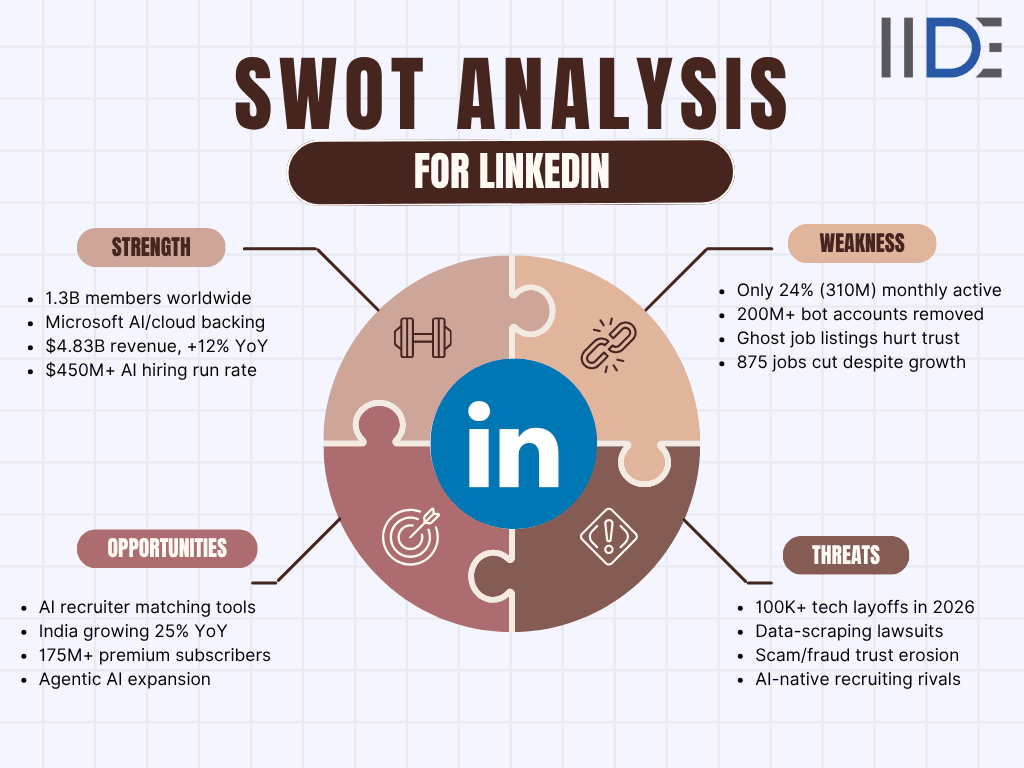
Here's a quick visual snapshot of LinkedIn's SWOT Analysis:

Is Digital Marketing the Right Career for You?
Find out in a free 45-min masterclass · Career paths, roles and growth explained · By Karan Shah, Founder & CEO, IIDE

Is Digital Marketing the Right Career for You?
Find out in a free 45-min masterclass · Career paths, roles and growth explained · By Karan Shah, Founder & CEO, IIDE
What Are LinkedIn's Strengths?
LinkedIn's core strength is scale. It has 1.3 billion registered members globally as of 2026, a milestone confirmed by Microsoft's CEO during a recent earnings call. No professional network comes close to this footprint.
- Financial momentum: LinkedIn revenue was up 12% to $4.83 billion in Microsoft's fiscal third quarter ended March 31, 2026, with growth across its business lines. This places LinkedIn on an annualised run rate above $19 billion, one of Microsoft's steadiest growth engines.
- Microsoft's AI and cloud backing: LinkedIn draws on Microsoft's Intelligent Cloud segment, which grew 30% to $34.7 billion in the same quarter, with Azure revenue up 40%. LinkedIn can plug directly into Microsoft's AI infrastructure without building it from scratch.
- AI hiring products gaining real traction: LinkedIn's AI-focused hiring products, including recruiter copilots and automated candidate-matching systems, have crossed a $450 million annual revenue run rate. This is a genuinely new, fast-growing revenue line, not just an add-on.
- Premium subscription base: LinkedIn has over 175 million premium users, up from 154 million in 2022. Subscriptions are high-margin, recurring revenue that's less exposed to ad-market swings.
- Entrenched enterprise position: LinkedIn's Q3 FY2026 growth spanned Talent Solutions, Marketing Solutions, and Premium Subscriptions - three distinct, diversified revenue lines rather than dependence on one.
What Are LinkedIn's Weaknesses?
LinkedIn's central weakness is the gap between its headline numbers and actual engagement, alongside a persistent trust problem from fake accounts and listings.
- Active-user gap: Registered members sit at 1.3 billion, but monthly active users are estimated at approximately 310 million - roughly 24% of registered members. Three in four "members" aren't meaningfully using the platform, which matters for anyone pricing ads or subscriptions off the 1.3B headline figure.
- A large bot and fake-profile problem: LinkedIn removed over 200 million bot accounts in 2024, roughly 16.7% of its entire stated user base, and continues fighting industrial-scale scraping operations in court. This directly undermines advertiser trust and lead quality on the platform.
- Ghost job listings: A significant share of companies have admitted to posting job listings with no real intent to fill them, sometimes just to collect resumes. This erodes the core trust proposition LinkedIn sells to job seekers.
- Cutting staff despite growth: LinkedIn cut roughly 875 jobs, about 5% of its 17,500-person workforce, in May 2026, despite 12% revenue growth and a first-ever $5 billion quarterly revenue crossing. Layoffs during growth signal margin pressure from AI infrastructure costs, not weak demand - but it's still a headline weakness for a company built on job security narratives.
- Leadership transition risk: The layoffs were the first major workforce decision from LinkedIn's new CEO, who took over just three weeks earlier following the departure of the previous six-year CEO. New leadership plus a restructuring signal strategic uncertainty in the near term.
If you're curious how a company balances scale with constant reinvention, our SWOT analysis of Amazon breaks down how AWS profits, thin retail margins, and an aggressive AI bet are shaping its next decade.
What Are LinkedIn's Opportunities?
LinkedIn's clearest opportunity is doubling down on AI as the differentiator in recruiting and professional networking, alongside emerging-market growth.
- AI-native hiring tools: With AI hiring products already at a $450M+ run rate and a company-wide focus on using AI to improve match quality for recruiters and help members find opportunities more efficiently, this is the fastest-growing lever available. Recruiting is LinkedIn's most defensible business, and AI deepens that moat.
- India as the growth engine: India's 150 million members, growing 25% year-over-year, make it the platform's fastest-growing major market. As US/Europe membership matures, India (and similar markets) represent the next leg of member growth.
- Reorganising around growth, not just cost: LinkedIn's leadership has said the company wants smaller, faster, more agile teams that heavily leverage AI tools. If executed well, this could improve product velocity in a market where AI-native startups move fast.
- Video and native content growth: Video content on the platform has been growing significantly year-over-year, outpacing other formats. This keeps users on-platform longer, supporting both ad revenue and engagement depth.
What Are LinkedIn's Threats?
LinkedIn's biggest threat is that the AI-driven restructuring sweeping the tech industry has now reached a business that was previously considered insulated.
- The layoff signals a broader industry pattern: LinkedIn's cuts land in a month that already saw layoffs at several major tech and consumer companies, plus Microsoft's own large voluntary retirement program - the first of its kind in the company's 51-year history. Even Microsoft's most reliable growth unit isn't exempt from the AI-cost-discipline wave.
- Softening tech hiring overall: Industry trackers have recorded over 103,000 tech job cuts in 2026 so far, nearing the total for all of 2025. LinkedIn's Talent Solutions revenue depends on companies actively hiring and paying for recruiter tools - a prolonged hiring slowdown directly hits its core business.
- Legal exposure from data scraping: Microsoft has sued multiple companies for allegedly creating millions of fake accounts to scrape LinkedIn profile data, in a legal fight that dates back to a nearly six-year-long case that reached the Supreme Court. Scraped LinkedIn data increasingly feeds AI model training pipelines that LinkedIn doesn't control, threatening both user privacy and LinkedIn's own data moat.
- Scam and fraud vector: The FBI has issued warnings about LinkedIn specifically as a vector for financial scams, including fake-persona investment fraud. Trust is LinkedIn's core product; sustained fraud exposure risks user and advertiser confidence.
For a look at how India's own job-market leader stacks up, our SWOT analysis of Infoedge unpacks how Naukri.com's dominant hiring platform, diversified verticals like 99acres and Jeevansathi, and rising competition are shaping the company's next phase.
About LinkedIn
LinkedIn is the world's largest professional networking platform, founded in 2003 by Reid Hoffman and acquired by Microsoft in December 2016 for $26.2 billion. Headquartered in Sunnyvale, California, it operates across recruiting, marketing solutions, learning, and premium subscriptions, now increasingly powered by AI.
| Metric/Attribute | Details |
|---|---|
| Founded | 2003 (by Reid Hoffman) |
| Acquisition | Acquired by Microsoft in December 2016 for $26.2B |
| Parent Company | Microsoft Corporation |
| Headquarters | Sunnyvale, California |
| CEO | Dan Shapero (since April 2026) |
| Members | 1.3 billion (2026) |
| Monthly Active Users | ~310 million (2026) |
| Employees | ~17,500 (pre-May 2026 cuts) |
| Q3 FY2026 Revenue | $4.83B (+12% YoY) |
Key Takeaways & Recommendations
LinkedIn's core tension right now: it's growing revenue at double digits while simultaneously cutting staff - a pattern becoming normal across Big Tech in 2026, where AI infrastructure spend is squeezing headcount even at profitable units.
Its scale and Microsoft backing remain unmatched strengths, but trust issues (bots, ghost jobs, scraping) and a widening active-user gap are real vulnerabilities. The path forward clearly runs through AI-powered recruiting products, which are already proving their commercial value.
The following are IIDE's recommendations to LinkedIn:
- Close the active-user gap: With only ~24% of registered members monthly active, LinkedIn should prioritise re-engagement features (smarter notifications, lighter-weight content formats) over pure member acquisition, which is starting to show diminishing returns on trust.
- Make bot and ghost-job detection visible to users: The scraping lawsuits and bot removals happen largely behind the scenes. Surfacing verification status and listing-freshness signals more prominently on the platform itself (not just in legal filings) would rebuild trust faster than enforcement alone.
- Lean further into AI hiring products as the growth engine: The $450M+ run rate on AI recruiting tools is LinkedIn's strongest proof point. Doubling down here, rather than spreading AI investment thin across every product line, is the more defensible bet.
- Communicate the layoff-growth paradox clearly: Cutting staff during a growth quarter confuses the market and employees alike. Clearer external framing (this is infrastructure reallocation, not distress) would protect both employer brand and investor confidence.
- Treat India & emerging markets as a product priority: 25% YoY growth in India needs matching investment in localised features and pricing, or the growth curve will flatten as it did in mature markets.
Want to Know Why 5,00,000+ Students Trust Us?
Dive into the numbers that make us the #1 choice for career success



MBA - Level
Post Graduate in Digital Marketing & Business Strategy

Best For
Fresh Graduates

Mode of Learning
On Campus (Mumbai & Delhi)

Starts from
Nov 27, 2026

Duration
11 Months

Live & Online
Advanced Online Digital Marketing Course
Best For
Working Professionals
Mode of Learning
Online
Starts from
Nov 2, 2026
Duration
4-6 Months

Offline
Top AI Courses to Make You Future Ready!
Best For
AI Enthusiasts
Mode of Learning
2–5 Month Program
Starts from
Nov 24, 2026
Duration
Flexiable

Offline
Undergraduate Program in Digital Business & Entrepreneurship
Best For
12th Passouts
Mode of Learning
On Campus (Mumbai)
Duration
3 Years
Offline
Degree In 2026 ≠ Enough Degree + Digital Skills = Future-Ready
Best For
12th Passouts
Mode of Learning
At IIDE Campus
Duration
3 Years
Recent Post
LinkedIn's biggest strength is its unmatched scale, over 1.3 billion registered members worldwide, backed by Microsoft's AI and cloud infrastructure.
LinkedIn's main weakness is the gap between its registered members and actual engagement, along with a persistent fake profile and bot problem that affects trust on the platform.
The biggest threats are a softening global tech hiring market, ongoing data-scraping and AI-training lawsuits, and rising competition from AI-native recruiting startups.
LinkedIn's main competitors include Indeed, Naukri.com (Infoedge) in India, Xing in Europe, Handshake for early-career hiring, and a growing set of AI-native recruiting platforms.
LinkedIn operates as a global professional network with recruiting as one of several business lines, while Naukri.com is a dedicated job portal focused primarily on the Indian hiring market.
LinkedIn is shifting from a networking platform to an AI-powered talent infrastructure company, with its future largely tied to how well it builds trust and scales its AI recruiting tools.
LinkedIn was founded in 2003 by Reid Hoffman.

Lead Trainer & Business Development Head at IIDE
Aditya Shastri leads the Business Development segment at IIDE and is a seasoned Content Marketing expert. With over a decade of experience, Aditya has trained more than 20,000 students and professionals in digital marketing, collaborating with prestigious institutions and corporations such as Jet Airways, Godrej Professionals, Pfizer, Mahindra Group, Publicis Worldwide, and many others. His ability to simplify complex marketing concepts, combined with his engaging teaching style, has earned him widespread admiration from students and professionals alike.
Aditya has spearheaded IIDE’s B2B growth, forging partnerships with over 40 higher education institutions across India to upskill students in digital marketing and business skills. As a visiting faculty member at top institutions like IIT Bhilai, Mithibai College, Amity University, and SRCC, he continues to influence the next generation of marketers.
Apart from his marketing expertise, Aditya is also a spiritual speaker, often traveling internationally to share insights on spirituality. His unique blend of digital marketing proficiency and spiritual wisdom makes him a highly respected figure in both fields.