Newly Launched: Post Graduation Program in Digital Marketing & Business Strategy.

Students Centric
Placements Report
Trackable results, real numbers
Reviews
Proven success, real voices
Trainers
Expert-led, Industry-Driven Training
Life at IIDE
Vibrant Spirit student life
Alumni
Successful Journeys, Inspiring Stories
Learning Centre
Webinars
Blogs
Case studies
Live, Interactive Masterclasses
Fresh Insights, quick reads
Real-life, Industry relevant
More
Hire from us
Hire Top Digital Marketing Talent
Work with us
Join Our Team, Make an Impact
Customised Training
Personalised digital marketing training for your company
Refer & earn
Simple, easy rewards
Contact us
Get the answers you need
About us
Know more about IIDE
Explore all course options

FOR FRESH GRADUATES
Post Graduation Program in Digital Marketing & Business Strategy- Ideal for Age: 20–25 Years

Can’t decide? Explore all our
Digital Marketing CoursesTrending

Professional Certification in AI Strategy
- Ideal for AI Enthusiast










Orginally Written by Aditya Shastri
Updated on Feb 13, 2026
Share on:


IKEA's business model focuses on low-cost, high-value offerings with a mix of in-store experiences and e-commerce. By designing functional furniture for the masses, it creates a win-win for both customers and the company. This model has helped IKEA achieve global success, from competitive pricing to a seamless customer experience.
About IKEA
IKEA was founded in 1943 by Ingvar Kamprad in Älmhult, Sweden. Starting as a small mail-order business, it soon expanded into a global furniture and home goods powerhouse.
The one great idea that propelled IKEA into international success was its innovative concept of flat-packed furniture. This reduced transportation costs and allowed customers to assemble their own furniture at home, cutting down on costs and making home furnishings more affordable.
Today, IKEA operates over 450 stores in more than 50 countries and serves millions of customers annually. It continues to be a leader in the global furniture market, generating billions in revenue each year. IKEA cares deeply about sustainability, affordability, and functional design.
Their in-store experience focuses on convenience, with customers experiencing an entire journey, from the showroom to the checkout counter. IKEA’s commitment to sustainability is evident in its use of renewable resources, eco-friendly packaging, and partnerships with NGOs. Its success lies in its combination of affordable pricing, efficiency, and constant innovation in the supply chain and customer experience.
| Feature | Details |
|---|---|
| Founded | 1943, Sweden |
| Founder | Ingvar Kamprad |
| Headquarters | Delft, Netherlands |
| Industry | Retail (Home Furnishing) |
| Revenue (2025) | €47.6 Billion |
| Presence | 60+ countries |
| Employees | Over 231,000 |
| Popular for | Affordable furniture, DIY assembly |

Learn Digital Marketing for FREE

How Does IKEA Make Money?
Revenue Stream Breakdown:
- Product Sales: The primary revenue source, IKEA earns most of its income through the sale of home furnishings, appliances, and food products globally
- Franchise Fees: IKEA operates through a franchise model, with franchisees paying a percentage of their sales to the brand in franchise fees
- Wholesale Sales: IKEA sells its products to franchisees and third-party distributors worldwide
- Services: IKEA also generates income from services such as delivery, assembly, and installation of products
Nike’s business model focuses on leveraging digital marketing and direct-to-consumer sales, strategies that can be compared with IKEA’s retail approach.
Revenue Contribution:
- Product Sales: 75% of total revenue
- Franchise Fees: 15% of total revenue
- Wholesale Sales: 10% of total revenue
Pricing Strategy:
- IKEA uses a low-cost pricing model, focusing on providing affordable home solutions while maintaining profitability through efficient supply chain management, bulk production, and global reach.
- This strategy allows IKEA to remain competitive while offering products at prices accessible to a wide range of consumers.
IKEA's Value Proposition
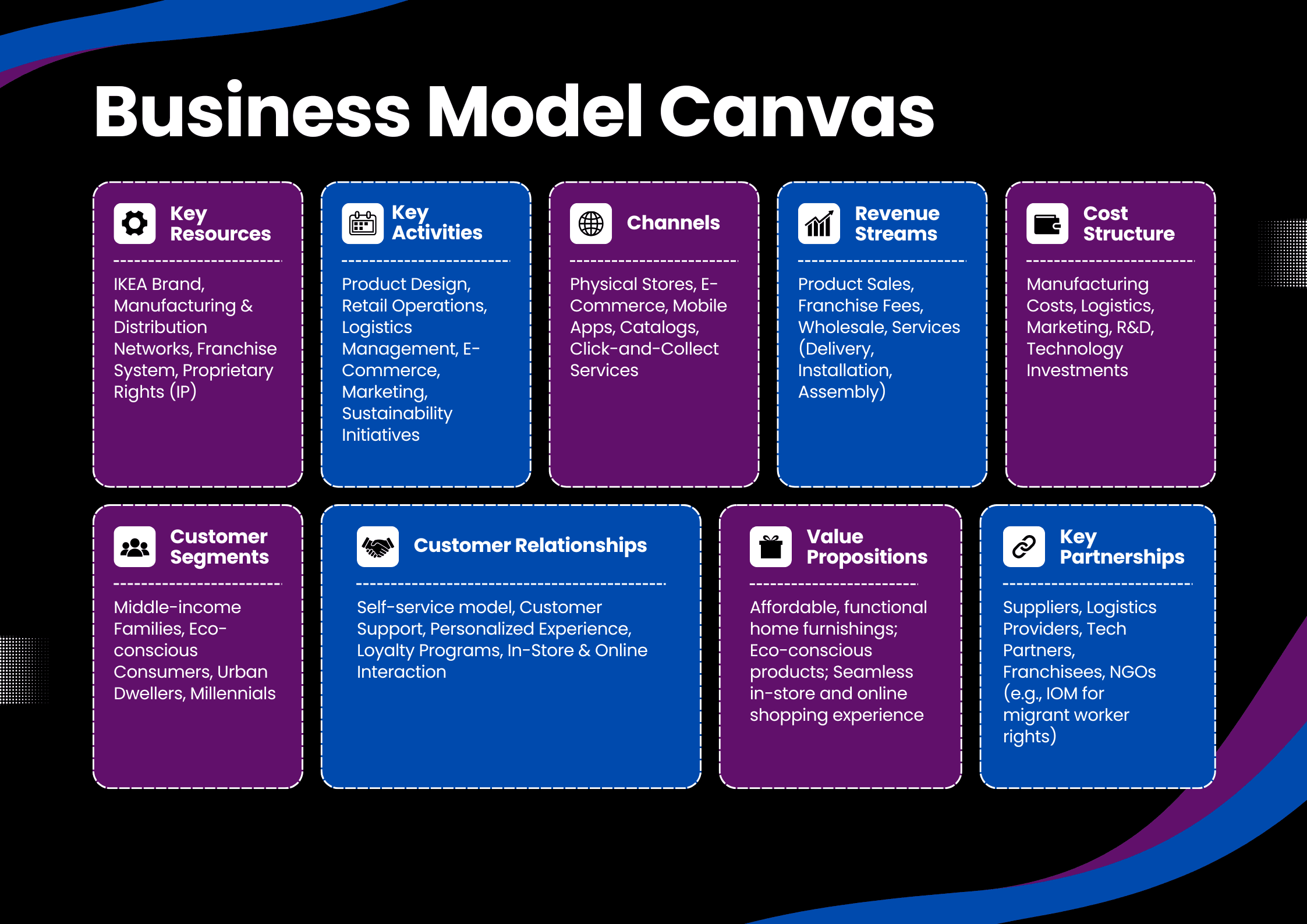
- IKEA’s unique value proposition is its ability to provide stylish, functional, and affordable home furnishings through a combination of efficient operations, innovative product designs, and low-cost production.
- Unlike many competitors, IKEA emphasises affordability while maintaining quality.
- The company solves key customer pain points by offering easy-to-assemble furniture and home goods at accessible prices, making it an attractive option for customers on a budget.
- The emotional benefit IKEA provides is a sense of pride, as customers feel they are contributing to a sustainable future by supporting a brand that prioritises eco-friendly materials and practices.
- IKEA’s functional benefits include the durability of its products, ensuring that customers receive long-term value.
- Additionally, the company offers services like home delivery and assembly, making it even more convenient for consumers.
- The competitive advantage lies in IKEA’s ability to scale operations globally, reducing costs through economies of scale while offering high-quality, affordable home goods.
IKEA's Cost Structure
- IKEA’s major expenses include manufacturing costs, logistics, marketing, salaries, and technology investments.
- The company uses automation, bulk production, and outsourcing to reduce operational costs. By leveraging economies of scale and optimising its supply chain, IKEA maintains healthy profit margins despite rising raw material costs.
- Continuous innovations in production and logistics help the brand streamline operations and control expenses.
IKEA's Customer Segment
- IKEA primarily targets middle-income families, eco-conscious consumers, and urban dwellers looking for affordable, stylish, and functional home furnishings.
- The brand operates primarily on a B2C model, offering a wide range of products for individual consumers, with a growing focus on millennials and sustainability-focused buyers.
- Customers are motivated by affordability, convenience, and eco-friendliness, which drives their preference for IKEA over competitors.
IKEA's Distribution Channels
1. Global Physical Footprint
IKEA’s physical presence is the backbone of its brand identity, utilizing a tiered store strategy to capture different market segments.
- Large-Format "Blue Box" Stores: These iconic, massive warehouses serve as both retail showrooms and regional distribution hubs. They are designed for high-volume inventory, allowing customers to experience the brand’s "lifestyle" settings before picking up flat-pack items directly.
- Urban Small-Format Stores: To adapt to changing demographics, IKEA has moved into city centers. These smaller locations act as touchpoints for urban dwellers who may not have cars, focusing on design consultations and smaller home accessories while facilitating orders for larger items.
2. Robust E-commerce & Logistics
The company has transitioned from a purely "cash-and-carry" model to a sophisticated digital marketplace.
- Online Shopping Infrastructure: IKEA’s digital platform isn't just a website; it’s a logistics engine. By integrating its global inventory into a user-friendly interface, they provide a 24/7 storefront for those who prefer browsing from home.
- Flexible Fulfillment: * Direct Delivery: Optimized shipping routes bring heavy furniture straight to the doorstep.
- Click-and-Collect: This hybrid model leverages physical stores as pick-up points, reducing shipping costs for the consumer and increasing foot traffic for the store.
3. The Omnichannel Ecosystem
Rather than treating "online" and "offline" as separate entities, IKEA merges them into a single, seamless journey.
- Seamless Integration: A customer can start their journey on a smartphone, save items to a list, and find them easily via the store’s navigation map, or vice-versa.
- Consistency: Whether a customer interacts with a sales associate in person or a support agent online, the pricing, inventory data, and brand experience remain unified.
4. Tech-Driven Distribution Enhancements
IKEA uses technology to bridge the gap between imagination and purchase, effectively shortening the "consideration" phase of the distribution cycle.
- AR (Augmented Reality) Apps: Tools like IKEA Place allow customers to virtually "drop" furniture into their homes. This reduces the friction of uncertainty, leading to more confident purchases and fewer returns.
- Catalogue-Based Shopping: By evolving the traditional catalogue into a digital and interactive tool, IKEA maintains its legacy of inspiration while providing a direct path to the checkout cart.
IKEA's Key Partnerships
- IKEA works closely with a variety of suppliers, logistics providers, and tech partners to maintain its global supply chain.
- Key partners include manufacturers and distributors of home furnishings and accessories.
- IKEA also collaborates with organisations like the International Organisation for Migration (IOM) to improve ethical sourcing practices.
- These partnerships ensure efficient production, delivery, and sustainability efforts, all of which contribute to IKEA’s ability to maintain low prices and scale globally.
DHL’s business model, consisting of logistics and global supply chains, can provide valuable lessons for IKEA’s operational strategies.
SWOT Analysis of IKEA:
| Strengths | Weaknesses | Opportunities | Threats |
|---|---|---|---|
| Strong brand recognition | Dependency on the supply chain | Expansion in emerging markets | Supply chain disruptions |
| Cost-effective pricing | Over-reliance on franchises | Digital transformation | Rising raw material costs |
| Large global presence | Limited store formats in some regions | Increased demand for sustainable products | Economic downturns |
IKEA Competitor Comparison:
| Parameter | IKEA | Walmart | Amazon |
|---|---|---|---|
| Pricing | Low-cost | Low-cost | Competitive |
| Customer Experience | Seamless (In-store & Online) | In-store Focused | Online-Only |
| Channel Strategy | Omnichannel | Omnichannel | Digital-First |
| Market Focus | Global | Global | Global |
| Innovation | Sustainability, Digital Features | Price Leadership | Delivery Speed |
IKEA's Business Model Canvas
What’s New with IKEA?
IKEA is undergoing a strategic evolution characterized by a pivot toward "affordable intelligence" and hyper-localized retail formats. The brand has transitioned from a traditional furniture warehouse into a tech-centric lifestyle partner, most notably through the launch of its Matter-compatible smart home ecosystem which integrates seamlessly with global tech platforms.
While the company is streamlining its physical footprint by closing underperforming "blue box" locations in markets like the U.S. and China, it is simultaneously investing billions in India and urban Planning Studios to meet customers where they live.
This shift is bolstered by the global rollout of IKEA Kreativ, an AI-driven spatial computing tool that allows users to digitally delete their old furniture and visualize new designs in real-time.
Complementing these tech leaps is a renewed focus on sustainable living, headlined by the "Cooking & Eating" initiative that introduces modular, small-space kitchen solutions and an expanded menu of plant-based food options designed to make eco-friendly living the default choice for the modern consumer.
Key Takeaways for Students/Marketers
- IKEA’s low-cost pricing and efficiency-driven operations are scalable across global markets
- Small businesses can replicate IKEA’s digital transformation and omnichannel strategy to enhance customer reach
- IKEA’s focus on sustainability and customer convenience offers valuable insights into long-term brand loyalty
Conclusion
IKEA’s business model blends affordability with sustainability, allowing it to dominate the global market. As it adapts to new digital and sustainability demands, IKEA’s ability to innovate and scale positions it for continued success in the future. Will IKEA's approach continue to shape the future of home goods retail? What do you think?
Want to Know Why 2,50,000+ Students Trust Us?
Dive into the numbers that make us the #1 choice for career success


MBA - Level
Post Graduate in Digital Marketing & Business Strategy

Best For
Fresh Graduates

Mode of Learning
On Campus (Mumbai & Delhi)

Starts from
May 29, 2026

Duration
11 Months
Live & Online
Advanced Online Digital Marketing Course
Best For
Working Professionals
Mode of Learning
Online
Starts from
Apr 6, 2026
Duration
4-6 Months

Online
Professional Certification in AI Strategy
Best For
AI Enthusiasts
Mode of Learning
Online
Duration
5 Months

Offline
Undergraduate Program in Digital Business & Entrepreneurship
Best For
12th Passouts
Mode of Learning
On Campus (Mumbai)
Duration
3 Years
Recent Post
You May Also Like
IKEA makes money through direct sales of home furnishings, accessories, food sales in its restaurants, and service fees for home delivery and assembly.
IKEA’s main products include furniture, kitchenware, textiles, lighting, and accessories for home furnishing.
IKEA’s top competitors include Wayfair, Home Depot, Ashley Furniture, West Elm, and Amazon.
IKEA uses technology for augmented reality furniture placement, room design planning, and innovations in sustainable materials.
IKEA holds approximately 12% of the global home furnishings market.
IKEA’s CSR initiatives focus on sustainability, climate positivity by 2030, supporting refugees, and global humanitarian projects.
IKEA markets its products through traditional advertising, digital marketing, iconic catalogues, social media campaigns, and in-store experiences.

Aditya Shastri
Lead Trainer & Business Development Head at IIDE
Aditya Shastri leads the Business Development segment at IIDE and is a seasoned Content Marketing expert. With over a decade of experience, Aditya has trained more than 20,000 students and professionals in digital marketing, collaborating with prestigious institutions and corporations such as Jet Airways, Godrej Professionals, Pfizer, Mahindra Group, Publicis Worldwide, and many others. His ability to simplify complex marketing concepts, combined with his engaging teaching style, has earned him widespread admiration from students and professionals alike.
Aditya has spearheaded IIDE’s B2B growth, forging partnerships with over 40 higher education institutions across India to upskill students in digital marketing and business skills. As a visiting faculty member at top institutions like IIT Bhilai, Mithibai College, Amity University, and SRCC, he continues to influence the next generation of marketers.
Apart from his marketing expertise, Aditya is also a spiritual speaker, often traveling internationally to share insights on spirituality. His unique blend of digital marketing proficiency and spiritual wisdom makes him a highly respected figure in both fields.