Application Deadline for 3-Year UG Program closes on 31st Aug. Book a Counselling to know more

Students Centric
Placements Report
Trackable results, real numbers
Reviews
Proven success, real voices
Trainers
Expert-led, Industry-Driven Training
Life at IIDE
Vibrant Spirit student life
Alumni
Successful Journeys, Inspiring Stories
Learning Centre
Webinars
Blogs
Case studies
Live, Interactive Masterclasses
Fresh Insights, quick reads
Real-life, Industry relevant
More
Hire from us
Hire Top Digital Marketing Talent
Work with us
Join Our Team, Make an Impact
Customised Training
Personalised digital marketing training for your company
Refer & earn
Simple, easy rewards
Contact us
Get the answers you need
About us
Know more about IIDE
Explore all course options

FOR FRESH GRADUATES
Post Graduation Program in Digital Marketing & Business Strategy- Ideal for Age: 20–25 Years

Can’t decide? Explore all our
Digital Marketing Courses
COMPARE ALL 3 PROGRAMSOnline & Offline
Explore Top AI CoursesIndustry-Aligned TRACKMost Popular
UG Program in Digital Business & Entrepreneurship- Ideal for 12th Pass out / FY Degree Student

PARTNER PROGRAMS







Can’t decide? Explore all
BBA In Digital Marketing Colleges
Orginally Written by Aditya Shastri
Updated on May 22, 2026
Share on:


Panasonic, a global leader in electronics and EV batteries, is making bold moves in 2026. But is the strategy paying off? Are the challenges bigger than the opportunities?
This analysis breaks down Panasonic's position in the market and how it competes across multiple industries. Business students and strategists will gain key insights into how a century-old brand reinvents itself. Discover what Panasonic is getting right, where it falls short, and what the future holds.
About Panasonic
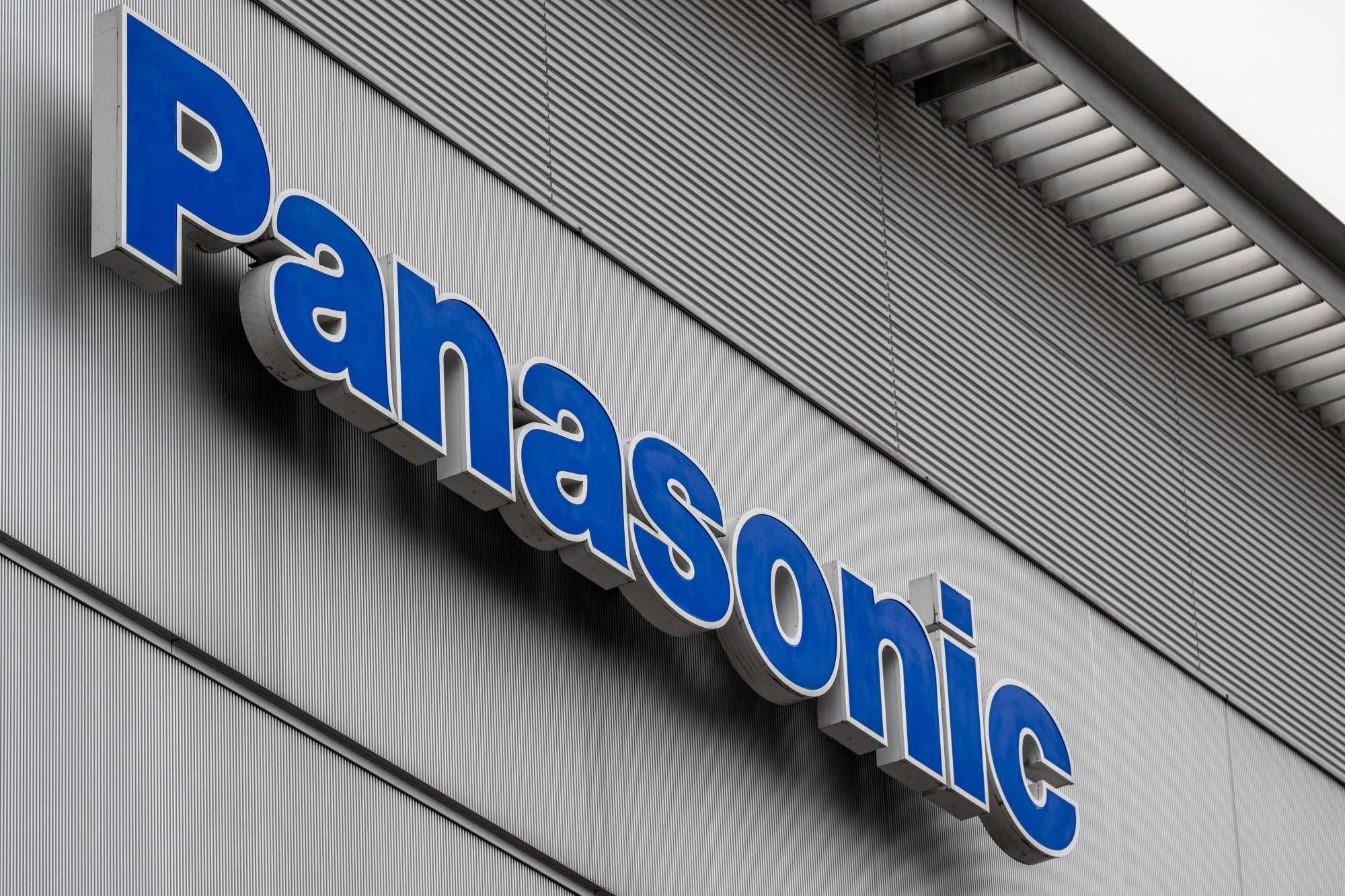
Panasonic Corporation was founded in 1918 by Konosuke Matsushita. What began as a modest electrical parts workshop grew steadily into one of the world's most recognized technology brands, present in over 150 countries and employing more than 240,000 people globally.
In 2008, the company rebranded from Matsushita Electric Industrial Co. to Panasonic Corporation, unifying its identity under a single global name.
Today it trades on the Tokyo Stock Exchange under ticker 6752 and ranks among the top ten largest electronics manufacturers in the world by revenue.
Quick Stats about Panasonic :
| Parameter | Details |
|---|---|
| Founder | Konosuke Matsushita |
| Year Founded | 1918 |
| Headquarters | Kadoma, Osaka, Japan |
| Employees | ~240,000 |
| Stock Listing | Tokyo Stock Exchange (6752) |
| Core Segments | Consumer Electronics, Automotive, Industrial Solutions, Energy |
| Key Products | Home Appliances, EV Batteries, HVAC Systems, Avionics, Industrial Automation |
| Brand Motto | A Better Life, A Better World |
| Primary Competitors | Samsung, Sony, LG, Philips, Toshiba, CATL, BYD |
Why This SWOT Analysis Matters in 2026
Panasonic is not the same company it was five years ago, and that is precisely what makes this analysis worth reading.
The company has deliberately moved away from commoditized consumer electronics and is doubling down on EV batteries, B2B industrial solutions, AI-integrated devices, and energy management systems.
That pivot creates real opportunity, but it also introduces new competitive pressures, margin risks, and execution challenges.
Understanding where Panasonic genuinely excels and where it is still catching up is essential context for anyone tracking the company, whether as an investor, a competitor, a business partner, or a consumer.
Four reasons 2026 is a defining year for Panasonic:
- EV Acceleration: Panasonic's Kansas Gigafactory is ramping toward full utilization as global EV adoption outpaces earlier industry forecasts.
- Restructuring Results: Panasonic exceeded its ¥122 billion restructuring target, delivering ¥145 billion in adjusted operating profit improvement in FY2026.
- AI Investment: The company has committed ¥500 billion toward AI-centered device businesses through FY2028, a bet that will fundamentally reshape its product portfolio.
- Battery Competition: CATL and BYD are scaling aggressively with strong cost structures and state backing, raising the stakes in Panasonic's most critical growth segment.

Is Digital Marketing the Right Career for You?
Find out in a free 45-min masterclass · Career paths, roles and growth explained · By Karan Shah, Founder & CEO, IIDE


Is Digital Marketing the Right Career for You?
Find out in a free 45-min masterclass · Career paths, roles and growth explained · By Karan Shah, Founder & CEO, IIDE
SWOT Analysis of Panasonic
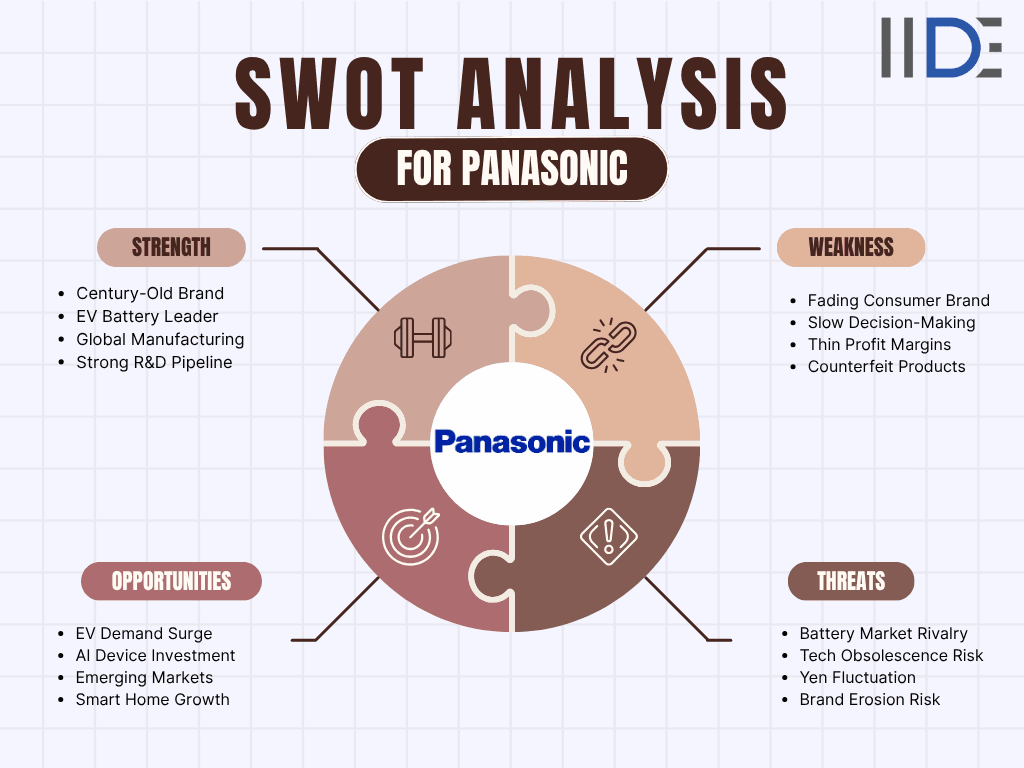
A SWOT Analysis evaluates where a company truly stands, both internally and in the world around it. For Panasonic, that evaluation matters more than ever. Operating across consumer electronics, EV batteries, and industrial solutions simultaneously, a single market shift can reshape the company's entire growth trajectory. This analysis focuses on what actually matters for Panasonic in 2026.
Strengths of Panasonic: Why the Century-Old Tech Giant Still Competes in 2026
Panasonic's recovery is built on a century of brand trust, a critical position in the global EV battery supply chain, and consistent R&D investment that keeps the company relevant across multiple industries.
Over a Century of Brand Trust:
- Panasonic's name carries genuine credibility with both consumers and industrial buyers across more than 150 countries.
- A hundred years of consistent product quality has built institutional trust that newer competitors cannot replicate overnight.
- In markets like Japan, India, and Southeast Asia, Panasonic remains a first-choice brand for home appliances and durable electronics, an asset that takes decades to build and has real commercial value.
Strategic Leadership in EV Battery Manufacturing:
- Panasonic's long-standing partnership with Tesla and its investment in the Kansas Gigafactory place it at the center of the global EV battery supply chain.
- The company manufactures the 2170 cylindrical cell that powers Tesla's flagship vehicles and is developing the next-generation 4680 cell with roughly five times the energy capacity.
- Few electronics companies can point to this kind of structural relevance in one of the most important technology transitions of this decade.
Consistent R&D Investment:
- Panasonic has maintained steady investment in research and development across battery technology, HVAC efficiency, smart home systems, and AI-integrated devices.
- Its ¥500 billion commitment to AI-centered device businesses through FY2028 signals that the company is not just defending its current position.
- It is actively building for the next cycle of product innovation.
Global Manufacturing Footprint:
- With production facilities across Japan, Southeast Asia, North America, and Europe, Panasonic has the manufacturing infrastructure to serve diverse global markets at scale.
- This footprint also gives the company flexibility to localize production in response to tariff shifts and trade policy changes, a meaningful advantage in today's fragmented geopolitical environment.
High-Profile Brand Sponsorships:
- Panasonic's partnerships with the Olympics, FIFA, and Formula 1 keep the brand visible to global audiences and reinforce its positioning as a precision technology company.
- These sponsorships are not just marketing spend.
- They are strategic signals about the company's ambitions and the quality tier it targets.
Weaknesses of Panasonic: The Challenges Holding the Brand Back in 2026
Panasonic carries serious structural vulnerabilities. Declining consumer electronics relevance, organizational complexity, thin margins, and inconsistent customer service are challenges the brand must address before its strategic pivot can deliver full results.
Declining Consumer Electronics Relevance:
- Panasonic has steadily lost ground to Samsung, Sony, and LG in televisions, audio, and home entertainment.
- Among younger consumers especially, the brand has lost the cultural visibility it once commanded.
- Recovering that relevance requires more than product updates.
- It demands a clear narrative about why Panasonic belongs in a consumer's consideration set alongside brands with more aggressive innovation cycles and stronger digital ecosystems.
Samsung's approach to consumer electronics offers a useful contrast to where Panasonic currently stands. Their Marketing Strategy of Samsung is worth a read if you want to understand how the competitive gap widened over the past decade.
Organizational Complexity Slows Execution:
- Managing over 240,000 employees across dozens of business units and geographies creates genuine coordination challenges.
- Panasonic has faced consistent criticism for slow decision-making, siloed divisions, and uneven execution across segments.
- In an industry where speed-to-market often determines competitive outcomes, structural inertia is a meaningful handicap.
Profitability Remains Under Pressure:
- Revenue growth has been inconsistent, and operating margins in several divisions remain thin compared to best-in-class global competitors.
- While Panasonic's strategic direction, shifting toward B2B and industrial solutions, is sound, the financial results are not yet fully reflecting the scale of investment being made.
- The transition period carries real earnings risk.
Counterfeit Products Damage Brand Equity:
- Fake Panasonic products circulate widely across several Asian and emerging markets.
- These counterfeits are sold under the Panasonic name, erode consumer trust, distort sales data, and are costly to police at scale.
- For a brand that depends on its quality reputation, this is an ongoing structural problem with no quick fix.
Customer Service Inconsistency:
- Panasonic has been repeatedly cited for below-average post-purchase service in key markets.
- For a brand built on reliability and quality, poor customer service directly contradicts its core value proposition and steadily drives customers toward competitors.
Opportunities for Panasonic: Where Long-Term Growth Is Being Built in 2026
Surging EV battery demand, AI-integrated devices, emerging market expansion, and the global energy transition all represent credible long-term growth paths for Panasonic in 2026.
EV Battery Demand Is Outpacing Supply:
- Global EV adoption is accelerating and battery cell demand is outpacing current supply.
- Panasonic's Tesla partnership, Kansas Gigafactory, and 4680 cell development give it a credible path to significantly higher revenue and margins through the end of the decade.
AI-Integrated Devices and Smart Technology:
- Panasonic's ¥500 billion investment in AI-centered businesses through FY2028 is its clearest bet on the next product cycle.
- AI-integrated appliances, smart HVAC, and intelligent manufacturing tools give Panasonic a credible path to premium pricing and differentiation against lower-cost rivals.
Emerging Market Expansion:
- India, Southeast Asia, Africa, and Latin America represent large and fast-growing markets for electronics, appliances, and industrial solutions.
- Rising middle classes in these regions are driving demand for durable, reliable products, exactly the category Panasonic has built its reputation on.
- Deeper local partnerships, localized product lines, and expanded distribution networks remain a clear and underexploited growth lever for the company.
Smart Home and Connected Living:
- The global smart home market is expanding rapidly as consumers increasingly prioritize energy efficiency, automation, and seamlessly connected living environments.
- Panasonic's deep expertise across HVAC, home appliances, and energy management gives it a strong foundation to offer integrated home ecosystems that extend well beyond single-product purchases.
- This positions Panasonic to build the kind of platform stickiness that tech companies have long mastered and that traditional manufacturers are now racing to develop.
Sustainability and Energy Transition:
- As governments and corporations worldwide accelerate investment in low-carbon solutions, the demand for clean energy products is growing stronger every year.
- Panasonic's portfolio spanning solar energy, home battery storage, high-efficiency HVAC, and EV infrastructure places it directly in the path of this shift.
- Policy incentives, green procurement mandates, and corporate sustainability commitments are creating strong tailwinds for Panasonic's energy division, making it a key growth area through the decade.
Threats to Panasonic: Pressures That Could Derail the Strategy in 2026
Fierce competition from Samsung, LG, CATL, and BYD, rapid technological change, currency risk, and growing brand erosion among younger consumers are active pressures on Panasonic's long-term position.
Fierce Competition in Every Core Market:
- Panasonic faces formidable competitors across all of its major segments simultaneously. Samsung and LG dominate consumer electronics.
- CATL and BYD are scaling aggressively in EV batteries with competitive cost structures.
- Siemens and Honeywell compete in industrial automation.
- Competing effectively across all of these while managing a large, complex organization puts real strain on management focus and capital allocation.
LG faces many of the same market dynamics as Panasonic, making it one of the more instructive comparisons in this space. If you are curious how they are navigating it, the Marketing Strategy of LG covers it well.
Rapid Technological Change:
- Consumer electronics and industrial technology evolve at a pace that can make entire product lines obsolete within a few years.
- Panasonic must continuously invest in next-generation technologies, including the 4680 battery, AI integration, and smart manufacturing, while managing its existing portfolio.
- Any misjudgment about where the market is heading can result in costly write-offs and lost competitive positioning.
Currency and Raw Material Risk:
- As a Japanese company generating a significant portion of its revenue overseas, Panasonic is exposed to yen volatility.
- A strengthening yen compresses the value of overseas earnings when repatriated, cutting into margins without any change in operational performance.
- Rising raw material costs, particularly for battery inputs like lithium and cobalt, add further margin pressure across the energy segment.
Regulatory Complexity Across Markets:
- Panasonic operates in industries with growing regulatory requirements covering battery disposal, environmental compliance, product safety standards, data privacy, and trade restrictions.
- Managing compliance across dozens of countries is an escalating operational burden that slows market entry, increases overhead, and creates headline risk if standards are not consistently met.
Brand Erosion Among Younger Consumers:
- Younger consumers in key markets are gravitating toward tech-native brands such as Apple, Samsung, and Xiaomi, which offer tighter ecosystem integration, more frequent product updates, and stronger digital identities.
- Panasonic's brand, while trusted, can feel legacy in categories where freshness and connectivity drive purchase decisions.
- Without a deliberate and sustained effort to reposition for this audience, the gap will widen.
Conclusion
Panasonic enters the second half of this decade with a clear strategy and the infrastructure to back it up. The shift toward EV batteries, AI-integrated devices, and industrial automation is not a reaction to decline.
It is a deliberate bet placed at the right time and in the right sectors. The Kansas Gigafactory, the 4680 battery development, and the ¥500 billion AI device commitment are structural moves that take time to fully pay off.
But they are being built on a foundation that most competitors cannot easily replicate. A century of brand equity, a proven global manufacturing footprint, and deepening B2B relationships give Panasonic a starting position that genuinely matters.
The challenges around margins, organizational complexity, and consumer brand relevance are real.
They will not resolve themselves and will require consistent, disciplined execution to address over the coming years.
But the sectors Panasonic is moving into are growing faster than the ones it is stepping away from, and that momentum is a meaningful advantage.
The direction is right. The foundation is strong. The only variable that matters now is how fast Panasonic moves.
Want to Know Why 2,50,000+ Students Trust Us?
Dive into the numbers that make us the #1 choice for career success



MBA - Level
Post Graduate in Digital Marketing & Business Strategy

Best For
Fresh Graduates

Mode of Learning
On Campus (Mumbai & Delhi)

Starts from
Oct 1, 2026

Duration
11 Months

Live & Online
Advanced Online Digital Marketing Course
Best For
Working Professionals
Mode of Learning
Online
Starts from
Sep 4, 2026
Duration
4-6 Months

Online
Professional Certification in AI Strategy
Best For
AI Enthusiasts
Mode of Learning
Online
Starts from
Sep 8, 2026
Duration
5 Months

Online or Offline
Top AI Courses to Make You Future Ready!
Best For
AI Enthusiasts
Mode of Learning
2–5 Month Program
Starts from
Sep 8, 2026
Duration
Flexiable

On Campus
Advanced Certification in Artificial Intelligence
Best For
AI Enthusiasts
Mode of Learning
On Campus (Mumbai)
Starts from
Sep 1, 2026
Duration
3 Months

Offline
Degree In 2026 ≠ Enough Degree + Digital Skills = Future-Ready
Best For
12th Passouts
Mode of Learning
At IIDE Campus
Starts from
Aug 31, 2026
Duration
3 Years

Offline
Undergraduate Program in Digital Business & Entrepreneurship
Best For
12th Passouts
Mode of Learning
On Campus (Mumbai)
Starts from
Aug 31, 2026
Duration
3 Years
Recent Post
You May also like
Panasonic is a Japanese multinational founded in 1918, renowned for consumer electronics, home appliances, EV batteries (Tesla partnership), and B2B automation solutions across 100+ countries.
Century-old brand credibility, a highly diversified product portfolio, a critical role as Tesla's battery cell supplier, strong R&D capabilities, and a wide global manufacturing and distribution network.
Sony, Samsung, LG Electronics, Hitachi, and Philips compete across Panasonic's various segments, with Chinese brands like Haier and Midea adding significant price pressure.
Aggressive pricing from Chinese brands, rapid product commoditisation, rising raw material costs for batteries, and disruption from agile tech startups are Panasonic's primary threats.
By pivoting away from low-margin consumer electronics toward high-growth areas EV batteries, smart housing, and B2B industrial automation Panasonic is strategically repositioning for long-term relevance.

Lead Trainer & Business Development Head at IIDE
Aditya Shastri leads the Business Development segment at IIDE and is a seasoned Content Marketing expert. With over a decade of experience, Aditya has trained more than 20,000 students and professionals in digital marketing, collaborating with prestigious institutions and corporations such as Jet Airways, Godrej Professionals, Pfizer, Mahindra Group, Publicis Worldwide, and many others. His ability to simplify complex marketing concepts, combined with his engaging teaching style, has earned him widespread admiration from students and professionals alike.
Aditya has spearheaded IIDE’s B2B growth, forging partnerships with over 40 higher education institutions across India to upskill students in digital marketing and business skills. As a visiting faculty member at top institutions like IIT Bhilai, Mithibai College, Amity University, and SRCC, he continues to influence the next generation of marketers.
Apart from his marketing expertise, Aditya is also a spiritual speaker, often traveling internationally to share insights on spirituality. His unique blend of digital marketing proficiency and spiritual wisdom makes him a highly respected figure in both fields.