Newly Launched: Post Graduation Program in Digital Marketing & Business Strategy.

Students Centric
Placements Report
Trackable results, real numbers
Reviews
Proven success, real voices
Trainers
Expert-led, Industry-Driven Training
Life at IIDE
Vibrant Spirit student life
Alumni
Successful Journeys, Inspiring Stories
Learning Centre
Webinars
Blogs
Case studies
Live, Interactive Masterclasses
Fresh Insights, quick reads
Real-life, Industry relevant
More
Hire from us
Hire Top Digital Marketing Talent
Work with us
Join Our Team, Make an Impact
Customised Training
Personalised digital marketing training for your company
Refer & earn
Simple, easy rewards
Contact us
Get the answers you need
About us
Know more about IIDE
Explore all course options

FOR FRESH GRADUATES
Post Graduation Program in Digital Marketing & Business Strategy- Ideal for Age: 20–25 Years

Can’t decide? Explore all our
Digital Marketing CoursesTrending

Professional Certification in AI Strategy
- Ideal for AI Enthusiast










Orginally Written by Aditya Shastri
Updated on Feb 19, 2026
Share on:


FedEx's marketing strategy centers on reliability over aggressive promotions. The global logistics leader leverages utility-first digital platforms, SEO-driven search visibility, and service-led marketing to build trust among businesses worldwide.
Strategic partnerships like the Chennai Super Kings collaboration strengthen brand recall in India, while innovations in healthcare logistics and sustainability initiatives support long-term growth. FedEx's approach demonstrates that in logistics, consistent performance and digital convenience matter more than flashy advertising campaigns.
The foundational research and analysis for this case study were conducted by Ishika Swarnakar, currently pursuing IIDE's Post Graduate Digital Marketing (Batch 2025).
If you found this insightful, consider reaching out to Ishika Swarnakar with a note of appreciation she'll value the recognition
About FedEx
FedEx is one of the world’s most trusted logistics and courier brands, known for fast, reliable, and time-definite delivery services. Founded in 1971 by Frederick W. Smith, the company transformed the industry by introducing overnight shipping and building a global logistics network that supports businesses of all sizes from startups to multinational corporations.
Operating in more than 220 countries and territories, FedEx handles millions of shipments daily through its integrated express, ground freight, and supply-chain solutions. In India, the brand plays a key role in supporting e-commerce growth, SMEs, and export businesses across major metro cities and commercial hubs.
Today, FedEx positions itself as a technology-driven logistics partner, offering real-time tracking, digital shipping tools, and sustainable delivery solutions.
Its core focus on speed, reliability, and innovation continues to power global trade and help businesses scale in a competitive market.

Learn Digital Marketing for FREE

Marketing Objective or Business Challenge
FedEx's primary marketing objective in 2026 is strengthening its position as a tech-driven, sustainability-focused logistics partner while expanding market share in e-commerce and cross-border business shipping.
The brand aims to be perceived not merely as a delivery provider but as an essential growth enabler for SMEs, online sellers, and enterprise clients.
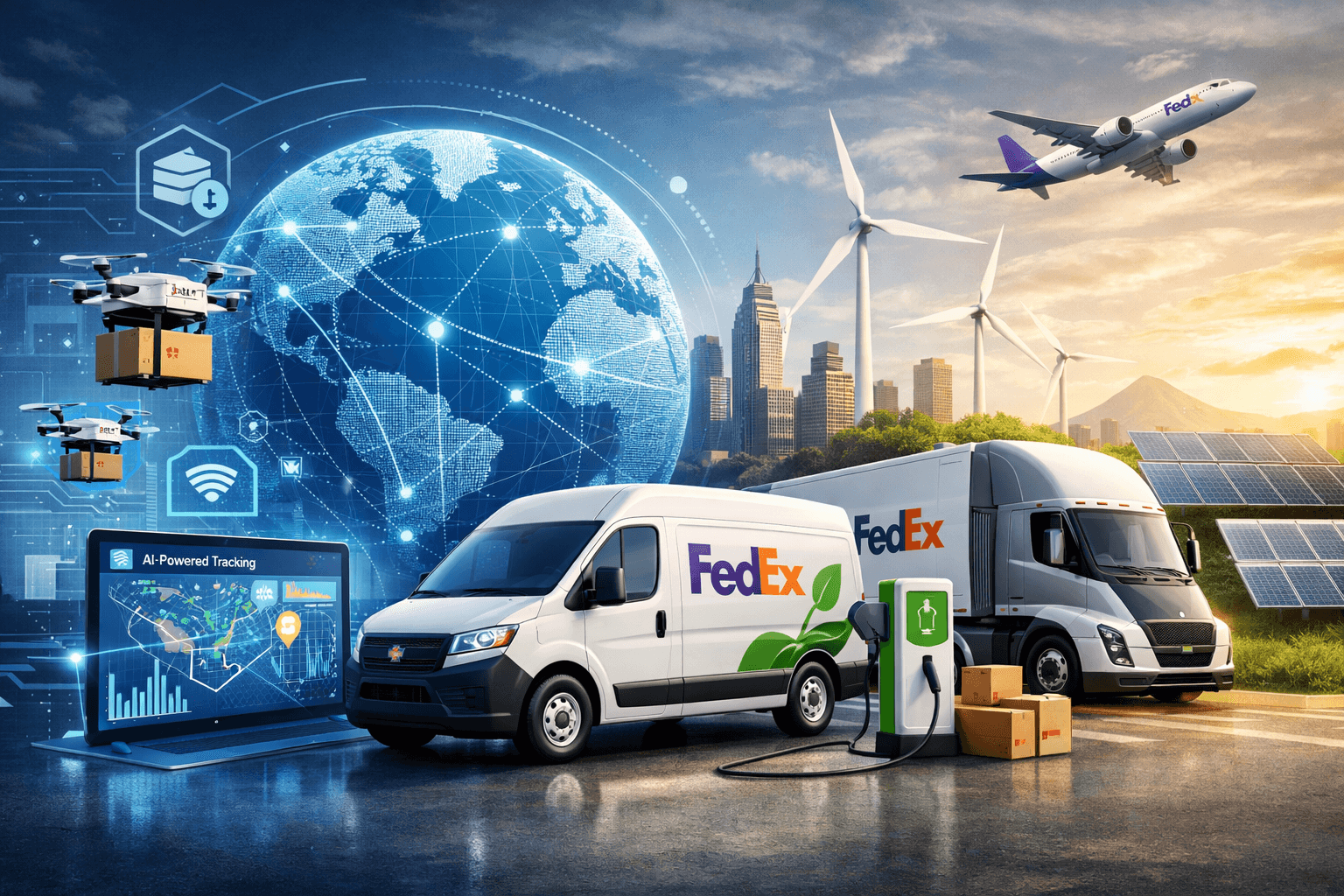
Key objectives include integrating AI-powered tracking, machine learning for route optimization, and advanced analytics to enhance customer experience.
While simultaneously investing in electric vehicles and carbon-neutral delivery options to meet growing sustainability demands from conscious businesses and consumers.
Explore our detailed SWOT analysis of FedEx to understand its strengths, weaknesses, opportunities, and threats in the global logistics industry
Buyers Persona:

Fareena
Mumbai
Occupation: Working Profession
Age: 20 years
Motivation
- Guaranteed on-time delivery to protect business reputation
- Complete shipment visibility with real-time tracking
- Seamless international shipping with minimal customs hassles
- Trusted logistics partner reducing operational risks
- Technology that automates shipping workflows
Interest & Hobbies
- Scaling online business domestically and internationally
- Integration with Shopify, Amazon, WooCommerce, and ERP systems
- Eco-friendly shipping options to align with brand values
- Transparent pricing without hidden charges
- Educational content on export documentation and compliance
Pain Points
- Delivery delays damaging customer relationships
- Lack of proactive communication during transit issues
- Complex international shipping documentation
- Juggling multiple courier partners
- Unpredictable costs affecting profit margins
- Poor last-mile delivery experiences
Social Media Presence
- Website dashboards
- Mobile apps
- YouTube
Marketing Channels Used by FedEx
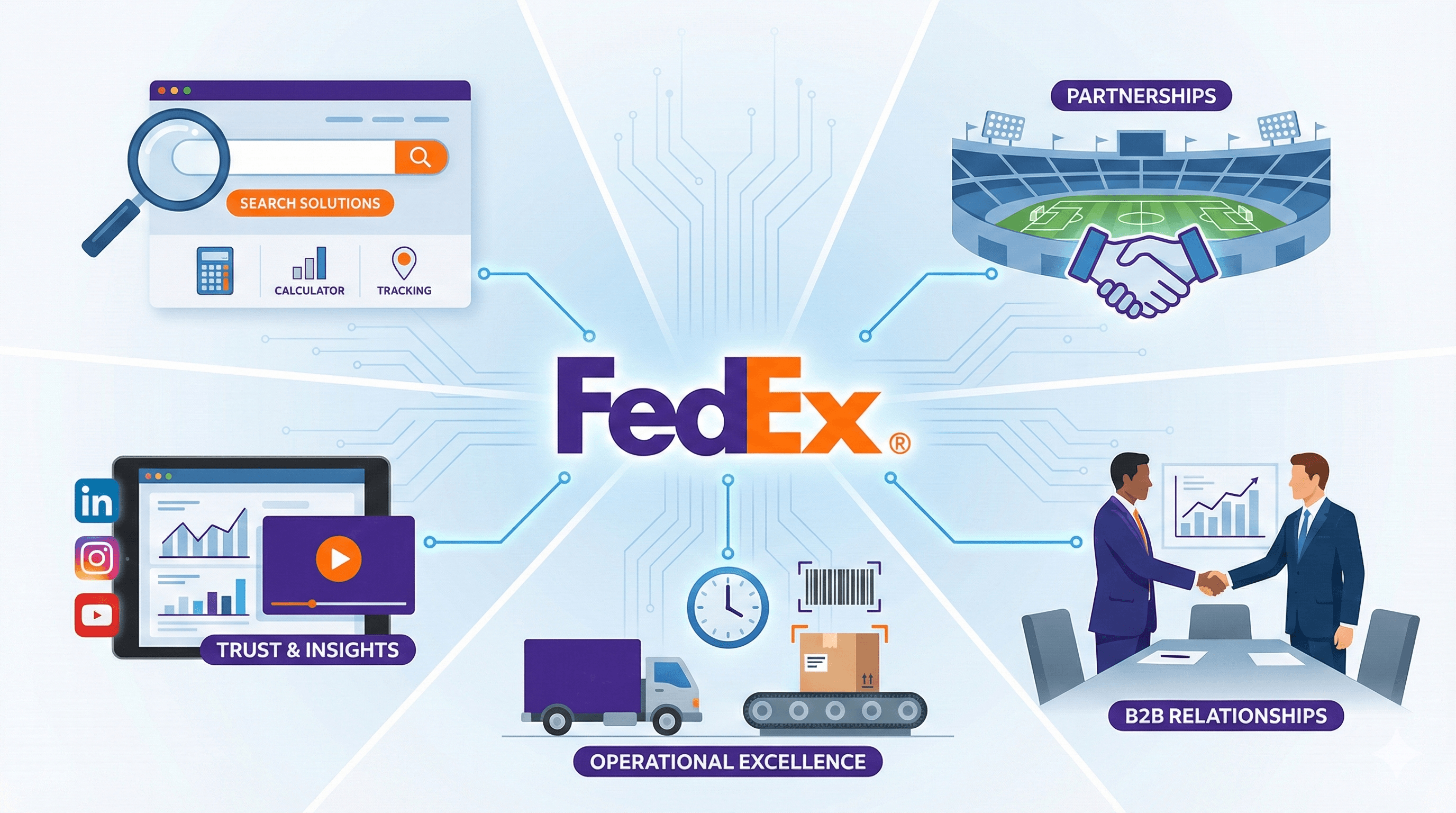
FedEx uses a high-intent, performance-driven marketing strategy focused on digital discovery, operational excellence, and long-term B2B relationships. Instead of heavy discounting or mass advertising, the brand prioritizes trust, reliability, and technology-led logistics solutions to attract and retain customers.
On the digital front, FedEx invests in:
- SEO and Google Search Ads to capture users searching for international courier, express delivery and business shipping services.
- Performance marketing campaigns that drive users directly to booking, tracking, and rate-calculator pages.
- Social media platforms like LinkedIn, Instagram, Facebook, X, and YouTube to build credibility through thought leadership, sustainability initiatives, and customer success stories.
FedEx also leverages service-as-marketing, where operational excellence on-time delivery, accurate tracking, and proactive communication acts as its strongest brand differentiator.
Strategic sponsorships like Chennai Super Kings (IPL) enhance brand visibility and emotional connection in India, while B2B relationship marketing through enterprise partnerships and dedicated account management drives long-term growth.
This multi-channel strategy helps FedEx strengthen brand trust, capture high-intent demand, and convert businesses into loyal customers.
Compare FedEx with competitors in this SWOT analysis of UPS, highlighting key differences in logistics and delivery strategy.
FedEx Marketing Strategy Breakdown
1. Search-Led Digital Strategy
FedEx focuses heavily on search-intent marketing to reach customers at the exact moment they need shipping solutions.
When users search for terms like same-day courier Mumbai, international shipping India, or express parcel delivery, FedEx appears prominently through SEO and paid search ads.
- Shipping cost calculators
- Pickup scheduling tools
- Tracking dashboards
- Documentation support
The FedEx website and mobile app function as self-service logistics platforms, allowing businesses to manage shipments, print labels, and track deliveries in real time.
2. Social Media as a Trust-Building Channel
FedEx uses social media less for promotions and more for credibility building.
- LinkedIn: Thought leadership, supply-chain insights, and enterprise solutions for decision-makers
- Instagram & Facebook: Customer success stories, employee culture, and operational highlights
- YouTube: Educational videos on packaging, customs, and international shipping regulations
This content strategy positions FedEx as a logistics partner and industry expert, not just a courier brand.
3. Operational Excellence as Marketing
FedEx’s biggest marketing asset is its performance. Reliable delivery timelines, transparent tracking, and proactive notifications build trust more effectively than traditional advertising.
In logistics, a single late shipment can impact business revenue. FedEx’s consistent on-time delivery rates, real-time tracking, and responsive communication generate strong word-of-mouth referrals and repeat business.
4. Strategic Partnership Marketing
FedEx’s sponsorship with Chennai Super Kings reflects a focused partnership strategy aligned with brand values like reliability, consistency, and performance.
IPL visibility strengthens brand recall among Indian SMEs and entrepreneurs, while campaign integrations highlight logistics support for high-pressure, time-sensitive operations.
5. B2B Relationship Marketing
FedEx prioritizes enterprise clients through account-based marketing strategies:
- Dedicated relationship managers
- Customized logistics and shipping solutions
- API integrations with enterprise systems
- Volume-based pricing and priority support
This ecosystem increases switching costs and strengthens long-term customer lifetime value.
FedEx plays a major role in e-commerce logistics learn more through this Marketing Strategy of Amazon case study.
Results & Impact
FedEx’s marketing and operational strategy delivered strong performance in fiscal 2026
- Revenue reached $45.7 billion in H1 FY2026 (Q1: $22.2B Q2: $23.5B), driven by strong B2B demand and shipping volume growth.
- Enterprise and SME clients contributed significantly to overall revenue expansion.
- FedEx maintained strong market presence in the global courier industry, supported by decades of operational reliability.
- Digital adoption increased, with more businesses using the FedEx website, mobile app, and API integrations for shipping management.
- Ground and economy delivery services saw higher adoption, indicating growing trust across service tiers.
These results highlight how FedEx’s performance-driven marketing translates directly into commercial growth.
What Worked & Why
Reliability as a Core Differentiator: FedEx’s strong on-time delivery performance builds measurable business value, improving retention and customer trust.
High-Intent Search Marketing: Capturing users actively searching for courier solutions ensures better conversion rates compared to awareness campaigns.
Digital Self-Service Ecosystem: Automation tools simplify logistics management for businesses, encouraging repeat usage and long-term dependency.
Strategic IPL Partnership: The Chennai Super Kings collaboration strengthened brand recall among Indian business audiences and entrepreneurs.
Transparent Tracking & Communication: Real-time shipment updates reduce anxiety and enhance customer confidence in the service.
What Didn’t Work & Why
Overly Technical Messaging: Some campaigns focused heavily on logistics infrastructure and operational capabilities, which felt complex and less relatable for small business owners.
Limited Social Media Engagement: While informative, FedEx’s social presence remained professional and less interactive, reducing opportunities for community building and user-generated content.
Premium Pricing Perception: FedEx is often perceived as a premium logistics provider, making price-sensitive SMEs in Tier 2 and Tier 3 markets consider cheaper alternatives.
Inconsistent Storytelling: Customer success stories and real business impact narratives were not consistently leveraged across campaigns, missing opportunities to build deeper emotional connections.
IIDE Student Recommendations: Key Areas for Brand Improvement
1. Simplify First-Time User Onboarding
FedEx can improve adoption among new SME customers by creating a structured onboarding journey for first-time international shippers. A guided setup experience explaining customs documentation, packaging rules, pricing, and restricted items would reduce confusion.
Adding regional-language video tutorials and a short consultation with a logistics expert for first shipments can build confidence and improve long-term retention among small businesses.
2. Develop a Customer Story Content Engine
FedEx should systematically capture and promote real customer success stories to humanize the brand. Narratives of Indian exporters, startups, and SMEs scaling globally using FedEx logistics can be converted into blogs, LinkedIn posts, Instagram reels, and YouTube videos.
This storytelling approach builds emotional trust and provides social proof, making the brand more relatable than corporate-led communication.
3. Launch an Educational Content Ecosystem
FedEx can position itself as a knowledge leader in international logistics by creating educational resources for exporters and e-commerce sellers.
Content ideas include:
- Export documentation guides
- Packaging standards
- Customs compliance tutorials
- Country-specific shipping regulations
Webinars, templates, and downloadable resources can attract early-stage businesses and establish FedEx as a trusted logistics advisor, not just a courier service.
4. Implement Hyper-Personalized Communication
FedEx can use customer data to deliver targeted communication based on industry, shipping behavior, and destination markets.
- E-commerce brands receive peak-season preparation tips
- Healthcare companies get updates on temperature-controlled logistics
- Exporters receive country-specific regulation alerts
This personalization improves engagement, relevance, and customer satisfaction while strengthening brand loyalty.
5. Strengthen Sustainability Messaging
FedEx invests in sustainable logistics, but customer-facing communication can be more visible and data-driven.
Introducing shipment-level carbon impact insights, eco-shipping options, and sustainability progress updates can appeal to environmentally conscious businesses and improve brand perception beyond price and speed.
6. Expand Strategic Partnership Activation
The Chennai Super Kings partnership can be leveraged further through deeper brand integrations.
Ideas include:
- SME success stories during match campaigns
- Entrepreneurship-focused collaborations with players
- Exclusive business-focused activations linked to IPL visibility
These initiatives can transform sponsorship into a stronger engagement and brand recall opportunity.
7. Build a Digital Business Community
FedEx can create a dedicated platform for SME customers to network, learn, and collaborate.
A FedEx Business Connect ecosystem featuring:
- Logistics expert sessions
- Exporter networking opportunities
- Market-entry insights
- Community discussions
This approach builds long-term engagement, encourages knowledge sharing, and increases customer lifetime value while strengthening brand loyalty.
Want to Know Why 50,00,00+ Students Trust Us?
Dive into the numbers that make us the #1 choice for career success


MBA - Level
Post Graduate in Digital Marketing & Business Strategy

Best For
Fresh Graduates

Mode of Learning
On Campus (Mumbai & Delhi)

Starts from
May 29, 2026

Duration
11 Months
Live & Online
Advanced Online Digital Marketing Course
Best For
Working Professionals
Mode of Learning
Online
Starts from
Apr 22, 2026
Duration
4-6 Months

Online
Professional Certification in AI Strategy
Best For
AI Enthusiasts
Mode of Learning
Online
Duration
5 Months
Offline
Undergraduate Program in Digital Business & Entrepreneurship
Best For
12th Passouts
Mode of Learning
On Campus (Mumbai)
Duration
3 Years
Recent Post
More Marketing Strategies
As part of the marketing strategy of FedEx, the company combines traditional advertising with innovative digital campaigns, focusing on reliability, global reach, and technological advancements.
Key products include shipping services, logistics solutions, and the FedEx SameDay Bot for efficient same-day deliveries.
FedEx’s key competitors are UPS, DHL, Amazon Logistics, USPS, and TNT Express. This competition can highly influence the company to bring alterations to its marketing strategy of FedEx.
In line with FedEx’s marketing strategy, the company engages with its audience on platforms like LinkedIn, Twitter, and Instagram, using targeted content, informative videos, and interactive posts.
A 2018 campaign faced backlash for its depiction of environmental issues, leading to its withdrawal and a reinforced commitment to sustainability.
Keeping in line with FedEx’s marketing strategy, the company collaborates with influencers and forms strategic partnerships, such as with Formula 1, to effectively promote its innovative delivery solutions.
FedEx reported a 12% increase in revenue, reaching $95.5 billion in 2023.
FedEx's mission is to provide fast and reliable delivery services worldwide, enhancing the customer experience through innovative solutions.

Aditya Shastri
Lead Trainer & Business Development Head at IIDE
Aditya Shastri leads the Business Development segment at IIDE and is a seasoned Content Marketing expert. With over a decade of experience, Aditya has trained more than 20,000 students and professionals in digital marketing, collaborating with prestigious institutions and corporations such as Jet Airways, Godrej Professionals, Pfizer, Mahindra Group, Publicis Worldwide, and many others. His ability to simplify complex marketing concepts, combined with his engaging teaching style, has earned him widespread admiration from students and professionals alike.
Aditya has spearheaded IIDE’s B2B growth, forging partnerships with over 40 higher education institutions across India to upskill students in digital marketing and business skills. As a visiting faculty member at top institutions like IIT Bhilai, Mithibai College, Amity University, and SRCC, he continues to influence the next generation of marketers.
Apart from his marketing expertise, Aditya is also a spiritual speaker, often traveling internationally to share insights on spirituality. His unique blend of digital marketing proficiency and spiritual wisdom makes him a highly respected figure in both fields.