
Students Centric
Placements Report
Trackable results, real numbers
Reviews
Proven success, real voices
Trainers
Expert-led, Industry-Driven Training
Life at IIDE
Vibrant Spirit student life
Alumni
Successful Journeys, Inspiring Stories
Learning Centre
Webinars
Blogs
Case studies
Live, Interactive Masterclasses
Fresh Insights, quick reads
Real-life, Industry relevant
More
Hire from us
Hire Top Digital Marketing Talent
Work with us
Join Our Team, Make an Impact
Customised Training
Personalised digital marketing training for your company
Refer & earn
Simple, easy rewards
Contact us
Get the answers you need
About us
Know more about IIDE
Explore all course options

FOR FRESH GRADUATES
Post Graduation Program in Digital Marketing & Business Strategy- Ideal for Age: 20–25 Years

Can’t decide? Explore all our
Digital Marketing Courses
COMPARE BOTH OUR PROGRAMSOffline
Offline AI Courses with Dual CertificationsIndustry-Aligned TRACKMost Popular
UG Program in Digital Business & Entrepreneurship- Ideal for 12th Pass out / FY Degree Student

PARTNER PROGRAMS




Can’t decide? Explore all
BBA In Digital Marketing Colleges
Orginally Written by Kartik Mittal
Updated on Jun 10, 2026
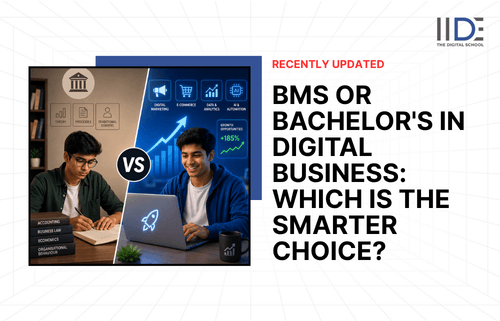
The choice between BMS and a Bachelor's in Digital Business is becoming the biggest decision for Class 12 students right now. And honestly, it shapes your entire career.
In 2026, something shifted. Mumbai's leading colleges partnered with IIDE - The Digital Business School to launch a Bachelor's in Digital Business program as their industry knowledge partner. The goal is simple - get you job-ready the moment you graduate. But the reality is that most students still pick BMS because it's familiar. The problem? Its curriculum was designed for an economy that doesn't exist anymore.
So when you're weighing BMS against a Bachelor's in Digital Business, you're really deciding between an old and a new version of the same coin. One path leads you toward traditional management positions that are slowly becoming irrelevant. While the other opens doors to the roles that companies are actively hiring for. Understanding this difference is what actually matters.
You assume BMS is your best bet, and you're not alone to think like that. Most Class 12 students think the same. But here's what's actually happening: A BMS degree is preparing you for an economy that's already moving on.
India's digital economy is on track to hit $1 trillion by 2030. And the jobs are opening up in performance marketing, e-commerce operations, AI strategy, and content-driven businesses. These fields barely existed when the BMS curriculum was last changed.
Take a look at what BMS still teaches today - accounting, economics, finance, and organisational behaviour. These subjects build a solid foundation, but are not only what today's employers are seeking. The companies today demand people who understand e-commerce, AI strategy, and content-led businesses along with foundation.
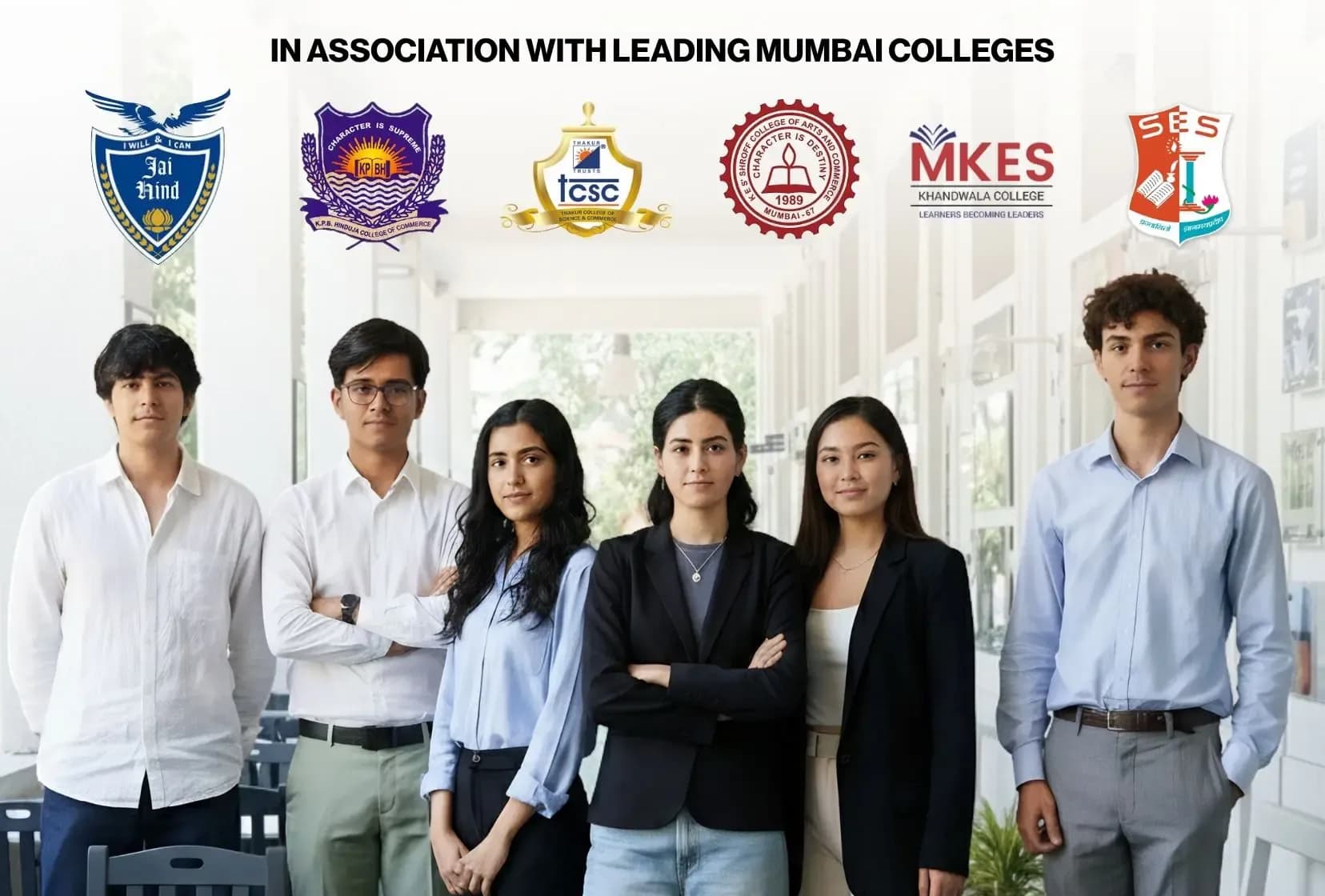
That's why six of Mumbai's best colleges launched the Bachelor's in Digital Business in collaboration with IIDE- The Digital Business School, because they identified this gap.
This degree is genuinely recognised and teaches skills that make you immediately useful on the job. The employers are looking for people who can walk in and contribute from day one. BMS alone won't get you there. But a Bachelor's in Digital Business is built for exactly that moment.
If you're still exploring courses after 12th, this shift is something worth paying attention to.
Admissions Closing Soon: Bachelor's in Digital Business!
Offered at: Jai Hind, KPB Hinduja, LS Raheja, KES Shroff, Thakur & Nagindas Khandwala
📅 Apply Before: 15th June, 2026

Admissions Closing Soon: Bachelor's in Digital Business!
Offered at: Jai Hind, KPB Hinduja, LS Raheja, KES Shroff, Thakur & Nagindas Khandwala
📅 Apply Before: 15th June, 2026
What is a BMS Degree?
BMS, or Bachelor of Management Studies, is a 3-year degree that's been a staple in Indian colleges for over two decades. It was created to give students a foundational understanding of management, business operations, and organisational principles.
The coursework typically covers management theory, business law, economics, human resources, operations management, and organisational behaviour. If you're thinking about management degrees after Class 12, BMS is often the go-to option because it feels secure and comprehensive.
But here's the catch - the curriculum is broad but static. It hasn't fundamentally changed since the early 2000s.
The real issue? BMS doesn't equip you for the careers that are actually booming right now. If your goal is to work in digital marketing, e-commerce operations, startup growth, content strategy, or AI integration, a BMS degree leaves you underprepared.
And these happen to be the fastest-growing skill areas in today's economy. Most companies that are scaling rapidly, like fintech platforms, SaaS startups, D2C brands, and digital agencies, barely recruit BMS graduates because the degree simply doesn't cover how modern digital businesses actually function.
Students today are increasingly exploring a degree in digital marketing first, because it aligns more closely with how businesses operate in 2026.
What You'll Study in BMS
Let's look at what a typical BMS curriculum includes. You'll find these subjects in almost every BMS program across India, with only minor differences between colleges.
- Financial Accounting: The focus here is on recording financial transactions and preparing financial statements using conventional methods. You'll work with ledgers, journal entries, and balance sheets. It's relevant if you're heading to an accounting department, but here's the reality: by 2026, AI is handling most routine accounting work.
- Cost Accounting and Management Accounting: This covers production costing, pricing models, and budget planning. A lot of time goes into manual calculations and cost sheet preparation. But most businesses now use automated software that does this in seconds. You're essentially learning processes that technology has already replaced.
- Taxation (Income Tax and Indirect Taxes): You dive deep into tax law, calculations, and regulatory compliance. The catch? Tax codes change annually. Half of what you study becomes outdated before you even graduate. And the moment regulations shift, everything changes again.
- Auditing: Auditing financial records, validating statements, and ensuring compliance. It's niche - useful mainly in audit firms and compliance departments, but not relevant across most industries.
- Business Economics: Economic theory, market dynamics, supply-demand concepts. Understanding how economies work is foundational, but theoretical economics alone won't build a strong career trajectory.
- Business Law and Corporate Governance: Company law, contract fundamentals, and legal structures. Important knowledge, but it's really only crucial if you're heading into legal or compliance functions.
- Human Resource Management: Organisational dynamics, recruitment, performance management. The field itself is evolving faster than the curriculum can keep up, and automation is reshaping what HR actually does.
- Operations Management: Supply chains, production processes, and inventory management. Valuable for manufacturing or logistics, but less relevant in digital-first companies.
The underlying issue is that these subjects give you theoretical grounding in business fundamentals, which is necessary. But they don't teach you how modern businesses actually create value, acquire customers, or scale.
You graduate with deep knowledge of processes and compliance, but zero practical understanding of what drives real business growth in 2026.
Where Do BMS Graduates Work
Here's the realistic picture of where a BMS career typically takes you. The jobs exist, but your options are limited.
- Banking and Financial Services: BMS graduates land roles as operations officers, credit managers, and client relationship specialists. You're processing transactions, managing accounts, and handling day-to-day operations. It pays the bills, but you're executing directives from above, not driving strategy.
- Retail and FMCG Companies: Positions in supply chain management, store operations, and distribution. You're coordinating logistics and managing inventory across multiple channels. Functional work, but it doesn't expand your capabilities beyond classroom learning.
- Manufacturing and Production: Operations management roles overseeing production schedules, quality control, and plant management. Stable sector, but not where innovation or rapid growth is happening.
- Human Resources Departments: Recruitment, employee training, and performance management roles. The work is important, but HR itself is being reshaped by automation and talent marketplaces faster than BMS programs can adapt.
- Government and Public Sector Administration: Management positions in government departments, public enterprises, and administrative bodies. Secure employment, but the work is bureaucratic and process-heavy, focused on maintaining systems rather than building them.
- Corporate Finance and Planning: In-house roles at established companies handling budgeting, financial planning, and resource allocation. Again, you're managing numbers that already exist, not creating new revenue streams.
- Hotel and Hospitality Management: Some BMS graduates move into operations and management in hotels and service businesses. Functional experience, but limited ceiling for advancement.
BMS graduate jobs cluster around operations, compliance, and administration. These functions matter, sure. But they're also the first to get automated or consolidated as companies streamline their management layers and adopt AI-driven systems.
You're competing in a shrinking job pool. And frankly, the work you're doing is increasingly something technology can handle better and faster than humans.
What is a Bachelor's in Digital Business?
A Bachelor's in Digital Business is a 3-year undergraduate programme designed to teach both core business principles and the competencies that employers are actively seeking in 2026. What sets it apart from conventional degrees is that it directly connects academic learning with real market demands.
You don't just graduate with a degree, you graduate job-ready, having gained practical experience in digital marketing strategies, e-commerce operations, AI integration, and proficiency with 25+ industry-standard tools.
Along the way, you earn credentials from Google, Meta, and HubSpot. You build a tangible portfolio showcasing actual projects you've executed. And you complete a mandatory period of on-the-job training - all as an integral part of your degree.
This programme emerged from a collaboration between IIDE - The Digital Business School, and six of Mumbai's most respected institutions - Jai Hind College, K.P.B. Hinduja College, Thakur College, KES Shroff College, Nagindas Khandwala College, and L.S. Raheja College.
IIDE brings its industry expertise to partner with college faculty, ensuring that the Bachelor's in Digital Business remains both academically credible and immediately applicable to the jobs available today.
This is one reason why students are increasingly considering professional courses after 12th like Bachelor's in Digital Business that offer direct industry exposure instead of purely theoretical degrees.
What You'll Study in a Bachelor's in Digital Business
The Bachelor's in Digital Business curriculum blends traditional business knowledge with capabilities that matter in the modern economy. You get the foundational subjects, layered with skills that employers actually value.
- Digital Marketing and SEO: You're not reading case studies. You plan, launch, and measure marketing campaigns with real brands. You manage accounts on Google, Meta, and other platforms, watching real results happen. This is applied marketing, not textbook theory.
- E-commerce Operations: Build and scale online selling platforms. Master product positioning, pricing mechanics, stock control, and strategies to boost digital sales. By graduation, you've actually managed e-commerce businesses.
- Data Analytics and Business Insights: Learn to interpret data, construct analytics reports, and ground decisions in numbers. Using platforms like Google Analytics, you'll answer questions like "what caused the revenue decline?" or "which marketing effort is paying off?"
- Brand and Content Development: Master the art of building brand presence through strategic storytelling. You'll create, publish, and track content performance across different channels. Skills that translate to virtually any modern organisation.
- Workflow and Marketing Scaling: Discover how to grow your marketing footprint through smart automation. You'll learn the systems and strategies that let a single person deliver the impact of an entire team.
- AI in Business Context: Explore how AI is transforming industries and business models. You'll apply AI solutions to real scenarios, work with platforms like Make.ai and Claude for business applications, and develop thinking around an AI-first strategy.
- Accounting Fundamentals and Economics: Yes, core business subjects are included. But you learn them through a practical lens. You grasp how revenue actually flows in modern businesses, not just transaction recording mechanics.
- Venture Building and Founder Mindset: Move from concept to execution. You'll work on initiatives where you validate ideas, locate your customer base, and generate actual revenue. It's real entrepreneurship, not simulations.
Unlike traditional business programmes, every module in the Bachelor's in Digital Business connects directly to roles that companies are opening right now. You're acquiring skills, not memorising rules.
Where Digital Business Graduates Work
Digital Business graduates are hired across diverse sectors, particularly those undergoing rapid digital transformation:
- Technology & SaaS Companies: Fast-growing software firms that need people who understand both product development and business strategy to scale operations globally.
- E-commerce & Retail: Online marketplaces, direct-to-consumer brands, and traditional retailers transitioning to digital-first operations and omnichannel models.
- Fintech & Financial Services: Digital banking platforms, payment processors, and investment apps are hiring for roles that blend financial expertise with digital innovation.
- Startups & Scale-ups: Early-stage companies where graduates wear multiple roles, contribute across functions, and advance into leadership positions within 2-3 years.
- Digital Agencies & Marketing: Creative and performance marketing agencies building digital campaigns, managing client growth, and optimising online advertising at scale.
- Traditional Companies in Transition: Banks, insurance firms, and legacy businesses are rebuilding core processes around digital technologies and cloud infrastructure.
- EdTech & Content Platforms: Online learning platforms, digital publishing companies, and content networks hiring for business operations and growth management roles
MBA - Level
Post Graduate in Digital Marketing & Business Strategy

Best For
Fresh Graduates

Mode of Learning
On Campus (Mumbai & Delhi)

Starts from
Nov 27, 2026

Duration
11 Months

Live & Online
Advanced Online Digital Marketing Course
Best For
Working Professionals
Mode of Learning
Online
Starts from
Nov 2, 2026
Duration
4-6 Months

Offline
Top AI Courses to Make You Future Ready!
Best For
AI Enthusiasts
Mode of Learning
2–5 Month Program
Starts from
Nov 24, 2026
Duration
Flexiable
Offline
Undergraduate Program in Digital Business & Entrepreneurship
Best For
12th Passouts
Mode of Learning
On Campus (Mumbai)
Duration
3 Years
Offline
Degree In 2026 ≠ Enough Degree + Digital Skills = Future-Ready
Best For
12th Passouts
Mode of Learning
At IIDE Campus
Duration
3 Years
Recent Post
Interesting Reads
You May Also Like


Partner & CEO at One Impact and Digital Marketing Trainer
Kartik is a certified digital marketer and an experienced marketing trainer with a strong passion for imparting knowledge in the field of digital marketing. As a marketing leader, he brings expertise in SEO (Search Engine Optimization), ASO (App Store Optimization), Website Development & much more. His curiosity and commitment to staying updated with industry trends have made him a dedicated digital marketing educator.
Kartik's dedication to teaching has led him to train over 55,000 students globally. His students range from engineers, MBA graduates, start-up entrepreneurs, marketing managers, and even those new to the world of digital marketing. His sessions have reached learners across India, Canada, Dubai, the USA, and other parts of the globe.
Kartik is committed to helping students and professionals alike understand the complexities of digital marketing, empowering them to advance their careers and businesses in this dynamic industry. His deep knowledge and practical approach have earned him a reputation as top 1% digital marketing trainer.