
Students Centric
Placements Report
Trackable results, real numbers
Reviews
Proven success, real voices
Trainers
Expert-led, Industry-Driven Training
Life at IIDE
Vibrant Spirit student life
Alumni
Successful Journeys, Inspiring Stories
Learning Centre
Webinars
Blogs
Case studies
Live, Interactive Masterclasses
Fresh Insights, quick reads
Real-life, Industry relevant
More
Hire from us
Hire Top Digital Marketing Talent
Work with us
Join Our Team, Make an Impact
Customised Training
Personalised digital marketing training for your company
Refer & earn
Simple, easy rewards
Contact us
Get the answers you need
About us
Know more about IIDE
Explore all course options

FOR FRESH GRADUATES
Post Graduation Program in Digital Marketing & Business Strategy- Ideal for Age: 20–25 Years

Can’t decide? Explore all our
Digital Marketing Courses
FOR STUDENTSOn-campus
Advanced Certification in AI
FOR WORKING PROFESSIONALSOnline
Professional Certification in AI StrategyFOR 12TH GRADUATESMost Popular
UG Program in Digital Business & Entrepreneurship- Ideal for Age: 18–19 Years

PARTNER PROGRAMS







Can’t decide? Explore all
BBA In Digital Marketing Colleges
Orginally Written by Kartik Mittal
Updated on May 12, 2026
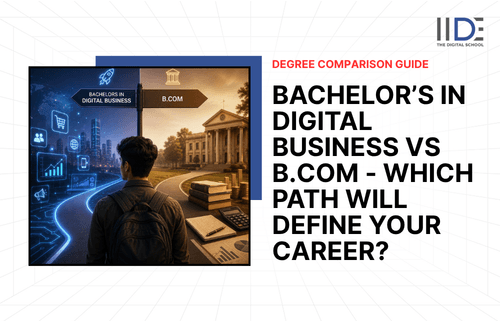
A Bachelor's in Digital Business is for someone who wants to blend business with emerging technologies like AI, data analytics, and e-commerce. You're choosing to be a digital specialist in a fast-transforming world. While a B.Com Degree is specializes in commerce, accounting, finance, and business law. It's the finance and accounting expert path.
When you're deciding between them, ask yourself what you want to master. Do you want deep knowledge in how digital transformation reshapes business, like IIDE's Bachelor's in Digital Business offers? Or do you want specialized expertise in finance, accounting, and commercial law that every organization needs?
Choosing between a Bachelor's in Digital Business and a B.Com Degree is a point where the decisions will shape your career ahead. If you're feeling confused, that's completely normal. Basic business operations have changed drastically.
For years, a B.Com Degree was the top choice for anyone interested in commerce and finance. It still is for many. But recently, something new has emerged. Companies realised they needed professionals who understood both traditional business and technology.
That's why a Bachelor's in Digital Business has become a separate path. Nearly 75% of businesses globally are accelerating their digital transformation initiatives. This shift isn't just in tech companies. Banks, insurance firms, and manufacturers are all rebuilding themselves around digital technologies. Companies need people who understand both old business fundamentals and new digital tools.
Programs like IIDE's Under-Graduation in Digital Business & Entrepreneurship were created specifically to address this gap. It teaches you how to think like a business professional while mastering the digital transformation skills that modern organisations need.
Yet B.Com Degree hasn't become outdated. Organisations still need strong accountants, financial analysts, and commerce specialists. The fundamentals of accounting, tax compliance, and financial reporting remain critical to every business.
So Digital Business vs B.Com isn't about one being better. Both are valid paths capable of leading to meaningful careers. It's about understanding which aligns with your strengths and where you see your career moving.
The Bachelor’s Program That Sets You Apart
Understanding the B.Com Degree
A B.Com Degree is one of the oldest and most trusted courses after 12th in India. When you pursue a B.Com course, you aqcuire insights on commerce, accounting, finance, and business law.
Unlike broader business programs, a B.Com Degree specializes in the financial and commercial basics of organisations. It's the traditional route for students who want to understand the backend workings of money, taxes, and financial systems.
What You'll Study in B.Com
A B.Com Degree curriculum is designed to give you specialized knowledge in commerce, accounting, and finance. Most B.Com programs in India include core subjects as following:
- Financial Accounting: This subject focuses on the skill of accurately recording and interpreting financial transactions. It teaches you how to analyse balance sheets, prepare income statements, and understand the financial health of an organisation through precise accounting records.
- Corporate Accounting: You master the difficulties of managing finances across large organisations, including consolidated accounts, inter-company transactions, and financial reporting for multi-unit businesses.
- Taxation and GST: This course teaches you how businesses calculate their tax liability, file returns, and navigate income tax, corporate tax, and Goods and Services Tax regulations that govern commerce.
- Business Law and Company Law: You study the legal framework governing business operations, including contract law, partnership deeds, corporate governance, and the regulatory requirements that organisations should follow.
- Economics: These subjects provide the analytical foundation of business, combining the study of market forces, pricing strategies, and macroeconomic policies that shape how businesses operate.
- Business Management Fundamentals: Serving as a bridge between pure accounting and strategic thinking, this subject introduces cost accounting, budgeting, and financial planning to help you manage business resources efficiently.
- Auditing and Compliance: You learn how internal and external audits work, ensuring that financial records are accurate, organisations meet regulatory requirements, and financial statements are honest.
- Banking and Finance: This course introduces you to banking operations, credit systems, investment vehicles, and financial markets that form the backbone of modern commerce.
Where B.Com Graduates Work
B.Com graduates can build careers across various established industries and organisations as mentioned below:
- Finance & Banking - Banks, financial institutions, and investment firms hiring for roles in treasury, financial analysis, and corporate finance management.
- Accounting and Audit Firms - Big audit firms like Deloitte and EY hiring for auditing, financial statement preparation, and compliance roles.
- Corporate Finance Departments - Large companies across all sectors hiring for treasury, financial planning, and internal audit teams.
- Government & Public Sector - Government agencies, municipal corporations, and public enterprises requiring financial management and audit professionals.
- Insurance Companies - Insurance firms hiring for underwriting, claims management, and financial analysis roles.
- Stock Brokerages and Investment Firms - Companies needing professionals who understand securities, portfolio management, and investment analysis.
- Tax and Compliance Services - Chartered accountant firms and tax consultancies hiring for tax planning and regulatory compliance support.
- Manufacturing and Retail - Every large organisation hiring accountants and finance managers to oversee operations and financial reporting.
Advantages of a B.Com Degree
There are several strong reasons why a B.Com Degree remains credible to employers and students:
- Deep Financial Expertise: The curriculum provides specialised knowledge in accounting, finance, and taxation that makes you genuinely expert in areas every organisation depends on.
- Industry Recognition: As a long-standing academic standard, the B.Com is a widely respected credential that employers immediately recognise and value across banking, accounting, and finance sectors.
- Career Stability: This degree opens the way for consistent, high-demand roles with transparent salary growth and clear promotion milestones in finance and accounting careers.
- Professional Qualification Pathway: A B.Com Degree positions you perfectly to pursue courses after B.Com like CA (Chartered Accountant), CS (Company Secretary), or CMA qualifications that dramatically increase your earning potential.
- Universal Relevance: Financial management and accounting are non-negotiable functions in every organisation globally, meaning your skills remain in demand across industries and countries.
Limitations of a B.Com Degree
But there are compromises to consider when choosing a B.Com Degree:
- Lack of Digital Skills: While the program covers accounting fundamentals, it often lacks specialised training in areas like e-commerce, AI-driven analytics, data analytics tools, and digital-first business models that modern companies need.
- Limited Breadth: Compared to more modern, versatile degrees, B.Com is narrow in focus, which means you won't get exposure to digital marketing, business strategy, or technology integration that employers ask for today.
- Digital Fluency Gap: Employers are increasingly looking for professionals adept at automation software, cloud accounting, and business intelligence tools, but many B.Com programs keep this training optional or expect you to learn independently.
- Heavy on Theory: The academics often prioritise theory over hands-on experience like modern accounting softwares, fintech platforms, and real-world digital finance projects.
- Slower to Adapt: Due to rigid academic structures, B.Com curriculum can be slow to include emerging trends like blockchain accounting, cryptocurrency finance, or AI in auditing compared to newer degrees.
Understanding Bachelor's in Digital Business
A Bachelor's in Digital Business is among the fastest-growing programs today. It's built for an economy where technology isn't just an add-on to business anymore. It's liteally into every part of how organisations operate. This degree brings together core business knowledge with high technology and modern digital approaches that companies need today.
What You'll Study in a Bachelor's in Digital Business
A Bachelor's in Digital Business syllabus is centred on the intersection of business and technology. You'll build skills in:
- Digital Marketing Specialisation: This covers how to build online presence and customer engagement by combining SEO techniques, content strategy, social media management, and advertising campaigns.
- E-commerce Management: You learn how to succeed in online marketplaces by developing digital sales strategies, enhancing how customers move through your online store, and shoot up the percentage of visitors who actually make a purchase.
- Data-driven Decision Making: This focuses on using business analytics and data insights to turn numbers and trends into smart business decisions and strategies.
- AI & Automation in Business: You explore how artificial intelligence and automation technology can make operations smoother and help businesses go through their own digital transformation.
- Digital Transformation in Business: This looks at the bigger picture of how technology is really changing industries, business structures, and the way organisations work.
- Business Fundamentals: You learn traditional business topics like money management and people management, but taught for today's digital environment with focus on online systems, managing remote teams, and tech-enabled budgeting.
- Growth Manager Skills: This teaches you how to grow a business faster by studying user acquisition tactics, how to keep customers coming back, and what sustainable growth looks like.
Where Digital Business Graduates Work
Digital Business graduates find opportunities across many sectors, especially those rapidly shifting to the digital world:
- Technology & SaaS Companies - Fast-moving software and tech companies looking for professionals who blend product understanding with business strategy to expand globally.
- E-commerce & Retail - Online shopping platforms, direct-to-consumer brands, and brick-and-mortar retailers moving toward digital-first operations and multiple sales channels.
- Fintech & Financial Services - Digital banking apps, online payment platforms, and digital investment services hiring for roles that mix finance knowledge with tech innovation.
- Startups & Scale-ups - Young companies where graduates take on multiple responsibilities across different areas and climb into leadership roles quickly, often within 2-3 years.
- Digital Agencies & Marketing - Marketing agencies and creative firms managing digital campaigns for clients, helping businesses grow online, and running large-scale digital advertising.
- Traditional Companies in Transition - Established banks, insurance companies, and older businesses transforming their systems and processes to work with new digital technology.
- EdTech & Content Platforms - Online education companies, digital media outlets, and knowledge-sharing networks looking for professionals in operations and growth roles.
Advantages of a Bachelor's in Digital Business
Picking a Bachelor's in Digital Business offers real advantages in today's job market:
- Always Relevant: Your learnings change along with the business world, so what you grasp stays current and matches what employers actually need.
- Learning by Doing: You study with the exact same tools and real data that working professionals use every single day.
- In High Demand: You gain the particular skills that major organisations actively search for and hire right now.
- Better Starting Pay: Companies value digital expertise more than old-school business training, which often means higher salaries when you start your first job.
- Practical Knowledge: You learn skills that directly apply to jobs, so you won't have to spend months relearning how things actually work.
- Clear Career Paths: You train specifically for today's emerging roles, like running online businesses, expanding user bases for apps, and similar positions.
- Real Expertise: You finish your degree as someone who truly knows the digital landscape, not just someone with surface-level knowledge across many areas.
Recognizing the demand for digital business education, IIDE has partnered with seven leading colleges in Mumbai to structure and deliver their Digital Business curriculum:
- Thakur College of Arts, Science & Commerce
- Jai Hind College
- KPB Hinduja College
- Nagindas Khandwala College
- KES Shroff College of Arts & Commerce
- Raheja College
- Pillai College
These collaborations ensure students throughout Mumbai have access to quality business degrees in Mumbai through our Digital Business curriculum that matches what industries actually demand.
But if you want the most comprehensive digital business education with direct industry mentorship and real-world projects, IIDE's own Undergraduate Programme in Bachelor's in Digital Business & Entrepreneurship in the Mumbai campus offers the deepest immersion into this field.
Limitations of a Bachelor's in Digital Business
- Focused on One Area: You won't get a complete view of all business functions because most of your time goes to studying digital and technology topics.
- Newer in the Market: Established, older companies might still favour traditional degrees like BBA because they've been hiring people with those credentials for a long time.
- Not Ideal for Every Field: Certain industries like government work or traditional insurance still prefer conventional business degrees, which can make job hunting tougher.
- Ongoing Education Required: After you graduate, you'll need to keep learning because technology moves quickly and what you know today can feel outdated tomorrow.
- Career Switch Challenges: Changing direction to a totally different type of business job might be difficult later because your training was so focused on one direction.
B.Com vs. Digital Business: The Quick Breakdown
Now you know what both degrees teaches and where it can take you. Let's compare them on what really matters.
The table shows where B.Com is stronger and where Digital Business wins. Neither is objectively better. The right choice depends on your goals and what you're naturally good at.
| Feature | B.Com Degree | Digital Business Degree |
|---|---|---|
| Career Specialization |
|
|
| Industry Recognition |
|
|
| Job Readiness |
|
|
Career Paths and Salaries: What You Can Earn with Each Degree
Here's where theory becomes reality. Let's look at actual jobs you'll get with each degree, what you'll earn, and how far these roles can take you. This section will help you understand how to choose a career based on what genuinely interests you and where you see yourself working.
Career Opportunities for B.Com Graduates
1. Chartered Accountant (CA)
- Work with organisations on financial audits, tax planning, and ensuring compliance with accounting standards and regulations.
- Advise clients on financial strategies, investment decisions, and ways to optimise their tax obligations.
- Build your own practice or work with major accounting firms to grow your client base and reputation.
Average Salary: [₹5 - 12 LPA]
2. Financial Analyst
- Examine financial statements, balance sheets, and market trends to help organisations make smart investment and spending decisions.
- Prepare financial forecasts and reports that guide senior management on business performance and future opportunities.
- Analyse risks and recommend ways to improve financial performance and strengthen the organisation's financial position.
Average Salary: [₹4 - 9 LPA]
3. Tax Consultant
- Guide businesses through tax laws, GST regulations, and income tax requirements to ensure they pay the right amount of tax.
- Develop tax strategies that help organisations legally reduce their tax burden and improve their bottom line.
- Represent clients during tax audits and help resolve disputes with tax authorities.
Average Salary: [₹4 - 10 LPA]
4. Auditor/Internal Auditor
- Review financial records and business processes to ensure accuracy, detect errors, and catch potential fraud.
- Create reports for management highlighting risks and recommending improvements to internal controls and operations.
- Work with both internal teams and external auditors to maintain financial integrity and meet regulatory requirements.
Average Salary: [₹3.5 - 8 LPA]
5. Bank Manager
- Oversee branch operations, manage customer relationships, and ensure smooth daily banking functions.
- Approve loans, monitor credit quality, and manage the branch's financial performance and profitability.
- Lead teams, handle customer complaints, and drive business growth through new account acquisition.
Average Salary: [₹4 - 10 LPA]
6. Company Secretary (CS)
- Handle legal compliance, corporate governance, and ensure the organisation follows all regulatory requirements and company laws.
- Manage board meetings, prepare minutes, and maintain corporate records and documentation.
- Advise the organisation on legal risks and help navigate complex corporate and regulatory matters.
Average Salary: [₹4.5 - 11 LPA]
7. Cost Accountant (CMA)
- Analyse production costs, calculate product profitability, and help organisations understand where their money goes.
- Create budgets, track spending, and suggest ways to reduce costs without affecting quality.
- Support management with financial planning and help optimise resource allocation across departments.
Average Salary: [₹4 - 9 LPA]
Career Opportunities for Bachelor's in Digital Business Graduates
1. Digital Marketing Manager
- Build and execute online marketing strategies using SEO, content marketing, social media, and paid advertising to drive customer acquisition. These are the core skills for anyone pursuing digital marketing courses in India.
- Monitor campaign performance, analyse engagement metrics, and continuously optimise marketing spend for better returns.
- Lead teams or agencies to create compelling digital campaigns that boost brand visibility and drive business growth.
Average Salary: [₹3.5 - 8 LPA]
2. E-commerce Manager
- Oversee online store operations, manage product listings, and optimise the customer shopping experience to boost sales.
- Analyse customer behaviour, identify conversion barriers, and implement changes to increase the percentage of visitors who buy.
- Manage inventory, handle supplier relationships, and ensure smooth order fulfilment and delivery processes.
Average Salary: [₹4 - 9 LPA]
3. Data Analyst/Business Intelligence Professional
- Transform raw business data into meaningful insights that drive decision-making across the organisation.
- Create dashboards and reports that help different teams understand performance, spot trends, and identify growth opportunities.
- Work with various departments to understand their data needs and provide analysis that supports strategic planning.
Average Salary: [₹4 - 9 LPA]
4. Growth Manager
- Identify and execute strategies to acquire new customers, retain existing ones, and scale business revenue efficiently.
- Run experiments with new features, marketing channels, and pricing strategies to discover what drives sustainable growth.
- Analyse user behaviour, retention metrics, and funnel performance to guide product and marketing decisions.
Average Salary: [₹5 - 11 LPA]
5. Product Manager
- Define product vision and strategy by understanding customer needs and market opportunities in the digital space.
- Work with engineering, design, and marketing teams to build and launch digital products that solve real customer problems.
- Track product performance, gather user feedback, and continuously iterate to improve features and user experience.
Average Salary: [₹5 - 12 LPA]
6. Digital Transformation Consultant
- Help traditional organisations reimagine their business models and operations using modern technology and digital approaches.
- Assess current processes, identify areas where technology can add value, and create roadmaps for digital change.
- Guide organisations through technology implementation and help teams adapt to new digital-first ways of working.
Average Salary: [₹6 - 13 LPA]
7. AI & Automation Specialist
- Identify opportunities where artificial intelligence and automation can streamline operations and reduce manual work.
- Implement AI tools and automation solutions that improve efficiency, reduce costs, and enhance decision-making.
- Guide organisations through the adoption of emerging technologies like machine learning and robotic process automation.
Average Salary: [₹6 - 14 LPA]
Conclusion
B.Com graduates often move into financial leadership roles, while Digital Business professionals advance into strategy-focused positions. The real difference isn't the program, it's your willingness to keep learning beyond graduation.
Today's businesses need both skill sets. Companies still need strong accountants and finance experts. At the same time, every organisation needs people who understand digital transformation. The line between these two paths is blurring.
Choose the degree that fits your strengths. But don't stop there. If you pick B.Com, learn digital tools and data skills. If you pick Digital Business, understand how businesses manage money and plan financially.
The market rewards adaptability and continuous learning far more than credentials alone. Your career success depends on your hunger to grow beyond what your degree teaches you.

MBA - Level
Post Graduate in Digital Marketing & Business Strategy

Best For
Fresh Graduates

Mode of Learning
On Campus (Mumbai & Delhi)

Starts from
Jun 25, 2026

Duration
11 Months

Live & Online
Advanced Online Digital Marketing Course
Best For
Working Professionals
Mode of Learning
Online
Starts from
Jun 1, 2026
Duration
4-6 Months

Online
Professional Certification in AI Strategy
Best For
AI Enthusiasts
Mode of Learning
Online
Starts from
Jun 16, 2026
Duration
5 Months

On Campus
Advanced Certification in Artificial Intelligence
Best For
AI Enthusiasts
Mode of Learning
On Campus (Mumbai)
Starts from
Jun 15, 2026
Duration
3 Months
Recent Post
Interesting Reads
You May Also Like
A Bachelor's in Digital Business is a 3 to 4 year degree that combines business basics with modern technology and data skills. It prepares you to guide companies through digital change, manage e-commerce operations, and use AI and analytics to solve business problems.
A Bachelor's in Digital Business opens doors to careers in digital marketing, online retail, data analytics, and digital transformation. Common jobs include Digital Marketing Manager, E-commerce Manager, SEO Specialist, Data Analyst, and Digital Project Manager. Graduates are prepared to help companies grow online and connect technology with business goals.
Yes. B.Com remains relevant because every organisation needs strong accountants, finance managers, and audit professionals. Banks, insurance companies, and accounting firms actively hire B.Com graduates. However, as and how companies digitize, employers are actively looking for people with a commerce foundation with excellent skills in digital tools and strategies. B.Com stays relevent but digital business is the need of the hour.
B.Com specializes in accounting, finance, taxation, and business law. You become an expert in how money, taxes, and financial systems work. Digital Business combines business knowledge with technology, digital marketing, e-commerce, and data analytics. You learn how technology reshapes business operations.
No, you don't need to be a programmer. Digital Business focuses on using technology and data to solve business problems, not on writing code. Tools like Excel, Google Analytics, marketing platforms, and data dashboards are much more important.
Absolutely. Colleges like Jai Hind, KPB Hinduja, KES Shroff College, and Raheja College in Mumbai offer a traditional B.Com/BBA degree along with Digital Business partnered with IIDE. Students get to build a strong commerce foundation with upskilling in new emerging tech and business strategies.
Digital Business graduates often get jobs faster in tech, startups, and digital agencies because these sectors are growing rapidly and actively hiring. B.Com graduates find jobs more easily in banking, accounting, and traditional finance sectors. The key is choosing based on which sector you want to work in, not just on job availability.
Neither is objectively better. Digital Business is better if you want to work in tech, startups, and modern digital roles. B.Com is better if you want deep expertise in finance, accounting, and stable careers in banking and accounting firms. Choose based on where you see yourself working and what genuinely interests you.
Yes, absolutely. Both degrees qualify you for MBA programs. Many B.Com graduates pursue MBAs to transition into management and strategy roles. Digital Business graduates often do MBAs to move from tactical digital roles into leadership and strategic positions. An MBA after either degree strengthens your credentials and opens doors to senior management roles.
Yes. IIDE's Bachelor's in Digital Business & Entrepreneurship is a legitimate undergraduate degree that qualifies students for higher education and employment. The curriculum is designed in collaboration with industry leaders, and recruiters actively hire IIDE graduates because the skills are immediately applicable.
Most traditional business degrees teach theory. IIDE focuses on what the industry actually does right now. Students work on real client projects, learn current tools and strategies, and understand how digital channels drive business decisions. IIDE was founded specifically to bridge the gap between what colleges teach and what companies actually need.
IIDE graduates work as digital marketers, business strategists, operations managers, brand managers, startup founders, and in many other roles. Because the degree teaches both business thinking and AI driven digital skills. Graduates become flexible, and they can move between functions and grow quickly.
Yes. IIDE's curriculum of Undergraduation in Digital Business & Entrepreneurship is built around practical skills and real brand projects. By graduation, students have portfolios with actual campaign work, data analysis, strategy documents, and sometimes live client projects. This makes them competitive from day one because they're not learning theory; they're learning what works.
Yes. IIDE welcomes students from all streams - commerce, science, humanities. The Undrgraduate Digital Business programme doesn't assume prior business knowledge; it builds everything from the ground up. Students learn the fundamentals alongside digital skills.
Absolutely. IIDE's curriculum includes a strong focus on entrepreneurship alongside digital business fundamentals. Students learn how to identify opportunities, validate ideas, build business models, and launch ventures. Many graduates feel confident starting their own businesses, and some already have ideas in motion by the time they graduate.


Partner & CEO at One Impact and Digital Marketing Trainer
Kartik is a certified digital marketer and an experienced marketing trainer with a strong passion for imparting knowledge in the field of digital marketing. As a marketing leader, he brings expertise in SEO (Search Engine Optimization), ASO (App Store Optimization), Website Development & much more. His curiosity and commitment to staying updated with industry trends have made him a dedicated digital marketing educator.
Kartik's dedication to teaching has led him to train over 55,000 students globally. His students range from engineers, MBA graduates, start-up entrepreneurs, marketing managers, and even those new to the world of digital marketing. His sessions have reached learners across India, Canada, Dubai, the USA, and other parts of the globe.
Kartik is committed to helping students and professionals alike understand the complexities of digital marketing, empowering them to advance their careers and businesses in this dynamic industry. His deep knowledge and practical approach have earned him a reputation as top 1% digital marketing trainer.