
Students Centric
Placements Report
Trackable results, real numbers
Reviews
Proven success, real voices
Trainers
Expert-led, Industry-Driven Training
Life at IIDE
Vibrant Spirit student life
Alumni
Successful Journeys, Inspiring Stories
Learning Centre
Webinars
Blogs
Case studies
Live, Interactive Masterclasses
Fresh Insights, quick reads
Real-life, Industry relevant
More
Hire from us
Hire Top Digital Marketing Talent
Work with us
Join Our Team, Make an Impact
Customised Training
Personalised digital marketing training for your company
Refer & earn
Simple, easy rewards
Contact us
Get the answers you need
About us
Know more about IIDE
Explore all course options

FOR FRESH GRADUATES
Post Graduation Program in Digital Marketing & Business Strategy- Ideal for Age: 20–25 Years

Can’t decide? Explore all our
Digital Marketing Courses
COMPARE BOTH OUR PROGRAMSOffline
Offline AI Courses with Dual CertificationsIndustry-Aligned TRACKMost Popular
UG Program in Digital Business & Entrepreneurship- Ideal for 12th Pass out / FY Degree Student

PARTNER PROGRAMS






Can’t decide? Explore all
BBA In Digital Marketing Colleges
Orginally Written by Kartik Mittal
Updated on May 7, 2026
|8,469K+ views
Share on:


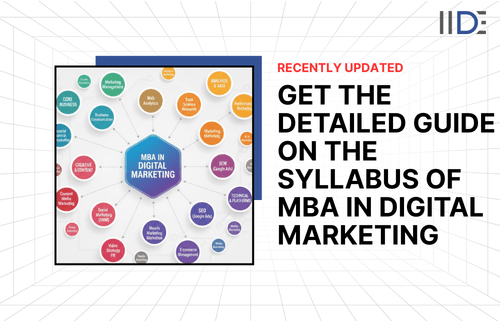
An MBA in digital marketing syllabus is a comprehensive two-year curriculum, split into four semesters, that merges traditional management foundations with modern digital expertise. The core subjects for the MBA digital marketing syllabus focus on essential modules like Search Engine Optimization (SEO), Social Media Marketing (SMM), Web Analytics, Content Strategy, and Performance Marketing to build data-driven leaders.
Core Subjects & Elective Subjects: Understanding the Difference
When you look at a comprehensive MBA in digital marketing syllabus, you will notice that it is divided into two distinct categories: Core Subjects and Elective Subjects. Understanding the distinction between these two is vital for any student planning their academic journey, as it defines how you will build your expertise over the four semesters.
What are the Core Subjects in the MBA in Digital Marketing Syllabus?
The core subjects in an MBA digital marketing syllabus represent the mandatory foundation of the program. These are the building blocks that every student must master to earn their degree. In the first year, the focus is heavily on these core modules.
The purpose of core subjects for MBA Digital Marketing is to ensure that you aren't just a "social media manager," but a holistic business leader. You will study traditional management topics like Marketing Management, Financial Accounting, Organizational Behavior, and Statistics.
You first need to understand the consumer psychology and business economics that drive the market. Without these core pillars, your digital strategies would lack a solid business ROI focus.
Beyond mastering the MBA in digital marketing, understanding the long-term trajectory of digital marketing career growth is essential for students who want to transition from entry-level execution to high-level strategic leadership roles.
What are the Elective Subjects in the MBA in Digital Marketing Syllabus?
Elective subjects are where the syllabus becomes truly exciting and customizable. These are specialized courses that you choose based on your specific career interests. While the core subjects give you the "breadth" of business knowledge, the electives provide the "depth" in digital niches.
In the second year of the MBA, students typically select electives such as Programmatic Advertising, Influencer Marketing, Advanced Google Analytics, or Mobile Marketing. If you want to work in a creative agency, you might choose electives focused on Content Strategy and Video Marketing.
If you prefer a technical role, your course structure might lean toward Data Science, Big Data, and Marketing Automation.
By balancing these two categories, the degree ensures you graduate with a "T-shaped" skill set: a broad understanding of how a business operates and a deep, specialized mastery of the digital tools required to grow it in 2026. Speaking of which, there is one institute in our country offering both courses in just 11 months.
Meet IIDE - The Digital Business School's Postgraduate in Digital Marketing & Strategy Course. How does this course stand out?
| Feature |
Traditional MBA in Digital Marketing |
IIDE’s PG in Digital Marketing & Strategy |
|---|---|---|
| Duration | 2 Years (4 Semesters) | 11 Months (Fast-track) |
| Core Focus |
General Management (HR, Finance, Ops) + Digital Theory |
100% Digital Execution + AI Strategy |
| Syllabus Change |
Updated every 3-5 years (University regulated) |
Real-time updates (Industry-regulated) |
| Learning Mode | Academic/Theoretical Case Studies | Practical/Live Simulations & Tools |
| Placement |
Senior Management/ Generalist Roles |
Specialist Roles (Performance, Creative) |
| Degree/Certification | UGC/AICTE Recognized Degree | Industry-Recognized PG Diploma |

Is Digital Marketing the Right Career for You?
Find out in a free 45-min masterclass · Career paths, roles and growth explained · By Karan Shah, Founder & CEO, IIDE

Is Digital Marketing the Right Career for You?
Find out in a free 45-min masterclass · Career paths, roles and growth explained · By Karan Shah, Founder & CEO, IIDE
Core Subjects for MBA in Digital Marketing
In the initial semesters, you will focus on these pillars to develop a holistic view of how organizations operate and compete. They are essential for building a strong career in digital marketing.
Key Subjects in the MBA Digital Marketing Syllabus
| Subject Name | What’s covered |
|---|---|
| Marketing Management |
Fundamentals of the 4Ps (Product, Price, Place, Promotion), consumer behavior, and market segmentation strategies. |
| Search Engine Optimization (SEO) |
On-page and off-page optimization, keyword research, technical SEO, and site auditing to improve organic rankings. |
| Social Media Marketing (SMM) |
Strategy development for platforms like Facebook, Instagram, LinkedIn, and X, including the community management and organic growth. |
| Web Analytics & Data Science |
Interpreting user data using tools like GA4, tracking conversion funnels, and using data to drive marketing decisions. |
| Business Communication |
Professional writing, presentation skills, and corporate storytelling, essential for client-facing digital roles. |
| Consumer Behavior in the Digital Age |
Studying the psychological shift in how modern customers discover, research, and purchase products online. |
| Content Marketing & Strategy |
Creating high-value content, blogging, and video marketing, and managing the editorial calendar for brand authority. |
| Financial Accounting & Management |
Understanding balance sheets, budgeting for digital campaigns, and calculating the ROI of marketing spend. |
| Search Engine Marketing (SEM) |
Managing paid search campaigns (PPC), Google Ads, bidding strategies, and Quality Score optimization. |
| Marketing Research |
Techniques for gathering primary and secondary data to identify market gaps and digital opportunities. |
Elective Subjects for MBA in Digital Marketing
Choosing the right electives within your MBA digital marketing syllabus can significantly broaden the digital marketing roadmap and impact your employability in specialized sectors like E-commerce, Fintech, or EdTech.
Specialized Elective Subjects in the MBA Digital Marketing Syllabus
| Subject Name | What’s covered |
|---|---|
| Influencer Marketing |
Identifying brand advocates, negotiating contracts, and measuring the impact of creator-led campaigns. |
| Programmatic Advertising |
Automated ad buying, Real-Time Bidding (RTB), and managing Demand-Side Platforms (DSPs). |
| Mobile Marketing & App SEO |
Strategies for SMS marketing, push notifications, and App Store Optimization (ASO) for iOS and Android. |
| E-commerce Management |
Managing online storefronts (Shopify/Magento), logistics, inventory, and marketplace selling on Amazon. |
| Video Marketing Strategy |
Producing and optimizing content for YouTube, TikTok and Reels to drive high engagement. |
| Marketing Automation |
Using tools like HubSpot, Salesforce, or Marketo to create automated lead nurturing workflows. |
| Affiliate Marketing |
Building partner networks, tracking commission structures, and managing third-party traffic sources. |
| Neuromarketing |
Using neuroscience to understand the subconscious consumer reactions to digital ads and UI/UX designs. |
| Big Data & AI in Marketing |
Leveraging Artificial Intelligence for predictive analytics, chatbots, and personalized customer experiences. |
| Digital PR & Reputation Management |
Handling online crises, brand sentiment analysis, and maintaining a positive digital footprint. |
Semester-Wise MBA Digital Marketing Syllabus Breakdown
To understand the complete MBA in digital marketing course structure, it is helpful to see how the learning evolves over two years.
The MBA in digital marketing syllabus is strategically sequenced to move from broad business concepts to specialized digital execution. In the first year, the focus remains on building a management mindset, while the second year allows for deep dives into technical subjects.
The following table illustrates the typical journey of a student through the MBA in digital marketing, showcasing the progression from foundational theory to advanced digital mastery:
| Semesters | Subjects Covered |
|---|---|
| Semester 1 |
Principles of Management, Financial Accounting, Marketing Management, Business Communication, Managerial Economics, Statistics for Business, and Organizational Behavior. |
| Semester 2 |
Human Resource Management, Operations Research, Market Research, Consumer Behavior, Search Engine Optimization (SEO) and Basics of Digital Media. |
| Semester 3 |
Social Media Marketing (SMM), Web Analytics, Search Engine Marketing (SEM), Email Marketing, Content Strategy, and elective choices like Influencer Marketing. |
| Semester 4 |
Performance Marketing, Digital Strategy, and Planning, Marketing Automation, Integrated Marketing Communications (IMC), Capstone Project, and Internship Viva. |
A unique highlight of this journey is learning to apply high-growth digital marketing strategies for startups, such as lean experimentation, growth hacking, and cost-effective customer acquisition, directly to the business models you study.
Entrance Exams for MBA in Digital Marketing
To secure admission into a top-tier business school, navigating the entrance exams is the first critical step. While the digital marketing syllabus for MBA focuses on future-ready skills, the entry barrier remains traditional management aptitude tests that evaluate your analytical, linguistic, and logical capabilities.
Most prestigious universities in India do not offer direct admission; instead, they require a valid score from national or state-level entrance exams to filter the most capable candidates. Preparing for these exams requires a strategic approach, as each test has a unique flavor. While some focus on speed, others prioritize accuracy and deep thinking.
Below are the primary MBA digital marketing entrance exams you should target for the 2026-27 academic session:
CAT (Common Admission Test): Conducted by the IIMs, this is the most prestigious national-level exam. It is a computer-based test consisting of three sections: Verbal Ability & Reading Comprehension (VARC), Data Interpretation & Logical Reasoning (DILR), and Quantitative Ability (QA). A high percentile here opens doors to IIMs and other top-tier institutes like FMS and SPJIMR.
XAT (Xavier Aptitude Test): Managed by XLRI Jamshedpur, XAT is known for its unique "Decision Making" section, which tests your managerial instincts. It also includes Verbal and Logical Ability, Quantitative Ability, and a General Knowledge section. Many colleges with a strong MBA digital marketing syllabus accept XAT scores.
NMAT by GMAC: This is a candidate-friendly, adaptive exam where you can choose your exam date within a testing window. It consists of Language Skills, Quantitative Skills, and Logical Reasoning. It is the primary gateway for NMIMS University, which offers a highly regarded MBA in digital marketing course structure.
SNAP (Symbiosis National Aptitude Test): This is a speed-based test conducted for admission to Symbiosis International University's various programs. The exam is shorter (60 minutes) and focuses on General English, Analytical & Logical Reasoning, and Quantitative Aptitude.
CMAT (Common Management Admission Test): Conducted by the National Testing Agency (NTA), CMAT is a popular national-level exam accepted by over 1,300 AICTE-approved colleges. It features an additional section on "Innovation and Entrepreneurship," making it ideal for those interested in the startup side of the MBA in digital marketing syllabus.
MAT (Management Aptitude Test): Conducted four times a year by AIMA, MAT offers multiple testing modes (Paper-based, Computer-based, and Internet-based). It is considered slightly easier than CAT/XAT and is accepted by hundreds of regional B-schools.
MICAT (MICA Admission Test): For those specifically targeting MICA Ahmedabad, this test is mandatory alongside CAT/XAT/GMAT. It includes a psychometric test and a descriptive section to assess your creative and divergent thinking.
Summing Up
Choosing to pursue an MBA in digital marketing is a definitive step toward becoming a leader in the modern economy. By mastering the core and elective subjects, you aren't just learning to use tools; you are learning to drive business growth through data and strategy. From the moment you clear your entrance exams to the day you complete the MBA, you are evolving into a high-value asset for any global brand.
The digital landscape changes daily, but a solid foundation in the MBA digital marketing remains a constant advantage. If you meet the eligibility requirements and have the drive to innovate, this degree is your gateway to the C-suite.
Want to Know Why 2,50,000+ Students Trust Us?
Dive into the numbers that make us the #1 choice for career success



MBA - Level
Post Graduate in Digital Marketing & Business Strategy

Best For
Fresh Graduates

Mode of Learning
On Campus (Mumbai & Delhi)

Starts from
Nov 27, 2026

Duration
11 Months

Live & Online
Advanced Online Digital Marketing Course
Best For
Working Professionals
Mode of Learning
Online
Starts from
Nov 2, 2026
Duration
4-6 Months

Offline
Top AI Courses to Make You Future Ready!
Best For
AI Enthusiasts
Mode of Learning
2–5 Month Program
Starts from
Nov 23, 2026
Duration
Flexiable

Offline
Undergraduate Program in Digital Business & Entrepreneurship
Best For
12th Passouts
Mode of Learning
On Campus (Mumbai)
Duration
3 Years

Offline
Degree In 2026 ≠ Enough Degree + Digital Skills = Future-Ready
Best For
12th Passouts
Mode of Learning
At IIDE Campus
Duration
3 Years
Recent Post
Interesting Reads
You May Also Like
The MBA in digital marketing syllabus is designed to blend core business management principles with advanced digital techniques. Unlike a short-term certificate, the MBA digital marketing syllabus covers everything from financial accounting and human resources to technical modules like Programmatic Advertising, Web Analytics, and Performance Marketing. The goal is to prepare students for leadership roles rather than just entry-level execution.
While specific subjects vary by college, the standard subjects for MBA Digital Marketing include Marketing Management, Search Engine Optimization (SEO), Social Media Marketing (SMM), Business Analytics, and Consumer Behavior in the Digital Age. These modules form the foundation of the MBA in digital marketing across most top institutions.
No, a coding background is not required. However, the MBA in digital marketing course structure does require comfort with data and numbers. You will learn to use tools like Google Analytics, SQL, or CRM software, but the focus is on strategic decision-making rather than writing code.
The MBA in digital marketing eligibility typically requires a bachelor’s degree from a recognized university with a minimum aggregate of 50%. Additionally, candidates must clear competitive MBA in digital marketing entrance exams like CAT, XAT, or NMAT to secure a seat in a reputable program.
While an MBA provides a significant boost, transition depends on your prior experience and the depth of the MBA in digital marketing course structure you followed. Graduates often start in mid-level roles like Digital Marketing Manager or Performance Head, eventually scaling to C-suite positions like Chief Marketing Officer (CMO).

Partner & CEO at One Impact and Digital Marketing Trainer
Kartik is a certified digital marketer and an experienced marketing trainer with a strong passion for imparting knowledge in the field of digital marketing. As a marketing leader, he brings expertise in SEO (Search Engine Optimization), ASO (App Store Optimization), Website Development & much more. His curiosity and commitment to staying updated with industry trends have made him a dedicated digital marketing educator.
Kartik's dedication to teaching has led him to train over 55,000 students globally. His students range from engineers, MBA graduates, start-up entrepreneurs, marketing managers, and even those new to the world of digital marketing. His sessions have reached learners across India, Canada, Dubai, the USA, and other parts of the globe.
Kartik is committed to helping students and professionals alike understand the complexities of digital marketing, empowering them to advance their careers and businesses in this dynamic industry. His deep knowledge and practical approach have earned him a reputation as top 1% digital marketing trainer.