
Students Centric
Placements Report
Trackable results, real numbers
Reviews
Proven success, real voices
Trainers
Expert-led, Industry-Driven Training
Life at IIDE
Vibrant Spirit student life
Alumni
Successful Journeys, Inspiring Stories
Learning Centre
Webinars
Blogs
Case studies
Live, Interactive Masterclasses
Fresh Insights, quick reads
Real-life, Industry relevant
More
Hire from us
Hire Top Digital Marketing Talent
Work with us
Join Our Team, Make an Impact
Customised Training
Personalised digital marketing training for your company
Refer & earn
Simple, easy rewards
Contact us
Get the answers you need
About us
Know more about IIDE
Explore all course options

FOR FRESH GRADUATES
Post Graduation Program in Digital Marketing & Business Strategy- Ideal for Age: 20–25 Years

Can’t decide? Explore all our
Digital Marketing Courses
COMPARE BOTH OUR PROGRAMSOffline
Offline AI Courses with Dual CertificationsIndustry-Aligned TRACKMost Popular
UG Program in Digital Business & Entrepreneurship- Ideal for 12th Pass out / FY Degree Student

PARTNER PROGRAMS






Can’t decide? Explore all
BBA In Digital Marketing Colleges
Orginally Written by Aditya Shastri
Updated on Feb 12, 2026
Share on:


L'Oréal, the world's largest beauty company, commands a dominant position in the global cosmetics industry with €43.48 billion in 2024 sales. Operating across 150+ countries with 37 international brands spanning luxury, mass-market, professional, and dermatological segments, the French beauty giant continues to outperform market growth through innovation and strategic acquisitions.
But what makes L'Oréal unstoppable, and where are its vulnerabilities? This comprehensive swot analysis of L'Oréal reveals the strategic factors that define the company's competitive position as it navigates AI transformation, sustainability demands, and intensifying competition in 2026.
For entrepreneurs and business students, understanding this loreal swot analysis provides invaluable insights into how legacy brands maintain market leadership while adapting to digital-first consumer behavior.
About LOreal
L'Oréal S.A., founded in 1909 by French chemist Eugène Schueller in Paris, revolutionized the beauty industry with a single hair dye formula called "Auréale." Over 115 years later, the company has evolved into the undisputed global leader in cosmetics and personal care, maintaining its headquarters in Clichy, Hauts-de-Seine with its main office in Paris, France.

The brand's iconic slogan "Because You're Worth It" (L'Oréal Paris) embodies its democratizing mission, making premium beauty accessible to everyone regardless of geography, income, or demographics. This philosophy of "universalization" combines global reach with local cultural relevance, allowing L'Oréal to serve diverse consumer needs across six continents.
In October 2025, L'Oréal made its largest acquisition in history, purchasing Kering's beauty division for €4 billion, securing 50-year exclusive licensing rights for Gucci, Bottega Veneta, Balenciaga fragrances and cosmetics, plus acquiring niche fragrance house The House of Creed. This strategic move positions L'Oréal as the definitive leader in luxury fragrances and designer beauty, signaling aggressive expansion in premium categories.
SWOT Analysis is a strategic framework evaluating a company's Strengths, Weaknesses, Opportunities, and Threats, providing actionable insights for competitive positioning and strategic decision-making.
L'Oréal Overview Table
| Company Information | Details |
|---|---|
| Official Company Name | L'Oréal S.A. |
| Founded | July 31, 1909 (115 years) |
| Founder | Eugène Paul Louis Schueller |
| Headquarters | Clichy, Hauts-de-Seine, France |
| Website | https://www.loreal.com |
| Industries Served | Beauty, Cosmetics, Personal Care, Dermatology, Fragrances |
| Geographic Areas Served | 150+ countries across Europe, North America, Asia-Pacific, Latin America, Middle East, Africa |
| Revenue (2024) | €43.48 billion ($45.25 billion USD) |
| Net Income (2024) | €7.07 billion |
| Employees | 90,000+ globally |
| Main Competitors | Estée Lauder Companies, Unilever, Procter & Gamble (P&G), Shiseido, Coty, Beiersdorf, LVMH (Parfums & Cosmétiques), Chanel |

Is Digital Marketing the Right Career for You?
Find out in a free 45-min masterclass · Career paths, roles and growth explained · By Karan Shah, Founder & CEO, IIDE

Is Digital Marketing the Right Career for You?
Find out in a free 45-min masterclass · Career paths, roles and growth explained · By Karan Shah, Founder & CEO, IIDE
SWOT Analysis of L'Oréal
L'Oréal's Strengths: The Beauty Giant's Superpowers in 2026
1. Unmatched Brand Portfolio & Market Leadership
L'Oréal's greatest strength lies in its unparalleled portfolio of 37 international brands strategically organized across four divisions:
- Consumer Products (mass-market): L'Oréal Paris, Garnier, Maybelline, NYX, Essie
- L'Oréal Luxe (premium): Lancôme, Yves Saint Laurent, Giorgio Armani, Kiehl's, Helena Rubinstein, Urban Decay, Valentino
- Professional Products (salon): Kérastase, Redken, Matrix, Color Wow
- Dermatological Beauty: La Roche-Posay, CeraVe, Vichy, SkinCeuticals
This diversification enables L'Oréal to serve every consumer segment from $5 drugstore mascara to $500 luxury skincare, creating resilience against category-specific downturns. When makeup softened in 2025, fragrances and haircare compensated, demonstrating the portfolio's strategic value.
The October 2025 Kering Beauty acquisition (Gucci, Bottega Veneta, Balenciaga licenses + House of Creed) for €4 billion further cemented L'Oréal's dominance in designer fragrances and luxury beauty, creating competitive moats against LVMH and Estée Lauder.
2. R&D Excellence & Innovation Leadership
L'Oréal invests over €1 billion annually in research and development across 21 research centers in 13 countries, employing 4,000+ scientists and 8,000 digital talents. This commitment to innovation produced groundbreaking achievements:
- CES 2026 Innovations: Light Straight + Multi-styler (infrared hair styling at lower temperatures) and LED Face Mask (anti-aging skincare device), both CES Innovation Award Honorees
- Cell BioPrint (CES 2025): Tabletop proteomics device providing personalized skin analysis in five minutes
- IFSCC Congress 2025: "Best Applied Research" award for ultramarine blue pigments' skin-enhancing effects
- TIME's Best Inventions 2025: AirLight Pro, Lancôme Rénergie Nano-Resurfacer, and Melasyl recognized
- 497+ patents owned (top nanotechnology patent-holder in U.S.)
In January 2025, L'Oréal partnered with IBM to develop custom AI foundation models for cosmetic formulation, accelerating product development while improving inclusivity, sustainability, and personalization.
3. AI & Beauty Tech Powerhouse
L'Oréal earned recognition as Europe's Most Innovative Company (Fortune, 2025) and Most Future-Ready Beauty Company (IMD, 2025) by embracing AI transformation:
CREAITECH Lab: Partnership with Google Cloud's Imagen 3 and Gemini models generates localized campaign assets from text prompts, reducing production time from weeks to hours
Agentic AI: L'Oréal Paris Beauty Genius on WhatsApp (Meta partnership) provides 24/7 personalized beauty consultations at scale
ModiFace Acquisition: Virtual try-on technology for makeup and hair color, now integrated across brands and retail partners
Performance Marketing AI: "Tidal" tool automates paid media campaigns across platforms, achieving 22% increase in media efficiency
This technology leadership positions L'Oréal ahead of traditional competitors who lag in digital transformation.
4. Global Scale & Distribution Mastery
With presence in 150+ countries, 38 manufacturing plants globally, and sales across all distribution networks (e-commerce, mass market, department stores, pharmacies, perfumeries, salons, travel retail), L'Oréal leverages economies of scale impossible for smaller competitors to replicate.
E-commerce penetration reached 29% of total sales in 2025 (growing low-teens), outpacing most competitors. L'Oréal's omnichannel strategy seamlessly integrates online discovery (TikTok, Instagram, YouTube), virtual try-on tools, and in-store purchase, capturing consumers across the entire journey.
The company's multipolar model, balancing growth across regions, categories, and divisions, provides resilience. When China luxury softened, North America recovery and emerging markets strength (India, Vietnam, GCC, Brazil) offset declines.
The competitive dynamics in luxury skincare closely resemble insights from the SWOT analysis of Estée Lauder.
5. Financial Strength & Profitability
L'Oréal's 2024 financial performance demonstrates operational excellence:
- Revenue: €43.48 billion (+5.8% vs. 2023)
- Operating Margin: 21.1% (H1 2025, +30 basis points YoY)
- Net Income: €7.07 billion (+10.31% vs. 2024)
- Net Cash Flow: €6.64 billion (+8.6%)
- Shareholders' Equity: €33.1 billion
- Dividend: €7.00 per share (+6.1% increase)
This financial firepower enables strategic acquisitions (Kering Beauty, Galderma stake, Color Wow, Medik8, Dr.G), R&D investments, and marketing dominance, advantages cash-constrained competitors cannot match.
6. Sustainability & ESG Leadership
L'Oréal achieved its 10th consecutive CDP triple 'A' rating for climate change, forests, and water security, the only company globally to hold this distinction for a decade. Sustainability achievements include:
- 97% renewable energy across sites (targeting 100% by 2025)
- 51% reduction in CO2 emissions on sites
- L'AcceleratOR Program: €100 million over 5 years funding 13 startups for sustainable packaging, nature-sourced ingredients, and circular economy
- 95% bio-based ingredients target by 2025
- Top 1% ESG rating worldwide (ISS ESG Prime classification, MSCI AA rating)
These credentials appeal to eco-conscious consumers and investors while mitigating regulatory risks in Europe and North America.
7. Social Media & Influencer Marketing Dominance
L'Oréal Paris rose from #10 to #1 beauty brand by social media engagement and reach in 2025 (CreatorIQ data), surpassing Huda Beauty and Rare Beauty with 57% growth in earned media value.
The shift from polished celebrity endorsements to authentic creator content resonated with Gen Z consumers who distrust traditional advertising. L'Oréal's 60%+ digital media allocation to social platforms (TikTok, Instagram, YouTube) drives organic amplification and reduces customer acquisition costs.
Celebrity & Ambassador Partnerships: Eva Longoria, Kendall Jenner, Kate Winslet, Jane Fonda, Elle Fanning provide aspirational appeal while micro-influencers build community trust.
L'Oréal's Weaknesses: The Beauty Giant's Struggles in 2026
1. North America Underperformance & Market Share Challenges
Despite being L'Oréal's largest single market after Europe, North America growth significantly lagged expectations in 2025:
- Q1-Q3 2025: +1.8% growth (vs. ~3% forecast)
- Q3 2025: Only +1.4% (below 4.9% global average)
The U.S. makeup market faced oversaturation and consumer fatigue from constant newness. Mass-market brands (Maybelline, L'Oréal Paris) struggled to differentiate in crowded drugstore shelves while specialty retailers (Ulta, Sephora) captured premium-seeking consumers.
Root Causes:
- Distribution challenges as drugstore traffic declined
- Inventory destocking post-pandemic overstocking
- Clean beauty and indie brands (Glossier, Rare Beauty, The Ordinary) captured Gen Z attention
- Innovation pipeline didn't translate to consumer pull-through
This weakness exposes L'Oréal's vulnerability in its most profitable region, threatening margin expansion.
2. China Market Volatility & Luxury Dependency
While mainland China returned to growth after two-year contraction, the market remains unpredictable. L'Oréal Luxe grew only +2.2% (Q1-Q3 2025), reflecting broader luxury category softness.
Challenges:
- Economic Headwinds: Youth unemployment and dampened aspirational spending
- "Guochao" Movement: Rising nationalist preference for domestic Chinese beauty brands (Florasis, Perfect Diary, Proya)
- Value-Focused Consumers: Chinese buyers became more discerning post-pandemic, concentrating luxury purchases on "investment pieces"
- Local Competition: Domestic brands offer comparable quality at lower price points with cultural authenticity
L'Oréal underestimated the speed of local Chinese beauty innovation and the shift away from Western prestige brands, creating strategic vulnerability in a market critical to luxury growth.
3. Premium Pricing Pressure & Accessibility Perception
L'Oréal's premium and luxury brands face pricing resistance in recessionary environments. While high-end positioning drives profitability, it alienates price-sensitive consumers during economic uncertainty.
Specific Issues:
- Luxury Brand Concentration: Lancôme, YSL, Armani positioned at aspirational price points vulnerable to trading down
- Mass-Market Perception: Even Consumer Products brands (L'Oréal Paris, Maybelline) perceived as more expensive than competitors (e.l.f. Beauty, CeraVe, Neutrogena)
- Limited Budget Options: Insufficient entry-level products to capture inflation-pressured consumers
This pricing architecture creates a gap where value-focused consumers defect to indie brands offering "clean" formulations at accessible price points.
4. Organizational Complexity & Decentralization Challenges
With 37 brands across four divisions, L'Oréal's structure creates coordination challenges:
- Brand Overlap: Maybelline, L'Oréal Paris, and NYX compete in mass makeup without sufficiently distinct positioning
- Decision-Making Speed: Multi-layered approval processes slow agility versus nimble D2C brands
- Quality Control: Managing consistent standards across hundreds of SKUs and global manufacturing plants
- Resource Allocation: Investment distribution across extensive portfolio risks underfunding high-potential brands
While diversification provides resilience, it also creates operational complexity that impedes rapid market response, particularly problematic in fast-moving beauty trends.
The brand’s ethical beauty initiatives mirror positioning discussed in the SWOT analysis of The Body Shop.
5. Dependence on Acquisitions for Growth
L'Oréal's expansion strategy relies heavily on acquiring established brands rather than organic innovation:
- 2025 Major Acquisitions: Kering Beauty (€4B), Medik8, Color Wow, Dr.G, Miu Miu license, Galderma stake (10% → 20%)
- Integration Risks: Acquired brands may underperform expectations or prove difficult to integrate culturally and operationally
- Opportunity Cost: Capital deployed on acquisitions could fund organic R&D or marketing
This model works when targets deliver, but failed acquisitions (like The Body Shop, eventually divested) expose financial and reputational risks. Over-reliance on M&A also signals potential organic innovation gaps.
6. Sustainability Communication Gaps & "Greenwashing" Perception
Despite genuine environmental progress (97% renewable energy, L'AcceleratOR program, 10 consecutive CDP triple 'A' scores), consumer perception lags reality.
Communication Failures:
- Aspirational vs. Current: Messaging emphasizes future targets over present achievements, creating credibility gaps
- Lack of Consumer-Facing Tools: No QR codes on packaging revealing carbon footprint or refill station maps
- Product-Level Opacity: Consumers can't easily assess individual product sustainability during purchase decisions
Beauty industry skepticism around "greenwashing" is high. When L'Oréal's messaging outpaces tangible results, it faces criticism, particularly from eco-conscious Gen Z consumers who research brands deeply.
7. Ethical Controversies & Animal Testing Backlash
L'Oréal faces ongoing criticism regarding ethical practices:
Animal Testing Concerns: Selling products in China (where animal testing for finished cosmetics was historically mandatory) created backlash from cruelty-free advocates. While regulations evolved, reputational damage persists.
Child Labor Allegations: May 2024 BBC documentary "Perfume's Dark Secret" uncovered child labor in Egyptian jasmine fields supplying L'Oréal and other beauty giants, damaging brand reputation among ethically-minded consumers.
Product Origin Lawsuits: February 2022 U.S. lawsuit alleged L'Oréal misrepresents product origin, falsely presenting items as "Made in France" when containing significant non-French components.
These controversies undermine L'Oréal's premium positioning and alienate consumers prioritizing ethical consumption, a growing segment particularly among younger demographics.
L'Oréal's Opportunities: Future Moves for Global Beauty Leadership
1. Men's Grooming Market Expansion
The $70B+ global men's grooming market grows faster than women's beauty, yet L'Oréal lacks dedicated positioning outside L'Oréal Men Expert (mass) and isolated luxury fragrance/skincare lines.
Growth Potential:
- Mass Market Opportunity: Develop performance-driven "L'Oréal Men Pro" line competing with Gillette, Harry's, addressing acne, aging, shave care with athlete/fitness influencer partnerships
- Premium Expansion: Leverage Kiehl's apothecary credibility for "Kiehl's for Him" sanctuary experiences with male advisors
- Professional Services: Partner Matrix, Redken, and newly acquired Color Wow with barber culture through exclusive education and products
- Fragrance Leadership: Position Creed, Armani, YSL as masculine fragrance authorities through craftsmanship storytelling
Expected Impact: Capture 3-5% additional market share in men's categories, diversifying revenue beyond female-dominated segments while future-proofing against gender-neutral beauty trends.
2. Aesthetic Dermatology & Medical Beauty
L'Oréal's 20% stake in Galderma (increased from 10% in December 2025) positions the company to participate in the fast-growing $60B+ global aesthetics market including injectables, dermal fillers, and medical-grade skincare.
Strategic Advantages:
- Scientific Credibility: Galderma's dermatology expertise enhances L'Oréal's clinical positioning
- Product Development Synergies: Joint R&D projects combining cosmeceuticals with medical-grade treatments
- Distribution Cross-Pollination: Dermatologist relationships driving recommendation of La Roche-Posay, CeraVe, SkinCeuticals
- Premium Pricing: Aesthetic treatments command higher margins than traditional cosmetics
This opportunity allows L'Oréal to capture consumers' entire beauty journey, from preventive skincare (La Roche-Posay) to corrective treatments (Galderma injectables), building lifetime value.
3. Emerging Markets & Geographic Expansion
While Europe and North America mature, emerging markets delivered double-digit growth in 2025:
- India: Rising middle class, beauty consciousness, digital penetration
- Vietnam, Thailand, Indonesia: Southeast Asian beauty boom
- GCC (Gulf Cooperation Council): Luxury appetite, premium haircare demand
- Brazil, Mexico: Latin American mass-market expansion
- Sub-Saharan Africa: Untapped beauty potential, haircare opportunities
Localization Strategy:
- Tailored Product Formulations: Climate-appropriate skincare, hair textures, skin tones
- Cultural Relevance: Region-specific brand ambassadors, localized marketing campaigns
- Accessible Price Points: Entry-level products capturing aspirational mass consumers
- Distribution Partnerships: Local retailers, e-commerce platforms (Nykaa in India, Lazada in Southeast Asia)
Expected Impact: Emerging markets could contribute 40-50% of total revenue by 2030 (up from ~30% in 2025), offsetting slower developed market growth.
4. AI-Powered Hyper-Personalization at Scale
L'Oréal's AI partnerships (Google Cloud, IBM, Meta, NVIDIA) create opportunities for mass personalization:
Product Innovation:
- Custom Formulations: AI analyzing skin/hair conditions to create bespoke products
- Predictive Beauty: Recommending preventive solutions based on genetic data, environmental factors, lifestyle
Consumer Experience:
- Conversational Commerce: Expanding Beauty Genius AI consultants across all brands and platforms
- AR/VR Integration: Virtual makeup try-ons evolving into full beauty consultations with real-time product recommendations
- Adaptive Content: AI generating culturally relevant campaign assets for 150+ markets in real-time
Data Moat:
- Unified Beauty Profiles: Single consumer ID across touchpoints (brand sites, AR tools, salon visits) building comprehensive preferences
- Lifecycle Personalization: Tailored messaging based on life stage (new parent, pre-wedding, aging concerns)
- Predictive Replenishment: Proactive notifications when products likely depleted
Expected Impact: 20-25% increase in customer lifetime value, 30% email engagement improvement, 15% reduction in acquisition costs through superior retention.
5. Sustainability as Competitive Differentiation
L'Oréal can transform environmental leadership from corporate responsibility into consumer-facing brand value:
Transparent Tools:
- "Impact Scan" QR Codes: Every product linking to carbon footprint, water usage, recyclability, social impact metrics
- Refill Station Network: Quadruple refillable products beyond luxury (Lancôme, Kiehl's) to mass brands (Garnier, L'Oréal Paris), partnering retailers for in-store refills
- Gamified Engagement: "Beauty for the Planet" rewards program where consumers earn points for refills, recycling, lower-impact choices
Clean Beauty Credibility:
- Ingredient Transparency: PhD chemists explaining controversial ingredients (parabens, sulfates, silicones) with nuanced science
- Third-Party Certifications: Display EWG Verified, Cradle to Cradle, or B Corp badges on packaging
- Sourcing Stories: Short-form content showing ingredient origins (e.g., "This shea butter supports women's cooperative in Burkina Faso")
Expected Impact: 30-40% increase in sustainability-aware consumer segment, 10-15% premiumization potential, differentiation from "greenwashing" competitors.
6. Direct-to-Consumer (DTC) & Subscription Models
While L'Oréal sells through retail partners, expanding DTC capabilities offers higher margins and data ownership:
Subscription Opportunities:
- Skincare Regimens: Monthly deliveries of personalized routines (La Roche-Posay, CeraVe)
- Salon-Quality Haircare: Professional Products brands (Kérastase, Redken) direct to consumers
- Fragrance Discovery: Sample subscriptions leading to full-size purchases
DTC Advantages:
- Margin Expansion: Eliminating retailer margins (30-50%)
- First-Party Data: Direct consumer relationships enabling personalization
- Agile Testing: Rapid iteration of new products, formats, marketing messages
- Brand Control: Owning narrative without retail partner constraints
Expected Impact: DTC could contribute 15-20% of e-commerce sales by 2028, improving profitability while reducing dependence on retail partners.
7. Beauty Tech Devices & Diagnostic Tools
Building on CES innovations (Light Straight, LED Face Mask, Cell BioPrint), L'Oréal can expand beauty tech hardware:
At-Home Devices:
- Hair Styling: Infrared technology line (straighteners, curlers, dryers)
- Skincare: LED masks, ultrasonic cleansers, microcurrent devices
- Diagnostic: AI-powered skin analyzers, scalp health cameras
Professional Salon Tools:
- AirLight Pro Ecosystem: Complete salon equipment portfolio
- Smart Color Mixing: AI-optimized hair color formulation for stylists
Ecosystem Strategy:
- Devices + Consumables: Hardware sold at cost/profit, revenue from proprietary serums, styling products, replacement parts
- Data Collection: Devices gathering beauty data to inform product development, personalization
Expected Impact: Create $500M-$1B beauty tech division by 2028, positioning L'Oréal as holistic beauty solutions provider beyond traditional cosmetics.
L'Oréal's Threats: Challenges in a Competitive Beauty Arena
1. Intensified Competition from Agile Indie Brands
Direct-to-Consumer (DTC) disruptors threaten L'Oréal's market share with nimble innovation, authentic brand stories, and social media virality:
Competitive Threats:
- Clean Beauty Specialists: The Ordinary (Deciem, owned by Estée Lauder), Drunk Elephant (Shiseido), Glossier, Beautycounter offer transparent "free-from" formulations
- Inclusive Makeup: Fenty Beauty, Rare Beauty captured Gen Z/Millennial loyalty through shade diversity and mental health positioning
- K-Beauty Innovation: Korean brands (COSRX, Innisfree, Sulwhasoo) pioneered ingredients (snail mucin, Centella asiatica) and formats (sheet masks, essences)
- Niche Fragrance Houses: Independent perfumers competing with L'Oréal's luxury fragrances on artisanal credibility
Advantages Over L'Oréal:
- Agility: Indie brands launch products in months vs. L'Oréal's 12-18 month cycles
- Authenticity: Founder-led storytelling resonates more than corporate marketing
- Digital-Native: Born on social media, optimized for e-commerce, skilled at community building
- Lower Overhead: Smaller teams, outsourced manufacturing enable aggressive pricing
While L'Oréal's scale provides advantages, indie brands capture cultural zeitgeist faster, particularly dangerous in trend-driven categories like makeup and skincare.
2. Counterfeiting & Intellectual Property Violations
As the world's largest beauty company, L'Oréal faces rampant counterfeiting threatening:
Revenue Loss: Fake products divert billions in sales, particularly in emerging markets (China, India, Southeast Asia) and through online marketplaces (Alibaba, Amazon third-party sellers)
Brand Damage: Counterfeit products with inferior or dangerous formulations harm consumers, creating negative associations with authentic L'Oréal brands
IP Theft: Competitors reverse-engineering patented formulations, copying packaging design, infringing trademarks
Enforcement Challenges:
- Global Scale: Policing 150+ countries with varying IP laws
- E-commerce Anonymity: Sellers operating across borders with minimal accountability
- Legal Costs: Pursuing infringers internationally requires massive legal resources
Even with strong IP enforcement (497+ patents, dedicated legal teams), L'Oréal cannot eliminate counterfeiting, an ongoing tax on profitability and brand equity.
3. Economic Recession & Consumer Spending Contraction
Macroeconomic headwinds threaten discretionary beauty spending:
Inflation Impact: Persistent inflation in Europe, North America, and emerging markets pressures household budgets, forcing consumers to:
- Trade Down: Switch from L'Oréal Luxe (Lancôme) to Consumer Products (L'Oréal Paris) or competitors (e.l.f., CeraVe)
- Reduce Frequency: Delay repurchase, use products more sparingly
- Skip Categories: Eliminate "nice-to-have" makeup, fragrances, focusing only on essentials (skincare, haircare)
Recession Risks: Potential economic downturns in major markets (U.S., Eurozone, China) could significantly reduce beauty spending, particularly in premium/luxury categories
Currency Volatility: L'Oréal reports in euros but generates global revenue, unfavorable exchange rates (strong euro) reduce reported sales and profits
Consumer Behavior Shifts: "Lipstick Effect" (buying small luxuries during recessions) may not hold as Gen Z prioritizes experiences (travel, dining) over products
Historical data shows beauty partially recession-resistant, but severe downturns do impact L'Oréal's premium-weighted portfolio.
L’Oréal’s luxury positioning operates in a competitive space similar to the SWOT analysis of Louis Vuitton.
4. Geopolitical Tensions & Supply Chain Disruptions
Global operations expose L'Oréal to geopolitical risks:
Russia-Ukraine Conflict: L'Oréal suspended investments in Russia (2022-ongoing), losing significant Eastern European revenue
U.S.-China Trade War: Tariffs, sanctions, technology restrictions complicate manufacturing, IP protection, cross-border collaboration
Middle East Instability: Conflicts affecting GCC markets, supply chain routes, raw material sourcing
Supply Chain Vulnerabilities:
- Raw Material Shortages: Natural ingredients (jasmine, shea butter, argan oil) subject to climate variability, geopolitical restrictions
- Manufacturing Concentration: Reliance on specific regions for production creates bottleneck risks
- Logistics Disruptions: Port congestion, shipping cost spikes, pandemic-style lockdowns
Energy Costs: European manufacturing dependent on natural gas, price volatility threatens margin expansion
Diversifying supply chains and manufacturing footprint requires years and billions in investment.
5. Regulatory Pressures & Ingredient Restrictions
Evolving regulations across markets create compliance burdens:
EU Cosmetics Regulation: Strictest ingredient restrictions globally, banning microplastics, limiting preservatives, requiring extensive safety testing. Compliance is expensive; non-compliance risks market access.
China Import Requirements: Changing animal testing policies, registration delays, formulation approvals create uncertainty
U.S. FDA Oversight: Increased scrutiny of cosmetics safety, potential new legislation requiring pre-market approval (like drugs)
Sustainability Mandates: Carbon disclosure requirements, packaging recycling targets, extended producer responsibility schemes
Ingredient Bans:
- PFAS ("Forever Chemicals"): Being phased out in U.S. states, EU, requires reformulation
- Talc: Controversy over asbestos contamination forcing removal from products
- Fragrance Allergens: Increasing restrictions on EU Allergen List components
Expected Impact: R&D costs rise to reformulate products for regional compliance; slower innovation cycles; potential revenue loss if regulations ban profitable ingredients.
6. Shifting Consumer Preferences Toward "Clean" & "Natural" Beauty
"Clean Beauty" movement challenges L'Oréal's traditional formulations:
Consumer Demands:
- "Free-From" Formulations: Parabens, sulfates, phthalates, synthetic fragrances
- Natural/Organic Ingredients: Plant-based, biodegradable, sustainably sourced
- Minimal Processing: "Kitchen cosmetics" transparency
Credibility Gap: L'Oréal perceived as "big beauty" with legacy chemical formulations versus indie brands (Drunk Elephant, Beautycounter, Goop) positioned as "clean" alternatives
Scientific Tension: L'Oréal's science-backed approach (synthetic ingredients can be safer, more effective) conflicts with consumer desire for "natural" despite lacking rigorous definition
Reformulation Challenges:
- Performance Trade-Offs: Removing preservatives shortens shelf life; natural alternatives may be less effective
- Cost Increases: Natural/organic ingredients often more expensive than synthetic counterparts
- Supply Constraints: Limited availability of sustainably sourced natural ingredients at L'Oréal's scale
If "clean beauty" gains mainstream adoption, L'Oréal risks losing consumers unwilling to trust reformulation efforts, particularly if competitor head start creates perception gap.
7. Digital Platform Dependency & Algorithm Changes
L'Oréal's 60%+ digital media allocation creates vulnerability:
Platform Risks:
- Algorithm Volatility: Instagram, TikTok, Facebook algorithm changes reducing organic reach, forcing increased paid spend
- Policy Shifts: Beauty content restrictions, influencer disclosure requirements, data privacy regulations (GDPR, CCPA)
- Platform Competition: Fragmentation across TikTok, Instagram, YouTube, emerging platforms requires multi-platform expertise
Data Privacy Backlash: Third-party cookie deprecation, iOS privacy changes (App Tracking Transparency) reduce ad targeting effectiveness, increasing customer acquisition costs
Influencer Fatigue: Audiences tuning out sponsored content; shifting toward peer recommendations, user-generated content
Platform Power: Meta, Google, TikTok control distribution, can change terms, pricing, access arbitrarily, threatening L'Oréal's digital-first strategy
Dependence on platforms L'Oréal doesn't control creates strategic risk if policies shift or consumer behavior migrates to new channels.
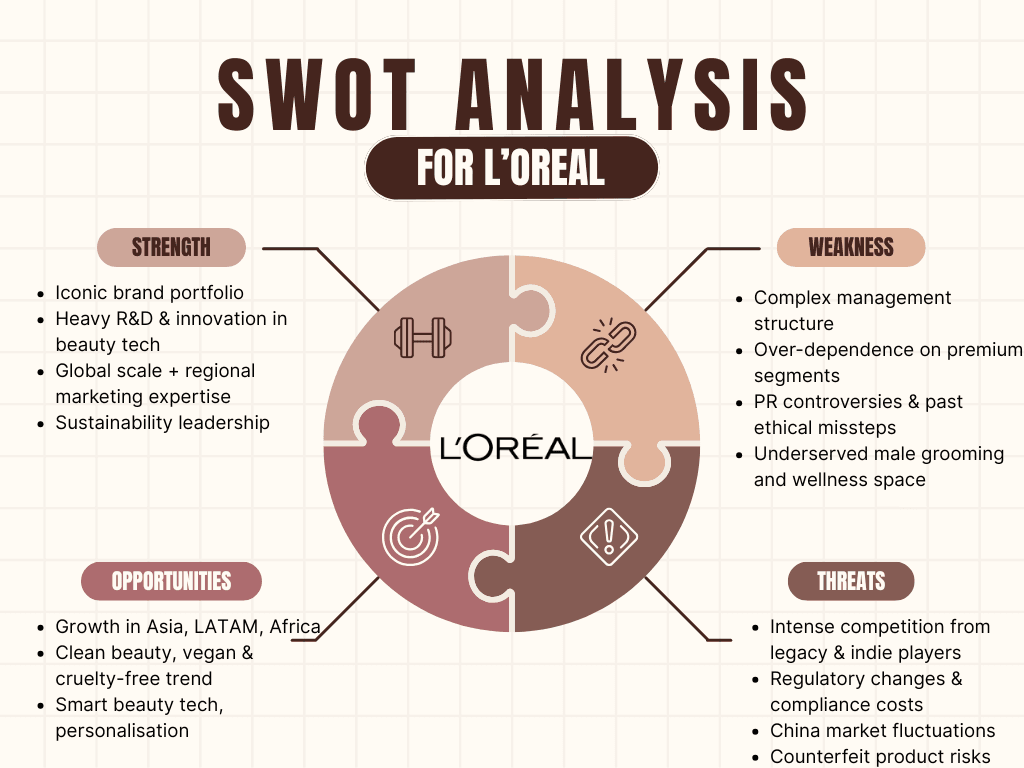
Summary Table – SWOT of L'Oréal
IIDE Student Takeaway, Conclusion & Recommendations
This comprehensive l'oreal swot analysis reveals a beauty titan at a strategic crossroads. L'Oréal's dominance, fueled by unmatched brand portfolio, R&D firepower, AI transformation, and €43.48 billion in financial muscle, remains formidable. The swot analysis L'Oréal demonstrates how systematic innovation (CES 2026 infrared beauty tech), strategic acquisitions (€4B Kering Beauty deal), and digital leadership (#1 social media engagement) sustain market outperformance despite category headwinds.
However, the loreal swot analysis also exposes critical vulnerabilities. North America underperformance (+1.8% vs. 4.9% global growth), China market unpredictability, and premium pricing pressure in recessionary environments threaten margin expansion. The rise of agile D2C indie brands (Glossier, The Ordinary, Rare Beauty) capturing Gen Z through authentic storytelling and clean beauty positioning reveals L'Oréal's corporate scale as both asset and liability.
The Core Strategic Tension: L'Oréal must maintain innovation velocity and cultural relevance while leveraging global scale, balancing efficiency with agility, premium positioning with accessibility, legacy brand equity with disruptive reinvention. The company faces a fundamental question: Can a 115-year-old conglomerate with 37 brands and 90,000 employees move as fast as a 10-person startup launching viral TikTok campaigns?
4 Actionable Recommendations for L'Oréal (2026-2028)
1. Accelerate North America Turnaround Through Portfolio Rationalization
- Conduct aggressive SKU and brand consolidation in underperforming Consumer Products division.
- Define clear positioning for Maybelline (trendy/Gen Z), L'Oréal Paris (aspirational/mass), and NYX (indie credibility), eliminating overlap.
- Invest saved marketing dollars in 3-5 "hero SKUs" per brand rather than broad launches.
- Partner aggressively with Ulta and Sephora for exclusive mass-prestige collections, moving traffic from declining drugstore channels.
- Target: Return North America to 3-4% growth within 18 months.
2. Build Authentic Gen Z Credibility Through "L'Oréal Collective" Co-Creation Platform
- Launch dedicated community platform where Gen Z creators, artists, and beauty enthusiasts co-create limited-edition products, campaign concepts, and trend reports.
- Provide meaningful revenue sharing (affiliate programs, licensing fees for co-created IP, equity-like participation) beyond free products.
- Position L'Oréal as collaborator rather than advertiser.
- Deploy across TikTok, Instagram, Discord with zero corporate branding, letting community lead aesthetics, messaging, product development.
- Target: 25-30% increase in Gen Z brand consideration, 40% boost in organic social amplification by 2027.
The company’s global beauty influence reflects strategies seen in the SWOT analysis of Burberry.
3. Transform Sustainability Leadership into Consumer-Facing Competitive Moat
- Develop "Impact Scan" QR code system on all packaging linking to product-specific carbon footprint, water usage, recyclability, ingredient sourcing, social impact, verified by third parties.
- Quadruple refillable product availability beyond luxury to mass brands, partnering retailers for in-store refill stations.
- Launch gamified "Beauty for the Planet" loyalty program where consumers earn tangible rewards (discounts, charitable donations) for sustainable choices.
- Position L'AcceleratOR startup partnerships as innovation pipeline feeding mainstream brands.
- Target: 35% increase in sustainability-aware consumer segment, 12-15% premiumization opportunity.
4. Deepen China Engagement Through Cultural Humility & Local Innovation Centers
- Establish autonomous "L'Oréal China Innovation Lab" with local R&D team, product development authority, and marketing control, reducing reliance on French headquarters for approvals.
- Partner with Chinese ingredient suppliers, manufacturers, and cultural consultants to create "designed in China, for China" collections across divisions.
- Shift from Western ambassador strategy to Chinese celebrity, KOL, and livestream commerce.
- Acquire or invest in Chinese beauty startups to gain cultural credibility and local market intelligence.
- Target: Sustained mid-to-high single-digit growth in China by 2027, rebuilding trust post-"guochao" movement.
Want to Know Why 2,50,000+ Students Trust Us?
Dive into the numbers that make us the #1 choice for career success


MBA - Level
Post Graduate in Digital Marketing & Business Strategy

Best For
Fresh Graduates

Mode of Learning
On Campus (Mumbai & Delhi)

Starts from
Nov 27, 2026

Duration
11 Months
Live & Online
Advanced Online Digital Marketing Course
Best For
Working Professionals
Mode of Learning
Online
Starts from
Oct 7, 2026
Duration
4-6 Months

Offline
Top AI Courses to Make You Future Ready!
Best For
AI Enthusiasts
Mode of Learning
2–5 Month Program
Starts from
Nov 23, 2026
Duration
Flexiable
Offline
Undergraduate Program in Digital Business & Entrepreneurship
Best For
12th Passouts
Mode of Learning
On Campus (Mumbai)
Starts from
-
Duration
3 Years
Offline
Degree In 2026 ≠ Enough Degree + Digital Skills = Future-Ready
Best For
12th Passouts
Mode of Learning
At IIDE Campus
Starts from
-
Duration
3 Years
Recent Post
More SWOT Analysis
L’Oréal is best known for its wide range of beauty and personal care products, including skincare, makeup, haircare, and fragrances across luxury, mass-market, and professional segments.
L’Oréal faces competition from global giants like Estée Lauder, Unilever, P&G, Shiseido, and Coty, as well as emerging D2C beauty brands like Glossier, The Ordinary, and Fenty Beauty.
L’Oréal follows a multi-brand, multi-channel strategy that caters to different customer segments. It focuses heavily on innovation, sustainability, and tech integration (like AI and AR) to enhance customer experience.
L’Oréal operates across both - it owns mass-market brands like Garnier and Maybelline, as well as luxury brands like Lancôme, Yves Saint Laurent Beauty, and Kiehl’s.
L’Oréal’s biggest strength is its powerful brand portfolio. With 37 global brands across luxury, mass, professional, and dermatological categories, the company can serve every type of consumer and price segment. This diversification also protects it when one category slows down.
Some key challenges include slower growth in North America, volatility in China, pressure on premium pricing during uncertain economies, and the complexity of managing a large multi-brand structure. There’s also a gap between sustainability efforts and how consumers perceive them.
L’Oréal has strong opportunities in men’s grooming, aesthetic dermatology, and emerging markets like India and Southeast Asia. AI-driven personalization, beauty tech innovations, and sustainability transparency can also unlock future growth.
Competition from fast-growing indie brands targeting Gen Z, counterfeit products, economic slowdowns, supply chain disruptions, and stricter regulations are key threats. The clean beauty movement is also reshaping consumer expectations.
L’Oréal leads the global beauty market with a highly diversified portfolio and strong R&D investment. While competitors dominate specific niches like luxury or fragrances, L’Oréal’s scale, innovation, and global presence give it a clear competitive edge.
L’Oréal is heavily investing in AI for marketing, product development, virtual try-ons, and personalized beauty consultations. These technologies help the brand stay innovative and improve customer experiences.
Yes, L’Oréal is considered a sustainability leader with renewable energy adoption, reduced emissions, and strong environmental ratings. However, the brand still needs to communicate these efforts more clearly to consumers.
L’Oréal is focusing on localization, digital commerce, premium innovation, and dermatological credibility. By aligning with local culture and consumer behavior, it aims to rebuild growth and relevance in China.
It shows how a global brand maintains leadership through diversification, innovation, and adaptability. Students can learn about portfolio strategy, digital transformation, sustainability, and how to stay competitive in a rapidly evolving market.
The acquisition strengthened L’Oréal’s position in luxury fragrances and designer beauty. It gives the company access to iconic fashion brands and high-margin segments while boosting its premium market presence.

Lead Trainer & Business Development Head at IIDE
Aditya Shastri leads the Business Development segment at IIDE and is a seasoned Content Marketing expert. With over a decade of experience, Aditya has trained more than 20,000 students and professionals in digital marketing, collaborating with prestigious institutions and corporations such as Jet Airways, Godrej Professionals, Pfizer, Mahindra Group, Publicis Worldwide, and many others. His ability to simplify complex marketing concepts, combined with his engaging teaching style, has earned him widespread admiration from students and professionals alike.
Aditya has spearheaded IIDE’s B2B growth, forging partnerships with over 40 higher education institutions across India to upskill students in digital marketing and business skills. As a visiting faculty member at top institutions like IIT Bhilai, Mithibai College, Amity University, and SRCC, he continues to influence the next generation of marketers.
Apart from his marketing expertise, Aditya is also a spiritual speaker, often traveling internationally to share insights on spirituality. His unique blend of digital marketing proficiency and spiritual wisdom makes him a highly respected figure in both fields.