
Students Centric
Placements Report
Trackable results, real numbers
Reviews
Proven success, real voices
Trainers
Expert-led, Industry-Driven Training
Life at IIDE
Vibrant Spirit student life
Alumni
Successful Journeys, Inspiring Stories
Learning Centre
Webinars
Blogs
Case studies
Live, Interactive Masterclasses
Fresh Insights, quick reads
Real-life, Industry relevant
More
Hire from us
Hire Top Digital Marketing Talent
Work with us
Join Our Team, Make an Impact
Customised Training
Personalised digital marketing training for your company
Refer & earn
Simple, easy rewards
Contact us
Get the answers you need
About us
Know more about IIDE
Explore all course options

FOR FRESH GRADUATES
Post Graduation Program in Digital Marketing & Business Strategy- Ideal for Age: 20–25 Years

Can’t decide? Explore all our
Digital Marketing Courses
COMPARE BOTH OUR PROGRAMSOffline
Offline AI Courses with Dual CertificationsIndustry-Aligned TRACKMost Popular
UG Program in Digital Business & Entrepreneurship- Ideal for 12th Pass out / FY Degree Student

PARTNER PROGRAMS






Can’t decide? Explore all
BBA In Digital Marketing Colleges
Orginally Written by Aditya Shastri
Updated on Jun 10, 2026
Share on:


Nike turned athletic performance into a cultural identity and built one of the most recognised brands in history. Today it still leads global sportswear, but the brand is navigating its most challenging strategic reset in decades. Can the Swoosh reclaim its dominance before a new generation of buyers writes a different story? For entrepreneurs and business students, this SWOT analysis breaks down exactly what still works, what does not, and what comes next.
About Nike
Nike, Inc. was founded in 1964 by Phil Knight and Bill Bowerman in Eugene, Oregon. It started as a small distributor of Japanese running shoes before relaunching under the Nike name in 1971, named after the Greek goddess of victory.
Over the next five decades, it grew into the world's largest athletic footwear and apparel company, building a portfolio that spans performance sport, lifestyle, streetwear, and digital fitness across nearly 190 countries.
What has always made Nike different is its ability to turn a product into a cultural moment. "Just Do It", introduced in 1988, is not just a slogan.
It is a belief system that has connected the brand to athletes, achievers, and everyday consumers across three generations, making Nike far more than a shoe company in the minds of billions of people worldwide.
In India, Nike competes in one of the fastest-growing sportswear markets on the planet, targeting fitness-conscious urban consumers and young sports enthusiasts through both physical retail and its expanding digital ecosystem.
In 2026, Nike is in the middle of its biggest strategic reset in decades. CEO Elliott Hill, a 32-year Nike veteran who returned in October 2024, is driving a five-pillar "Win Now" turnaround with one clear goal: rebuild wholesale trust, restore product innovation, and return Nike to the sport-first identity that made it the world's most dominant athletic brand.
Quick Stats of Nike:
| Parameter | Details |
|---|---|
| Official Company Name | Nike, Inc. |
| Founded | 1964 (relaunched as Nike, 1971) |
| Industries Served | Athletic Footwear, Apparel, Sports Equipment, Digital Fitness |
| Geographic Presence | Nearly 190 countries and territories |
| Revenue (FY 2025) | $46.3 Billion |
| Net Income (FY 2025) | ~$0.2 Billion (down 86% YoY) |
| Employees | ~79,000+ worldwide |
| Key Sub-Brands | Nike, Jordan Brand, Converse |
| Main Competitors | Adidas, On Running, Hoka, Lululemon, Puma, Anta, Li-Ning |
What Does SWOT Stand For in Nike's Case?
SWOT stands for Strengths, Weaknesses, Opportunities, and Threats. It is a simple framework that looks at what a company does well internally and what external forces are shaping its future. For Nike in 2026, this lens is especially useful because the brand is both one of the most powerful names in sportswear and one of the most pressured businesses in its own industry at the same time.
Why SWOT Analysis Matters for Nike in 2026
- The Turnaround Under Elliott Hill: Nike is executing its biggest strategic reset in decades, with the "Win Now" framework targeting wholesale recovery, product innovation, and cultural reconnection with sport.
- DTC Model Failure and Wholesale Rebuild: The previous leadership's aggressive push toward direct-to-consumer channels alienated key retail partners and handed shelf space directly to On Running and Hoka.
- Rising Competition from Challenger Brands: On Running and Hoka are growing fast in segments where Nike was once unbeatable, winning serious runners, premium buyers, and Gen Z consumers alike.
- Tariff and Supply Chain Pressure: US trade policy is costing Nike an estimated $1.5 billion annually, squeezing margins on a business already dealing with revenue decline.
- Brand Relevance with Gen Z: Younger consumers are gravitating toward sharper, more focused brands, creating a relevance gap that marketing spend alone cannot fix.

Is Digital Marketing the Right Career for You?
Find out in a free 45-min masterclass · Career paths, roles and growth explained · By Karan Shah, Founder & CEO, IIDE


Is Digital Marketing the Right Career for You?
Find out in a free 45-min masterclass · Career paths, roles and growth explained · By Karan Shah, Founder & CEO, IIDE
SWOT Analysis of Nike
A SWOT analysis provides a structured lens for examining the internal strengths and weaknesses a company controls and the external opportunities and threats it must navigate. For Nike in 2026, this framework surfaces a company that still owns extraordinary competitive assets but is fighting to convert those assets back into consistent commercial momentum after a period of strategic miscalculation that will take several more quarters to fully unwind.
Strengths of Nike: What Still Makes the Swoosh the Standard
Despite a difficult eighteen months, Nike retains advantages that most of its competitors would need decades to replicate. These are structural strengths, not legacy positions, and they remain the foundation of any credible recovery.
Global Brand Equity and Cultural Authority:
- Nike was ranked the world's strongest apparel brand in 2025 by Brand Finance, with a Brand Strength Index score of 94.7 out of 100.
- The Jordan Brand commands pricing power and consumer desire that no competing athletic brand has come close to matching in basketball and lifestyle.
- "Just Do It", introduced in 1988, gives Nike a storytelling foundation that allows it to rebuild brand premium faster than any challenger brand could ever create from scratch.
Market Leadership in Athletic Footwear:
- Nike holds an estimated 27% share of the global athletic footwear market, well ahead of Adidas at approximately 12%.
- North America wholesale revenue grew 11% in Q3 fiscal 2026, the first time in two years that every distribution channel turned positive simultaneously.
- Nike's portfolio spans performance, lifestyle, and streetwear across Nike, Jordan, and Converse, giving it coverage no single competitor can match.
Adidas remains the closest rival in this space, and a closer look at the Marketing Mix of Adidas reveals exactly where the gap between the two brands continues to widen.
Elite Athlete and League Endorsement Portfolio:
- Nike's partnerships with LeBron James, Cristiano Ronaldo, and Serena Williams deliver commercial returns and brand storytelling no challenger can easily replicate.
- Partnerships with the NBA, NFL, WNBA, and global football connect Nike to live sport at the moments when consumer attention is highest.
- These endorsement assets would cost any rival billions and years to partially replicate, making them one of Nike's most durable competitive barriers.
Asset-Light, Diversified Production Model:
- Nike manufactures across 660+ third-party factories in Vietnam, Indonesia, India, and China, keeping internal capital focused on design and marketing.
- This model allows Nike to shift production between geographies faster than vertically integrated competitors when tariffs or disruptions hit.
- The scale of Nike's supplier network delivers unit cost advantages that smaller challenger brands simply cannot access.
Nike Direct Digital Ecosystem:
- Nike's digital platforms including the Nike App, Nike Run Club, and Nike Training Club give it direct consumer relationships no wholesale retailer can access.
- This ecosystem enables personalised launches and community fitness engagement that deepens loyalty beyond a standard retail transaction.
Weaknesses of Nike: Where the Pressure Is Real in 2026
Nike's current challenges are not cyclical noise. Several of them reflect strategic decisions made over the past five years that created structural vulnerabilities the company is still actively unwinding, and they require clear-eyed acknowledgment alongside the strength story.
Revenue Decline and Margin Compression:
- Nike made $46.3 billion in revenue in fiscal 2025, which was 10% less than the year before and the worst annual drop in the company's history.
- Profits fell even harder, dropping 86% to just $0.2 billion, meaning the business lost far more in earnings than it did in sales.
- As recently as Q2 fiscal 2026, profits were still 32% lower than the same period last year, showing the recovery is taking longer than hoped.
- On top of all this, US tariffs are costing Nike around $1.5 billion every year, making it even harder to fix profit margins while sales are still healing.
Footwear Revenue Concentration:
- About 68% of Nike's revenue comes from footwear alone, making it highly vulnerable when competitors attack the shoe market.
- Gains by On Running, Hoka, and Adidas in footwear hurt Nike more directly than they would a business with a more balanced revenue mix.
- Growing apparel and equipment sales is the right move, but it is slow when management attention is already stretched thin on the core brand recovery.
Geographic Revenue Concentration:
- North America makes up 43% of Nike's total revenue, creating heavy reliance on a single mature and contested market.
- Any spending slowdown in North America hits Nike harder than it would a more globally balanced competitor.
- Greater China, once expected to be Nike's second growth engine, is now in steep decline.
DTC Over-Pivot and Wholesale Relationship Damage:
- Nike's pullback from wholesale partners left shelf space that On Running, Hoka, and Adidas quickly made their own.
- Nike Direct sales still fell 8% in Q2 fiscal 2026, showing the DTC strategy never delivered the loyalty it promised.
- Winning back key wholesale partners takes time and costly concessions that squeeze margins further in the short term.
Labour and Ethical Controversies:
- Nike faces recurring allegations of poor working conditions across factories in Vietnam, Indonesia, and Cambodia that create reputational risk with younger consumers.
- Gen Z and millennial buyers factor ethical sourcing into purchase decisions more consciously than any previous generation, making this a growing commercial liability.
- High staff turnover raises recruitment costs and risks the loss of experienced personnel whose knowledge supports product quality and supply chain continuity.
Converse Collapse:
- Converse revenue fell 30% in Q2 fiscal 2026, showing the sub-brand has lost its relevance with younger consumers.
- This hurts both revenue and profit at once, since Converse historically delivered strong margins with very little marketing spend.
- A quick revival is unlikely as management focus is almost entirely locked on fixing the core Nike brand first.
Opportunities for Nike: The Growth Frontiers That Matter in 2026
Nike's scale, brand equity, and global infrastructure give it access to opportunities that most competitors cannot credibly pursue at comparable speed or conviction. Several of the most important ones align directly with where consumer behaviour and market conditions are moving.
Women's Sport and Apparel Expansion:
- The global women's sports market is growing faster than ever, driven by rising participation rates and increasing professional visibility worldwide.
- Nike's partnerships with the WNBA and athletes like Caitlin Clark place it at the centre of this shift in a way no competitor currently matches.
- Building women's performance lines around female physiology rather than scaled-down men's products is one of Nike's clearest margin-accretive growth paths right now.
Emerging Markets Including India and Southeast Asia:
- India's sportswear market is expanding rapidly, driven by rising incomes, urban fitness culture, and growing sports viewership among younger consumers.
- Nike's existing retail and digital presence in India gives it a foundation to build localised products, regional athlete partnerships, and Hindi-language digital content.
- Southeast Asia and parts of Africa offer similarly fast-growing middle-class consumer pipelines where Nike's brand equity gives it a genuine head start.
Puma has been aggressively targeting these same emerging markets, and understanding the Marketing Strategy of Puma shows just how competitive the race for the next billion sportswear consumers is becoming.
Athleisure, Digital Ecosystems, and AI Integration:
- The rise of athleisure as everyday wear creates sustained demand for functional athletic clothing that works across gym, street, and social settings.
- Nike Run Club and Nike Training Club have tens of millions of active users, giving Nike a proprietary dataset no retailer or competitor can access.
- Integrating AI into product personalisation and digital fitness experiences could create entirely new revenue categories within Nike's existing membership base.
Circular Economy and Sustainability:
- Building product lines with recycled materials meets the growing ESG expectations of investors, consumers, and regulators all at once.
- Nike's Move to Zero initiative, targeting zero carbon and zero waste, gives it a strong and credible sustainability platform to build on.
- Expanding and communicating these efforts more aggressively would strengthen Nike's appeal among Gen Z buyers who weigh environmental responsibility heavily.
- Circular economy innovation also helps justify premium pricing by giving Nike a differentiation story that goes beyond athlete endorsements alone.
Wholesale and Amazon Recovery:
- Nike's return to Amazon places new product innovation in front of millions of shoppers who were buying competitor products during the gap.
- Rebuilding Foot Locker and Dick's Sporting Goods partnerships creates physical distribution that Nike's own stores cannot replicate at mass-market scale.
- If the wholesale rebuild delivers as planned, fiscal 2027 could mark Nike's first full-year revenue growth since the decline began.
Threats to Nike: The Forces That Cannot Be Ignored in 2026
The external threats Nike faces in 2026 are not temporary market headwinds. Several of them reflect permanent shifts in consumer behaviour, competitive dynamics, and geopolitical reality that require strategic responses, not just tactical adjustments.
On Running and Hoka Capturing the Serious Runner:
- Nike's global athletic footwear market share fell to 22.9% in 2025, the third consecutive year of decline, with On Running and Hoka as the primary beneficiaries.
- On Running has become the premium running status symbol of 2026, winning the affluent, performance-oriented buyers Nike's brand has historically relied upon most.
- Hoka's cushioning technology has captured serious marathon runners and everyday comfort seekers in a segment Nike did not defend aggressively enough before the shift happened.
Anta and Li-Ning Dominating China:
- Anta and Li-Ning are outpacing Nike in China through national pride marketing and deep integration with Tmall, JD.com, and Douyin.
- Government support for domestic brands and anti-Western consumer sentiment create a structural disadvantage that marketing alone cannot fix.
- Nike risks permanently losing a market where it spent decades building brand equity to rivals who have no reason to give it back.
Counterfeit Marketplace and Brand Dilution:
- High-quality counterfeit Nike products across online marketplaces dilute brand exclusivity and undermine its premium pricing power.
- Consumers who unknowingly buy fakes and get poor quality end up blaming Nike itself, eroding the trust its premium positioning depends on.
- As low-cost direct-from-factory platforms grow, the counterfeit threat becomes harder to police and more damaging to recover from.
US-China Tariff Escalation:
- Current tariffs are costing Nike an estimated $1.5 billion annually, squeezing margins on a business already under significant revenue pressure.
- Nike's diversified manufacturing across Vietnam, Indonesia, and India provides partial relief but cannot fully absorb further escalation without disrupting supplier relationships.
- Further tariff increases would force Nike to choose between compressing margins further or raising consumer prices at the worst possible moment for brand recovery.
Foreign Exchange Risk:
- Nike operates in nearly 190 countries and reports in US dollars, meaning dollar strength reduces the reported value of international revenue without any real change in local performance.
- Currency fluctuations create earnings volatility and investor perception problems that disproportionately affect a business of Nike's global scale.
- In strong dollar periods, Nike's international revenue translates back into fewer dollars, making results look weaker than local market conditions actually are.
Gen Z Brand Relevance Gap:
- Gen Z consumers are gravitating toward sharper, more focused brands like On Running, Hoka, and New Balance rather than broad heritage names.
- Nike's heavy discounting during the DTC years damaged its premium positioning with younger buyers who read markdowns as a sign of weak brand health.
- Closing this gap requires Nike to tell its story through content and community rather than broadcast advertising, which is slower and harder to control.
Lululemon's Female Consumer Capture:
- Lululemon's fit-first products and community-led retail are winning female consumers in ways Nike's broader women's strategy has consistently failed to match.
- As women's sport participation hits record levels, the biggest growth segment in premium sportswear is being claimed by a sharper, more focused competitor.
- Nike needs dedicated product investment and a distinct marketing voice for women before Lululemon makes that relationship permanent.
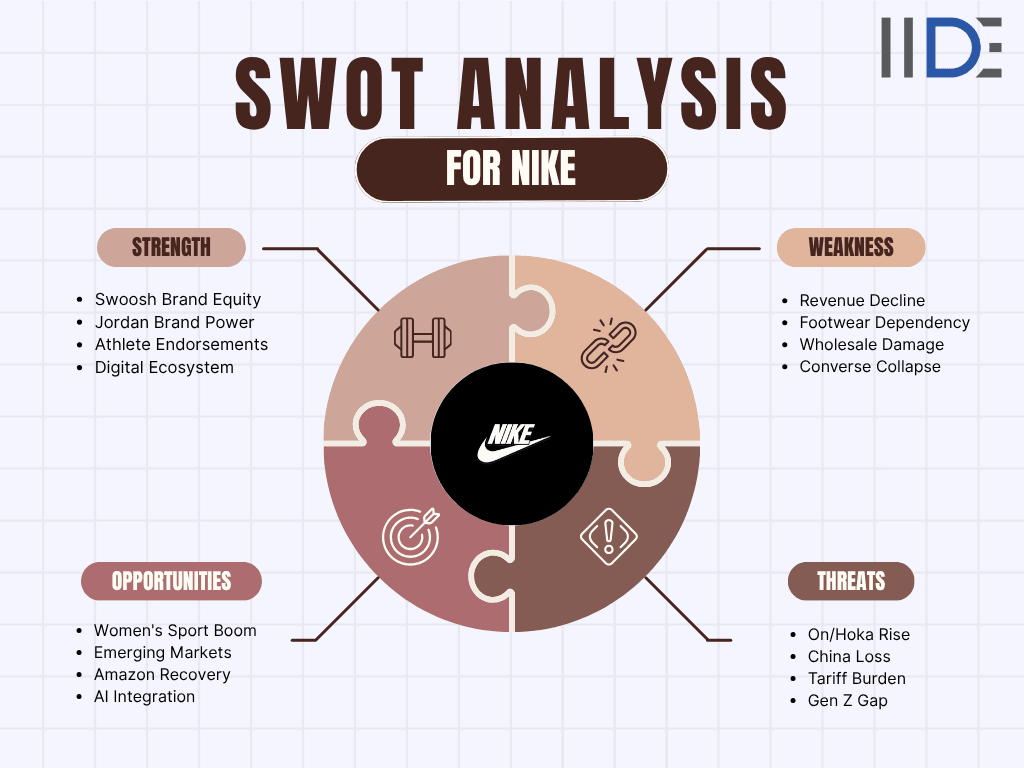
Summary Table: SWOT of Nike
Conclusion
Nike in 2026 is not a brand in crisis. It is a brand in correction. The swoosh still holds the highest brand strength score in global apparel, Jordan Brand still sets the cultural benchmark in basketball, and a $5 billion marketing engine gives Nike a reach no challenger can match today.
These are not small advantages. They are the kind of assets that take decades to build.
But great assets do not guarantee great results when the strategy behind them breaks down. The Direct-To-Consumer (DTC) over-pivot handed shelf space and consumer attention to On Running, Hoka, and Adidas at exactly the moment Nike stopped defending them.
The revenue decline, margin collapse, China exit, and Converse freefall were not bad luck. They were the direct cost of losing focus on the very things that made Nike matter.
The recovery under Elliott Hill is moving in the right direction. Wholesale is healing, running is growing, and the brand foundation remains strong. But the turnaround is still in its hardest phase, and time is not standing still.
The real question is not whether Nike can recover. It is whether it can recover fast enough, before On Running, Hoka, and a generation of Gen Z consumers finish building loyalties that no longer include the swoosh.
For business students and entrepreneurs, the Nike story in 2026 is one of the most valuable lessons available, not just in building a great brand, but in what happens when a great brand loses sight of its own identity.
Want to Know Why 2,50,000+ Students Trust Us?
Dive into the numbers that make us the #1 choice for career success



MBA - Level
Post Graduate in Digital Marketing & Business Strategy

Best For
Fresh Graduates

Mode of Learning
On Campus (Mumbai & Delhi)

Starts from
Nov 27, 2026

Duration
11 Months

Live & Online
Advanced Online Digital Marketing Course
Best For
Working Professionals
Mode of Learning
Online
Starts from
Nov 2, 2026
Duration
4-6 Months

Offline
Top AI Courses to Make You Future Ready!
Best For
AI Enthusiasts
Mode of Learning
2–5 Month Program
Starts from
Nov 24, 2026
Duration
Flexiable

Offline
Undergraduate Program in Digital Business & Entrepreneurship
Best For
12th Passouts
Mode of Learning
On Campus (Mumbai)
Duration
3 Years

Offline
Degree In 2026 ≠ Enough Degree + Digital Skills = Future-Ready
Best For
12th Passouts
Mode of Learning
At IIDE Campus
Duration
3 Years
Recent Post
You May Also Like
Nike's biggest strengths are its powerful brand identity, the highly profitable Jordan Brand, and its deep partnerships with elite athletes.
Nike lost sales by pulling away from retail stores to sell directly online, which allowed rival brands to steal their empty shelf space.
Major threats include fast-growing running brands like On and Hoka, losing ground to local brands in China, and high US tariff costs.
Nike is returning to a sports-first focus and rebuilding important relationships with major retail stores like Foot Locker and Amazon.
Yes, many Gen Z shoppers are shifting to fresh brands like Hoka and New Balance because Nike's frequent discounting hurt its premium image.
Nike can grow rapidly by creating specific products for the booming women's sports market and expanding into fast-growing countries like India.
It is Nike's plan to reach zero carbon and zero waste by using recycled materials, which helps attract eco-conscious shoppers.
No, Nike outsources its production to hundreds of independent factories worldwide, which saves money and keeps the business highly flexible.

Lead Trainer & Business Development Head at IIDE
Aditya Shastri leads the Business Development segment at IIDE and is a seasoned Content Marketing expert. With over a decade of experience, Aditya has trained more than 20,000 students and professionals in digital marketing, collaborating with prestigious institutions and corporations such as Jet Airways, Godrej Professionals, Pfizer, Mahindra Group, Publicis Worldwide, and many others. His ability to simplify complex marketing concepts, combined with his engaging teaching style, has earned him widespread admiration from students and professionals alike.
Aditya has spearheaded IIDE’s B2B growth, forging partnerships with over 40 higher education institutions across India to upskill students in digital marketing and business skills. As a visiting faculty member at top institutions like IIT Bhilai, Mithibai College, Amity University, and SRCC, he continues to influence the next generation of marketers.
Apart from his marketing expertise, Aditya is also a spiritual speaker, often traveling internationally to share insights on spirituality. His unique blend of digital marketing proficiency and spiritual wisdom makes him a highly respected figure in both fields.