
Students Centric
Placements Report
Trackable results, real numbers
Reviews
Proven success, real voices
Trainers
Expert-led, Industry-Driven Training
Life at IIDE
Vibrant Spirit student life
Alumni
Successful Journeys, Inspiring Stories
Learning Centre
Webinars
Blogs
Case studies
Live, Interactive Masterclasses
Fresh Insights, quick reads
Real-life, Industry relevant
More
Hire from us
Hire Top Digital Marketing Talent
Work with us
Join Our Team, Make an Impact
Customised Training
Personalised digital marketing training for your company
Refer & earn
Simple, easy rewards
Contact us
Get the answers you need
About us
Know more about IIDE
Explore all course options

FOR FRESH GRADUATES
Post Graduation Program in Digital Marketing & Business Strategy- Ideal for Age: 20–25 Years

Can’t decide? Explore all our
Digital Marketing Courses
COMPARE BOTH OUR PROGRAMSOffline
Offline AI Courses with Dual CertificationsIndustry-Aligned TRACKMost Popular
UG Program in Digital Business & Entrepreneurship- Ideal for 12th Pass out / FY Degree Student

PARTNER PROGRAMS






Can’t decide? Explore all
BBA In Digital Marketing Colleges
Orginally Written by Aditya Shastri
Updated on May 22, 2026
Share on:


Patel Engineering, one of India's most experienced infrastructure specialists, remains a formidable force in 2026. But is legacy enough in a rapidly modernising industry? Are the challenges bigger than the opportunities?
This analysis breaks down Patel Engineering's position in the market and how it competes. Business students and strategists will gain key insights into how a 75-year-old infrastructure company navigates growth, competition, and technological change.
Discover what Patel Engineering is getting right, where it falls short, and what the future holds.
Before diving in, the research and initial analysis for this piece were conducted by Raghav Manchanda, a student in IIDE's Post Graduation in Digital Marketing & Business Strategy, August 2025 Batch.
If you found this helpful, feel free to connect with Raghav Manchanda and send him a note for his well researched work.
About Patel Engineering

Patel Engineering Ltd. has been a cornerstone of India's infrastructure development since its founding in 1949. Headquartered in Mumbai, the company specialises in technically demanding civil engineering projects, including large-scale dams, tunnels, and hydroelectric power plants.
With over 250 projects delivered across India, South Asia, and parts of Africa, Patel Engineering has cultivated deep domain expertise in some of the most geographically challenging construction environments in the world.
In 2026, the company stands at a critical inflection point. The Indian government's aggressive push for infrastructure development through programmes like the National Infrastructure Pipeline (NIP) presents significant opportunity.
However, increased competition from domestic giants and global entrants demands that Patel Engineering evolve its operational and technological capabilities.
What continues to distinguish Patel Engineering is its ability to execute in difficult terrain where few others can, paired with decades-long relationships with key government bodies. That institutional trust remains one of its greatest assets.
Quick Stats about Patel Engineering:
| Feature | Details |
|---|---|
| Official Name | Patel Engineering Limited |
| Founded | 1949 |
| Headquarters | Mumbai, India |
| Sector | Civil Engineering and Infrastructure Construction |
| Key Focus Areas | Dams, Tunnels, Hydropower Plants |
| Operating Regions | India, South Asia, Africa |
| Workforce | Approximately 5,000 employees |
| Major Clients | NHPC, NHAI |
| Key Competitors | Larsen & Toubro, NCC Limited, Afcons Infrastructure |
Why SWOT Analysis Matters for Patel Engineering in 2026
The infrastructure sector in India is not just growing, it is transforming. Several forces make a SWOT analysis especially relevant right now:
- Increased Competition: Companies like L&T and international contractors are entering niche infrastructure segments that were previously the domain of specialists like Patel Engineering.
- Technology Disruption: Building Information Modelling (BIM), AI-driven project planning, drone-based surveying, and construction automation are now expected capabilities, not premium features.
- Shifting Government Expectations: Public sector clients now demand faster delivery timelines, greater transparency, digital documentation, and environmentally compliant execution.
- Financial Pressures: Fluctuating material costs and delays in government payments continue to impact margins and working capital, making financial resilience a strategic priority.
- ESG and Regulatory Standards: Environmental clearances are becoming stricter and sustainability considerations are increasingly being built into project evaluation criteria.
Against this backdrop, understanding Patel Engineering's SWOT helps determine whether its legacy strengths translate into a competitive future or require significant recalibration.

Is Digital Marketing the Right Career for You?
Find out in a free 45-min masterclass · Career paths, roles and growth explained · By Karan Shah, Founder & CEO, IIDE


Is Digital Marketing the Right Career for You?
Find out in a free 45-min masterclass · Career paths, roles and growth explained · By Karan Shah, Founder & CEO, IIDE
SWOT Analysis of Patel Engineering
A SWOT Analysis evaluates where a company truly stands, both internally and in the world around it. For Patel Engineering, that evaluation carries real weight, as a single policy shift or payment delay can directly impact the company's order book and financial stability. This analysis focuses on what actually matters for Patel Engineering in 2026.
Strengths of Patel Engineering: Why India's Infrastructure Specialist Still Leads in 2026
Patel Engineering's strengths are rooted in decades of proven execution. These are not theoretical advantages but capabilities tested across some of India's most technically demanding projects.
Legacy of 75+ Years with Deep Technical Expertise:
- Established in 1949, Patel Engineering brings unmatched institutional knowledge in high-complexity civil engineering.
- Its experience in tunneling through Himalayan geology and constructing hydropower infrastructure in remote regions is a genuine competitive moat.
Proven Track Record Across 250+ Projects:
- Having successfully completed over 250 infrastructure projects, the company carries a portfolio that signals reliability to government clients evaluating large-scale tenders.
Strong Relationships with Government Bodies:
- Long-standing partnerships with organisations like NHPC (National Hydroelectric Power Corporation) and NHAI (National Highways Authority of India) give Patel Engineering a pipeline advantage and a trusted position in tendering processes.
Government relationships are a genuine advantage, but they come with their own risks the SWOT analysis of Engineers India is a good example of how that plays out for a firm built on similar institutional ties.
Specialised Workforce with Rare Technical Skills:
- The company employs approximately 5,000 professionals with deep expertise in areas like tunnel boring, dam construction, and hydroelectric plant engineering.
- This is a talent profile that competitors cannot replicate quickly.
Ability to Execute in Remote and Difficult Terrain:
- One of Patel Engineering's most defensible advantages is its operational capability in geographically challenging environments, areas where logistics, safety, and engineering complexity can disqualify most firms from even bidding.
Weaknesses of Patel Engineering: The Challenges Behind the Track Record
Despite its strengths, Patel Engineering carries real operational vulnerabilities. Slow technology adoption, government payment delays, and talent attrition are challenges that will not resolve themselves.
Slow Adoption of Modern Construction Technologies:
- The company has been relatively slower to adopt digital tools such as BIM, AI-powered project management platforms, and automation compared to larger rivals.
- This creates gaps in project efficiency and reporting quality.
Cash Flow Challenges Due to Payment Delays:
- A significant portion of Patel Engineering's revenue comes from government contracts, where payment timelines can be irregular.
- These delays strain working capital and limit the company's ability to invest in growth initiatives.
Mid-Level Talent Attrition:
- Retaining skilled engineers and project managers at the mid-career level has been a persistent challenge.
- Larger firms and urban opportunities often pull experienced professionals away, affecting continuity on complex, long-duration projects.
Limited Brand Visibility in the Broader Market:
- Compared to L&T or Afcons, Patel Engineering has a lower public and industry profile.
- This can be a disadvantage in talent acquisition, international business development, and attracting private sector clients.
Heavy Dependence on Infrastructure Sector Contracts:
- The company's revenue is closely tied to government infrastructure spending.
- Any slowdown, policy shift, or budget reallocation in this sector directly impacts Patel Engineering's order book and financial stability.
Brand visibility is a recurring challenge across mid-tier infrastructure firms, not just Patel Engineering the SWOT analysis of NCC puts that in perspective pretty well.
Opportunities for Patel Engineering: Where Growth Is Being Built
India's infrastructure ambitions open multiple avenues for growth. The National Infrastructure Pipeline, South Asia and Africa expansion, and green infrastructure demand all provide credible long-term paths forward.
India's National Infrastructure Pipeline:
- The Indian government's NIP targets over Rs. 100 lakh crore in infrastructure investment across roads, railways, water, and energy.
- For a company with Patel Engineering's specialisation and track record, this represents a sustained pipeline of high-value project opportunities.
Geographic Diversification into South Asia and Africa:
- Several countries across South Asia and Sub-Saharan Africa are investing heavily in hydropower and civil infrastructure.
- Patel Engineering's expertise in difficult terrain positions it well to compete for projects in these markets, reducing its dependence on domestic contracts.
Technology Adoption as a Differentiator:
- By strategically investing in BIM, drone-based surveying, AI project planning, and digital monitoring systems, Patel Engineering can close the technology gap with competitors and improve margins through better resource management and reduced project overruns.
Growing Demand for Sustainable and Green Infrastructure:
- Environmental sustainability is increasingly becoming a procurement criterion. Patel Engineering's expertise in hydropower, a clean energy source, and its growing capabilities in eco-sensitive construction place it well to capture the green infrastructure segment.
Expansion Through Public-Private Partnership (PPP) Models:
- The growing adoption of PPP models in India allows specialised firms to participate in larger projects with structured financing.
- This can help Patel Engineering access project categories that would otherwise be out of reach due to capital constraints.
For context on how a similar Indian contractor is approaching international expansion, the SWOT analysis of Afcons Infrastructure covers the ground-level challenges and strategic bets that come with it.
Threats to Patel Engineering: Pressures That Could Limit Growth
Competition from L&T and global contractors is intensifying, regulatory delays remain a persistent risk, and a widening technology gap could cost Patel Engineering projects it would otherwise win on experience alone.
Intensifying Competition from Large and Global Firms:
- Domestic players like L&T and international contractors are increasingly competing in segments where Patel Engineering has traditionally operated with less rivalry.
- This compresses margins and reduces win rates on key tenders.
Regulatory and Environmental Clearance Delays:
- Large infrastructure projects in India frequently face delays linked to environmental approvals, land acquisition, and inter-agency coordination.
- These delays affect revenue recognition, cash flows, and resource utilisation.
Raw Material Price Volatility:
- The cost of steel, cement, and energy has experienced significant volatility in recent years.
- For companies operating on fixed-price government contracts, this directly erodes project profitability and makes financial planning more complex.
Currency and Geopolitical Risks in International Markets:
- As Patel Engineering explores opportunities in Africa and South Asia, it faces exposure to currency fluctuations, political instability, and contract enforcement risks that are more pronounced than in domestic operations.
Risk of Falling Behind on Technology Adoption:
- With clients increasingly specifying digital delivery expectations and competitors integrating advanced technology into their bids, a continued lag in technology adoption could cost Patel Engineering projects it would otherwise win on experience alone.
Summary Table - SWOT of Patel Engineering
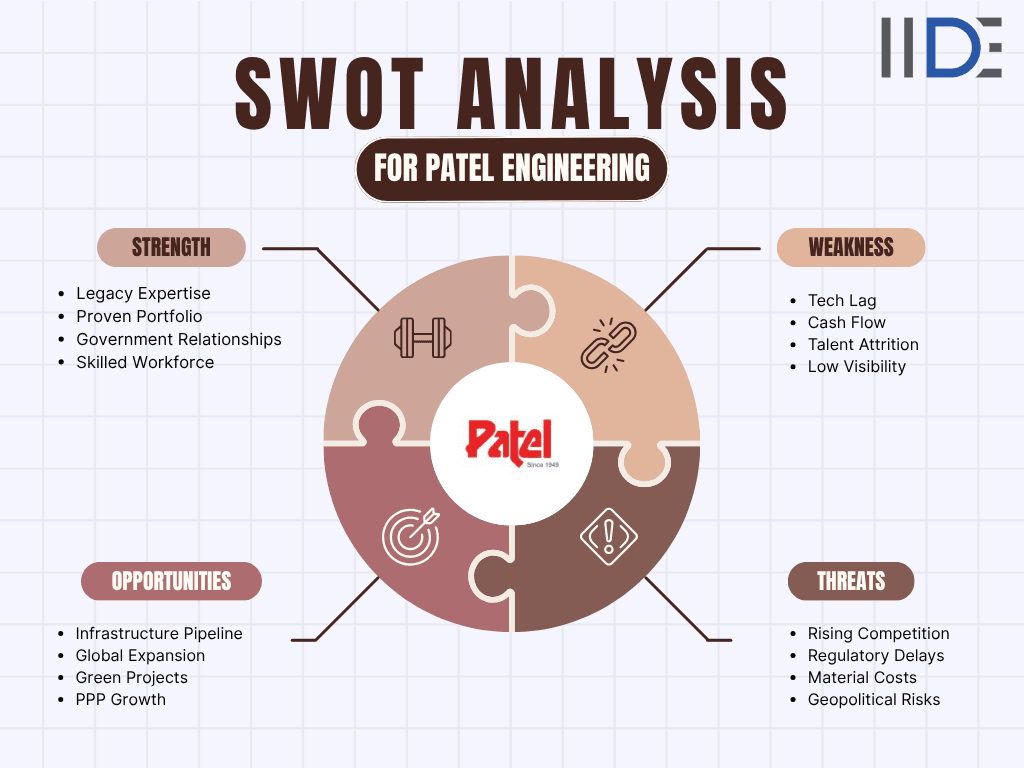
IIDE Student Takeaway, Recommendations & Conclusion for Patel Engineering in 2026 and Beyond
Patel Engineering's SWOT analysis reveals a company with genuinely rare capabilities but one standing at a crossroads. Its technical depth, institutional relationships, and execution record in complex terrain are advantages that cannot be replicated overnight.
Yet the infrastructure landscape is shifting in ways that reward speed, transparency, and technological sophistication alongside raw experience.
Core Tension: While Patel Engineering's legacy and specialised expertise secure its relevance today, the growing expectation for digitally enabled project delivery and faster execution cycles puts pressure on a company that has historically moved at the pace of its projects rather than the pace of the market.
Future Outlook: To remain a first-choice partner for India's most ambitious infrastructure programmes, Patel Engineering must invest in modernising its operational backbone, while continuing to leverage the domain knowledge and government trust it has earned over decades.
Sustainability will play an increasingly decisive role. As environmental clearances tighten and green infrastructure spending rises, companies that lead on eco-sensitive construction practices will have a structural advantage in project selection.
Recommendations:
- Accelerate Technology Adoption: Begin phased integration of BIM, AI-based project planning, and digital site monitoring across new tenders. Even early-stage implementation signals capability to government evaluators and improves margin management.
- Resolve Cash Flow Vulnerability: Explore structured PPP participation and project-specific financing arrangements to reduce over-reliance on government payment cycles. This would improve working capital and fund reinvestment.
- Build a Strong Employer Brand: Position Patel Engineering as the destination for engineers who want to work on technically extraordinary projects. A focused recruitment and retention campaign targeting mid-career infrastructure professionals can reduce attrition.
- Expand Strategically into New Markets: Rather than broad international diversification, identify two to three target markets in South Asia or East Africa where hydropower and tunneling expertise provide a clear competitive edge over local players.
- Lead on Green Infrastructure: Proactively adopt sustainable construction standards and pursue relevant certifications. As ESG criteria become embedded in government and multilateral procurement, this shift will become a qualifying requirement rather than a differentiator.
Patel Engineering in 2026 is a company with genuine strengths and genuine vulnerabilities that cannot be ignored.
The 75-year legacy, the proven track record across 250 plus projects, and the rare capability to execute in India's most technically demanding terrain are competitive advantages that most rivals cannot replicate quickly.
Deep relationships with NHPC and NHAI further strengthen its position in government tendering.
But slow technology adoption, irregular payment timelines, and limited brand visibility compared to L&T and Afcons are structural challenges that will compound if left unaddressed.
The opportunity ahead is real. India's National Infrastructure Pipeline, growing demand for hydropower and green infrastructure, geographic expansion into South Asia and Africa, and the adoption of PPP models all provide credible paths to long-term growth.
Capturing those opportunities will require faster technology adoption, deliberate geographic diversification, and the discipline to build a brand that attracts both talent and private sector clients.
For business students and strategists, that is the real lesson Patel Engineering teaches right now.
Want to Know Why 2,50,000+ Students Trust Us?
Dive into the numbers that make us the #1 choice for career success



MBA - Level
Post Graduate in Digital Marketing & Business Strategy

Best For
Fresh Graduates

Mode of Learning
On Campus (Mumbai & Delhi)

Starts from
Nov 27, 2026

Duration
11 Months

Live & Online
Advanced Online Digital Marketing Course
Best For
Working Professionals
Mode of Learning
Online
Starts from
Nov 2, 2026
Duration
4-6 Months

Offline
Top AI Courses to Make You Future Ready!
Best For
AI Enthusiasts
Mode of Learning
2–5 Month Program
Starts from
Nov 24, 2026
Duration
Flexiable

Offline
Undergraduate Program in Digital Business & Entrepreneurship
Best For
12th Passouts
Mode of Learning
On Campus (Mumbai)
Duration
3 Years
Offline
Degree In 2026 ≠ Enough Degree + Digital Skills = Future-Ready
Best For
12th Passouts
Mode of Learning
At IIDE Campus
Duration
3 Years
Recent Post
You May Also Like
Patel Engineering Limited is an Indian infrastructure company founded in 1949, specialising in hydropower projects, tunnels, dams, irrigation systems, and road construction.
70+ years of domain expertise, a strong hydropower and tunneling project track record, established government relationships, and a skilled technical workforce across complex terrain projects.
High debt levels, heavy dependence on government contracts, limited international footprint, and susceptibility to project delays caused by regulatory or environmental clearance hurdles.
Rising input costs (steel, cement), intense bidding competition for government tenders, infrastructure funding policy shifts, and execution challenges in remote geographies are the primary threats.
Patel Engineering has successfully delivered the Kishanganga Hydroelectric Project, several NHPC assignments, and major tunnel infrastructure projects cementing its reputation in India's critical infrastructure development.

Lead Trainer & Business Development Head at IIDE
Aditya Shastri leads the Business Development segment at IIDE and is a seasoned Content Marketing expert. With over a decade of experience, Aditya has trained more than 20,000 students and professionals in digital marketing, collaborating with prestigious institutions and corporations such as Jet Airways, Godrej Professionals, Pfizer, Mahindra Group, Publicis Worldwide, and many others. His ability to simplify complex marketing concepts, combined with his engaging teaching style, has earned him widespread admiration from students and professionals alike.
Aditya has spearheaded IIDE’s B2B growth, forging partnerships with over 40 higher education institutions across India to upskill students in digital marketing and business skills. As a visiting faculty member at top institutions like IIT Bhilai, Mithibai College, Amity University, and SRCC, he continues to influence the next generation of marketers.
Apart from his marketing expertise, Aditya is also a spiritual speaker, often traveling internationally to share insights on spirituality. His unique blend of digital marketing proficiency and spiritual wisdom makes him a highly respected figure in both fields.