
Students Centric
Placements Report
Trackable results, real numbers
Reviews
Proven success, real voices
Trainers
Expert-led, Industry-Driven Training
Life at IIDE
Vibrant Spirit student life
Alumni
Successful Journeys, Inspiring Stories
Learning Centre
Webinars
Blogs
Case studies
Live, Interactive Masterclasses
Fresh Insights, quick reads
Real-life, Industry relevant
More
Hire from us
Hire Top Digital Marketing Talent
Work with us
Join Our Team, Make an Impact
Customised Training
Personalised digital marketing training for your company
Refer & earn
Simple, easy rewards
Contact us
Get the answers you need
About us
Know more about IIDE
Explore all course options

FOR FRESH GRADUATES
Post Graduation Program in Digital Marketing & Business Strategy- Ideal for Age: 20–25 Years

Can’t decide? Explore all our
Digital Marketing Courses
COMPARE ALL 3 PROGRAMSOnline & Offline
Explore Top AI CoursesIndustry-Aligned TRACKMost Popular
UG Program in Digital Business & Entrepreneurship- Ideal for 12th Pass out / FY Degree Student

PARTNER PROGRAMS






Can’t decide? Explore all
BBA In Digital Marketing Colleges
Orginally Written by Aditya Shastri
Updated on May 13, 2026
Share on:


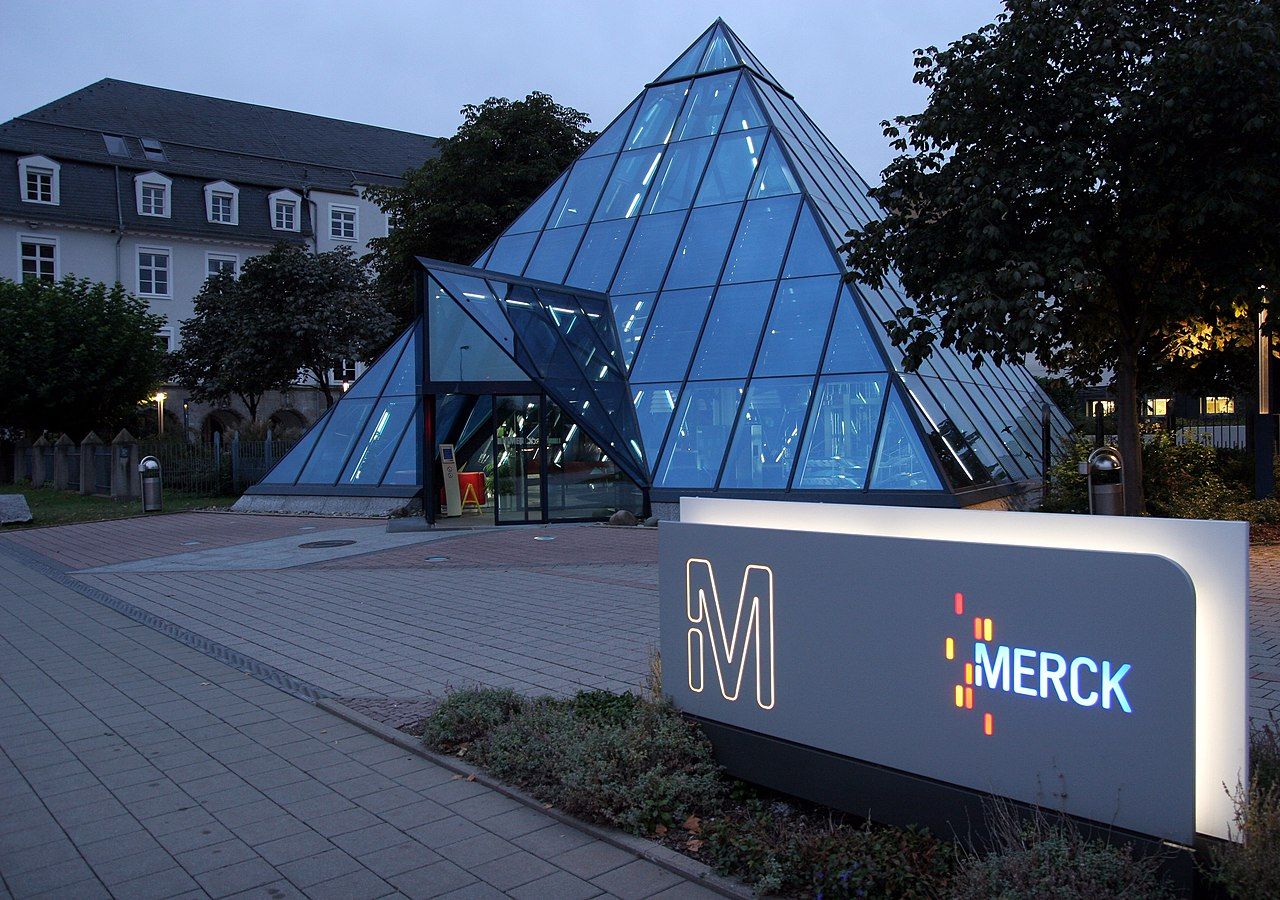
Merck & Co., Inc. is one of the most respected names in healthcare. From life-saving cancer treatments to global vaccine programs, the company has built trust that few pharmaceutical brands can match.
In 2026, the pharmaceutical industry is changing fast. AI is reshaping drug discovery, governments are tightening pricing rules, and competition is becoming more aggressive. That is exactly why Merck’s SWOT analysis matters today.
Before diving into the article, I would like to acknowledge that the research and initial analysis for this piece were conducted by Simran Sehgal, a current student of IIDE’s Post Graduation in Digital Marketing and Business Strategy, August Batch 2026.
If you found this helpful, feel free to reach out to Simran Sehgal to send a quick note of appreciation for her fantastic research, She will appreciate the kudos!
About Merck

Merck & Co., Inc. was founded in 1891 and is headquartered in Rahway, New Jersey.
For more than 130 years, the company has remained at the forefront of scientific innovation and global healthcare advancement.
Known for its positioning, "Inventing for Life," Merck focuses on oncology, vaccines, infectious diseases, cardiovascular care, and animal health.
The company's biggest commercial product remains Keytruda, the world's leading cancer immunotherapy. Keytruda sales reached $31.7 billion in full-year 2025, growing 7% year over year.
Full-year 2025 worldwide sales came in at $65.0 billion, reflecting 1% growth year over year. For 2026, Merck anticipates full-year worldwide sales between $65.5 billion and $67.0 billion.
Its key competitors include Pfizer Inc., Johnson and Johnson, Eli Lilly and Company, GSK plc, and Sanofi.
Why This SWOT Matters in 2026
The pharmaceutical industry is no longer predictable.
Earlier, companies could depend heavily on blockbuster drugs for years.
Today the market is shaped by:
- AI-led drug discovery
- Faster innovation cycles
- Government pricing pressure through the Inflation Reduction Act
- Patent expiry risks on major products
- Rising biotech and ADC competition
At the same time:
- Cancer treatment demand is growing globally
- New drug categories like ADCs are gaining momentum
- Emerging markets are expanding
- Strategic acquisitions can accelerate pipeline depth
That makes 2026 a defining year for Merck, with the 2028 Keytruda patent cliff now firmly in view.

Learn Digital Marketing for FREE

Learn Digital Marketing for FREE
SWOT Analysis of Merck
1. Strengths
If you had to describe Merck in one line, it would be this: it combines deep scientific credibility with serious commercial scale. Its biggest strength is an expanding pipeline backed by proven execution.
Key Strengths:
Keytruda dominance in oncology: Keytruda accounts for around 55% of the company's pharmaceutical sales and recorded $31.7 billion in 2025, growing 7% year over year.
Subcutaneous Keytruda approved: FDA approved Keytruda QLEX for subcutaneous use across all solid tumor indications, making it the first immune checkpoint inhibitor administrable in as little as one minute.
Strong new product launches: Winrevair generated $1.4 billion in 2025 sales while Capvaxive brought in $759 million, both representing meaningful new revenue contributors.
High R&D output: Merck announced positive late-stage results from 18 Phase 3 trials in 2025 and began enrolling patients in 21 new Phase 3 studies, with approximately 80 Phase 3 studies currently underway.
Smart acquisitions building future pipeline: Merck acquired Verona Pharma and Cidara Therapeutics in 2025, each worth approximately $10 billion, adding first-in-class assets in COPD and flu prevention.
$70 billion pipeline opportunity: Merck projects over $70 billion in non-risk-adjusted commercial opportunity from its current pipeline by the mid-2030s, more than double Keytruda's expected peak sales.
Strong animal health business: Animal Health sales reached $6.4 billion in 2025, growing 8% year over year.
Organisational restructuring for focus: Merck reorganised its Human Health segment into two focused units: an Oncology Business Unit and a Specialty, Pharma and Infectious Diseases Business Unit to sharpen commercial execution.
2. Weaknesses
Now this is where the challenge begins. Even strong pharmaceutical companies can become dangerously dependent on a single product. In 2026, that pressure is becoming impossible to ignore.
Key Weaknesses:
Extreme Keytruda dependence: Keytruda alone accounts for more than 50% of Merck's pharmaceutical sales. No single product should carry that much weight.
2028 patent cliff approaching: When Keytruda loses exclusivity in the U.S. in late 2028, Merck could lose up to 30% of total revenue almost overnight if biosimilar competition is aggressive.
Gardasil decline: Gardasil and Gardasil 9 sales fell 39% in full-year 2025 to $5.2 billion, driven by collapsed demand in China.
IRA pricing pressure: Merck's diabetes drug Januvia saw a 79% Medicare price cut in 2026 under the Inflation Reduction Act, with Keytruda expected to enter future negotiation rounds.
High R&D risk: Failed trials can destroy years of investment, and Merck is running approximately 80 active Phase 3 studies simultaneously.
Long product cycles: Drug approvals take years and involve significant uncertainty at every stage.
Regulatory complexity: Global pharma operations face constant and evolving scrutiny across multiple markets.
3. Opportunities
Here is where Merck's story gets genuinely compelling again. The company still has assets most challengers would envy: scale, engineering depth, global market presence, and a rapidly expanding pipeline backed by major acquisitions.
Key Opportunities:
ADC pipeline with Daiichi Sankyo: Merck and Daiichi Sankyo are co-developing three DXd antibody-drug conjugates targeting multiple cancer types, positioning Merck at the frontier of next-generation oncology beyond PD-1 inhibitors.
Subcutaneous Keytruda transition: If Merck successfully transitions 30 to 40% of Keytruda patients to the subcutaneous version by 2027, it will significantly extend commercial exclusivity and mitigate the 2028 patent cliff impact.
Winrevair blockbuster potential: Winrevair is reshaping the standard of care in pulmonary arterial hypertension, with a strong blockbuster revenue trajectory already well underway.
Cardiometabolic expansion: Merck sees over $20 billion in opportunity in the cardiometabolic area through its mid-2030s pipeline, including enlicitide decanoate for high cholesterol.
Infectious disease portfolio: Cidara's flu antiviral holds over $5 billion in prospective commercial opportunity in the next decade, adding meaningful diversification away from oncology.
AI in drug discovery: AI can reduce trial timelines and improve precision across Merck's broad pipeline, compressing time-to-market for future assets.
Emerging market expansion: Countries like India and China offer strong long-term growth potential across vaccines and oncology as healthcare access improves.
4. Threats
Not everything is in Merck's control. Pharma is one of the most regulated and competitive industries in the world, and 2026 has introduced new pressure from multiple directions simultaneously.
Key Threats:
Keytruda biosimilar competition: A growing pipeline of Keytruda biosimilars is already lining up to compete after exclusivity expires, creating structural revenue risk.
Direct oncology competition: Bristol Myers Squibb's Opdivo recorded $10.05 billion in 2025 sales while AstraZeneca's Imfinzi grew 28% to $6.06 billion, both competing directly with Keytruda across multiple cancer types.
IRA escalation risk: Keytruda is expected to enter the next round of Medicare price negotiations, which could institute price caps just before patent expiry.
Gardasil China recovery uncertain: Collapsed demand in China for Gardasil creates a revenue gap that has not yet been filled by alternative markets.
M&A execution risk: If late-stage assets from Prometheus, Acceleron, Verona, and Cidara fail to meet peak sales expectations, Merck will struggle to fill the Keytruda revenue gap.
Biotech disruption: Smaller, faster-moving innovators continue to advance in niche oncology and rare disease areas where Merck competes.
Economic uncertainty: Healthcare budgets can face pressure during downturns, impacting uptake of high-cost therapies and new product launches.
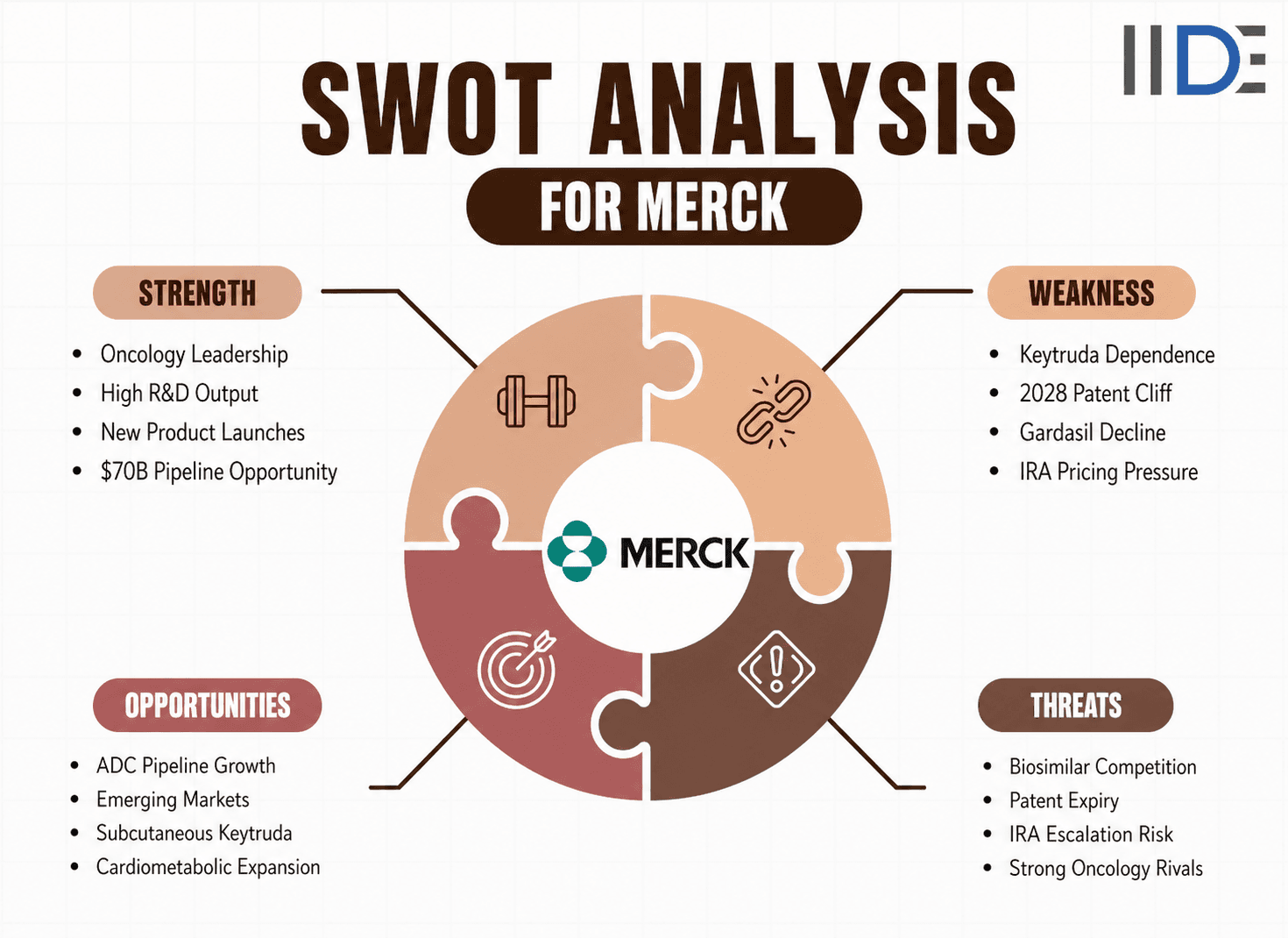
SWOT Analysis of Merck Summary Chart
Key Insight, Final Thought and Conclusion
2026 Insight
Merck and Co., Inc. is not chasing recognition. In global healthcare, the brand already carries deep credibility.
The real challenge in 2026 is proving that future growth will not depend on one blockbuster story whose patent clock is ticking loudly.
Merck's $70 billion pipeline opportunity projection for the mid-2030s is more than double the $35 billion peak sales estimate for Keytruda in 2028. That is a company that understands what is coming and is actively building the answer.
But investors, healthcare professionals, and markets want to see that pipeline convert into real commercial results, not just projections. Winrevair, Capvaxive, the ADC partnerships, and the subcutaneous Keytruda transition are the most visible proof points right now.
If Merck continues being defined mainly by today's biggest winner, it may remain strong in the short term.
But if Merck successfully demonstrates pipeline depth and multiple future growth engines across oncology, cardiometabolic, and infectious disease, it can lead for decades to come.
For a useful comparison on how diversified healthcare companies build resilience across categories, read the SWOT Analysis of Johnson & Johnson to understand how scale, portfolio breadth, and brand trust create long-term stability.
That is the difference between owning the present and securing the future.
Final Thought
Merck and Co., Inc. remains one of the strongest names in global healthcare. Its biggest strength is a proven commercial machine backed by a rapidly deepening pipeline, while its biggest risk remains overdependence on a single product that loses exclusivity in 2028.
Merck is slashing $3 billion in costs by end of 2027 while simultaneously funding acquisitions and running 80 active Phase 3 trials. That level of simultaneous execution is either a sign of confidence or overextension.
Final Question: Can Merck successfully convert its $70 billion pipeline opportunity into real revenue before Keytruda's exclusivity window closes?
Want to Know Why 2,50,000+ Students Trust Us?
Dive into the numbers that make us the #1 choice for career success



MBA - Level
Post Graduate in Digital Marketing & Business Strategy

Best For
Fresh Graduates

Mode of Learning
On Campus (Mumbai & Delhi)

Starts from
Oct 1, 2026

Duration
11 Months

Live & Online
Advanced Online Digital Marketing Course
Best For
Working Professionals
Mode of Learning
Online
Starts from
Aug 7, 2026
Duration
4-6 Months

Online
Professional Certification in AI Strategy
Best For
AI Enthusiasts
Mode of Learning
Online
Starts from
Sep 8, 2026
Duration
5 Months

On Campus
Advanced Certification in Artificial Intelligence
Best For
AI Enthusiasts
Mode of Learning
On Campus (Mumbai)
Starts from
Sep 1, 2026
Duration
3 Months

Online or Offline
Top AI Courses to Make You Future Ready!
Best For
AI Enthusiasts
Mode of Learning
2–5 Month Program
Starts from
Sep 8, 2026
Duration
Flexiable
Offline
Undergraduate Program in Digital Business & Entrepreneurship
Best For
12th Passouts
Mode of Learning
On Campus (Mumbai)
Starts from
Aug 19, 2026
Duration
3 Years
Offline
Degree In 2026 ≠ Enough Degree + Digital Skills = Future-Ready
Best For
12th Passouts
Mode of Learning
At IIDE Campus
Starts from
Aug 6, 2026
Duration
3 Years
Recent Post
The standard SWOT model includes Strengths, Weaknesses, Opportunities, and Threats. Some experts add a fifth point called Strategy or Action Plan after the analysis. This focuses on using insights to improve decisions and future planning. It helps businesses convert analysis into practical growth steps.
Merck’s marketing strategy focuses on scientific credibility, healthcare trust, and innovation leadership. The company promotes strong research capabilities, breakthrough medicines, and long-term healthcare impact. It also builds trust with doctors, regulators, hospitals, and investors globally. In recent years, communicating pipeline depth beyond Keytruda has become increasingly important.
The main SWOT analysis is a strategic framework used to evaluate a company or brand. It studies internal strengths and weaknesses first. Then it examines external opportunities and threats in the market. This helps organisations make smarter long-term business decisions.
The 3 C’s are not part of SWOT directly but are another business framework. They stand for Company, Customers, and Competitors. Many organisations use both SWOT and the 3 C’s together for stronger planning. This gives a broader understanding of strategy and market position.
Merck is considered strong because of its long history of medical innovation and global trust. The company has built leadership in oncology, vaccines, and life sciences. Its strong financial scale also supports research and acquisitions. This combination gives Merck a solid competitive advantage.
Patent expiries can reduce revenue from major medicines over time. Pricing regulations may pressure margins in global markets. Failed clinical trials can delay or cancel future growth products. Rising competition from pharma and biotech rivals can also slow expansion.
The future outlook for Merck remains positive if innovation continues strongly. Growth can come from oncology, vaccines, immunology, and new pipeline launches. AI-driven drug discovery may also improve future efficiency. Long-term success depends on replacing blockbuster dependence with diversified growth.

Lead Trainer & Business Development Head at IIDE
Aditya Shastri leads the Business Development segment at IIDE and is a seasoned Content Marketing expert. With over a decade of experience, Aditya has trained more than 20,000 students and professionals in digital marketing, collaborating with prestigious institutions and corporations such as Jet Airways, Godrej Professionals, Pfizer, Mahindra Group, Publicis Worldwide, and many others. His ability to simplify complex marketing concepts, combined with his engaging teaching style, has earned him widespread admiration from students and professionals alike.
Aditya has spearheaded IIDE’s B2B growth, forging partnerships with over 40 higher education institutions across India to upskill students in digital marketing and business skills. As a visiting faculty member at top institutions like IIT Bhilai, Mithibai College, Amity University, and SRCC, he continues to influence the next generation of marketers.
Apart from his marketing expertise, Aditya is also a spiritual speaker, often traveling internationally to share insights on spirituality. His unique blend of digital marketing proficiency and spiritual wisdom makes him a highly respected figure in both fields.