
Students Centric
Placements Report
Trackable results, real numbers
Reviews
Proven success, real voices
Trainers
Expert-led, Industry-Driven Training
Life at IIDE
Vibrant Spirit student life
Alumni
Successful Journeys, Inspiring Stories
Learning Centre
Webinars
Blogs
Case studies
Live, Interactive Masterclasses
Fresh Insights, quick reads
Real-life, Industry relevant
More
Hire from us
Hire Top Digital Marketing Talent
Work with us
Join Our Team, Make an Impact
Customised Training
Personalised digital marketing training for your company
Refer & earn
Simple, easy rewards
Contact us
Get the answers you need
About us
Know more about IIDE
Explore all course options

FOR FRESH GRADUATES
Post Graduation Program in Digital Marketing & Business Strategy- Ideal for Age: 20–25 Years

Can’t decide? Explore all our
Digital Marketing Courses
COMPARE BOTH OUR PROGRAMSOffline
Offline AI Courses with Dual CertificationsIndustry-Aligned TRACKMost Popular
UG Program in Digital Business & Entrepreneurship- Ideal for 12th Pass out / FY Degree Student

PARTNER PROGRAMS






Can’t decide? Explore all
BBA In Digital Marketing Colleges
Orginally Written by Aditya Shastri
Updated on Feb 18, 2026
Share on:


Lush is a UK‑based cosmetics retailer known for fresh, handmade, cruelty‑free bath and beauty products and a bold ethical brand voice. In its FY24 year, the group generated about £690.1 million in turnover, with roughly 869 shops and 13,600 employees across 27 operating countries and brand presence in 50+ markets. In September 2025, it closed every UK shop to protest Gaza conditions, forfeiting GBP 300,000.
This Lush SWOT Analysis gives entrepreneurs and business students the framework to understand how ethical principles create both extraordinary brand loyalty and material business risk in 2026.
About Lush
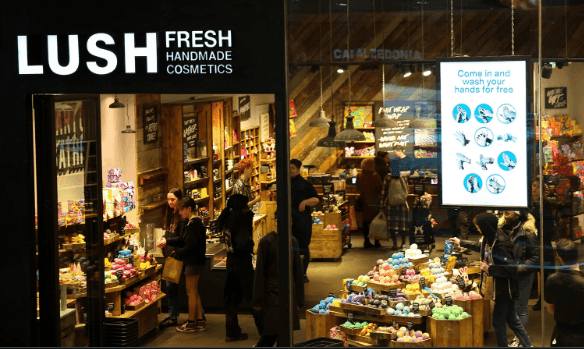
Founded in 1995 in Poole, Dorset by Mark Constantine, Mo Constantine, and five co-founders, Lush has grown from a single shop into a global ethical beauty movement. Its "Fresh Handmade Cosmetics" slogan reflects commitment to handmade products, minimal packaging, and zero animal testing.
In 2026, with 869 stores in 51 countries, 13,343 employees, and GBP 675m revenues, the swot analysis of lush makes the swot lush framework essential for business students. SWOT stands for Strengths, Weaknesses, Opportunities, and Threats.
Lush Company Overview 2026
| Parameter | Details |
|---|---|
| Official Company Name | Lush Cosmetics Limited |
| Founded Year | 1995 |
| Founders | Mark Constantine, Mo Constantine, Liz Weir, and four co-founders |
| Headquarters | Poole, Dorset, United Kingdom |
| Website | www.lush.com |
| Industry | Cosmetics, Personal Care, Ethical Beauty |
| Key Geographies Served | UK, Europe, North America, Asia Pacific, Latin America; operations in 27 countries with brand presence in 50+ markets |
| Products | Bath bombs, soaps, shampoo bars, skincare, haircare, body care, fragrances, spa treatments |
| Revenue (FY2024, ended June 30, 2024) | GBP 690 million total group turnover; UK and North America are the largest contributors |
| Operating Profit (FY2024) | Not separately disclosed; company moved from net cash of GBP 33.7m in FY2023 to net debt of GBP 11.7m in FY2024 |
| Employees (2025) | Approximately 13,600 Lush Group colleagues globally |
| Store Count | 869 stores worldwide as of FY2024; around 100+ stores in the UK and Ireland |
| Ownership Structure | Privately held; 10% employee-owned through an Employee Benefit Trust established in 2017 |
| Main Competitors | The Body Shop, Aveda, L’Occitane, Rituals, Aesop, and other independent clean beauty brands |

Is Digital Marketing the Right Career for You?
Find out in a free 45-min masterclass · Career paths, roles and growth explained · By Karan Shah, Founder & CEO, IIDE


Is Digital Marketing the Right Career for You?
Find out in a free 45-min masterclass · Career paths, roles and growth explained · By Karan Shah, Founder & CEO, IIDE
SWOT Analysis of Lush
In 2026, Lush sits at a fascinating strategic crossroads. The company's lush swot analysis reveals a brand with unparalleled ethical positioning, fiercely loyal customers, and a business model built entirely on principles rather than paid advertising.
Yet it simultaneously faces one of its most financially challenging periods: FY2024 results show a swing from GBP 33.7m net cash to GBP 11.7m net debt, driven by a GBP 34.8m capital expenditure programme and negative operating cash flow.
The brand that closed all UK stores for a day in September 2025 to protest Gaza humanitarian conditions, forfeiting an estimated GBP 300,000 in revenue, must now answer a defining question: can radical activism and sustained profitability coexist?
Lush's Strengths: The Brand's Ethical Superpowers in 2026
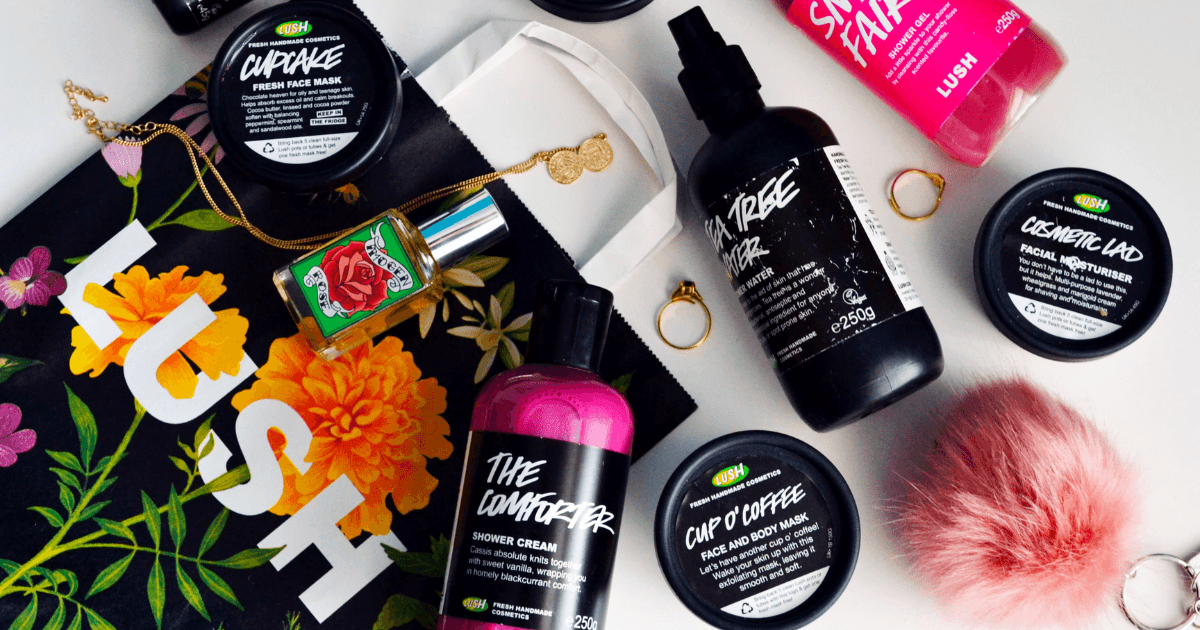
Understanding lush strengths and weaknesses requires starting with the genuinely radical positioning that has made Lush one of the most distinctive brands in global beauty. These are not superficial differentiators; they are structural moats built over three decades of uncompromising commitment to ethical principles.
1. Absolute Ethical Leadership and Brand Authenticity
Lush is the only major cosmetics brand in the world with a 100% vegetarian product range, 95% of which is vegan, zero animal testing across the entire supply chain, and a transparent stance against palm oil that predates industry greenwashing by more than a decade.
In September 2025, it became the first and only global beauty company to close all stores, e-commerce, and factories in a single market (the UK) to protest a humanitarian crisis, forfeiting an estimated GBP 300,000 in revenue.
This level of principles-first decision-making creates extraordinary brand equity with ethically-minded consumers who view Lush not as a cosmetics retailer but as a values-driven movement they actively support.
2. Zero Paid Advertising Model and Word-of-Mouth Dominance
Lush has never spent a single pound on traditional advertising, paid influencer partnerships, or social media advertising. In November 2021, it voluntarily closed its Facebook, Instagram, Snapchat, and TikTok accounts globally, citing mental health and body image concerns, and has never reopened them.
Instead, the company relies entirely on product scent, in-store experience, customer word-of-mouth, and earned media from its political activism to drive brand awareness.
In FY2024, despite zero digital advertising spend, the company achieved 74% brand awareness in the UK and maintained strong sales across all channels, proving that authentic brand building can compete with billion-pound marketing budgets in the beauty category.
3. Handmade Manufacturing and Vertical Integration
Lush handmakes every product it sells in manufacturing facilities in the UK, Canada, Croatia, Japan, Australia, and Poland, maintaining complete control over ingredient sourcing, formulation, production quality, and supply chain ethics.
This vertical integration allows Lush to move from ingredient to finished product in as little as 10 days, enabling rapid response to demand shifts and maintaining the "fresh" positioning that underpins its brand promise.
The company's ability to manufacture at scale while retaining handmade authenticity is a genuine operational differentiator that competitors with contract manufacturing models cannot replicate.
4. Employee Ownership and Cultural Cohesion
Since 2017, 10% of Lush's shares have been held in an Employee Benefit Trust on behalf of all staff, with a long-term commitment to increase employee ownership significantly.
This ownership structure, combined with Lush's progressive workplace policies including living wages, menstrual leave, and strong diversity and inclusion programmes, creates exceptionally low turnover in retail (where industry churn typically exceeds 60% annually) and a workforce that genuinely believes in the company's mission.
Employee ownership also insulates Lush from the short-term profit pressures that plague public beauty companies and allows it to make decisions like the September 2025 store closures that would be impossible for investor-owned competitors.
5. Iconic Product Innovation and Naked Packaging Leadership
Lush invented the fizzing bath bomb in 1989 (before the company was even formally founded) and pioneered solid shampoo bars, shower jellies, and naked (package-free) products that have now been copied industry-wide.
In FY2024, more than 40% of Lush's product range was sold without any packaging whatsoever, eliminating millions of plastic containers from the waste stream and creating a visual in-store differentiation that is immediately recognisable.
The company's commitment to minimal packaging also creates material cost advantages: while competitors spend 15-20% of product cost on packaging, Lush's naked products carry zero packaging cost, improving margin on the company's highest-volume lines.
6. Charitable Giving and Grassroots Movement Integration
In FY2024, Lush raised GBP 6.6 million and donated GBP 5.7 million to charities and grassroots organisations working on environmental protection, human rights, and animal welfare, maintaining one of the highest charitable giving ratios in the entire cosmetics industry.
This is not CSR theatre; it is a core business model feature where customers knowingly purchase products like Charity Pot hand cream understanding that 100% of the purchase price (minus VAT) goes directly to small activist organisations.
This creates a community-building flywheel where Lush customers view their purchases as activism, deepening loyalty beyond transactional product satisfaction.
As documented in the SWOT Analysis of The Body Shop, ethical positioning has historically been a durable competitive advantage in beauty, but Lush has taken this to a level of operational integration that its founder competitor never achieved.
Lush's Weaknesses: The Struggles Behind the Activism
Any honest assessment of lush strengths and weaknesses must confront the material business vulnerabilities that Lush's uncompromising ethical stance and activist positioning have created, particularly in the challenging macroeconomic environment of 2025 and 2026.
1. Financial Deterioration and Cash Flow Pressure
Lush's FY2024 financial results reveal a concerning swing from a net cash position of GBP 33.7 million in FY2023 to net debt of GBP 11.7 million in FY2024, a negative movement of GBP 45.4 million driven by GBP 34.8 million in capital expenditure and negative operating cash flow.
This debt was funded through borrowings from Cosmetic Warriors, a related party, suggesting that the core operating business is not generating sufficient cash to fund its ambitious store expansion programme.
While capital investment in physical retail demonstrates conviction in the long-term viability of experiential stores, the timing is concerning: investing heavily in retail property at a moment when consumer discretionary spend is under sustained pressure creates material downside risk if revenues do not recover as planned.
2. Political Activism Creating Boycott and Reputational Risk
Lush's September 2025 decision to close all UK stores, e-commerce, and factories for a full day to protest Gaza humanitarian conditions, while morally courageous, created immediate boycott calls from pro-Israel groups and Jewish community organisations that accused the company of antisemitism.
This follows a pattern of controversy: in 2011, Jewish groups protested Lush's partnership with OneWorld and War on Want over Israel-Palestine issues; in 2023, a Dublin store displayed a "Boycott Israel" sign that was removed after community backlash; in 2024, employees at a New York store allegedly shouted antisemitic insults at Jewish protesters, triggering an internal investigation.
While Lush's core customer base applauds its activism, the company is systematically alienating entire demographic and religious communities who might otherwise appreciate its ethical beauty positioning, creating a self-imposed ceiling on total addressable market.
3. Store Footprint Decline and Retail Economics Pressure
Despite opening 19 new shops and completing 14 relocations in FY2024, Lush's global store count has declined from a peak of approximately 950 stores in 2019 to 869 stores in 2024, a net reduction of more than 80 locations over five years.
This contraction is particularly concerning given that retail sales still accounted for approximately 85% of total turnover in FY2023, making Lush far more dependent on physical stores than digitally-native beauty brands or omnichannel retailers like Sephora, whose SWOT Analysis of Sephora shows a more balanced channel mix.
Lush's FY2024 audited accounts acknowledge that June 2024 was the first month to show positive year-on-year sales growth (plus 3.2%), suggesting that the business has been contracting or flat for the preceding 11 months, a deeply concerning trajectory in a consumer category that should be benefiting from the clean beauty mega-trend.
4. Social Media Absence and Digital Discovery Disadvantage
Lush's principled decision to close all major social media accounts in November 2021 and never return creates a structural disadvantage in an industry where product discovery, viral trends, and influencer recommendations drive the majority of new customer acquisition, particularly among Gen Z consumers.
While Lush's FY2024 accounts note that "customers recognise our friendly service, our values, our famous scents," the company is effectively invisible on the platforms where beauty consumers spend the majority of their time discovering new products.
Competitors like Glossier, Drunk Elephant, and The Ordinary have built billion-pound valuations almost entirely through social-first strategies, while Lush is fighting for awareness through word-of-mouth alone.
5. Geographic Revenue Concentration and Market Maturity
The UK remains Lush's largest single market and accounted for the largest portion of group revenues in FY2023, despite the UK beauty market growing at less than 2% annually and facing sustained consumer spending pressure from inflation, energy costs, and stagnant wage growth.
North America, Lush's second-largest market, showed signs of strain with the company noting in its FY2024 accounts that "positive growth in our North American market" in June 2024 was "a pleasing way to close" the year, implying that North America had been contracting in preceding months.
Overreliance on two mature, slow-growth markets creates structural revenue headwinds that cannot easily be offset by activism-driven brand love.
6. Ingredient Cost Inflation and Margin Compression
Lush's FY2024 accounts explicitly acknowledge that "over the past two years, global political and economic challenges have driven unprecedented levels of cost inflation. Understandably, the business has prioritised mitigating significant increases in raw materials, wages, and energy costs."
As a manufacturer that buys organic fruits, vegetables, essential oils, and fair-trade butters at premium prices, Lush has higher baseline ingredient costs than competitors using synthetic alternatives, and these costs are structurally more volatile and less hedgeable.
The company cannot easily pass through cost inflation via price increases without risking volume loss in a value-conscious consumer environment, creating sustained margin pressure that the FY2024 cash flow results clearly reflect.
Lush's Opportunities: Future Growth Vectors
Examining lush strengths and weaknesses reveals several compelling growth opportunities that align precisely with Lush's existing capabilities and the accelerating consumer mega-trends reshaping global beauty in 2026.
1. Clean Beauty Boom and Mainstream Ingredient Consciousness
The global clean beauty market is projected to reach USD 22 billion by 2030, growing at a compound annual rate exceeding 9%, driven by consumers increasingly scrutinising ingredient lists, demanding transparency, and rejecting synthetic chemicals.
Lush, which has been formulating with organic ingredients, minimal preservatives, and zero microplastics since 1995, is perfectly positioned to capture this wave without needing to reformulate, rebrand, or greenwash its existing product range.
As mainstream beauty giants scramble to launch "clean" sub-brands with questionable credentials, Lush can authentically position itself as the original clean beauty pioneer, a claim no competitor can credibly make. The rising consumer willingness to pay premium prices for verified clean formulations directly benefits Lush's margin structure.
2. Gen Z Values Alignment and Purpose-Driven Purchasing
Seventy-three per cent of Gen Z consumers state they are willing to pay more for sustainable products, and 62% prefer to buy from brands with demonstrated social and environmental commitments. Lush's radical activism, which older demographics sometimes view as polarising, resonates extraordinarily well with Gen Z buyers who demand that brands take clear stands on social issues and back those stands with operational action, not just marketing campaigns.
The September 2025 store closures, while controversial with some segments, generated massive positive viral amplification on TikTok and Instagram (despite Lush not having active accounts on either platform) where young consumers celebrated the brand's courage.
As Gen Z enters peak spending years through the late 2020s, Lush is positioned as one of the few beauty brands this cohort views as genuinely authentic.
3. Refill and Circular Economy Infrastructure
Lush has been piloting refill stations and return-to-recycle programmes for black pots (its signature product containers) since the early 2000s, but the circular economy infrastructure required to scale these programmes is only now becoming economically viable as consumer behaviour shifts and municipal recycling systems improve.
In FY2024, Lush invested heavily in in-store refill infrastructure and expanded its "Bring It Back" scheme where customers return five black pots to receive a free fresh face mask.
As EU regulations increasingly mandate producer responsibility for packaging waste and consumers actively seek refill options to reduce single-use plastic, Lush's three-decade head start in circular design becomes a genuine competitive moat.
The company can expand refill offerings across shampoo, conditioner, body wash, and lotions with minimal incremental investment.
4. Asia Pacific Expansion and Emerging Market Penetration
Despite operating globally for nearly 30 years, Lush remains surprisingly underpenetrated in high-growth Asian markets including India, Indonesia, Southeast Asia, and China, where rising middle-class consumers are rapidly adopting premium beauty routines and demonstrating strong preference for brands with sustainability credentials.
In December 2025, Lush launched in India with a full range of ethically sourced, cruelty-free products, capitalising on a market projected to grow at 9.2% annually through 2030.
Japan, where Lush already operates manufacturing facilities and has strong brand awareness, provides a template for successful Asia market entry: deep cultural adaptation, local ingredient sourcing, and retail locations designed as experiential destinations.
The opportunity to replicate the Japan playbook across Southeast Asia, India, and Australia represents a multi-hundred-million-pound revenue runway with materially higher growth rates than mature Western markets.
5. Spa and Wellness Vertical Expansion
Lush operates 19 Lush Spas in select locations across the UK, Spain, UAE, Canada, the US, Japan, and South Korea, offering immersive wellness treatments that command GBP 200 to GBP 500 per session and create extraordinarily high customer lifetime value.
The spa channel, while still a small percentage of total revenues, operates at significantly higher margins than retail product sales and creates a halo effect that drives customers into stores to purchase at-home versions of spa products.
The wellness tourism boom, particularly in high-income markets, creates runway to expand the spa footprint significantly over the next five years, particularly in major gateway cities where Lush already has flagship retail locations.
6. B2B and Hospitality Channel Partnership
Lush has historically resisted wholesale distribution to maintain brand control, but there is a significant opportunity to selectively partner with luxury hotels, resorts, and wellness retreats to provide branded bath amenities and in-room products that introduce new customers to the brand in premium experiential contexts.
High-end hospitality groups including Soho House, Six Senses, and Aman Resorts are actively seeking sustainable bath amenity partners to replace single-use plastic miniatures, and Lush's naked product format and handmade positioning align perfectly with luxury hospitality sustainability goals.
Hospitality partnerships could generate GBP 10 to GBP 20 million in incremental revenue at minimal customer acquisition cost.
Lush's Threats: Navigating the Headwinds
The swot lush framework cannot be complete without acknowledging the external forces that could materially undermine Lush's business model and brand positioning through 2026 and beyond.
1. Sustained Consumer Boycotts from Political Activism
Lush's September 2025 Gaza protest store closures have triggered organised boycott campaigns from pro-Israel advocacy groups, with social media hashtags calling for consumers to switch to competitors and anecdotal reports of store foot traffic declines in certain markets.
Unlike product quality issues or pricing controversies that fade quickly, politically motivated boycotts can persist for years because they are rooted in identity and values rather than transactional dissatisfaction. The risk for Lush is that its activism, while galvanising its core customer base, alienates a sufficiently large segment of the market that growth stalls even as clean beauty tailwinds accelerate.
The company cannot easily reverse course without appearing cynical, creating a strategic trap where doubling down on activism compounds boycott risk while moderating activism triggers accusations of abandoning principles.
2. Ingredient Cost Inflation and Supply Chain Fragility
Lush's commitment to organic, fair-trade, and ethically sourced ingredients creates structural exposure to agricultural commodity price volatility, climate-driven harvest failures, and geopolitical disruptions in key sourcing regions. The FY2024 accounts explicitly note that "unprecedented levels of cost inflation" in raw materials have compressed margins, and there is no indication that these pressures are abating.
Essential oils from Turkey, fair-trade cocoa butter from Ghana, organic fruits from Mediterranean suppliers, and flower absolutes from Grasse, France are all subject to weather events, currency fluctuations, and political instability that Lush cannot hedge through futures contracts or long-term supply agreements.
As climate change intensifies and geopolitical fragmentation accelerates, Lush's supply chain fragility will likely worsen, making consistent product availability and predictable pricing increasingly difficult.
3. Competitor Scale and Private Equity Beauty Consolidation
The global beauty industry is undergoing massive consolidation as private equity firms including TPG, KKR, and Carlyle acquire independent clean beauty brands and roll them up into multi-brand platforms with shared infrastructure, supply chain scale, and marketing budgets that dwarf Lush's capabilities.
Competitors like Drunk Elephant (acquired by Shiseido for USD 845 million), Tatcha (acquired by Unilever for USD 500 million), and Youth to the People (acquired by L'Oreal) now have billion-pound parent company resources to invest in R&D, retail expansion, and digital marketing while maintaining indie brand aesthetics.
Lush, as a privately held company with GBP 11.7 million in net debt and negative operating cash flow, cannot match this investment pace, creating a widening capability gap that threatens its ability to compete for shelf space, talent, and consumer attention.
4. Recession-Driven Discretionary Spend Cuts
Beauty is traditionally a resilient category in recessions due to the "lipstick effect" where consumers maintain small-luxury purchases even as they cut back on bigger-ticket items, but Lush's premium pricing (GBP 10 to GBP 30 per product) and lack of mass-market value options make it vulnerable to trading down.
In a prolonged recession or stagflation scenario where UK and European consumers face sustained real wage declines, Lush customers may shift to Superdrug own-label, Boots Botanics, or discount retailers offering beauty at 50% lower price points.
Lush's lack of a value range or smaller-format trial sizes limits its ability to retain price-sensitive customers during downturns, creating structural revenue vulnerability that the FY2024 results have already begun to reveal.
5. Regulatory Compliance and Reformulation Mandates
The EU's Cosmetics Regulation, UK post-Brexit divergence, California Proposition 65, and similar regional regulatory regimes create an increasingly complex compliance landscape that requires continuous product reformulation, safety testing, and labelling updates.
Lush's handmade, minimal-preservative products are particularly vulnerable to microbiological safety requirements that may force the introduction of synthetic preservatives the brand has historically avoided, threatening its clean positioning.
Additionally, Lush's refusal to use REACH-compliant suppliers for certain ingredient families (because REACH mandates animal testing for some chemicals) creates sourcing constraints that competitors using synthetic alternatives do not face.
As regulations tighten globally, Lush may be forced to choose between reformulating away from its founding principles or exiting certain markets entirely.
6. Retail Real Estate Obsolescence and Lease Liability
Lush's FY2024 capital investment of GBP 34.8 million was overwhelmingly allocated to its store estate, with 70% of spend going to new stores, relocations, and major refits.
This retail-heavy investment thesis assumes that experiential physical retail remains a viable growth channel through the 2030s, a bet that is far from certain as Gen Z shopping behaviour skews increasingly digital and mall foot traffic continues secular decline.
Lush holds long-term leases on many flagship locations in premium shopping districts, creating fixed-cost obligations that become extremely burdensome if store productivity declines.
The company's FY2024 accounts show positive sales growth of only 3.2% in June 2024 after many months of flat-to-negative performance, suggesting that the retail productivity assumption underpinning GBP 34.8 million in capex may be optimistic.
Marketing strategy of Lush delves into how ethical sourcing and bold branding amplify its niche appeal.
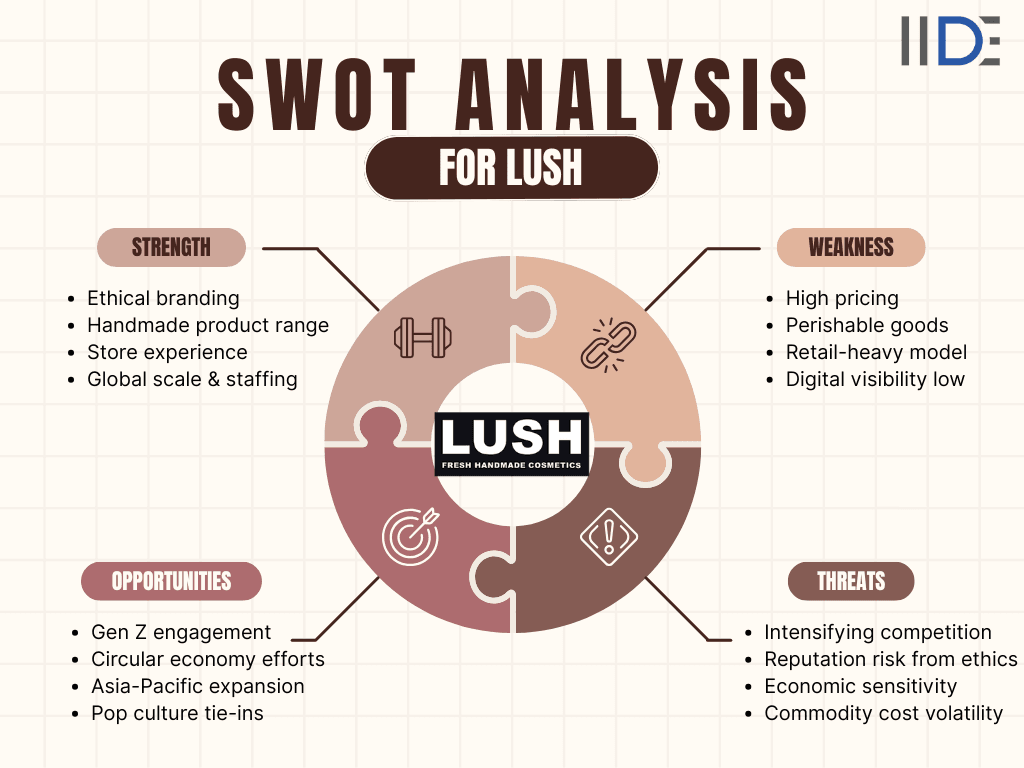
SWOT Summary Table
IIDE Student Takeaway, Conclusion & Recommendations
For business students and aspiring strategists, this lush swot analysis reveals a brand at the frontier of values-driven commerce. Lush's strengths are genuine: ethical positioning predating greenwashing by decades, zero paid advertising, vertical manufacturing, and employee ownership creating workforce alignment.
Yet the lush strengths and weaknesses framework exposes real vulnerabilities: GBP 11.7m net debt in FY2024, boycott risk from activism, store contraction, and voluntary social media absence surrendering digital discovery.
The central tension in 2026 is stark: Lush must prove radical activism can coexist with sustained profitability, or risk becoming a cautionary tale of principles without pragmatism.
Five actionable priorities:
- Segment activism carefully, identifying which causes resonate versus polarise, then allocate risk accordingly. Future activism must balance principle with commercial consequence.
- Accelerate digital commerce to offset store pressure, focusing on live shopping, virtual consultations, and content commerce recreating sensory experience without social media.
- Launch tiered pricing including GBP 3 to GBP 5 trial sizes to retain customers during downturns and lower barriers for younger discoverers.
- Scale Asia Pacific using India as template, targeting markets where ethics differentiate sharply and retail economics remain favourable.
- Monetise the activist community through subscriptions, exclusive access, and co-creation turning customers into ambassadors compensating for social media absence.
Looking beyond 2026, the comprehensive swot lush playbook demonstrates purpose-driven brands can build extraordinary loyalty, but purpose cannot substitute for financial discipline. Lush has ethical credibility to lead clean beauty for the next decade, provided it resolves activism-versus-growth with greater sophistication.
Want to Know Why 5,00,000+ Students Trust Us?
Dive into the numbers that make us the #1 choice for career success



MBA - Level
Post Graduate in Digital Marketing & Business Strategy

Best For
Fresh Graduates

Mode of Learning
On Campus (Mumbai & Delhi)

Starts from
Nov 27, 2026

Duration
11 Months

Live & Online
Advanced Online Digital Marketing Course
Best For
Working Professionals
Mode of Learning
Online
Starts from
Oct 7, 2026
Duration
4-6 Months

Offline
Top AI Courses to Make You Future Ready!
Best For
AI Enthusiasts
Mode of Learning
2–5 Month Program
Starts from
Nov 23, 2026
Duration
Flexiable

Offline
Undergraduate Program in Digital Business & Entrepreneurship
Best For
12th Passouts
Mode of Learning
On Campus (Mumbai)
Starts from
-
Duration
3 Years

Offline
Degree In 2026 ≠ Enough Degree + Digital Skills = Future-Ready
Best For
12th Passouts
Mode of Learning
At IIDE Campus
Starts from
-
Duration
3 Years
Recent Post
More SWOT Analysis
Lush offers a wide range of handmade cosmetics, including bath bombs, soaps, skincare, haircare, shower gels, lotions, perfumes, and gift sets. They focus on using natural ingredients and cruelty-free practices.
Many of Lush’s products are vegan, and they have a large selection of vegan-friendly items. Each product label clearly indicates whether it is suitable for vegans.
Lush is committed to reducing packaging waste. They offer many products in minimal or recyclable packaging and have a "naked" product line where products are sold without packaging. They also encourage customers to bring in used containers for recycling.
Lush products are made with natural ingredients, and many are designed for sensitive skin. However, as with any cosmetic product, it’s recommended to do a patch test before full use, especially for those with allergies or sensitive skin.
Yes, Lush offers a variety of products suitable for men, including skincare, haircare, and shaving products, along with many unisex options that can be enjoyed by anyone.

Lead Trainer & Business Development Head at IIDE
Aditya Shastri leads the Business Development segment at IIDE and is a seasoned Content Marketing expert. With over a decade of experience, Aditya has trained more than 20,000 students and professionals in digital marketing, collaborating with prestigious institutions and corporations such as Jet Airways, Godrej Professionals, Pfizer, Mahindra Group, Publicis Worldwide, and many others. His ability to simplify complex marketing concepts, combined with his engaging teaching style, has earned him widespread admiration from students and professionals alike.
Aditya has spearheaded IIDE’s B2B growth, forging partnerships with over 40 higher education institutions across India to upskill students in digital marketing and business skills. As a visiting faculty member at top institutions like IIT Bhilai, Mithibai College, Amity University, and SRCC, he continues to influence the next generation of marketers.
Apart from his marketing expertise, Aditya is also a spiritual speaker, often traveling internationally to share insights on spirituality. His unique blend of digital marketing proficiency and spiritual wisdom makes him a highly respected figure in both fields.