
Students Centric
Placements Report
Trackable results, real numbers
Reviews
Proven success, real voices
Trainers
Expert-led, Industry-Driven Training
Life at IIDE
Vibrant Spirit student life
Alumni
Successful Journeys, Inspiring Stories
Learning Centre
Webinars
Blogs
Case studies
Live, Interactive Masterclasses
Fresh Insights, quick reads
Real-life, Industry relevant
More
Hire from us
Hire Top Digital Marketing Talent
Work with us
Join Our Team, Make an Impact
Customised Training
Personalised digital marketing training for your company
Refer & earn
Simple, easy rewards
Contact us
Get the answers you need
About us
Know more about IIDE
Explore all course options

FOR FRESH GRADUATES
Post Graduation Program in Digital Marketing & Business Strategy- Ideal for Age: 20–25 Years

Can’t decide? Explore all our
Digital Marketing Courses
FOR STUDENTSOn-campus
Advanced Certification in AI
FOR WORKING PROFESSIONALSOnline
Professional Certification in AI StrategyIndustry-Aligned TRACKMost Popular
UG Program in Digital Business & Entrepreneurship- Ideal for 12th Pass out / FY Degree Student

PARTNER PROGRAMS







Can’t decide? Explore all
BBA In Digital Marketing Colleges
Orginally Written by Aditya Shastri
Updated on Aug 9, 2025
Share on:


About Home Depot
The Home Depot is the world’s biggest specialised shop for home improvement products. The Home Depot was founded in 1978 by Bernie Marcus and Arthur Blank in a coffee shop in Los Angeles. They envisioned a supermarket that would provide a wide selection of products at low rates, as avid DIYers. Home Depot has expanded from two shops in Atlanta to more than 2,200 locations across three continents.

In line with Marcus’s aim for slower, more prudent expansion, the business continues to establish new locations to totally capture existing markets rather than branching out into new geographic areas. Home Depot had overtaken Lowe’s Companies as the leading home-repair company in the United States by 1989.
Almost all outlets were using the company’s new satellite data communications network by the end of the year. By improving the company’s reaction to market changes, the rapid and reliable interchange of information now linking outlets allowed for continuous expansion.
| Founder | Bernard Marcus, Arthur Blank, Ron Brill, Pat Farrah |
|---|---|
| Year Founded | 1978 |
| Origin | Marietta, Georgia, United States |
| No. of Employees | 500,000+ |
| Company Type | Public |
| Market Cap | $347,324 Million (2021) |
| Annual Revenue | $132,110 Million (2021) |
| Net Profit | $12,866 Million (2021) |
Products of Home Depot
- Tools & Equipments
- Building Hardware & Materials
- Garden & Lawn
- Fixtures & Flooring
- Plumbing, Plumbing, Electrical & Millwork
- Kitchen & Furniture
- Paint
Competitors of Home Depot
- Lowe’s
- Amazon
- Walmart
- Williams Sonoma
- Mohawk Industries
SWOT Analysis of Home Depot
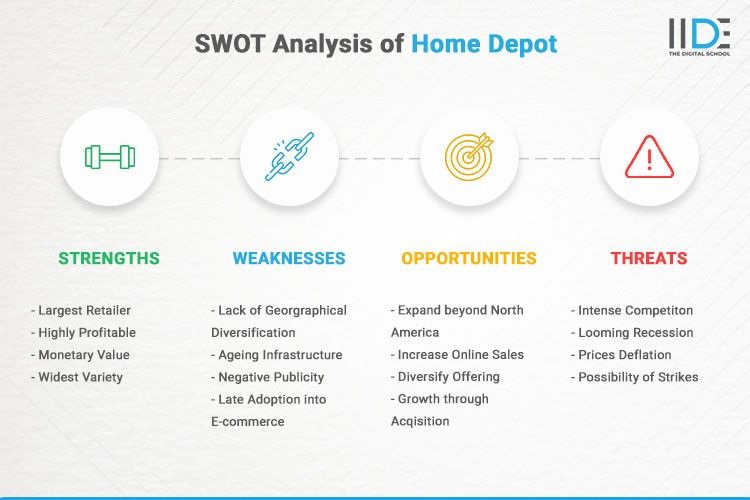
1. Strengths of Home Depot
Starting this SWOT with the Strengths of Home Depot. These are internal factors that push the company reputation and business, helping them secure their leading position –
- Largest Retailer – Home Depot is the largest retailer of home improvement products and services. Having the highest benefits of economies of scale than any one of its competitors in the world and has an abundance of resources to defeat its competitors as well as protect its overall market share.
- Highly Profitable – Home Depot’s revenues have been rising tremendously in the past five years; its revenue has been increasing at an average of 8.4% per annum and the profit to earnings ratio of Home Depot has increased from 20.5x to a phenomenal 33.2x in a short span of 3 years. This shows that the company is highly profitable and has good growth potential in the future.
- Monetary Value – The products and services offered by Home Depot have the highest value for their customer’s hard-earned money. The company has introduced a program known as Match and Beat program wherein customers can compare the prices of the products of Home Depot with that of their competitors in real-time and the prices offered by Home Depot is 10% lower than the prices offered by its competitors.
- Widest Variety – Home Depot offers its customers a wide variety of products and services to choose from namely building materials, home improvement products, lawn mowing equipment and others including home decor installation services and rental services for tools.
2. Weaknesses of Home Depot
Second, under the segment of the SWOT analysis of Home Depot, are the Weaknesses. These are internal factors that the organisation has stronger control over. Following are where Home Depot is failing at and can work on –
- Lack of Geographical Diversification – Even though Home Depot has around 2100 stores scattered across the USA, with about 160 stores in Canada and with about 140 stores spread across Mexico and the USA. While their stores in the USA and Canada are doing very well but their stores located in Mexico are not doing very well as Mexico’s market is slightly an under-penetrated market which is causing the brand’s downfall in Mexico.
- Ageing Infrastructure – Home Depot’s major challenge is due to its ageing infrastructure, as the company was set up way back so the majority of their stores are quite old. The company had invested more than $9 billion in digital transformation but that failed due to its poor infrastructure.
- Negative Publicity – In the year 2017, an employee of Home Depot faced disability discrimination who was working at a store located in the USA. The employee had asked for a disability-related emergency brake which was denied by the company, the employee took the company to court wherein the judgement was in favour of the employee and the company was ordered to pay $100,000 to the employee and this case caused a dent in the reputation of the company.
- Late Adoption into E-commerce – Home Depot had an e-commerce presence since 2001 but the website had a lot of glitches and many times the site didn’t load properly it was only after 2017 the company realised this point and started a new e-commerce website but when compared to its competitors Home Depot opened its e-commerce platform very later. As opening earlier than their competitors would have earned them more customers as well as an increase in revenue.
3. Opportunities for Home Depot
Opportunities are under the external umbrella of factors that can affect the company. These factors are usually ways the operations should focus on and capture to help grow the business. Following are Home Depot’s opportunities –
- Expand beyond North America – With more than 2100 stores located across The US, Canada, Mexico wherein the company has had a strong base for many years. But the company has no presence in growing markets like India, China so the company must expand its operations to developing countries as it has a high potential to grow its market share in these areas.
- Increase Online Sales – Home Depot earns 94% of its revenue through its offline stores it has geared up its online presence to get most of the internet, currently, the Covid-19 pandemic has had retail stores shut this can be a great medium to increase sales.
- Diversify Offering – Home Depot has a lot of variety of home decor products and services which surpass even that of their competitors but it would be beneficial if they could increase the diversity in their company by including apparel and food items.
- Growth through Acquisition – Home Decor in spite of having a strong base in the US, Canada and Mexico has still a lot of potentials to grow by acquiring companies that are not doing very well like Bed, Bath and Beyond.
4. Threats to Home Depot
Last, under the segment of the SWOT analysis of Home Depot, we dive into the Threats. These are considered as the external factors that cause potential damages to either the reputation or sales of the organisation. Here’s are a few of Home Depot’s recognised threats –
- Intense Competition – The competitors of Home Depot like Amazon, Lowe’s are closing the gap at an alarming level, by introducing huge discounts and a wide range of products and services they are posing a significant amount of threat to the company
- Looming Recession – The Coronavirus pandemic caused a meltdown in all sectors of the economy especially the construction and home improvement sectors, as the recession has set in due to the pandemic Home Depot’s profits may decrease.
- Price Deflation – Lumber, one of the biggest competitors of Home Depot has been significantly reducing the prices of its products in the past two years which has hammered the revenue of Home Depot by 17%.
- Possibility of Strikes – The adoption of a law in the USA has significantly helped employees by strengthening their bargaining power due to which employees of Home Depot in Mexico are demanding a 15% pay hike so that they get the same salary as their North American counterparts.
For large international corporations like Home Depot, a SWOT Analysis is an ideal technique to break down their operations and analyse their strongest and weakest factors. With this, we conclude the SWOT Analysis of Home Depot.

Learn Digital Marketing for FREE


Want to Know Why 2,50,000+ Students Trust Us?
Dive into the numbers that make us the #1 choice for career success



MBA - Level
Post Graduate in Digital Marketing & Business Strategy

Best For
Fresh Graduates

Mode of Learning
On Campus (Mumbai & Delhi)

Starts from
Jun 25, 2026

Duration
11 Months

Live & Online
Advanced Online Digital Marketing Course
Best For
Working Professionals
Mode of Learning
Online
Starts from
Jul 3, 2026
Duration
4-6 Months

Online
Professional Certification in AI Strategy
Best For
AI Enthusiasts
Mode of Learning
Online
Starts from
Jul 21, 2026
Duration
5 Months

On Campus
Advanced Certification in Artificial Intelligence
Best For
AI Enthusiasts
Mode of Learning
On Campus (Mumbai)
Starts from
Jul 20, 2026
Duration
3 Months

Offline
Undergraduate Program in Digital Business & Entrepreneurship
Best For
12th Passouts
Mode of Learning
On Campus (Mumbai)
Starts from
Aug 1, 2026
Duration
3 Years
Recent Post

Lead Trainer & Business Development Head at IIDE
Aditya Shastri leads the Business Development segment at IIDE and is a seasoned Content Marketing expert. With over a decade of experience, Aditya has trained more than 20,000 students and professionals in digital marketing, collaborating with prestigious institutions and corporations such as Jet Airways, Godrej Professionals, Pfizer, Mahindra Group, Publicis Worldwide, and many others. His ability to simplify complex marketing concepts, combined with his engaging teaching style, has earned him widespread admiration from students and professionals alike.
Aditya has spearheaded IIDE’s B2B growth, forging partnerships with over 40 higher education institutions across India to upskill students in digital marketing and business skills. As a visiting faculty member at top institutions like IIT Bhilai, Mithibai College, Amity University, and SRCC, he continues to influence the next generation of marketers.
Apart from his marketing expertise, Aditya is also a spiritual speaker, often traveling internationally to share insights on spirituality. His unique blend of digital marketing proficiency and spiritual wisdom makes him a highly respected figure in both fields.