
Students Centric
Placements Report
Trackable results, real numbers
Reviews
Proven success, real voices
Trainers
Expert-led, Industry-Driven Training
Life at IIDE
Vibrant Spirit student life
Alumni
Successful Journeys, Inspiring Stories
Learning Centre
Webinars
Blogs
Case studies
Live, Interactive Masterclasses
Fresh Insights, quick reads
Real-life, Industry relevant
More
Hire from us
Hire Top Digital Marketing Talent
Work with us
Join Our Team, Make an Impact
Customised Training
Personalised digital marketing training for your company
Refer & earn
Simple, easy rewards
Contact us
Get the answers you need
About us
Know more about IIDE
Explore all course options

FOR FRESH GRADUATES
Post Graduation Program in Digital Marketing & Business Strategy- Ideal for Age: 20–25 Years

Can’t decide? Explore all our
Digital Marketing Courses
FOR STUDENTSOn-campus
Advanced Certification in AI
FOR WORKING PROFESSIONALSOnline
Professional Certification in AI StrategyIndustry-Aligned TRACKMost Popular
UG Program in Digital Business & Entrepreneurship- Ideal for 12th Pass out / FY Degree Student

PARTNER PROGRAMS






Can’t decide? Explore all
BBA In Digital Marketing Colleges
Orginally Written by Aditya Shastri
Updated on Jul 3, 2026
Share on:


Colgate's key strengths are its 41.3% global toothpaste market share, its Hill's Pet Nutrition business, and a 220-year-old distribution network. Its main weaknesses are a slipping grip on India and a struggling skin care arm. The biggest opportunity lies in premiumisation and e-commerce, while herbal rivals like Dabur and Patanjali are its most critical threat. Founded in 1806, Colgate-Palmolive posted record net sales of $20.38 billion in FY2025.
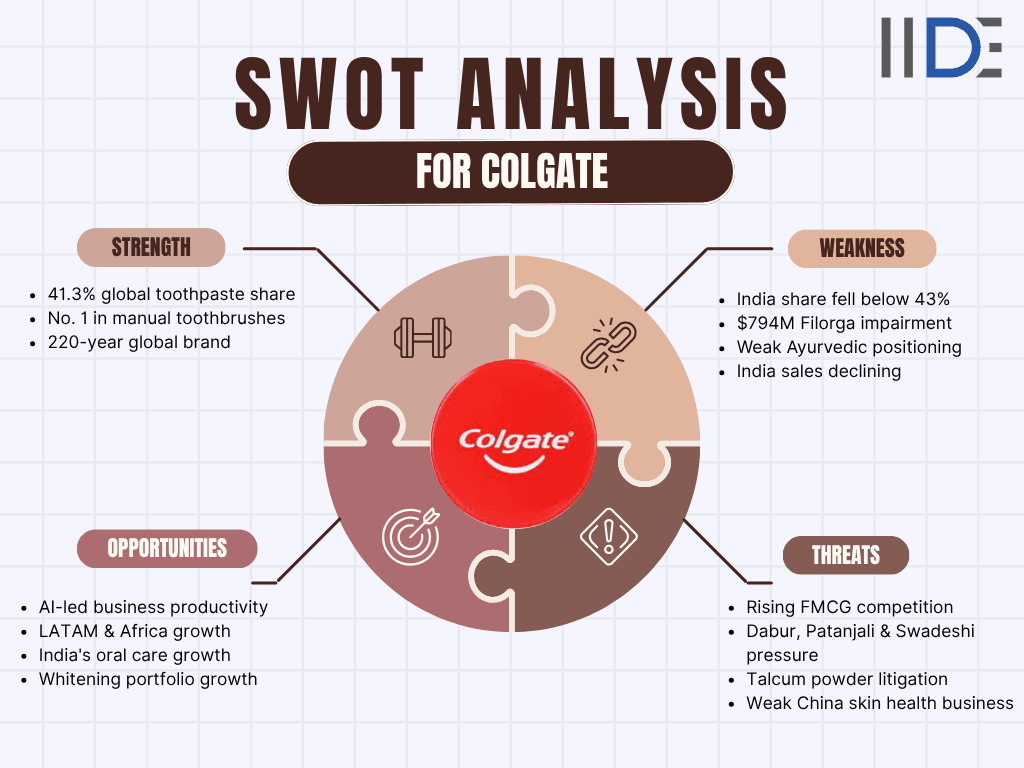
| SWOT ANALYSIS TABLE | |
|---|---|
| Strengths | Weaknesses |
| Global toothpaste leader with 41.3% market share | India's market share declined from 46.1% to under 43% in two years |
| No. 1 in manual toothbrushes with 32.4% share | $794 million impairment charge on the Filorga skin health business |
| Hill’s Pet Nutrition contributes $4.61 billion in revenue | Weak non-Ayurvedic positioning in India’s fastest-growing oral care segment |
| 220-year heritage with distribution in 200+ countries | Three straight quarters of sales decline in its India unit |
| Opportunities | Threats |
| AI-led productivity and digital transformation across the business | Intensifying competition from P&G, Unilever and private labels in emerging markets |
| Growth momentum is building in Latin America and Africa | Dabur, Patanjali and "Swadeshi" sentiment squeezing Colgate in India |
| India's oral care market projected to nearly double by 2033 | Ongoing talcum powder litigation exposure |
| A whitening portfolio spanning from value to professional price points | Weakening skin health business in China |
Here's a quick visual snapshot of Colgate's SWOT Analysis:

Learn Digital Marketing for FREE


What Are the Strengths of Colgate?
Colgate's biggest strength is that it leads the oral care market and has been doing so for a very long time. It also has a strong and steady financial record. This shows clearly in the numbers, not just in how well people know the brand.
1. The biggest toothpaste company in the world
Colgate holds 41.3% of the global toothpaste market as of late 2025, and this number has been going up for years. No other company comes close to this level of market share. Because of its size, Colgate gets better deals from shops and suppliers.
2. Number one in toothbrushes, too
Colgate also leads the toothbrush market, with a 32.4% global share. It sells both toothpaste and toothbrushes, so it takes up more shelf space in stores everywhere. This helps Colgate sell more of both products together.
3. A company that has paid rising dividends for 63 years straight
Colgate has paid its shareholders a dividend every year since 1895, without a break. It has also increased its dividend every single year for the last 63 years. Very few companies in the world have this kind of long, steady record. This shows that Colgate's business stays strong even during tough times, like recessions.
4. Strong cash flow and money returned to shareholders
Colgate made a record $4,198 million in cash from its operations in 2025. It gave back $2.9 billion to shareholders through dividends and buybacks. This means Colgate has enough money to keep spending on ads and new products, even when one market, like India, is struggling.
5. Colgate sells its products almost everywhere in the world
Colgate products are sold in more than 200 countries. It owns many well-known brands, including Colgate, Palmolive, Ajax, Darlie, elmex, EltaMD, Fabuloso, Filorga, hello, Irish Spring, Sanex, Softsoap, and Tom's of Maine. Because it sells in so many countries and owns so many brands, a problem in one country or one brand does not hurt the whole company much.
6. Sales kept growing even when the market slowed down
Colgate's full-year 2025 sales hit a record $20.38 billion, and sales grew again by 8.4% in the first quarter of 2026. Growing sales during a slow period show that people still trust and choose Colgate, even when they could pick cheaper options.
What Are the Weaknesses of Colgate?
Colgate's biggest weakness is that several things are going wrong at the same time. Its sustainability plans, its skin care business, and its home market of India are all facing problems together, even though the company just had a record year overall.
1. Missed its own 2025 sustainability and packaging targets
Colgate had promised to cut virgin plastic use by one-third and make all its packaging recyclable, reusable, or compostable by 2025. By 2023, it had only cut plastic by 21.4% and reached 89.5% recyclable packaging, falling short of its 100% goal.
Soft, flexible packaging like refill pouches proved hardest to fix. Colgate has also faced a lawsuit over claims that its "recyclable" toothpaste tube labels were misleading, showing how a missed promise can turn into a legal problem.
2. A costly stumble in skin health
In the last quarter of 2025, Colgate had to write down $794 million in value from its skin health business. This was because growth in that category was slower than expected, especially in China. This is the second time in a few years that Colgate has had to write down this same business, raising doubts about whether entering skin care was the right move.
3. Profits took a visible hit
Because of the skin health write-down, Colgate's official yearly profit per share fell by 25%, down to $2.63. Even though this drop came from a one-time charge, it still affects how investors and the market view the company's overall health.
4. Losing ground in India
Colgate's toothpaste market share in India dropped from 46.1% two years ago to 42.6% now, in a market worth around Rs 16,700 crore. Its India business has also seen sales fall for three quarters in a row.
The company's CEO, Noel Wallace, has said a recovery is expected only next year, as city demand stays weak and new tax rules have disrupted supply. India is one of Colgate's oldest markets outside the US, so this drop is a real loss on home turf.
5. Foreign Brand Perception
Industry experts say Colgate is seen as an international brand rather than a local, Ayurvedic one in India. This gap has been hard to close, even after Colgate launched its own natural products line. In a market where "natural" and "made locally" matter more to buyers now, Colgate's global, science-based image can actually work against it.
6. Too dependent on a slow-growing core business
Toothpaste and toothbrushes are already used by almost everyone in most countries, so there isn't much room left to grow there. Colgate's sales growth from its main business was just 2.9% in the first quarter of 2026, without counting price hikes. A company this large cannot depend on this slow growth alone. It needs to either win more market share or grow in new areas.
You can also explore our SWOT Analysis of Lifebuoy to understand how another leading FMCG brand builds trust, competes in hygiene, and grows across emerging markets.
What Are the Opportunities for Colgate?
Colgate's biggest opportunity is that it now has many different paths to grow, not just one. AI is helping it work faster, new regions like Latin America and Africa are growing, and India's market is expanding too. All of these can push growth forward at the same time.
1. Using AI to work faster and cheaper
Colgate is moving past simple chatbots and now uses smarter AI systems for product ideas, materials research, and daily tasks. In one test, the company used Google's AI video tool to make ads four to six times faster than usual, at a much lower cost. Colgate has also given AI tools to workers at every level, which should help it save money and launch new products faster.
2. Growth in African & Latin American Markets
Latin America and Asia Pacific together now make up close to 45% of Colgate's total sales, with Latin America alone making up 23%. Company leaders have said Africa is doing well too, with results improving through 2025. These regions give Colgate new places to grow, beyond its slower, more mature markets like North America and Europe.
3. Strong Premium Demand
In Europe, Colgate's elmex brand is hitting record toothpaste market shares by focusing on premium, science-backed oral care. In Asia Pacific, its Optic White Purple toothpaste and serum are driving growth in the teeth-whitening category. These premium products earn higher profits and let Colgate compete on quality and science, something cheaper local or herbal brands find hard to copy.
4. India's oral care market is set to almost double
India's oral care market was worth about US$2.03 billion in 2024. It is expected to grow to US$3.2 billion by 2033. Even if Colgate only wins back some of its lost market share, this overall growth could still bring in solid extra revenue over the next several years.
5. Rural markets are still largely untapped
Almost everyone in urban India already uses toothpaste, but about 55% of people in rural India still don't brush their teeth daily, according to Colgate's own annual report. The company has already expanded its reach to over 100,000 villages by using smaller pack sizes and lower prices. This is a real chance to win new customers, not just fight over existing ones.
6. Building a toothpaste for every budget
Colgate is building products across every price level, from everyday items priced at $4 to $10 to professional treatments that cost around $350. This lets Colgate serve both budget-conscious shoppers and high-spending customers within the same fast-growing whitening category. Covering the full range makes it harder for either cheap private labels or premium niche brands to beat Colgate at either end.
What Are the Threats to Colgate?
Colgate's biggest threat is that it's being challenged from many sides at once. Global rivals are competing on price, Indian rivals are competing on identity and local pride, and old lawsuits are still adding cost. None of these problems can be solved just by spending more on research.
1. Growing competition from P&G, Unilever, and cheaper store brands
Colgate faces tough competition from Procter & Gamble, Unilever, and low-cost private label brands across Latin America, Asia, and Africa. This competition is strongest in markets where buyers care most about price, since store brands can undercut Colgate simply by costing less. Rising costs for oil-based materials and packaging, along with currency swings, add even more pressure on profits in these markets.
2. Dabur & Patanjali are hurting Colgate in India
In India, Dabur has grown its toothpaste market share to 13.9%, Patanjali holds 10.9%, and GSK Consumer holds 8.8%, as more Indian shoppers turn to natural and Ayurvedic options. Dabur even ran an ad asking people to buy "Swadeshi," or local, products, at the same time the US placed tariffs of up to 50% on Indian goods. Because of this, Colgate now has to defend its market share against a message about national pride, not product quality.
3. Ongoing lawsuits linked to talcum powder
Colgate-Palmolive is still named, along with companies like Johnson & Johnson and Avon, in lawsuits about talcum powder. These lawsuits have already led to tens of millions of dollars in payouts, and more than 90,000 claims have been filed against talc product makers as of July 2026. Even though Colgate's risk is much smaller than J&J's, these ongoing cases still cost money and can hurt the brand's reputation.
4. A weak skin health business in China
Colgate's skin health division, led by its Filorga brand, is growing slower than expected. This weakness is especially clear in China. China was supposed to be a major growth market for Colgate's premium skin care push, so its poor performance raises doubts about the whole skin care investment.
5. Legal and reputation risk from sustainability claims
Colgate has already faced a lawsuit over claims that its recyclable toothpaste tube labels were misleading. As the company keeps updating its packaging, including toothbrushes, to be more eco-friendly, any gap between what it promises and what it actually delivers could lead to more legal trouble and bad press. Rivals like Unilever have faced similar criticism, so this risk affects the whole industry, not just Colgate.
6. Cautious consumer spending
Colgate's own guidance for 2026 expects the overall market to grow by only 1.5% to 2.5% worldwide. With the market growing so slowly, most of Colgate's future growth will have to come from taking customers away from rivals, rather than the market simply getting bigger. This is a harder and more expensive way to grow.
For a closer look at another major oral care competitor, check out our SWOT Analysis of Pepsodent and see how it positions itself against brands like Colgate in the toothpaste market.
About Colgate
Colgate-Palmolive Company, founded in 1806 by William Colgate, is the world's largest oral care company and a diversified consumer goods giant spanning oral care, personal care, and home care. Headquartered in New York, it operates in more than 200 countries and is led by Chairman, President and CEO Noel Wallace.
| Metric | Detail |
|---|---|
| Company Name | Colgate-Palmolive Company |
| Founded | 1806 |
| Headquarters | New York, USA |
| CEO | Noel Wallace, Chairman, President & CEO |
| Industry | Household & Personal Products, FMCG |
| Revenue, FY2025 | $20.38 billion |
| Net Income, FY2025 | $2.13 billion |
| Employees | 33600 |
| Market Cap | Approximately $68-70 billion |
| Main Competitors |
Procter & Gamble, Unilever/Hindustan Unilever, Dabur, Patanjali Ayurved, GSK Consumer |
What Is Happening With the Brand?
Colgate enters 2026 in an unusual position - globally dominant, with a record $20.38 billion in annual sales, but under real pressure in two specific places, its historic India stronghold and its newer skin health bet. Management has responded by leaning harder into premiumisation and science-led product relaunches in India, while working to stabilise the skin health business after a second impairment charge in a few years. The first quarter of 2026 showed early signs of momentum returning, with net sales up 8.4% and growth across every product category.
Key Takeaways & Recommendations
Colgate's SWOT tells the story of a category king being tested on several fronts at once, not just one. Its strengths, unmatched global scale, category leadership, and a 63-year record of consecutive dividend increases, remain genuinely formidable. But its weaknesses span the business: unmet sustainability targets, a costly stumble in skin health, and a slipping grip on India.
The core tension is that Colgate built its dominance on being a trusted, science-backed, global brand, but that same global identity is now a liability in specific pockets. Ayurvedic identity politics in India, private-label price competition in Latin America and Africa, and scrutiny over sustainability claims everywhere. Its opportunities, AI-led productivity, regional expansion, and premiumisation all depend on Colgate proving that scale and science still beat local and cheap, market by market.
Recommendations:
- Keep scaling AI-led productivity and innovation to protect margins as category growth slows globally.
- Double down on premium, science-backed sub-brands rather than trying to out-Ayurveda Dabur and Patanjali at their own game in India.
- Ring-fence the skin health business with clearer performance milestones before further investment.
- Close the gap between sustainability commitments and actual delivery to reduce litigation and reputational risk.
Future Outlook: Colgate's global fundamentals remain strong, with real growth momentum in Latin America, Africa, and AI-driven efficiency. But 2026-2027 will likely be defined by whether it can stabilise India, prove its skin health bet wasn't a misstep, and close out its sustainability commitments without further legal fallout. Its Q1 2026 rebound is an encouraging early signal, but these are multi-year fights, not one-quarter fixes.
Want to Know Why 2,50,000+ Students Trust Us?
Dive into the numbers that make us the #1 choice for career success



MBA - Level
Post Graduate in Digital Marketing & Business Strategy

Best For
Fresh Graduates

Mode of Learning
On Campus (Mumbai & Delhi)

Starts from
Jul 31, 2026

Duration
11 Months

Live & Online
Advanced Online Digital Marketing Course
Best For
Working Professionals
Mode of Learning
Online
Starts from
-
Duration
4-6 Months

Online
Professional Certification in AI Strategy
Best For
AI Enthusiasts
Mode of Learning
Online
Starts from
Jul 28, 2026
Duration
5 Months

On Campus
Advanced Certification in Artificial Intelligence
Best For
AI Enthusiasts
Mode of Learning
On Campus (Mumbai)
Starts from
Jul 27, 2026
Duration
3 Months

Online or Offline
Top AI Courses to Make You Future Ready!
Best For
AI Enthusiasts
Mode of Learning
2–5 Month Program
Starts from
Jul 28, 2026
Duration
Flexiable

Offline
Undergraduate Program in Digital Business & Entrepreneurship
Best For
12th Passouts
Mode of Learning
On Campus (Mumbai)
Starts from
Aug 1, 2026
Duration
3 Years
Offline
Undergraduate Program in Digital Business & Entrepreneurship
Best For
12th Passouts
Mode of Learning
On Campus (Mumbai)
Starts from
Aug 1, 2026
Duration
3 Years
Recent Post
Colgate's biggest strength is its global toothpaste market leadership at 41.3% share, far ahead of any competitor worldwide.
Colgate's main weakness is its declining market share in India, which fell from 46.1% to under 43% in two years, alongside a costly impairment in its skin health business.
The biggest threats are herbal challengers like Dabur and Patanjali in India, nationalist "Swadeshi" sentiment tied to US-India trade tensions, and ongoing talc-related litigation.
Colgate's main competitors are Procter & Gamble, Unilever (Hindustan Unilever in India), Dabur, Patanjali Ayurved, and GSK Consumer.
Colgate remains the larger global player with far greater scale and brand reach, but Dabur has been steadily gaining India toothpaste market share, rising to nearly 14-17% depending on the data source, on the strength of its herbal positioning.
Colgate leads in overall market share and global scale, but Patanjali has built stronger authenticity in India's fast-growing natural and Ayurvedic toothpaste segment, an area Colgate has struggled to compete in directly.
Colgate's outlook is cautiously positive, with 2026 guidance for 2-6% net sales growth, but its ability to stabilise India and fix its skin health business will determine whether that growth accelerates or stalls.
Latin America and Asia Pacific together make up nearly 45% of Colgate's net sales, with Africa also showing improving momentum, making these regions as important to Colgate's growth story as India.

Lead Trainer & Business Development Head at IIDE
Aditya Shastri leads the Business Development segment at IIDE and is a seasoned Content Marketing expert. With over a decade of experience, Aditya has trained more than 20,000 students and professionals in digital marketing, collaborating with prestigious institutions and corporations such as Jet Airways, Godrej Professionals, Pfizer, Mahindra Group, Publicis Worldwide, and many others. His ability to simplify complex marketing concepts, combined with his engaging teaching style, has earned him widespread admiration from students and professionals alike.
Aditya has spearheaded IIDE’s B2B growth, forging partnerships with over 40 higher education institutions across India to upskill students in digital marketing and business skills. As a visiting faculty member at top institutions like IIT Bhilai, Mithibai College, Amity University, and SRCC, he continues to influence the next generation of marketers.
Apart from his marketing expertise, Aditya is also a spiritual speaker, often traveling internationally to share insights on spirituality. His unique blend of digital marketing proficiency and spiritual wisdom makes him a highly respected figure in both fields.