
Students Centric
Placements Report
Trackable results, real numbers
Reviews
Proven success, real voices
Trainers
Expert-led, Industry-Driven Training
Life at IIDE
Vibrant Spirit student life
Alumni
Successful Journeys, Inspiring Stories
Learning Centre
Webinars
Blogs
Case studies
Live, Interactive Masterclasses
Fresh Insights, quick reads
Real-life, Industry relevant
More
Hire from us
Hire Top Digital Marketing Talent
Work with us
Join Our Team, Make an Impact
Customised Training
Personalised digital marketing training for your company
Refer & earn
Simple, easy rewards
Contact us
Get the answers you need
About us
Know more about IIDE
Explore all course options

FOR FRESH GRADUATES
Post Graduation Program in Digital Marketing & Business Strategy- Ideal for Age: 20–25 Years

Can’t decide? Explore all our
Digital Marketing Courses
COMPARE ALL 3 PROGRAMSOnline & Offline
Explore Top AI CoursesIndustry-Aligned TRACKMost Popular
UG Program in Digital Business & Entrepreneurship- Ideal for 12th Pass out / FY Degree Student

PARTNER PROGRAMS







Can’t decide? Explore all
BBA In Digital Marketing Colleges
Orginally Written by Karan Shah
Updated on Jul 16, 2026
Share on:


5 Facebook Engagement Metrics That Are Considered When Calculating The Engagement Rate:
- Likes: The number of people who like your posts. This also includes the number of people who react to your post. Likes are an indicator that tells you the resonance and acceptance by customers.
- Comments: The number of people who comment on your posts. The maximum number of posts have tagging of friends, or else some customer feedback. However, comments provide insight into how people feel about the content posted. Brands need to seriously consider customer experience through such comments.
- Shares: The number of people who share your content. Shares embark on amplification of your content which is seen by users and show that the users feel that your post was worth a ‘share’.
- Clicks/Links: The number of times a person clicks on one of your images or links. Those users will be sent to the website/app that you have linked.
- Reach: The number of individuals who have seen your post on their Facebook or Twitter feeds (included engaged and non-engaged users). People frequently mistake the terms “reach” and “engagement” on Facebook, so let’s clarify things. The number of unique visitors who see your content is best characterized as reach, whereas engagement refers to those who interact with it.
With that cleared up, let’s take a look at,
How does Facebook Engagement work?
Posting content generates engagement and it is possible to measure said that. The reach, relevancy, and uniqueness of the content directly influence the number of individuals who engage with that post.
Users’ timelines are updated when they interact with your posts or brand. It establishes a link to your material. This is visible to their friends and family, resulting in brand awareness.
Your audience’s level of engagement might reveal a lot. The number of reactions to a post may be used to gauge its popularity. It shows how much attention your article has gotten.
This is how you learn more about your target audience. Do they like it, share it, tag other people, participate in particular sorts of postings only, and so on?
Let’s take a look at how can you determine your Facebook Engagement Rate with the help of a calculator.
Facebook Engagement Rate Calculator
In general, the engagement rate is determined by this formula – dividing the number of engagements received (likes, comments, links, and shares) by the number of times a piece of content was seen (all multiplied by 100 to turn it into a percentage).
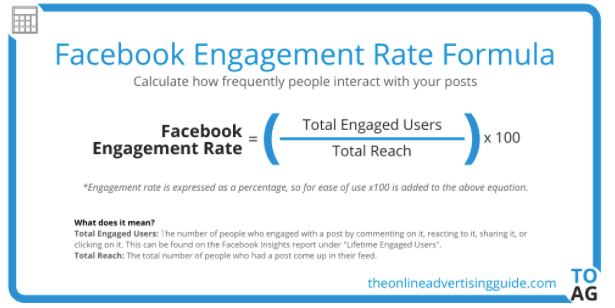
Source: theonlineadvertisingguide.com
Facebook Engagement Rate = (Engaged Users ÷ Total Reach ) x 100
Now, it is easier to find the stats for the total number of people your post has reached. But you cannot find the number of users who engaged with your post. Facebook only shows you the total number of engagements (reactions) received.
Thus, you can directly log on to Facebook > Insights >Posts > All Posts > Dropdown menu at the end > Select engagement rate. There you have it.
Now that you know how to calculate it, here’s an ideal engagement rate you should aim for.
What is a good Facebook engagement rate?
We believe that a rate of engagement of more than 1% is more than adequate.
The average engagement is between 0.5% and 0.99%, and engagement below 0.5 % indicates that your content needs improvement & more work. Anything more than 1-2% is considered fantastic engagement.
How To Increase Engagement on Facebook?
There are quite a number of ways that you can use to increase engagement. Those can be by posting content at certain times when your audience is most active or focus more so on quality content rather than quantity, and many more.
If you want to take a deeper look at the ways you can increase Facebook engagement, you can check out our blog on How To Increase Engagement On Facebook?
Apart from this, we have listed below some facebook engagement post ideas & examples to help you.
5 Facebook Engagement Post Ideas
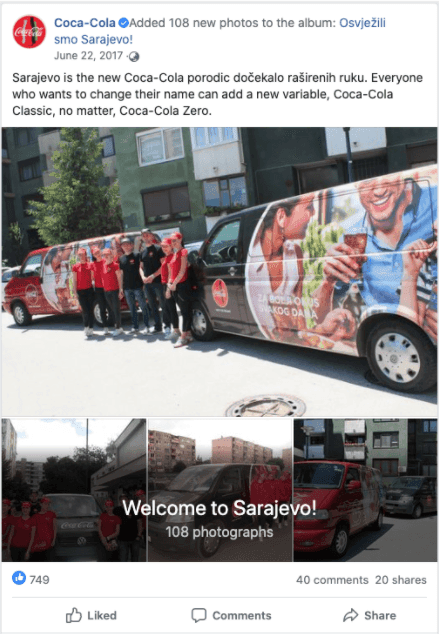
1. Sharing Photos Of Your Audience
If you’re stuck for Facebook post ideas, consider sharing fascinating, hilarious, or viral photographs and videos. This enables your audience to share important experiences from their lives with you, which can help them form bonds with the company.
A few examples of content you can repost are quotes, memes, artwork (with permission, of course), and any other type of content you feel is worth sharing.
2. Ask Questions
You may ask your audience questions, riddles, puzzles to solve, hold contents, and many other things to encourage them to interact with your material!
Include relevant questions in your posts or comment sections that you know your target audience would want to answer.
This is a simple and reliable method of getting your audience to connect with you.

3. Product Photos
This one might come as a no-brainer. It goes without saying that every company wants to showcase its goods and services.
However, to have effective Facebook posts, you’ll need to emphasize your products in unique methods.
How can you show off your products, whether they’re being displayed or not? Consider infographics, holiday-themed themes, or use or application shots, among other ideas.

4. Post Frequently
Even while we said you should prioritize quality above quantity, that doesn’t imply you should just post once a week or focus on quality.
You will need to find the perfect balance between quantity and quality, as Facebook likes pages that post frequently. Between 3-4 times a week is optimal.
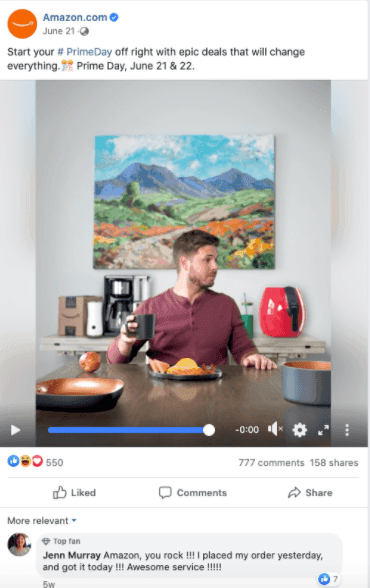
5. Promote upcoming sales/offers
If a member of your Facebook audience sees a post that advertises a deal on something they want, there’s a good chance they’ll take advantage of it.
Even if they weren’t seeking those specific goods, seeing your offer may persuade them to purchase from you.
We hope that some of the examples of Facebook post engagement have given you a clearer idea of what you should be concentrating on. Now, let’s take a look at some of the most commonly asked questions.

Learn Digital Marketing for FREE

Learn Digital Marketing for FREE
Want to Know Why 2,50,000+ Students Trust Us?
Dive into the numbers that make us the #1 choice for career success



MBA - Level
Post Graduate in Digital Marketing & Business Strategy

Best For
Fresh Graduates

Mode of Learning
On Campus (Mumbai & Delhi)

Starts from
Oct 1, 2026

Duration
11 Months

Live & Online
Advanced Online Digital Marketing Course
Best For
Working Professionals
Mode of Learning
Online
Starts from
Aug 7, 2026
Duration
4-6 Months

Online
Professional Certification in AI Strategy
Best For
AI Enthusiasts
Mode of Learning
Online
Starts from
Sep 8, 2026
Duration
5 Months

On Campus
Advanced Certification in Artificial Intelligence
Best For
AI Enthusiasts
Mode of Learning
On Campus (Mumbai)
Starts from
Sep 1, 2026
Duration
3 Months

Online or Offline
Top AI Courses to Make You Future Ready!
Best For
AI Enthusiasts
Mode of Learning
2–5 Month Program
Starts from
Sep 8, 2026
Duration
Flexiable

Offline
Undergraduate Program in Digital Business & Entrepreneurship
Best For
12th Passouts
Mode of Learning
On Campus (Mumbai)
Starts from
Aug 19, 2026
Duration
3 Years

Offline
Degree In 2026 ≠ Enough Degree + Digital Skills = Future-Ready
Best For
12th Passouts
Mode of Learning
At IIDE Campus
Starts from
Aug 6, 2026
Duration
3 Years
Recent Post
Digital Marketing Courses Nearby
You May Also Like

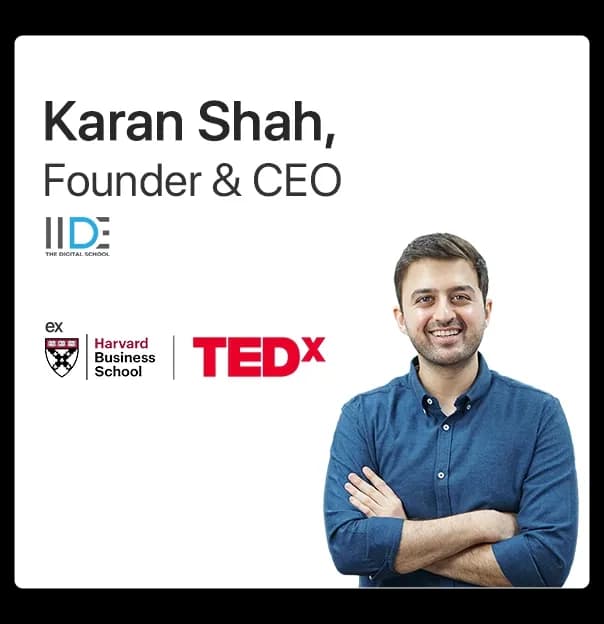
Founder and CEO at IIDE
Karan Shah is the Founder and CEO of IIDE – The Digital School, Asia’s premier digital marketing institute. With over ten years of hands-on experience in the digital marketing industry, Karan has played a pivotal role in empowering thousands of students to forge successful careers in this ever-evolving field.
His vast expertise encompasses various areas such as paid search, social media marketing, programmatic marketing, and much more. Karan's passion for education, teaching, and public speaking led him to establish IIDE, where he offers world-class digital marketing education designed to meet industry standards.
To date, he has trained over 60,000 students and worked with more than 25 corporates, sharing his knowledge through both online and offline platforms. A Harvard Business School alumnus with a specialisation in E-commerce, Karan is also an accomplished Tedx speaker. His industry insights and teaching excellence have earned him a prestigious role as a visiting faculty member at India’s top management institutes, including the Indian Institutes of Management (IIMs).