Application Deadline for 3-Year UG Program closes on 31st Aug. Book a Counselling to know more

Students Centric
Placements Report
Trackable results, real numbers
Reviews
Proven success, real voices
Trainers
Expert-led, Industry-Driven Training
Life at IIDE
Vibrant Spirit student life
Alumni
Successful Journeys, Inspiring Stories
Learning Centre
Webinars
Blogs
Case studies
Live, Interactive Masterclasses
Fresh Insights, quick reads
Real-life, Industry relevant
More
Hire from us
Hire Top Digital Marketing Talent
Work with us
Join Our Team, Make an Impact
Customised Training
Personalised digital marketing training for your company
Refer & earn
Simple, easy rewards
Contact us
Get the answers you need
About us
Know more about IIDE
Explore all course options

FOR FRESH GRADUATES
Post Graduation Program in Digital Marketing & Business Strategy- Ideal for Age: 20–25 Years

Can’t decide? Explore all our
Digital Marketing Courses
COMPARE ALL 3 PROGRAMSOnline & Offline
Explore Top AI CoursesIndustry-Aligned TRACKMost Popular
UG Program in Digital Business & Entrepreneurship- Ideal for 12th Pass out / FY Degree Student

PARTNER PROGRAMS







Can’t decide? Explore all
BBA In Digital Marketing Colleges
Orginally Written by Aditya Shastri
Updated on Dec 11, 2025
Share on:


Deloitte stands as a global leader in professional services, renowned for its ability to blend deep consulting expertise with the latest digital solutions.
With a legacy spanning more than 175 years, Deloitte works with major multinational brands as well as private businesses, helping them strategize, innovate, and grow in dynamic markets.
Their approach centers on measurable results, future-oriented thinking, and a commitment to making an impact that matters. From audit and advisory to risk management and sustainability, Deloitte’s experts leverage technology and real-world insights to solve complex challenges, shaping the future for their clients, their people, and the wider community.
Before diving into the article, please note that the research and initial analysis for this piece were conducted by Lakshit Soni. He is a student in IIDE’s Online Digital Marketing \Course, May Batch 2025.
If you found this analysis helpful, please feel free to reach out to him with a brief note of appreciation for his research; he will welcome the feedback.
About Deloitte
Deloitte was founded in London in 1845 by William Welch Deloitte and later expanded to the United States in 1890. Over the years, the firm grew through major mergers, including with Haskins & Sells in 1972 and Touche Ross in 1989, becoming Deloitte & Touche.
Today, it’s known simply as Deloitte, a global leader in audit, consulting, financial advisory, risk, tax, and legal services. With around 460,000 professionals in more than 150 countries, Deloitte earned about $67.2 billion in revenue in 2024.
The firm continues to play a major role in business and global events, including as a proud sponsor of the 2012 Summer Olympics.
What sets Deloitte apart is its unique structure?
Deloitte operates as a network of independent firms, blending global expertise with local insights to navigate regulations, drive digital transformation, and capture growth opportunities.
At its core, Deloitte is driven by people and innovation. Its culture of continuous learning and adaptability makes it a go-to advisor across industries like finance, healthcare, energy, consumer, technology, and the public sector.
| Item | Detail |
|---|---|
| Founded / Year Founded | 1845 |
| Founder | William Welch Deloitte |
| Origin / Headquarters | London, England (UK) |
| Company Type |
Private company limited by guarantee (network of independent member firms) |
| Number of Employees | Over 470,000 globally |
| Annual Revenue | US $70.5 billion (increases by 4.9%) |
| Services |
Audit Management consulting Financial advisory Risk advisory Tax Legal |
Why SWOT Analysis of Deloitte Matters in 2026?
The SWOT cuts through the noise and shows what Deloitte really does well and where it might stumble, so you can make smarter choices instead of guessing.
You’ll see which trends like AI, cloud shifts, regulation or ESG are likely to boost them and which could cause headaches. It’s also perfect prep for interviews or client meetings because you’ll sound informed, not scripted.
Want it tailored for hiring, buying services, or investing? I can draft that next.
- Let’s be real, the world Deloitte operates in today is anything but simple. The consulting and professional services arena is buzzing with cutthroat competition from agile boutique firms to disruptive, tech-driven platforms shaking up the traditional game.
- On top of that, technology isn’t just changing the rules, it’s rewriting the entire playbook. AI, cloud solutions, automation, and data-driven insights are transforming how services are delivered and clients now expect speed, precision, and innovation all rolled into one.
- Add in the weight of regulatory scrutiny and public trust issues, especially around auditing and ethics, and it’s clear why credibility has never been more critical. Layer this with economic headwinds, geopolitical uncertainty, and supply chain risks, and you’ve got a storm every global firm must navigate.
- And let’s not forget the talent war attracting top minds, keeping them engaged, and constantly reskilling a workforce that’s evolving as fast as the industries they serve.
- This is exactly why a SWOT analysis isn’t just an academic exercise, it's a powerful lens. It shows us where Deloitte has undeniable strengths, where cracks may appear, what opportunities it can seize in 2025, and the looming threats that could test its resilience.
Deloitte’s diversified global presence and strong consulting arm distinguish it from other Big Four firms. For instance, the SWOT analysis of PwC reveals similar regulatory challenges and competitive pressures, offering an industry-wide perspective.

Is Digital Marketing the Right Career for You?
Find out in a free 45-min masterclass · Career paths, roles and growth explained · By Karan Shah, Founder & CEO, IIDE

Is Digital Marketing the Right Career for You?
Find out in a free 45-min masterclass · Career paths, roles and growth explained · By Karan Shah, Founder & CEO, IIDE
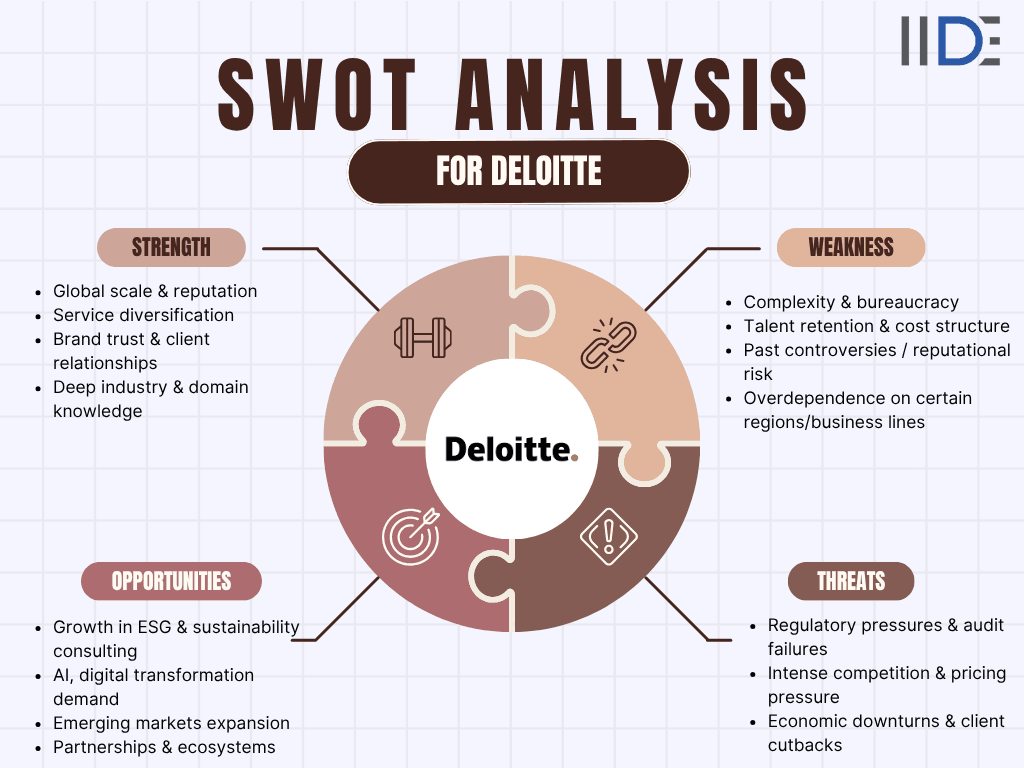
SWOT Analysis of Deloitte
1. Strengths of Deloitte
- Substantial Scale and Global Footprint: Deloitte’s vast presence across multiple markets forms the foundation of its strength and global influence.
- Strong Financial Performance: Reported aggregate global revenue of US$70.5 billion for FY2025, marking a 4.8% increase in local currency, showcasing steady and sustained market demand.
- Financial Dominance: Reflects Deloitte’s stability, brand trust, and continued leadership in the professional services industry.
- Unmatched Expertise: Built on a wide area of specialization and deep industry knowledge across sectors.
- Comprehensive Service Portfolio: Offers an unrivaled range of services among the Big Four - including Audit, Tax, Financial Advisory, and a dominant Consulting practice.
- Consulting Practice Divisions: The consulting arm is further divided into Strategy, Risk & Transactions (SR&T) and Technology & Transformation (T&T), driving innovation and digital excellence globally.
2. Weakness of Deloitte
- Chronic Regulatory and Audit Quality Deficiencies: Deloitte’s core business integrity faces ongoing challenges due to recurring regulatory compliance and audit quality issues. The firm continues to experience heavy scrutiny, lawsuits, and legal disputes that have damaged its reputation and raised concerns over governance standards.
- Reputation Damage from IP and Client Disputes: The firm’s rapid expansion into GenAI solutions has revealed weaknesses in brand governance and client management. This was notably reflected in the 2025 trademark infringement case filed by Zora Labs Inc. over the “Zora AI” platform, which negatively impacted Deloitte’s brand credibility.
- Competitive Prestige Gap: Despite strong global revenues, Deloitte Consulting struggles to match the prestige of top-tier strategy firms. It currently ranks fourth in global consulting prestige (Score: 7.203), trailing McKinsey & Company, Boston Consulting Group (BCG), and Bain & Company, highlighting an ongoing perception gap in elite consulting circles.
3. Opportunities for Deloitte
- Monetizing Global Regulatory Complexity: Deloitte transforms global regulatory challenges into profitable, high-margin consulting opportunities, ensuring steady revenue even during economic slowdowns. Its deep expertise allows clients to navigate complex global compliance landscapes efficiently.
- Pillar Two Tax Implementation: The rollout of the OECD Global Minimum Tax (Pillar Two) presents a significant, non-discretionary advisory opportunity. Deloitte supports companies in re-evaluating tax strategies, upgrading IT systems, and building new data infrastructures to comply with evolving international tax standards.
- AI Risk Management and Governance: With governments intensifying AI regulations, including anticipated 2025 U.S. Executive Orders, Deloitte helps clients design and implement strong AI governance and risk management frameworks, ensuring compliance and ethical AI adoption.
- Acceleration of GenAI and Digital Implementation: Backed by a US$3 billion GenAI investment, Deloitte enables clients to redesign operating models through automation and advanced AI.
- Scaling Agentic AI Systems: The firm guides organizations in adopting Agentic AI systems, optimizing business models, governance structures, and large-scale transformations for enterprise efficiency.
- Digital Health System Transformation: Deloitte supports healthcare clients in achieving digital transformation through improved operations, productivity, and patient engagement, a top global health priority in 2025.
- Strategic M&A and Sustainability Advisory: The projected M&A rebound in 2025 offers Deloitte twofold opportunities: expanding capabilities through acquisitions and offering transaction advisory services to clients.
4. Threats for Deloitte
- Intense Competitive Rivalry and Market Saturation: Deloitte operates in a highly competitive environment shaped by both established professional service firms and emerging technology disruptors.
- Big Four and Tech Rivalry: The firm faces direct competition from PwC, EY, and KPMG, alongside growing threats from technology leaders like Accenture, IBM, and AI-driven consulting startups offering faster, lower-cost solutions in technology implementation.
- Prestige Competition: Deloitte’s perceived prestige gap with McKinsey, BCG, and Bain forces it to rely on large-scale, technology-heavy projects to maintain market share, which increases operational costs and reduces profitability compared to boutique strategy firms.
- Regulatory Constraints on the Multidisciplinary Model: Recurring audit quality issues heighten the risk of structural intervention that could undermine Deloitte’s integrated model.
- Mandatory Audit Firm Rotation (MAFR): Global regulators continue to push for MAFR to ensure auditor independence. While Deloitte supports transparency, it argues that MAFR may not be the most effective method to enhance audit quality.
- Audit-Consulting Separation: Persistent scrutiny over auditor independence fuels discussions around separating Deloitte’s Audit and Consulting practices, especially in light of recent quality control lapses.
- Client Self-Service and Disintermediation Risk: Clients increasingly develop internal capabilities, reducing dependency on external consultants.
- In-House Knowledge Centers: Many organizations now establish their own knowledge hubs, retaining intellectual property and limiting the scope of outsourced advisory services.
- GenAI Self-Cannibalization: The rise of Generative AI, including Deloitte’s own Zora AI platform, poses a self-disruption risk. As clients adopt AI tools, they can automate complex analytical and strategic tasks traditionally performed by Deloitte’s consultants.
- Macroeconomic and Geopolitical Instability: Operating across nearly 100 countries, Deloitte is exposed to macroeconomic volatility and global uncertainty.
- Currency Fluctuation: Exchange rate variability can significantly impact profitability when local revenue is converted into U.S. dollars.
- Regulatory Divergence: Diverging regulatory standards across regions - particularly in AI governance and cybersecurity - create compliance complexities and increase operational costs.
IIDE Student Takeaway, Recommendations & Conclusion for Deloitte in 2026 and Beyond
Deloitte’s SWOT analysis reveals a firm that continues to thrive as one of the world’s most trusted professional services networks, yet operates in a rapidly changing business environment defined by technological disruption, regulatory scrutiny, and talent transformation.
The company’s unmatched scale, diversified services, and innovation-driven approach position it strongly but maintaining this leadership in 2025 and beyond requires strategic agility and cultural adaptability.
Core Tension
While Deloitte’s integrated multidisciplinary model provides a clear competitive edge, the increasing regulatory pressure to separate its audit and consulting divisions, coupled with AI-driven self-service threats, poses a direct challenge to its traditional business model. Balancing innovation with independence and trust has become Deloitte’s defining test.
Future Outlook
To sustain long-term growth, Deloitte must strengthen its positioning as a technology-empowered, purpose-driven advisor. Its investments in GenAI, sustainability, and risk advisory can become key differentiators if paired with a sharper focus on transparency, ethical governance, and human capital development.
Recommendations
1. Strengthen Trust & Transparency: Proactively enhance audit independence and quality controls to rebuild trust with regulators and clients. Clear governance communication can help Deloitte preserve the strength of its multidisciplinary model.
2. Double Down on AI & Emerging Tech: Capitalize on its US$3 billion GenAI initiative by creating proprietary tools that combine AI-driven insights with human judgment reinforcing Deloitte’s reputation for deep analytical rigor and innovation.
3. Champion Sustainable Advisory Growth: Expand consulting services in ESG, climate risk, and sustainability reporting, aligning with global corporate priorities and growing client demand for ethical transformation.
4. Empower Talent & Learning Culture: Invest in leadership development, digital upskilling, and flexible work models to retain top talent. A more empathetic, inclusive culture will strengthen Deloitte’s employer brand and future-readiness.
5. Deepen Strategic Partnerships: Form collaborations with technology platforms, universities, and startups to access cutting-edge expertise and scale innovation faster across regions.
Final Reflection
From this SWOT analysis, I’ve learned that Deloitte’s greatest strength lies in its ability to adapt and lead through complexity. What impressed me most was how the firm turns regulatory and technological disruption typically seen as threats into new growth avenues.
As a student, this analysis taught me the importance of strategic foresight, cultural resilience, and ethical leadership in modern business. Deloitte’s story shows that sustainable success isn’t just about size or revenue it’s about reinventing value while preserving trust.
Looking ahead, the key question is: Can Deloitte continue to evolve faster than the disruptions shaping its own clients’ futures?
If it can blend technology, transparency, and talent, Deloitte will remain not just a consulting leader, but a global benchmark for trust and transformation in the professional services industry.
Want to Know Why 2,50,000+ Students Trust Us?
Dive into the numbers that make us the #1 choice for career success



MBA - Level
Post Graduate in Digital Marketing & Business Strategy

Best For
Fresh Graduates

Mode of Learning
On Campus (Mumbai & Delhi)

Starts from
Oct 1, 2026

Duration
11 Months

Live & Online
Advanced Online Digital Marketing Course
Best For
Working Professionals
Mode of Learning
Online
Starts from
Sep 4, 2026
Duration
4-6 Months

Online
Professional Certification in AI Strategy
Best For
AI Enthusiasts
Mode of Learning
Online
Starts from
Sep 8, 2026
Duration
5 Months

Online or Offline
Top AI Courses to Make You Future Ready!
Best For
AI Enthusiasts
Mode of Learning
2–5 Month Program
Starts from
Sep 8, 2026
Duration
Flexiable

On Campus
Advanced Certification in Artificial Intelligence
Best For
AI Enthusiasts
Mode of Learning
On Campus (Mumbai)
Starts from
Sep 1, 2026
Duration
3 Months

Offline
Degree In 2026 ≠ Enough Degree + Digital Skills = Future-Ready
Best For
12th Passouts
Mode of Learning
At IIDE Campus
Starts from
Aug 31, 2026
Duration
3 Years

Offline
Undergraduate Program in Digital Business & Entrepreneurship
Best For
12th Passouts
Mode of Learning
On Campus (Mumbai)
Starts from
Aug 31, 2026
Duration
3 Years
Recent Post
You May Also Like
Deloitte offers audit, consulting, financial advisory, risk management, tax, and digital transformation services globally, serving various industries with tailored solutions.
Deloitte combines deep industry expertise, advanced technology capabilities, and a global footprint to deliver comprehensive, innovative solutions quickly and effectively.
Challenges include intense competition from other Big Four firms, potential for client concentration risks, and navigating complex regulatory environments globally.
Deloitte aligns digital strategy to business goals, develops leadership capabilities, and rewires the organizational culture to embrace digital innovation for sustained impact.
Deloitte operates in over 150 countries with a network of member firms, allowing localized services combined with global expertise.
It serves financial services, healthcare, technology, manufacturing, consumer business, energy, and government sectors, among others.
By investing heavily in technology platforms, analytics, and creative consulting approaches, Deloitte fosters innovation both internally and for its clients.
It is leveraging digital tools, agile methodologies, and workforce transformation strategies to create flexible, high-performance organizations.
Deloitte Digital combines technology, design, and analytics to transform customer experiences and business models for modern enterprises.

Lead Trainer & Business Development Head at IIDE
Aditya Shastri leads the Business Development segment at IIDE and is a seasoned Content Marketing expert. With over a decade of experience, Aditya has trained more than 20,000 students and professionals in digital marketing, collaborating with prestigious institutions and corporations such as Jet Airways, Godrej Professionals, Pfizer, Mahindra Group, Publicis Worldwide, and many others. His ability to simplify complex marketing concepts, combined with his engaging teaching style, has earned him widespread admiration from students and professionals alike.
Aditya has spearheaded IIDE’s B2B growth, forging partnerships with over 40 higher education institutions across India to upskill students in digital marketing and business skills. As a visiting faculty member at top institutions like IIT Bhilai, Mithibai College, Amity University, and SRCC, he continues to influence the next generation of marketers.
Apart from his marketing expertise, Aditya is also a spiritual speaker, often traveling internationally to share insights on spirituality. His unique blend of digital marketing proficiency and spiritual wisdom makes him a highly respected figure in both fields.