
Students Centric
Placements Report
Trackable results, real numbers
Reviews
Proven success, real voices
Trainers
Expert-led, Industry-Driven Training
Life at IIDE
Vibrant Spirit student life
Alumni
Successful Journeys, Inspiring Stories
Learning Centre
Webinars
Blogs
Case studies
Live, Interactive Masterclasses
Fresh Insights, quick reads
Real-life, Industry relevant
More
Hire from us
Hire Top Digital Marketing Talent
Work with us
Join Our Team, Make an Impact
Customised Training
Personalised digital marketing training for your company
Refer & earn
Simple, easy rewards
Contact us
Get the answers you need
About us
Know more about IIDE
Explore all course options

FOR FRESH GRADUATES
Post Graduation Program in Digital Marketing & Business Strategy- Ideal for Age: 20–25 Years

Can’t decide? Explore all our
Digital Marketing Courses
COMPARE BOTH OUR PROGRAMSOffline
Offline AI Courses with Dual CertificationsIndustry-Aligned TRACKMost Popular
UG Program in Digital Business & Entrepreneurship- Ideal for 12th Pass out / FY Degree Student

PARTNER PROGRAMS






Can’t decide? Explore all
BBA In Digital Marketing Colleges
Orginally Written by Aditya Shastri
Updated on May 13, 2026
Share on:


Citigroup Inc., commonly known as Citi, is one of the world's most recognised banking brands.
With over two centuries of history and operations across more than 160 countries, Citi represents scale, trust, and global financial reach.
But banking today looks very different. Customers now expect instant digital experiences, seamless mobile apps, smarter payments, and faster support. At the same time, fintech companies are changing how people interact with money.
So the real question is: Is Citi evolving with the times, or relying too much on legacy strength?
Before diving into the article, I would like to acknowledge that the research and initial analysis for this piece were conducted by Mahak Panwar, a current student of IIDE’s Post Graduation in Digital Marketing and Business Strategy, August Batch 2025.
If you found this helpful, feel free to reach out to Mahak Panwar to send a quick note of appreciation for her fantastic research, She will appreciate the kudos!
About Citi
Citigroup Inc. was founded in 1812 and has grown into one of the largest financial institutions in the world. Headquartered in New York City, the company operates across more than 160 countries and serves consumers, businesses, governments, and institutions globally.
Citi offers a wide portfolio of services including retail banking, credit cards, corporate banking, treasury solutions, wealth management, investment banking, and capital markets services.
In Q1 2026, Citi reported its highest quarterly revenue in a decade at $24.6 billion, up 14% year-over-year, with net income surging 42% to $5.8 billion, proving the transformation underway is beginning to deliver real results.
What differentiates Citi is not just size, but global connectivity. The bank is deeply positioned as an international financial network helping money move across borders, time zones, and markets. Its well-known line, "Citi Never Sleeps," reflects the round-the-clock nature of global finance and the company's always-on international presence.
Today, Citi competes with major global players such as JPMorgan Chase, HSBC, and other fast-evolving digital finance platforms.
Why This SWOT Matters in 2026
The banking industry is changing rapidly. Earlier, trust and branch presence were enough.
Today customers also expect:
- Instant mobile banking
- Fast digital payments
- Personalised financial tools
- Smooth app experiences
- Better security
- Seamless global access
At the same time:
- Fintech competition is rising
- Regulations are stricter
- Cyber risks are increasing
- Global economies remain uncertain
- Younger users prefer digital-first platforms
That makes 2026 a pivotal year for legacy financial giants like Citi. The bank is mid-transformation, and the early results are clearly showing.

Is Digital Marketing the Right Career for You?
Find out in a free 45-min masterclass · Career paths, roles and growth explained · By Karan Shah, Founder & CEO, IIDE

Is Digital Marketing the Right Career for You?
Find out in a free 45-min masterclass · Career paths, roles and growth explained · By Karan Shah, Founder & CEO, IIDE
SWOT Analysis of Citi
1. Strengths
If you had to describe Citi in one line, it would be this: it is built for global finance. Its biggest advantage lies in scale, trust, and international reach that few banks can match.
Key Strengths:
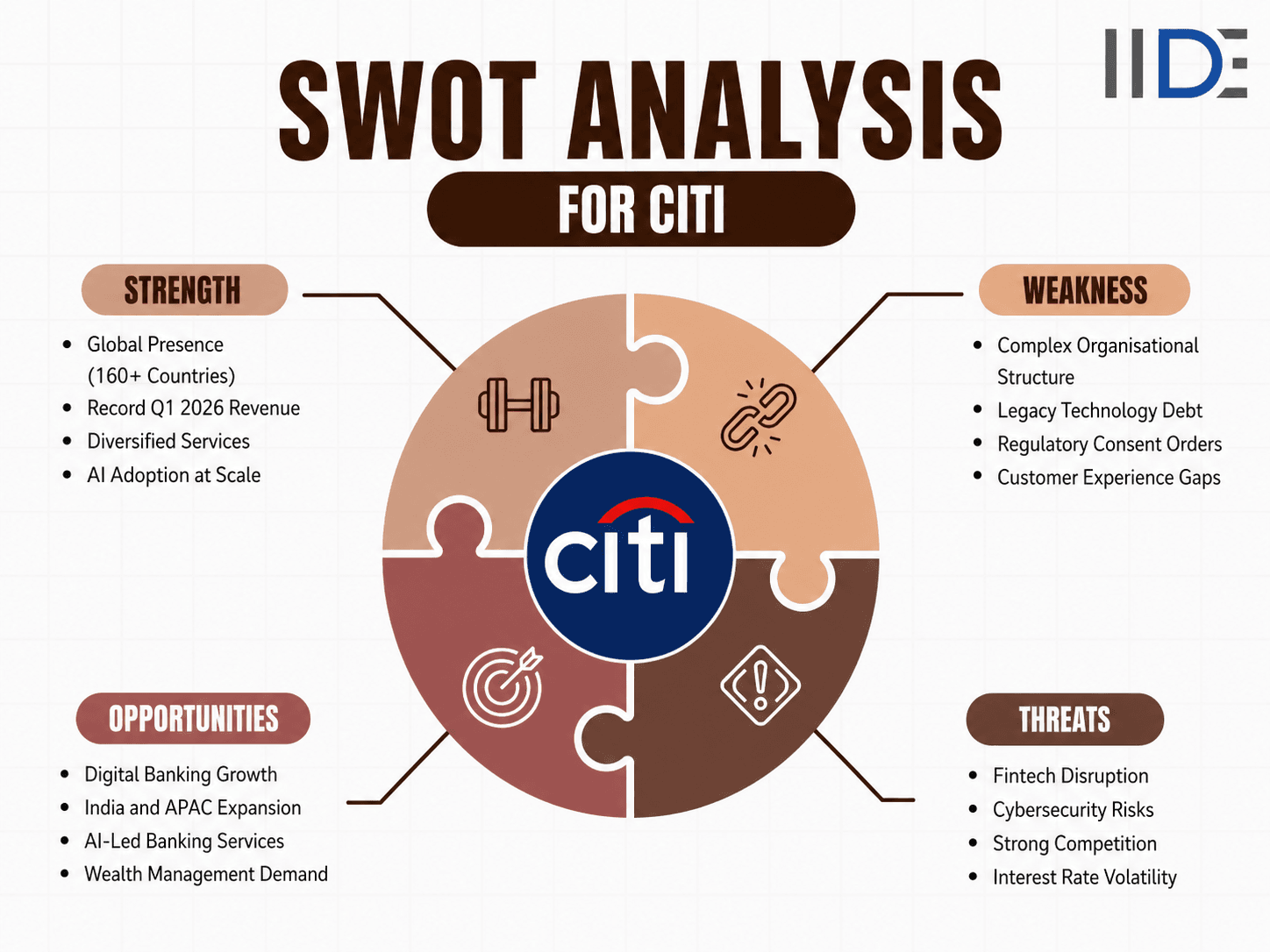
- Strong global presence: Citi operates across 160+ countries, giving it unmatched international scale that most competitors cannot replicate.
- Record financial momentum: In Q1 2026, the company delivered $24.6 billion in revenue, marking its strongest quarterly performance in a decade, along with a 13.1% return on tangible common equity.Select 66 more words to run Humanizer.
- Diversified services: Retail banking, cards, wealth management, and investment banking create resilience across different business cycles.
- Institutional relationships: Large corporations and governments rely on Citi globally for treasury, trade, and capital markets solutions.
- Cross-border expertise: Citi's Treasury and Trade Solutions division leads in global payments and Banking-as-a-Service infrastructure through API-driven platforms.
- AI adoption at scale: Citi has rolled out AI tools to 70% of its global workforce of approximately 180,000 colleagues, one of the most aggressive enterprise-wide AI deployments in financial services today.
- Improving digital platforms: The CitiDirect Commercial Banking platform now offers a fully digitised lending experience for mid-sized corporates, reflecting continued investment in modernisation.
2. Weaknesses
Now this is where the challenge begins. Large legacy organisations often move slower than digital-native competitors. That creates friction in a fast-moving market.
Key Weaknesses:
- Complex organisational structure: With approximately 226,000 employees globally, maintaining agility, decision-making speed, and consistent execution across geographies remains a persistent challenge.
- Ongoing regulatory obligations: Active consent orders require significant capital investment and management bandwidth, creating operational drag and ongoing headline risk.
- Below-peer efficiency ratio: Citi's expense ratio continues to lag key competitors, which limits profitability comparisons and investor confidence.
- Customer experience gaps: Fintech apps often feel smoother, faster, and more intuitive for everyday consumer needs.
- Legacy technology debt: Pockets of older infrastructure slow down new product development and integration timelines across markets.
- Retail banking growth lag: Revenue growth in core consumer segments remains modest at approximately 4.4%, suggesting competitive pressure from digital-first challengers.
- Restructuring impact: Significant headcount reductions as part of the ongoing transformation have affected employee morale and internal culture in several markets.
3. Opportunities
Now here is the interesting part. Citi still has major room to grow. Its scale gives it the ability to modernise faster if strategy is executed well.
Key Opportunities:
- Digital banking growth: Better mobile experiences and AI-driven personalisation can meaningfully improve loyalty and daily engagement among retail customers.
- India and APAC expansion: Citibank India's profit after tax rose 32% in the year ended March 2025. Citi was ranked the No. 1 M&A advisor in India in H1 2025, and plans to significantly increase capital deployment as Indian corporates pursue global expansion.
- Fintech partnerships: Collaborations through Citi Ventures can accelerate product launches in embedded finance, open banking, and digital payments.
- AI-led banking services: Citi Research forecasts global AI revenues will reach $780 billion by 2030 from $43 billion in 2025. Citi has already formed a dedicated internal group focused on capturing AI infrastructure opportunities.
- Wealth management demand: Wealth revenues grew 11% in Q1 2026, and growing affluent populations globally continue to seek integrated advisory and investment solutions.
- Investment banking momentum: APAC investment banking revenue hit $514 million in 2025, a 33% increase over 2024 and the strongest regional performance in over a decade.
- SME and commercial banking growth: The digitisation of Citi's commercial lending platform opens new doors with mid-sized businesses that previously lacked access to enterprise-grade financial solutions.
4. Threats
Of course, not everything is in Citi's control. Banking is one of the most competitive and regulated industries in the world.
Key Threats:
- Fintech disruption: Platforms like Wise, Revolut, and PayPal are capturing cross-border payment market share. Over 40% of banks have already lost at least 5% of their market share to fintechs, and 89% expect further erosion over the next decade.
- Strong competition: Rivals like JPMorgan Chase and HSBC continue to improve digital capabilities and widen the operational efficiency gap.
- Regulatory pressure: Compliance costs remain elevated across markets, and unresolved consent orders restrict strategic flexibility and capital deployment options.
- Cybersecurity risks: The global financial sector is now among the most targeted by AI-driven cybercrime, with 45% of financial organisations experiencing AI-powered cyberattack attempts in 2025 alone.
- Economic and geopolitical uncertainty: Despite market volatility boosting trading revenues in Q1 2026, persistent geopolitical instability and potential credit slowdowns remain real headwinds for lending businesses.
- Interest rate volatility: Rapid rate changes affect net interest income, profitability, and consumer borrowing demand in unpredictable ways.
- Digital-only challengers: Neobanks operate with significantly lower cost structures and faster innovation cycles, putting pressure on Citi's retail banking relevance with younger users.
SWOT Analysis of Citi Summary Chart
Key Insight, Final Thoughts and Conclusion
2026 Insights
Citigroup Inc. has spent decades building trust, scale, and global credibility. That legacy still holds strong value. But in 2026, customers are not choosing banks on reputation alone. They are choosing based on convenience, speed, and digital experience.
Today, consumers expect instant payments, intuitive apps, personalised offers, and seamless support as standard. The encouraging news is that Citi's transformation is visibly progressing.
With approximately 80% of its transformation initiatives nearing their target state and Q1 2026 posting the best quarterly revenue in a decade, the bank is no longer just a legacy institution holding ground. It is actively competing.
If Citi continues combining its global reach with modern digital execution, leveraging AI, deepening India and APAC presence, and simplifying its structure, it can remain highly competitive in a fintech-driven market.
To understand how the bank can stay relevant in today’s landscape, read the Marketing Strategy of Citi for deeper insights into its positioning, customer experience, and growth direction.
That is the difference between being trusted and being chosen first.
Final Thoughts
Citigroup Inc. remains one of the strongest names in global banking. Its biggest strength is trust combined with scale, while its biggest risk is moving slower than the market.
The transformation underway since 2023 is producing real results: record revenues, improving returns, and an accelerating AI rollout across the entire organisation.
If the company successfully combines its global reach with modern digital execution, growth can continue strongly. If not, younger customers may increasingly choose faster and more agile alternatives. And in finance today, convenience matters just as much as credibility.
Final Question: Can Citi think like a fintech while operating like a global bank?
Want to Know Why 2,50,000+ Students Trust Us?
Dive into the numbers that make us the #1 choice for career success



MBA - Level
Post Graduate in Digital Marketing & Business Strategy

Best For
Fresh Graduates

Mode of Learning
On Campus (Mumbai & Delhi)

Starts from
Nov 27, 2026

Duration
11 Months

Live & Online
Advanced Online Digital Marketing Course
Best For
Working Professionals
Mode of Learning
Online
Starts from
Nov 2, 2026
Duration
4-6 Months

Offline
Top AI Courses to Make You Future Ready!
Best For
AI Enthusiasts
Mode of Learning
2–5 Month Program
Starts from
Nov 24, 2026
Duration
Flexiable
Offline
Undergraduate Program in Digital Business & Entrepreneurship
Best For
12th Passouts
Mode of Learning
On Campus (Mumbai)
Duration
3 Years
Offline
Degree In 2026 ≠ Enough Degree + Digital Skills = Future-Ready
Best For
12th Passouts
Mode of Learning
At IIDE Campus
Duration
3 Years
Recent Post
You May Also Like
A SWOT analysis for a city evaluates its strengths, weaknesses, opportunities, and threats to understand growth potential.
Strengths may include infrastructure, tourism, or talent availability.
Weaknesses can be traffic, pollution, or poor planning.
It is often used for urban development and investment strategy.
The core SWOT model includes Strengths, Weaknesses, Opportunities, and Threats.
Some people add a fifth point called Strategy or Solutions after analysis.
This means using findings to create practical action plans.
It helps turn insights into real business decisions.
Citi has gone through restructuring and workforce reductions in recent years to improve efficiency.
In 2026, staffing decisions may continue depending on market conditions and business priorities.
Large banks often adjust teams during transformation phases.
Official announcements should be checked for the latest updates.
The 4 P’s are not part of SWOT analysis directly.
They belong to the marketing mix: Product, Price, Place, and Promotion.
SWOT focuses on internal and external strategic factors.
Both frameworks are often used together for business planning
The future outlook for Citi remains positive if digital transformation continues successfully.
Its global network gives it strong long-term advantages in international finance.
Growth can come from payments, wealth management, and emerging markets.
Modern execution will decide how strong that future becomes.
Yes, Citi can compete by combining trust, scale, and regulatory expertise with digital innovation.
It already has a large customer base and strong capital resources.
If it improves speed and user experience, it can stay competitive.
The challenge is adapting quickly enough.
Strict regulations can increase costs and slow expansion plans.
Economic slowdowns may reduce lending demand and customer activity.
Cybersecurity risks are rising as banking becomes more digital.
Strong competition from fintech firms can also pressure growth.
Yes, Citi remains relevant due to its trusted brand and financial product range.
However, younger customers increasingly expect smarter apps and easier digital experiences.
The bank must keep upgrading technology to stay attractive.
Convenience now matters as much as trust.

Lead Trainer & Business Development Head at IIDE
Aditya Shastri leads the Business Development segment at IIDE and is a seasoned Content Marketing expert. With over a decade of experience, Aditya has trained more than 20,000 students and professionals in digital marketing, collaborating with prestigious institutions and corporations such as Jet Airways, Godrej Professionals, Pfizer, Mahindra Group, Publicis Worldwide, and many others. His ability to simplify complex marketing concepts, combined with his engaging teaching style, has earned him widespread admiration from students and professionals alike.
Aditya has spearheaded IIDE’s B2B growth, forging partnerships with over 40 higher education institutions across India to upskill students in digital marketing and business skills. As a visiting faculty member at top institutions like IIT Bhilai, Mithibai College, Amity University, and SRCC, he continues to influence the next generation of marketers.
Apart from his marketing expertise, Aditya is also a spiritual speaker, often traveling internationally to share insights on spirituality. His unique blend of digital marketing proficiency and spiritual wisdom makes him a highly respected figure in both fields.