Application Deadline for 3-Year UG Program closes on 31st Aug. Book a Counselling to know more

Students Centric
Placements Report
Trackable results, real numbers
Reviews
Proven success, real voices
Trainers
Expert-led, Industry-Driven Training
Life at IIDE
Vibrant Spirit student life
Alumni
Successful Journeys, Inspiring Stories
Learning Centre
Webinars
Blogs
Case studies
Live, Interactive Masterclasses
Fresh Insights, quick reads
Real-life, Industry relevant
More
Hire from us
Hire Top Digital Marketing Talent
Work with us
Join Our Team, Make an Impact
Customised Training
Personalised digital marketing training for your company
Refer & earn
Simple, easy rewards
Contact us
Get the answers you need
About us
Know more about IIDE
Explore all course options

FOR FRESH GRADUATES
Post Graduation Program in Digital Marketing & Business Strategy- Ideal for Age: 20–25 Years

Can’t decide? Explore all our
Digital Marketing Courses
COMPARE ALL 3 PROGRAMSOnline & Offline
Explore Top AI CoursesIndustry-Aligned TRACKMost Popular
UG Program in Digital Business & Entrepreneurship- Ideal for 12th Pass out / FY Degree Student

PARTNER PROGRAMS







Can’t decide? Explore all
BBA In Digital Marketing Colleges
Orginally Written by Aditya Shastri
Updated on Aug 9, 2025
Share on:


About Whole Foods
Whole Foods Market, Inc. is an American multinational supermarket chain, founded on September 20, 1980. It has locations in the United States, Canada, and the United Kingdom.
After John Mackey and Renee Lawson Hardy, proprietors of the SaferWay health food shop teamed up with Craig Weller and Mark Skiles, owners of Clarksville Natural Grocery, the first Whole Foods store debuted in Austin.
Whole Foods sells products free from hydrogenated fats and artificial colours, flavours, and preservatives. The business is well-known for its organic options and is a USDA Certified Organic grocer in the United States.
| Founder | John Mackey, Renee Hardy-Lawson, Mark Skiles, Craig Weller |
|---|---|
| Year Founded | 1980 |
| Origin | Austin, Texas, United States |
| No. of Employees | 91,000 |
| Company Type | Subsidiary; Parent – Amazon |
| Market Cap | N/A |
| Annual Revenue | $385.06 Billion (2020) |
| Net Profit | $21.33 Billion (2020) |
Products of Whole Foods
Whole Foods has successfully risen in the health food retail market by selling the following –
- Produce
- Dairy & Eggs
- Meat
- Prepared Foods
- Pantry Essentials
- Bread, Rolls & Bakery
- Body Care
- Supplements.
Competitors of Whole Foods
These are Whole Foods major competitors –
- Publix Super Markets
- Trader Joe’s
- Walmart
- Kroger
- The Fresh Market
Now that understood the workings and history of the company, let’s dive into the SWOT Analysis of Whole Foods.
SWOT Analysis Of Whole Foods
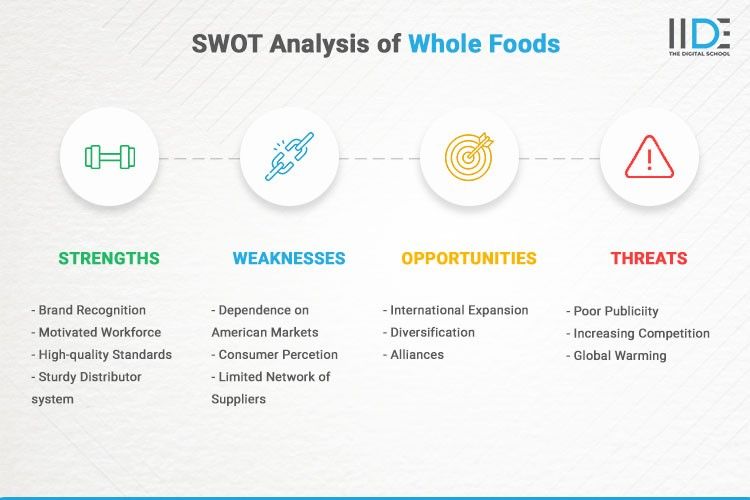
Read the following SWOT Analysis of the Whole Foods Market group to find out what are the various factors that define the success of this firm currently and the factors that would be a change-maker for the company in future.
1. Strengths of Whole Foods
The following are Whole Foods strengths that have helped them establish a strong position in America as a reliable supermarket:
- Brand Recognition – A company’s fate is completely determined by the image of its brand. Since its beginning, Whole Foods has maintained a strong brand image. It came in third place in the Reputation Institute’s annual ranking of the most dependable retailers. It aids Whole Foods in standing out from the competition and, as a consequence, translates its popularity into an ever-increasing customer base. The supermarket’s future has been secured by the profits and sales generated by such client demographics.
- Motivated Workforce – Whole Foods Market has a highly engaged workforce as a result of its organisational culture. This is a big benefit since it allows the company to optimise output while lowering recruitment and training expenditures.
- High-Quality Standards – Whole Foods has made it a mission to provide only the highest-quality food items in its supermarkets. Whole Foods has set the bar high by excluding substances that are typically found in other food merchants’ goods. Artificial flavours, sweeteners, colours, and hydrogenated fats are strictly forbidden. Fishing, farming, and ranching that do not satisfy the company’s high requirements are also prohibited.
- Sturdy distributor system – Whole Foods has established a strong culture with distributors, allowing them to not only promote the company’s products but also spend in educating the sales crew to explain to customers how to get the maximum profit from the items.
2. Weaknesses of Whole Foods
Here are the weaknesses in the SWOT Analysis of Wholefoods:
- Dependence on American Markets – Because Whole foods rely on American markets, it is at its most vulnerable. In 2015, it accounted for 97 per cent of all sales in the US market. It will not be sustainable if the American economy crashes owing to the global economy’s volatility. During the recession, the firm had to contend with reduced earnings. Its interests might be irreparably damaged if it is struck by another impending recession. In terms of international branches, it has only operated in Canada and the United Kingdom.
- Consumer Perception – Due to overpricing and overcharging their customers, wholesalers faced dismal sales growth. Many people have reacted negatively to this. The general opinion among customers is that the firm purposefully offers them costly items. It was given the moniker “Whole Paycheck” since it is believed that the prices may swallow a consumer’s whole income. It has tarnished the brand’s reputation.
- Limited network of suppliers – The firm has a very limited network of suppliers that satisfy Whole Foods Market’s quality standards. This weakness may obstruct the company’s ability to swiftly grow its activities.
3. Opportunities for Whole Foods
The potential for Whole Foods Market is based on existing competition and the worldwide market. The feasible actions for business growth are outlined in this section of the SWOT analysis.
- International Expansion – It is known that Whole Foods is overly reliant on the US market. It allows the firm to expand internationally and diversify its operating resources. Whole Foods has branches in Canada and the UK, but it needs to invest more to go further. It should also look to Europe and Asia as potential income boosters. Though it’s still under dispute internally, the margin of increase can be achieved if the plan is followed.
- Diversification (365 Stores) – To combat the issue of pricey products, Whole Foods has created 365 by Whole Foods Market, which is a new low-cost market. It aims to provide individuals with nutritious and cheap meals daily. 365 by Whole Foods was designed to provide organic food options to the middle class and millennials. The stores are a fraction of the size of the original superstores. They are, nevertheless, complimentary items. For years, Whole Foods has been criticised for overpricing, and they’ve put a lot of money into this location to address those complaints.
- Alliances – Amazon announced that it will buy Whole Foods Market and sell its items on its website. On August 28, 2017, the transaction was completed. This historic purchase has resulted in huge revenue growth and increased employee involvement for the firm.

4. Threats to Whole Foods
The threats to Whole Foods business are based on the competitive food, technology, and climate. The most significant threats are:
- Poor Publicity – As a result of how it handled its 2015 customer overcharging, the firm has received a lot of unfavourable press. A huge number of complaints were filed against the organisation as a result of this. A lawsuit was filed against the firm, which resulted in a settlement of $500,000. Since then, the company’s sales have slowed and received negative press.
- Increasing Competition – Despite Amazon’s acquisition of Whole Foods, the business has not been able to keep up with competitors such as Walmart, which plans to surpass Amazon. Whole Foods is up against the stiff competition, with Target giving it a run for its money. Walmart and Target both use competitive pricing techniques to surpass Whole Foods, which has so far been unproductive.
- Global warming – Global warming is a threat to Whole Foods. Climate change can modify or diminish food output considerably. As a result, this section of the SWOT analysis reveals that Whole Foods Market is confronted with substantial threats that are tough to manage or overcome.
On this note, we reach the end of the SWOT Analysis of Whole Foods. Let’s conclude this case study in the next section below.

Is Digital Marketing the Right Career for You?
Find out in a free 45-min masterclass · Career paths, roles and growth explained · By Karan Shah, Founder & CEO, IIDE

Is Digital Marketing the Right Career for You?
Find out in a free 45-min masterclass · Career paths, roles and growth explained · By Karan Shah, Founder & CEO, IIDE
Want to Know Why 2,50,000+ Students Trust Us?
Dive into the numbers that make us the #1 choice for career success



MBA - Level
Post Graduate in Digital Marketing & Business Strategy

Best For
Fresh Graduates

Mode of Learning
On Campus (Mumbai & Delhi)

Starts from
Oct 1, 2026

Duration
11 Months

Live & Online
Advanced Online Digital Marketing Course
Best For
Working Professionals
Mode of Learning
Online
Starts from
Sep 4, 2026
Duration
4-6 Months

Online
Professional Certification in AI Strategy
Best For
AI Enthusiasts
Mode of Learning
Online
Starts from
Sep 8, 2026
Duration
5 Months

Online or Offline
Top AI Courses to Make You Future Ready!
Best For
AI Enthusiasts
Mode of Learning
2–5 Month Program
Starts from
Sep 8, 2026
Duration
Flexiable

On Campus
Advanced Certification in Artificial Intelligence
Best For
AI Enthusiasts
Mode of Learning
On Campus (Mumbai)
Starts from
Sep 1, 2026
Duration
3 Months
Offline
Degree In 2026 ≠ Enough Degree + Digital Skills = Future-Ready
Best For
12th Passouts
Mode of Learning
At IIDE Campus
Starts from
Aug 31, 2026
Duration
3 Years
Offline
Undergraduate Program in Digital Business & Entrepreneurship
Best For
12th Passouts
Mode of Learning
On Campus (Mumbai)
Starts from
Aug 31, 2026
Duration
3 Years
Recent Post

Lead Trainer & Business Development Head at IIDE
Aditya Shastri leads the Business Development segment at IIDE and is a seasoned Content Marketing expert. With over a decade of experience, Aditya has trained more than 20,000 students and professionals in digital marketing, collaborating with prestigious institutions and corporations such as Jet Airways, Godrej Professionals, Pfizer, Mahindra Group, Publicis Worldwide, and many others. His ability to simplify complex marketing concepts, combined with his engaging teaching style, has earned him widespread admiration from students and professionals alike.
Aditya has spearheaded IIDE’s B2B growth, forging partnerships with over 40 higher education institutions across India to upskill students in digital marketing and business skills. As a visiting faculty member at top institutions like IIT Bhilai, Mithibai College, Amity University, and SRCC, he continues to influence the next generation of marketers.
Apart from his marketing expertise, Aditya is also a spiritual speaker, often traveling internationally to share insights on spirituality. His unique blend of digital marketing proficiency and spiritual wisdom makes him a highly respected figure in both fields.