
Students Centric
Placements Report
Trackable results, real numbers
Reviews
Proven success, real voices
Trainers
Expert-led, Industry-Driven Training
Life at IIDE
Vibrant Spirit student life
Alumni
Successful Journeys, Inspiring Stories
Learning Centre
Webinars
Blogs
Case studies
Live, Interactive Masterclasses
Fresh Insights, quick reads
Real-life, Industry relevant
More
Hire from us
Hire Top Digital Marketing Talent
Work with us
Join Our Team, Make an Impact
Customised Training
Personalised digital marketing training for your company
Refer & earn
Simple, easy rewards
Contact us
Get the answers you need
About us
Know more about IIDE
Explore all course options

FOR FRESH GRADUATES
Post Graduation Program in Digital Marketing & Business Strategy- Ideal for Age: 20–25 Years

Can’t decide? Explore all our
Digital Marketing Courses
COMPARE ALL 3 PROGRAMSOnline & Offline
Explore Top AI CoursesIndustry-Aligned TRACKMost Popular
UG Program in Digital Business & Entrepreneurship- Ideal for 12th Pass out / FY Degree Student

PARTNER PROGRAMS







Can’t decide? Explore all
BBA In Digital Marketing Colleges
Orginally Written by Aditya Shastri
Updated on Dec 12, 2025
Share on:


About Reebok
It all began in England, in 1958, by a sibling duo – Joseph and Jeff Foster, who aimed to carry on their family tradition of making athletic footwear. Reebok was then a subdivision of the family’s already existing footwear company. Today they have grown into one of the largest sportswear brands that not only sell footwear but expanded to CrossFit clothing, equipment and more.
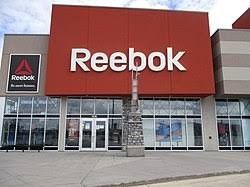
In 1979, Paul B. Fireman, a marketer of camping and fishing gear, spotted the wares of a tiny British sports shoemaker, Reebok International, at a Chicago sporting goods exhibition and decided to buy them. In search of a commercial opportunity, Fireman purchased the company’s North American licence and thus began the reign of Reebok U.S.A.
Reebok was then purchased by Adidas in 2005 in an attempt by the German business to create a double assault on Nike. The conventional thinking of the time led both shoe firms to assume that by joining forces, they might oust the number one sneaker producer and seize the top spot.
| Founder | Joseph William Foster |
|---|---|
| Year Founded | 1985 |
| Origin | Lancashire, England |
| No. of Employees | 4,967 |
| Company Type | Subsidiary | Parent – Adidas |
| Market Cap | Adidas | €58 Billion (2020) |
| Annual Revenue | €1.41 Billion (2020) |
| Net Profit | Adidas | €674 Billion (20201) |
Products of Reebok
Reebok has successfully risen in the sportswear market by selling the following –
- Clothing
- Footwears
- Fitness Equipment
- Fitness Accessories (Backpacks, watches, sunglasses, etc)
Competitors of Reebok
In the athletics fashion sector, there are a plethora of options. These are Reebok’s major competitors –
- Nike
- Adidas
- Puma
- Under Armour
- Hanesbrands
Now that we have tackled the areas that give us insight into the company’s core operations, let’s look into the SWOT Analysis of Reebok.
SWOT Analysis of Reebok
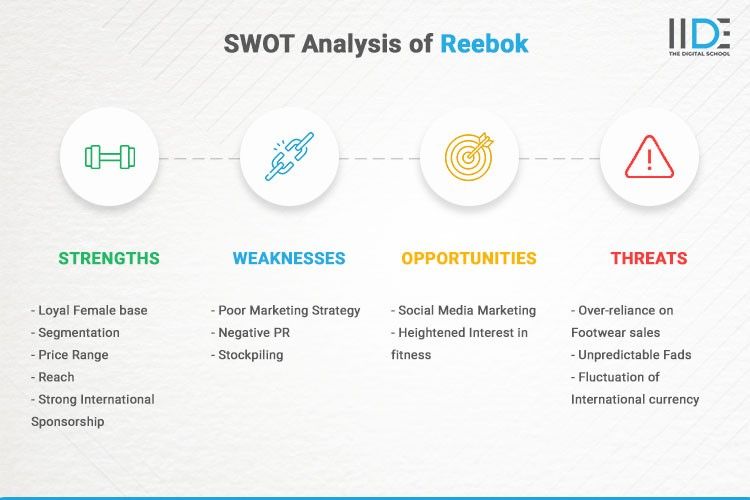
An organization’s internal strengths and weaknesses, as well as external opportunities and dangers, are identified through research that is done through the SWOT Analysis.
1. Strengths of Reebok
Let’s start with the S of SWOT analysis of Reebok i.e. Strength. These are termed as the internal factors that helped Reebok maintain its top position.
- Loyal Female base – In 1979, Reebok introduced the Aztec princess which happened to be their stepping stone to the US market. When no one was thinking about Women’s sports shoes, Reebok became the first brand to release Women athletic shoes. Since then Reebok has never let their targeted women audience down, creating a loyal female base.
- Segmentation – Reebok manufactured products for specific sports usage and categorised it to specific segments. This creates the brand image of creating products that cater to specific audiences – meeting demands.
- Price range – They aim to sell products at an average price, making their goods accessible to the middle-class. This gave the customers an option to utilise high-quality products. Other competitors don’t reach this market as their starting price of products belongs to the luxury category.
- Global Reach – In 1990, Reebok did business in only 45 countries, but it jumped to 140 countries in 1992, just 2 years. Reebok now sells its products worldwide. Through a Multi-Channel distribution strategy, Reebok can reach a larger customer base and satisfy the customer.
- Strong International Sponsorship – UFC and Spartan Race officially have a sponsorship deal in Apparel and Footwear with Reebok. The company has a stronghold on Hockey, Football, and Baseball sponsorships, globally. Moreover, they sponsored influential players in the NFL, UFC and NBA as well.
2. Weakness of Reebok
The next part of the SWOT analysis of Reebok is its Weakness. Let’s see the Weaknesses of Reebok which give Reebok a disadvantage in some or the other way!
- Poor Marketing Strategy – Reebok’s shortcoming in marketing is its main weakness. While other athletic shoe manufacturers are promoting their product lines, Reebok is not and remains out of constant reach with their customers.
- Negative PR – Any negative controversy affects the Brand image. In 2017, CrossFit said Reebok was dishonest and fraudulent, claiming $4.8 million in breach of contract. Another major controversy was an ad campaign in Germany asking gym-goers to cheat on their girlfriend instead of exercising. These kinds of controversies create a strained relationship between the brand and the customer – creating a negative brand value.

Reebok’s Controversial Ad was then removed.
- Stockpiling – The future growth of the company’s five brands is about 9.5% in dollar terms. This growth is alarming. Reebok should be careful as retailers may order more than they can sell. This could lead to a sudden drop in orders, resulting in more inventory and lower revenues for the company.
3. Opportunities for Reebok
Now we will analyze the O of SWOT analysis of Reebok. Here, We will understand what all opportunities will give Reebok a competitive advantage. Opportunities are the external factors that give a company a favourable condition to achieve its goal.
- Social Media Marketing – Social Media is now a prime location for Marketing, After Sales service, Customer services, Customer communication, and many more. To be in the spotlight or on the top of the customer’s mind it needs to be active on Social Media. Their lack of a strong presence and strategy in the digital sphere of marketing is a setback.
- Heightened Interest in fitness – Due to Covid-19, the movement around the world stopped due to quarantine. This created a lethargic environment. However, the fitness geeks and gradually the whole of society began looking out for home work-out options.
4. Threats to Reebok
Let’s see the Threats which are the external factors that have an unfavourable impact on Reebok! This is the last part of the SWOT analysis of Reebok.
- Over-reliance on Footwear sales – Footwear is Reebok’s largest division and therefore the company depends fairly heavily on the footwear market. Reebok had also to bear in mind that the marketplace for costlier footwear was slowing. This might ultimately force costs down, ought to this trend will continue for a major amount of time. The corporation was so dependent on footwear that it risked losses, whereas other competitors resembling Nike will fall back on their attire division.
- Unpredictable Fads – It implies that economic processes are unpredictable. E.g., client tastes for garments change frequently. Thus, the style business suffers an excellent uncertainty. The style may live for a few days or even years. The fads are unpredictable and pose a threat.
- Fluctuation of International currency – A depreciation of the local currency increases the cost of imports of goods, which can reduce the volume of imports Domestic companies will benefit from increased sales, profits and employment.
For large global brands like Reebok, a SWOT Analysis is a good approach to break down their operations and analyse management risks and benefits. With this, the SWOT Analysis of Reebok comes to an end.

Learn Digital Marketing for FREE


Want to Know Why 2,50,000+ Students Trust Us?
Dive into the numbers that make us the #1 choice for career success



MBA - Level
Post Graduate in Digital Marketing & Business Strategy

Best For
Fresh Graduates

Mode of Learning
On Campus (Mumbai & Delhi)

Starts from
Jul 31, 2026

Duration
11 Months

Live & Online
Advanced Online Digital Marketing Course
Best For
Working Professionals
Mode of Learning
Online
Starts from
Aug 7, 2026
Duration
4-6 Months

Online
Professional Certification in AI Strategy
Best For
AI Enthusiasts
Mode of Learning
Online
Starts from
Sep 8, 2026
Duration
5 Months

On Campus
Advanced Certification in Artificial Intelligence
Best For
AI Enthusiasts
Mode of Learning
On Campus (Mumbai)
Starts from
Aug 31, 2026
Duration
3 Months

Online or Offline
Top AI Courses to Make You Future Ready!
Best For
AI Enthusiasts
Mode of Learning
2–5 Month Program
Starts from
Sep 8, 2026
Duration
Flexiable
Offline
Undergraduate Program in Digital Business & Entrepreneurship
Best For
12th Passouts
Mode of Learning
On Campus (Mumbai)
Starts from
Aug 19, 2026
Duration
3 Years
Offline
Degree In 2026 ≠ Enough Degree + Digital Skills = Future-Ready
Best For
12th Passouts
Mode of Learning
At IIDE Campus
Starts from
Aug 6, 2026
Duration
3 Years
Recent Post

Lead Trainer & Business Development Head at IIDE
Aditya Shastri leads the Business Development segment at IIDE and is a seasoned Content Marketing expert. With over a decade of experience, Aditya has trained more than 20,000 students and professionals in digital marketing, collaborating with prestigious institutions and corporations such as Jet Airways, Godrej Professionals, Pfizer, Mahindra Group, Publicis Worldwide, and many others. His ability to simplify complex marketing concepts, combined with his engaging teaching style, has earned him widespread admiration from students and professionals alike.
Aditya has spearheaded IIDE’s B2B growth, forging partnerships with over 40 higher education institutions across India to upskill students in digital marketing and business skills. As a visiting faculty member at top institutions like IIT Bhilai, Mithibai College, Amity University, and SRCC, he continues to influence the next generation of marketers.
Apart from his marketing expertise, Aditya is also a spiritual speaker, often traveling internationally to share insights on spirituality. His unique blend of digital marketing proficiency and spiritual wisdom makes him a highly respected figure in both fields.