Application Deadline for 3-Year UG Program closes on 31st Aug. Book a Counselling to know more

Students Centric
Placements Report
Trackable results, real numbers
Reviews
Proven success, real voices
Trainers
Expert-led, Industry-Driven Training
Life at IIDE
Vibrant Spirit student life
Alumni
Successful Journeys, Inspiring Stories
Learning Centre
Webinars
Blogs
Case studies
Live, Interactive Masterclasses
Fresh Insights, quick reads
Real-life, Industry relevant
More
Hire from us
Hire Top Digital Marketing Talent
Work with us
Join Our Team, Make an Impact
Customised Training
Personalised digital marketing training for your company
Refer & earn
Simple, easy rewards
Contact us
Get the answers you need
About us
Know more about IIDE
Explore all course options

FOR FRESH GRADUATES
Post Graduation Program in Digital Marketing & Business Strategy- Ideal for Age: 20–25 Years

Can’t decide? Explore all our
Digital Marketing Courses
COMPARE ALL 3 PROGRAMSOnline & Offline
Explore Top AI CoursesIndustry-Aligned TRACKMost Popular
UG Program in Digital Business & Entrepreneurship- Ideal for 12th Pass out / FY Degree Student

PARTNER PROGRAMS







Can’t decide? Explore all
BBA In Digital Marketing Colleges
Orginally Written by Aditya Shastri
Updated on Jan 6, 2026
Share on:


Medtronic is one of the world’s leading medical technology companies, playing a major role in healthcare innovation in 2026. From cardiac devices to advanced surgical solutions, the brand continues to influence how modern healthcare operates.
But what makes Medtronic stand out in 2026? And are rising regulations, pricing pressure, and digital health disruption creating new challenges for the brand?
This blog breaks down the SWOT analysis of Medtronic to help students and business readers understand its strengths, weaknesses, opportunities, and threats, while gaining clarity on its market position and future direction.
Before you dive into the article, here’s a quick note. The research and initial analysis for this SWOT analysis of Medtronic were done by Aditi Singh, a student of IIDE's PG in Digital Marketing & Strategy, June 2025 batch.
If you found this blog helpful, feel free to connect with Aditi Singh on LinkedIn and share a quick word of appreciation. It always means a lot and encourages better work.
About Medtronic
Founded in 1949, Medtronic is a leading medical technology company focused on improving patient lives through innovative healthcare solutions. The brand designs and manufactures devices treating chronic conditions like heart disease, diabetes, and neurological disorders.
Its mission, "Alleviating pain, restoring health, and extending life," drives product innovation and global operations. Medtronic has built strong presence worldwide through cardiac devices, insulin pumps, and minimally invasive surgical solutions, impacting millions of patients annually.
As we move into 2026, Medtronic remains highly relevant due to growing demand for advanced medical care, aging populations, and data-driven healthcare. However, increasing regulatory scrutiny and cost pressures pose challenges.
Despite this, Medtronic's strong research capabilities and trusted brand reputation keep it competitive in the evolving medical technology landscape.
Why Does SWOT Analysis Matters Now?
SWOT stands for Strengths, Weaknesses, Opportunities, and Threats. For Medtronic, it helps explain how the brand balances innovation and global trust while dealing with pricing pressure, regulations, and rapid technological change. This matters even more as healthcare continues to evolve in 2026.
- Competitive Landscape: Medtronic operates in a highly competitive medical technology space. It competes with established brands like Abbott, Boston Scientific, and Johnson and Johnson, along with new health tech players offering AI driven and digital healthcare solutions. This competition pushes Medtronic to innovate constantly.
- Shifts in Customer Preferences: Hospitals and patients now want solutions that are effective, affordable, and connected. Medtronic is responding with smart devices, remote monitoring, and minimally invasive therapies that improve outcomes and reduce hospital stays.
- Technology and Innovation: Technology is central to Medtronic’s growth. The brand invests heavily in research, automation, and data driven solutions. AI enabled surgical tools and connected insulin systems help it stay competitive.
- Economic Impact: Rising healthcare costs make buyers more price sensitive. During slowdowns, premium brands face pressure. Value based solutions are key for Medtronic’s continued growth.
- Regulations and Sustainability: Strict global regulations shape how Medtronic operates. Changing healthcare and environmental laws impact products and supply chains. The brand focuses on compliant manufacturing and sustainable practices to adapt.

Is Digital Marketing the Right Career for You?
Find out in a free 45-min masterclass · Career paths, roles and growth explained · By Karan Shah, Founder & CEO, IIDE

Is Digital Marketing the Right Career for You?
Find out in a free 45-min masterclass · Career paths, roles and growth explained · By Karan Shah, Founder & CEO, IIDE
SWOT Analysis of the Medtronic
This SWOT analysis of Medtronic examines the global medical technology leader's strategic position and how can it leverage its advantages while navigating challenges in the competitive healthcare landscape.
Strengths of Medtronic
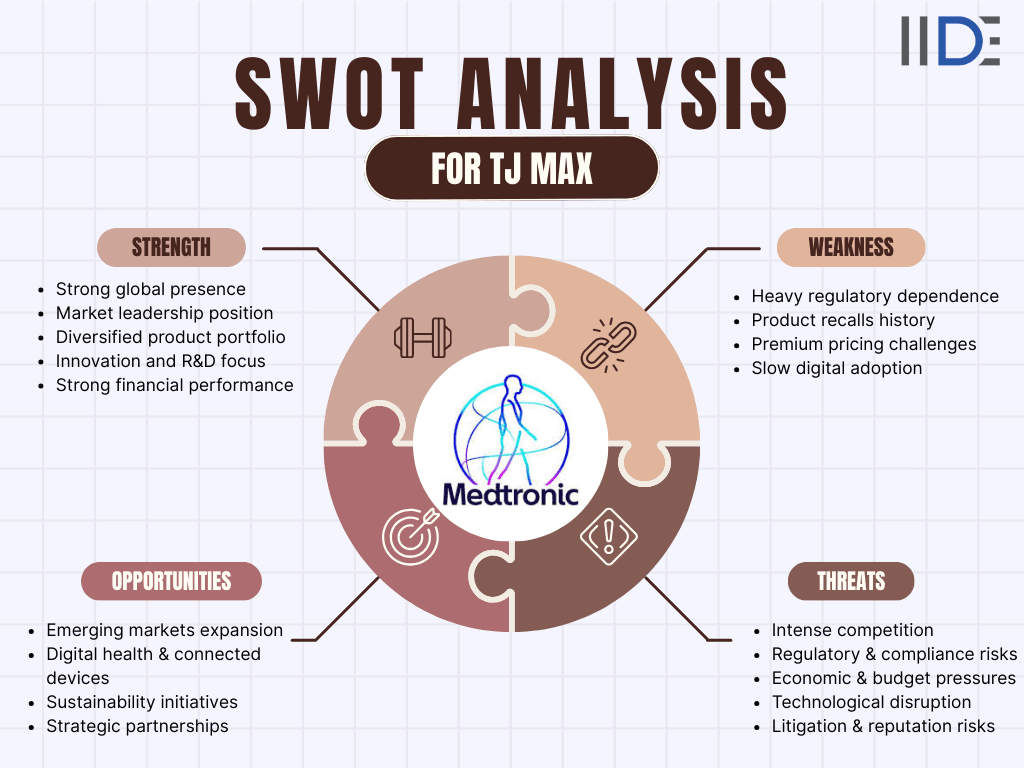
Medtronic has established itself as a dominant force in the global medical technology industry through innovation, scale, and trust. Its strengths lie not just in advanced products, but also in its ability to adapt to changing healthcare needs while maintaining strong relationships with hospitals and healthcare professionals worldwide.
1. Strong Global Presence and Market Leadership
- Medtronic operates in 150 plus countries, making it one of the most geographically diversified medical technology companies in the world.
- The brand holds leading positions in multiple categories, including cardiac rhythm management, spinal solutions, and diabetes care.
- Its global scale allows Medtronic to balance risks across markets and maintain steady revenue streams.
- The company consistently ranks among the top medical device companies globally by revenue.
2. Diversified and Innovative Product Portfolio
- Medtronic offers a wide range of products across cardiac care, neuroscience, surgical solutions, and diabetes management.
- Flagship product lines such as pacemakers, insulin pumps, and minimally invasive surgical tools strengthen its leadership.
- This diversification reduces dependence on a single therapy area and supports long term stability.
- Continuous product upgrades help Medtronic stay competitive in a fast evolving healthcare environment.
3. Strong Focus on Research and Development
- Medtronic invests billions of dollars annually in research and development, reinforcing its innovation driven culture.
- Advanced technologies like AI assisted surgical systems and connected medical devices improve patient outcomes.
- Ongoing clinical trials and product innovations keep the brand relevant in 2026 and beyond.
- This strong R and D pipeline supports sustainable growth and differentiation.
4. Trusted Brand Reputation in Healthcare
- Medtronic has built decades of trust among doctors, hospitals, and healthcare systems.
- Its devices are often preferred due to reliability, safety standards, and clinical effectiveness.
- Long standing relationships with healthcare providers create high entry barriers for new competitors.
- Trust plays a critical role in medical purchasing decisions, giving Medtronic a strong competitive edge.
5. Strong Financial Performance and Operational Scale
- Medtronic generates tens of billions of dollars in annual revenue, enabling large scale investments.
- Strong cash flows support acquisitions, innovation, and global expansion.
- Operational scale helps optimize manufacturing, distribution, and supply chain efficiency.
- Financial stability strengthens Medtronic’s ability to navigate economic uncertainty in 2026.
Weakness of Medtronic
While Medtronic is a global leader in medical technology, it also faces several weaknesses that can impact its growth and profitability. Understanding these limitations is important, especially as the healthcare industry becomes more cost conscious, regulated, and technology driven.
1. Heavy Dependence on Regulatory Approvals
- Medtronic operates in a highly regulated industry where product approvals can take years.
- Delays in regulatory clearances can slow down product launches and affect revenue timelines.
- Compared to smaller health tech startups, Medtronic often moves slower due to compliance requirements.
- Regulatory setbacks can increase development costs and reduce competitive agility.
2. Product Recalls and Quality Concerns
- Like many large medical device companies, Medtronic has faced product recalls in the past.
- Recalls can impact brand trust among healthcare providers and patients.
- They also lead to additional costs related to compliance, replacements, and legal processes.
- Competitors with fewer recall incidents may gain a temporary trust advantage.
3. Premium Pricing in Cost Sensitive Markets
- Medtronic’s products are often priced at a premium due to advanced technology and safety standards.
- This creates challenges in emerging and price sensitive markets.
- Hospitals under budget pressure may opt for lower cost alternatives offered by competitors.
- Pricing pressure can limit market share growth and impact long term profitability.
4. Slower Adoption of Consumer Facing Digital Health
- Compared to newer digital health companies, Medtronic has been slower in building consumer friendly platforms.
- Startups focusing on app based health monitoring often offer more intuitive digital experiences.
- This gap can reduce engagement with tech savvy patients and younger demographics.
- Falling behind in digital adoption could weaken Medtronic’s competitive position over time.
5. Operational Complexity at a Global Scale
- Operating across multiple regions increases supply chain and operational complexity.
- Managing diverse regulations, logistics, and market demands adds cost and inefficiency.
- Smaller competitors can often adapt faster to local market changes.
- High operational complexity can limit flexibility in a rapidly changing healthcare environment.
Opportunities for Medtronic
Medtronic has several promising opportunities to expand its impact and strengthen its position in the rapidly evolving medical technology industry. By aligning with global healthcare trends and leveraging its existing strengths, the brand can drive future growth and innovation.
1. Growing Demand for Minimally Invasive Procedures
- Patients and hospitals increasingly prefer less invasive surgeries that reduce recovery time.
- Medtronic can expand its portfolio of minimally invasive devices and robotic surgical tools.
- This trend aligns with the brand’s expertise in advanced surgical technologies.
- Offering cost effective solutions in this space can enhance adoption and market share.
2. Expansion into Emerging Markets
- While Medtronic has a strong presence globally, emerging markets in Asia, Africa, and Latin America remain high potential.
- Localizing products and pricing for these markets can drive revenue growth.
- Partnerships with regional healthcare providers can accelerate adoption and trust.
- Leveraging its global reputation makes market entry easier than smaller competitors.
3. Digital Health and Connected Devices
- The shift toward data driven healthcare opens opportunities for connected devices and remote patient monitoring.
- Medtronic can develop app-based platforms for patients using insulin pumps or cardiac devices.
- Digital tools improve patient engagement and strengthen the brand’s presence in tech-driven healthcare.
- Early adoption in these areas positions Medtronic ahead of smaller digital health startups.
4. Sustainability and Responsible Manufacturing
- Hospitals and healthcare systems are increasingly focused on sustainability and environmentally responsible sourcing.
- Medtronic can innovate with eco-friendly materials, energy-efficient production, and waste reduction.
- These initiatives not only meet regulatory expectations but also appeal to socially conscious stakeholders.
- Sustainability efforts can improve brand reputation and long-term viability.
5. Strategic Collaborations and Partnerships
- Collaborating with tech companies, research institutions, and healthcare startups can accelerate innovation.
- Joint pilot projects, clinical trials, or AI enabled medical devices can strengthen Medtronic’s market leadership.
- These partnerships allow faster integration of cutting-edge technologies without compromising safety or quality.
- Strategic alliances expand both brand influence and operational capability in 2026 and beyond.
Threats to Medtronic
Despite its strong market position, Medtronic faces several external threats that could affect its growth, profitability, and long-term leadership in the medical technology sector. Recognizing these threats is essential for strategic planning and risk management.
1. Intense Competition
- Medtronic faces strong competition from established companies like Abbott, Boston Scientific, and Johnson and Johnson.
- Emerging digital health startups offering AI-driven diagnostics and wearable medical devices add pressure to innovate faster.
- Competitors with more agile operations may capture market share in fast-growing segments like remote patient monitoring.
2. Regulatory and Compliance Risks
- Strict global regulations can delay product approvals or require costly adjustments.
- Changes in healthcare laws, device standards, or reimbursement policies could limit sales in key markets.
- Regulatory non-compliance or product recalls can harm brand reputation and trust among healthcare providers.
3. Economic Pressures and Healthcare Budgets
- Economic downturns, inflation, and budget constraints in hospitals can reduce demand for premium medical devices.
- Price-sensitive markets may opt for cheaper alternatives, affecting revenue growth.
- Global supply chain disruptions can increase costs and delay deliveries, impacting profitability.
4. Technological Disruption
- Rapid advancements in AI, digital health, and wearable technologies require continuous innovation.
- Medtronic risks falling behind smaller, tech-focused competitors if digital adoption is slow.
- Patient expectations for connected devices and remote monitoring are rising, and failure to meet them could reduce market relevance.
5. Public Perception and Litigation Risks
- Any adverse events, product recalls, or clinical failures can impact patient trust and brand reputation.
- Increased scrutiny from media and regulatory bodies can amplify the effects of minor operational issues.
- Legal challenges or patent disputes may divert resources and affect strategic focus.
Check out our detailed SWOT analysis of PharmEasy and understand how India's leading online pharmacy navigates the digital healthcare revolution.
IIDE Student Takeaway, Conclusion & Recommendations
Looking at Medtronic’s SWOT analysis, it’s clear that the brand is strong, innovative, and trusted, but like any global leader, it faces some big challenges. Its worldwide presence, diverse product portfolio, and reputation for reliability give it a serious advantage in the competitive medical tech space.
Core Tension: Medtronic has the scale, R and D power, and brand trust to stay ahead, but regulatory hurdles, premium pricing, and rapid digital disruption mean it can’t afford to stand still.
Future Outlook: To keep leading in 2026, Medtronic needs to focus on innovation, digital health, and smart market expansion. By playing to its strengths and addressing weaknesses, it can continue to be a go-to brand for hospitals and patients alike.
Recommendations
- Go Digital: Build more app-based monitoring tools and AI-enabled devices to stay in step with tech-savvy patients and hospitals.
- Expand Smartly: Tap into emerging markets in Asia, Africa, and Latin America with localized products and strong partnerships.
- Affordable Options: Introduce flexible pricing in cost-sensitive regions without compromising quality.
- Think Green & Compliant: Focus on eco-friendly production and maintain strict regulatory standards to keep trust high.
- Team Up: Collaborate with startups, research institutes, and hospitals to drive innovation and faster adoption.
By combining its global reach, innovation pipeline, and trusted reputation, Medtronic is well set to navigate challenges and grab new opportunities. If it embraces digital health, expands strategically, and stays patient-focused, it’s likely to remain a top player in medical technology for years to come.
Want to Know Why 2,50,000+ Students Trust Us?
Dive into the numbers that make us the #1 choice for career success



MBA - Level
Post Graduate in Digital Marketing & Business Strategy

Best For
Fresh Graduates

Mode of Learning
On Campus (Mumbai & Delhi)

Starts from
Oct 1, 2026

Duration
11 Months

Live & Online
Advanced Online Digital Marketing Course
Best For
Working Professionals
Mode of Learning
Online
Starts from
Sep 4, 2026
Duration
4-6 Months

Online
Professional Certification in AI Strategy
Best For
AI Enthusiasts
Mode of Learning
Online
Starts from
Sep 8, 2026
Duration
5 Months

Online or Offline
Top AI Courses to Make You Future Ready!
Best For
AI Enthusiasts
Mode of Learning
2–5 Month Program
Starts from
Sep 8, 2026
Duration
Flexiable

On Campus
Advanced Certification in Artificial Intelligence
Best For
AI Enthusiasts
Mode of Learning
On Campus (Mumbai)
Starts from
Sep 1, 2026
Duration
3 Months

Offline
Degree In 2026 ≠ Enough Degree + Digital Skills = Future-Ready
Best For
12th Passouts
Mode of Learning
At IIDE Campus
Starts from
Aug 31, 2026
Duration
3 Years

Offline
Undergraduate Program in Digital Business & Entrepreneurship
Best For
12th Passouts
Mode of Learning
On Campus (Mumbai)
Starts from
Aug 31, 2026
Duration
3 Years
Recent Post
Medtronic creates medical devices that help treat serious health conditions. Think pacemakers that regulate heartbeats, insulin pumps for diabetes management, devices for spine surgery, and tools that help surgeons perform minimally invasive procedures. Basically, if you or someone you know has a chronic condition, there's a good chance Medtronic makes something that helps treat it.
Yes, Medtronic is one of the most trusted names in medical technology with decades of clinical evidence backing its devices. Doctors and hospitals worldwide rely on their products because they meet strict safety standards. That said, like all medical device companies, they've had occasional recalls - but these are usually handled quickly and responsibly.
Medtronic devices are premium-priced, often costing thousands to tens of thousands of dollars depending on the device. A pacemaker, for example, can cost $20,000-$50,000 including the procedure. Most costs are covered by insurance or healthcare systems, but out-of-pocket expenses vary based on your coverage and location.
Absolutely. Millions of people worldwide live active, fulfilling lives with Medtronic devices. Pacemaker patients can exercise, travel, and work normally. Insulin pump users have better diabetes control with more freedom. Most devices are designed to improve your quality of life, not restrict it - though your doctor will provide specific guidance.
It depends on the device. Pacemakers typically last 7-10 years before the battery needs replacement. Insulin pumps are usually replaced every 4-5 years. Spinal implants may last decades. Your doctor will monitor your device and let you know when replacement or maintenance is needed.
Yes, many newer Medtronic devices come with apps and remote monitoring capabilities. For example, insulin pump users can track glucose levels and insulin delivery through smartphone apps. Cardiac patients can have their pacemakers monitored remotely by their doctor's office without frequent hospital visits.

Lead Trainer & Business Development Head at IIDE
Aditya Shastri leads the Business Development segment at IIDE and is a seasoned Content Marketing expert. With over a decade of experience, Aditya has trained more than 20,000 students and professionals in digital marketing, collaborating with prestigious institutions and corporations such as Jet Airways, Godrej Professionals, Pfizer, Mahindra Group, Publicis Worldwide, and many others. His ability to simplify complex marketing concepts, combined with his engaging teaching style, has earned him widespread admiration from students and professionals alike.
Aditya has spearheaded IIDE’s B2B growth, forging partnerships with over 40 higher education institutions across India to upskill students in digital marketing and business skills. As a visiting faculty member at top institutions like IIT Bhilai, Mithibai College, Amity University, and SRCC, he continues to influence the next generation of marketers.
Apart from his marketing expertise, Aditya is also a spiritual speaker, often traveling internationally to share insights on spirituality. His unique blend of digital marketing proficiency and spiritual wisdom makes him a highly respected figure in both fields.