
Students Centric
Placements Report
Trackable results, real numbers
Reviews
Proven success, real voices
Trainers
Expert-led, Industry-Driven Training
Life at IIDE
Vibrant Spirit student life
Alumni
Successful Journeys, Inspiring Stories
Learning Centre
Webinars
Blogs
Case studies
Live, Interactive Masterclasses
Fresh Insights, quick reads
Real-life, Industry relevant
More
Hire from us
Hire Top Digital Marketing Talent
Work with us
Join Our Team, Make an Impact
Customised Training
Personalised digital marketing training for your company
Refer & earn
Simple, easy rewards
Contact us
Get the answers you need
About us
Know more about IIDE
Explore all course options

FOR FRESH GRADUATES
Post Graduation Program in Digital Marketing & Business Strategy- Ideal for Age: 20–25 Years

Can’t decide? Explore all our
Digital Marketing Courses
COMPARE BOTH OUR PROGRAMSOffline
Offline AI Courses with Dual CertificationsIndustry-Aligned TRACKMost Popular
UG Program in Digital Business & Entrepreneurship- Ideal for 12th Pass out / FY Degree Student

PARTNER PROGRAMS






Can’t decide? Explore all
BBA In Digital Marketing Colleges
Orginally Written by Aditya Shastri
Updated on Jul 16, 2026
|1,573K+ views
F1Soft's SWOT in 2026 is the story of a company that built Nepal's entire financial digital infrastructure almost single-handedly and now must decide whether to double down on domestic dominance or bet its next decade on international markets.
Before diving into the article, I'd like to inform you that the research and initial analysis for this piece were conducted by Muluh Kevin, a current student in the IIDE's Online Digital Marketing Course batch, December 2025. If you found this helpful, feel free to send Muluh Kevin a quick note of appreciation it will mean a lot!
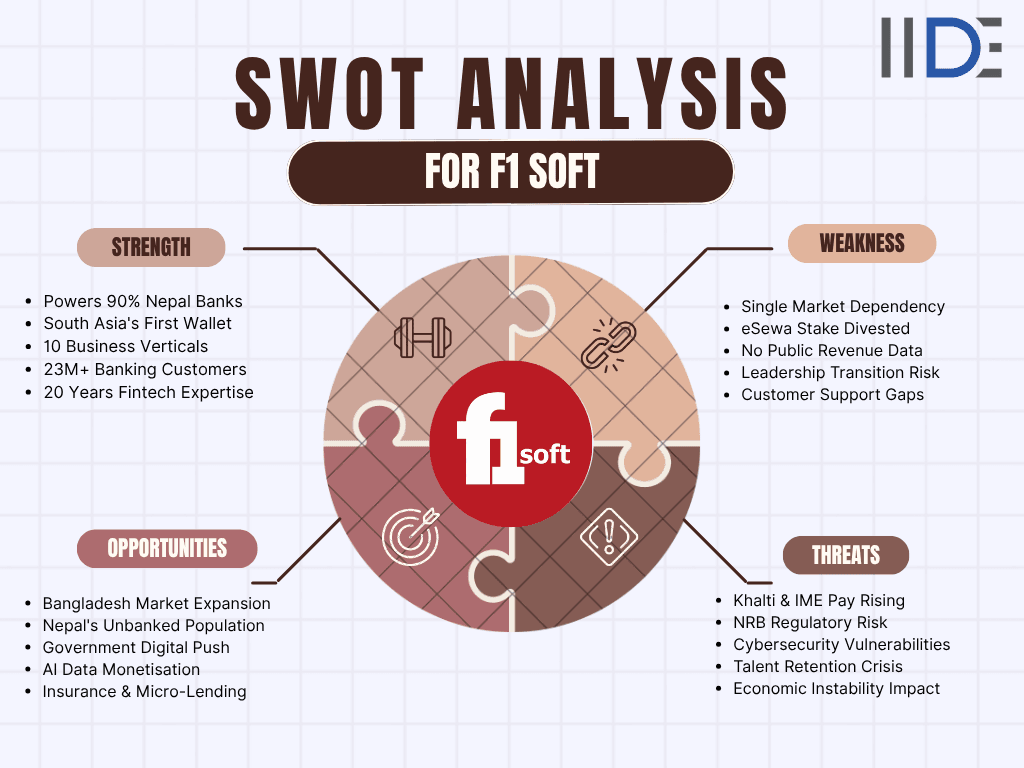
Before we break down each factor in detail, here is a snapshot of where F1Soft stands across all four dimensions:
| STRENGTHS | WEAKNESSES |
|---|---|
| Powers 90%+ of Nepal's banks 23M+ customers on BankXP | Almost all revenue comes from Nepal single market risk |
| 20+ years of fintech expertise first mover in every category | Divested 80% stake in eSewa biggest profit driver gone |
| 10 business verticals most diversified fintech in Nepal | No publicly disclosed group revenue or profit figures |
| South Asia's first digital wallet (eSewa, 2009) | New President appointed March 2025 leadership transition risk |
| 1,200+ employee group with 20 years of institutional knowledge | Customer support gaps during peak transaction periods |
| Fonepay holds 99% of Nepal's merchant payment market | Limited brand awareness outside Nepal |
| OPPORTUNITIES | THREATS |
| Bangladesh and global expansion already underway | Khalti and IME Pay growing fast with aggressive pricing |
| Nepal's unbanked population large untapped domestic market | Nepal Rastra Bank policy changes can shift rules overnight |
| Government's digital Nepal push public service payments | Cybersecurity breaches targeting Nepal's payment networks |
| FoneNXT and digital-only banking growing in demand | Global fintech players potentially entering Nepal |
| AI and big data monetisation via eXtensoData | Economic slowdown reducing digital transaction volumes |
| Insurance and micro-lending heavily underpenetrated in Nepal | Talent retention offshore salaries outbidding local pay |

Is Digital Marketing the Right Career for You?
Find out in a free 45-min masterclass · Career paths, roles and growth explained · By Karan Shah, Founder & CEO, IIDE

Is Digital Marketing the Right Career for You?
Find out in a free 45-min masterclass · Career paths, roles and growth explained · By Karan Shah, Founder & CEO, IIDE
Strengths of F1Soft
F1Soft's strengths are the cumulative result of two decades of patient infrastructure-building in a market where most global fintechs are completely ignored. Every strength below is an operational fact, not a marketing claim.
1. Powers 90%+ of Nepal's Banking Sector
- F1Soft's BankXP omnichannel banking platform is trusted by 50+ banks, delivering digital banking services to 23 million+ customers.
- The group built every layer of Nepal's digital banking stack from scratch: SMS Banking (2007), Internet Banking (2008), and BankSmart mobile banking app (2014).
- 90%+ of Nepal's banks and financial institutions use at least one F1Soft solution.
Why it matters: When 90% of an entire country's banking system runs on your infrastructure, switching costs are near-infinite. No competitor can displace F1Soft from its banking partnerships without displacing the banks themselves.
2. First-Mover Advantage Across Every Major Fintech Category
- eSewa (2009): South Asia's first digital wallet and Nepal's first payment gateway.
- Fonepay (2019): Nepal's first interoperable QR payment network, now holding 99% of merchant digital payments.
- FoneNXT (2022): Nepal's first digital-only Banking as a Service platform.
- Foneloan: Nepal's first fully digital collateral-free lending platform.
- Each of these was not just a product launch, but it was a market creation event with no existing playbook to follow.
Why it matters: First-mover advantage in fintech compounds over time. The first platform users adopt for a financial service is extremely hard to displace habits, trust, and network effects all reinforce the incumbent.
3. 10 Business Verticals Nepal's Most Diversified Fintech Group
- F1Soft operates across: F1Soft International (B2B banking tech), eSewa (digital wallet), Fonepay (payment network), Foneloan (digital lending), eSewa Money Transfer (remittance), FoneNXT (neo-banking), FoneInsure (insurtech), FonePoints (loyalty & rewards), eXtensoData (big data & AI), and Vidhypro Crafts (enterprise tech).
- No other fintech group in Nepal operates across this many verticals simultaneously.
Why it matters: Diversification means F1Soft is exposed to every growth vector in Nepal's digital economy at once. A slowdown in one vertical is cushioned by momentum in others, structural resilience that no single-product competitor can match.
4. 1,200+ Strong Team With 20 Years of Institutional Knowledge
- F1Soft employs 1,200+ people across all its verticals, the largest fintech workforce in Nepal.
- The leadership team spans bankers, technologists, AI specialists, and marketing experts across multiple subsidiary CEOs.
- Recognised as Nepal's highest taxpayer in the IT sector by the Government of Nepal in 2017.
Why it matters: Institutional knowledge in fintech is irreplaceable. A team that has built Nepal's banking infrastructure from SMS banking to AI-powered lending cannot be replicated by a new entrant with money alone.
5. International Awards and Institutional Validation
- Red Herring Top 100 Asia Award 2012
- FNCCI National Service Excellence Award 2013
- Stevie International Business Award 2014
- Nepal's highest IT sector taxpayer recognition 2017
- FoneNXT Platinum win at Infosys Finacle Innovation Awards 2024
Why it matters: International validation from credible institutions builds trust with enterprise clients, regulators, and potential global partners, particularly relevant as F1Soft expands beyond Nepal.
6. ISO 9001 Certified Quality Management
- F1Soft Group holds ISO 9001 certification for quality management systems, a globally recognised standard applied across its operations.
- This is in addition to PCI DSS and ISO 27001 certifications held by its Fonepay subsidiary.
Why it matters: Enterprise banking clients and government institutions require certified quality management before onboarding any technology partner. ISO 9001 is a procurement prerequisite that new competitors cannot fast-track.
To understand how F1Soft's most dominant payment subsidiary operates at scale, read our detailed SWOT Analysis of Fonepay.

Weaknesses of F1Soft
F1Soft's weaknesses are largely the structural consequences of 20 years of domestic-first growth and one major strategic decision in 2023 that changed the group's financial profile permanently.
1. Near-Total Nepal Market Dependency
- Despite operating 10 verticals, virtually all of F1Soft's revenue originates from Nepal, a country with a GDP of approximately $40 billion.
- Any domestic economic downturn, political disruption, or regulatory shift hits the entire group's revenue base simultaneously with no geographic buffer.
- Nepal has experienced multiple political transitions in recent years that directly affect consumer spending and institutional technology budgets.
Why it matters: Market concentration risk is the group's deepest structural vulnerability. Bangladesh's expansion has started, but meaningful revenue diversification is still years away from maturity.
2. eSewa Stake Divestment Biggest Profit Driver Gone
- F1Soft divested 80% of its stake in eSewa to its own shareholders, eSewa being the group's most profitable subsidiary.
- F1Soft now retains only 20% of eSewa, the brand it built from scratch in 2009, and Nepal's most recognised digital wallet.
- This divestment has directly reduced group-level consolidated revenue.
Why it matters: Divesting 80% of your most profitable unit while the replacement verticals are still early-stage is a high-risk structural bet. If new verticals don't generate equivalent returns in time, the revenue gap could widen further.
3. No Publicly Disclosed Group Revenue or Profit Data
- F1Soft is a private company and publishes no consolidated group revenue, profit, or growth figures.
- Third-party estimates vary significantly. F1Soft International (one arm) alone was estimated at $17.8M revenue in 2026, but group-level figures including all verticals are not publicly available.
- This lack of transparency limits verifiable authority for all content and analysis written about the company.
Why it matters: In an E-E-A-T world, brands and the content about them are penalised for unverifiable data. F1Soft's opacity limits its credibility ceiling with investors, partners, and international clients.
4. Leadership Transition Risk
- In March 2025, Biswas Dhakal transitioned from President to Chairman, with Siddhant Thakuri appointed as the new Group President.
- Thakuri, though previously Group COO, has not yet led F1Soft through a full business cycle as President.
- Leadership transitions at founder-led companies, especially in emerging markets, often carry execution risk during the handover period.
Why it matters: F1Soft's competitive position has been deeply tied to Biswas Dhakal's personal relationships with Nepal's banking sector and regulators. Managing that transition without disruption is a real operational challenge.
5. Customer Support Gaps at Scale
- As F1Soft's platforms serve 23M+ banking customers across mobile banking, eSewa, and Fonepay, complaint volume has scaled faster than support infrastructure.
- Delays in resolving user issues, particularly during peak transaction periods like festivals and salary days, generate persistent negative feedback across social media and app store reviews.
Why it matters: At 23M+ banking users, even a 1% service failure rate means 230,000 unhappy customers per incident. In financial services, support quality is not a nice-to-have; it is the product itself.
Opportunities for F1Soft
F1Soft's opportunity set in 2026 runs on two parallel tracks, deepening domestic penetration where large gaps remain, and exporting its B2B banking expertise to larger international markets where the same problems Nepal had in 2004 still exist today.
1. International Expansion: Bangladesh and Beyond
- Biswas Dhakal is personally leading F1Soft's international push into Bangladesh through a Dubai-based holding structure.
- Bangladesh has 170M+ population and a rapidly digitising banking sector actively seeking the kind of B2B banking infrastructure F1Soft has spent 20 years building in Nepal.
- F1Soft's BankXP platform, Foneloan, and FoneNXT are directly portable to markets at similar fintech development stages.
Why it matters: Nepal's domestic market has a structural ceiling. Bangladesh alone has 6x Nepal's population. Even 10% of Nepal-level penetration in Bangladesh would meaningfully diversify revenue and reduce single-market risk.
2. Nepal's Unbanked Population Largest Untapped Market
- Despite F1Soft's 23M+ banking customer base, a significant portion of Nepal's rural population remains unbanked or digitally underserved.
- Nepal Rastra Bank's financial inclusion mandate is actively pushing banks to onboard rural customers using digital platforms like F1Soft's mobile banking infrastructure.
- FoneNXT's digital-only banking model and Fonepay's offline payment capability are specifically designed for low-connectivity markets.
Why it matters: Every new Nepali who gets a bank account and smartphone is a potential F1Soft customer. Rural financial inclusion is both a government priority and F1Soft's largest remaining domestic growth pool.
3. Nepal Government's Digital Push for Public Services
- Nepal's government is actively promoting cashless payments across public services, tax payments, utility bills, government salaries, and transport.
- As the country's dominant banking technology provider, F1Soft is the natural infrastructure partner for the government's digital transition.
- Government contracts create recurring, high-volume transaction revenue with very low churn.
Why it matters: Government-mandated digital payment adoption creates captive transaction volume that no competitor can easily displace. F1Soft's relationships with 90%+ of Nepal's banks position it uniquely for public sector digital finance contracts.
4. AI and Big Data Monetisation via eXtensoData
- eXtensoData, F1Soft's big data and AI vertical established in 2018, sits on top of one of the richest financial transaction datasets in Nepal.
- As banks seek AI-powered credit scoring, fraud detection, and customer analytics, eXtensoData has a data moat that no new entrant can replicate.
- F1Soft's 20 years of transaction data across 90%+ of Nepal's banks is an asset whose commercial value is only beginning to be unlocked.
Why it matters: Financial data is the raw material of the AI economy. The organisation that owns the data owns the insight layer, and the insight layer commands the highest margins in the entire fintech stack.
5. Insurance and Micro-Lending Heavily Underpenetrated
- Nepal's insurance penetration rate remains very low by regional standards. FoneInsure is operating in a market with enormous headroom.
- Foneloan's digital micro-lending platform addresses a massive unmet credit need among Nepal's informal workers and small businesses.
- Both categories carry significantly higher margins than transaction processing fees.
Why it matters: Insurance and lending are recurring revenue businesses. If F1Soft converts even a fraction of its 23M+ banking customers into insurance and loan customers, revenue per user rises dramatically without new customer acquisition cost.
6. FoneNXT Digital-Only Banking Scaling Globally
- FoneNXT launched OrangeNxt in 2024, Nepal's first digital-only banking platform, winning a Platinum award at the Infosys Finacle Innovation Awards immediately after launch.
- Digital-only banking globally is growing as younger consumers prefer app-first financial services with no physical branch requirement.
- FoneNXT's BaaS model is directly exportable to banking partners in Bangladesh, Sri Lanka, and Southeast Asia.
Why it matters: Digital-only banking has significantly lower operating costs than traditional banking. A proven, award-winning BaaS platform is one of F1Soft's most internationally marketable assets.
Threats to F1Soft
F1Soft's threats come from regulation, competition, and the operational complexity of running 10 businesses simultaneously in a small, politically volatile market where a single policy change can reshape the entire landscape overnight.
1. Rising Fintech Competition: Khalti, IME Pay, and New Entrants
- Khalti, IME Pay, Prabhu Pay, and ConnectIPS are all actively competing for the same digital payment and wallet users that F1Soft's subsidiaries serve.
- Khalti in particular has received international venture capital backing, allowing it to sustain aggressive cashback campaigns and pricing that F1Soft must continuously respond to.
- NEPALPAY, backed by Nepal Clearing House, has institutional government support, giving it a structural legitimacy that is difficult to compete against.
Why it matters: Being first does not guarantee staying first. Well-funded competitors who don't need short-term profitability can undercut F1Soft's consumer-facing pricing and erode user loyalty faster than product improvements can recover it.
2. Nepal Rastra Bank Regulatory Risk
- NRB controls licensing, operating conditions, fee structures, and interoperability rules for every digital financial service F1Soft operates across all its verticals.
- Any change in NRB policy on wallet limits, interchange fees, PSO conditions, or data localisation can fundamentally alter multiple F1Soft business models simultaneously.
- Nepal has seen multiple NRB governor changes and regulatory shifts in recent years, each creating uncertainty across the entire fintech sector.
Why it matters: A company whose entire revenue base sits inside one regulatory jurisdiction faces the maximum possible concentration of policy risk. NRB decisions that affect one F1Soft vertical frequently affect all of them at once.
3. Cybersecurity Nepal's Single Highest-Value Target
- As the group running 90%+ of Nepal's banking infrastructure, F1Soft is the single highest-value cybersecurity target in the country.
- A successful breach of F1Soft's core banking platform would simultaneously affect the majority of Nepal's financial system, a systemic risk no other company in Nepal carries.
- Digital fraud incidents in Nepal have been increasing year-on-year in line with digital adoption growth.
Why it matters: One significant security breach could damage F1Soft's 20-year institutional trust with Nepal's banks, the foundation on which the entire group is built. Recovery from a systemic banking breach is measured in years, not months.
4. Talent Retention in a Competitive Market
- Nepal's best technology talent is increasingly recruited by Indian, Southeast Asian, and global tech companies offering offshore salaries that F1Soft's domestic pay structure cannot easily match.
- The group's 1,200+ employee team represents a 20-year accumulation of institutional fintech knowledge that is extremely difficult and expensive to replace.
Why it matters: F1Soft's competitive advantage is built on human expertise, not proprietary hardware. If experienced engineers and product managers leave for higher-paying offshore roles, the knowledge moat begins to erode faster than it can be rebuilt.
5. Economic Instability Reducing Transaction Volumes
- Nepal's economy has faced inflation, remittance income volatility, and political uncertainty in recent years, all directly affecting consumer spending and digital transaction frequency.
- When household budgets tighten, discretionary digital transactions decline, directly impacting Fonepay's volume-based revenue and eSewa's transaction fee income.
Why it matters: F1Soft's fintech revenue is directly correlated with Nepal's economic health. Unlike SaaS subscription revenue, transaction-based fintech income rises and falls with consumer spending, amplifying macro risk with no natural hedge.
6. Strategic Overstretch Managing 10 Verticals Simultaneously
- Managing 10 business verticals from insurtech to big data to neo-banking with a single group leadership team creates execution risk across the board.
- Post-eSewa divestment, F1Soft must now generate meaningful returns from newer, less-proven verticals under a newly appointed President with no prior full-cycle leadership experience at the group level.
Why it matters: The most dangerous failure mode for a diversified conglomerate is not a single catastrophic failure; it is gradual underperformance across all verticals as management attention is spread too thin to drive excellence in any one of them.
About F1Soft Group
F1Soft Group is Nepal's largest fintech company, founded in 2004 by Biswas Dhakal as a web development firm that pivoted into digital finance starting in 2006.
In just two decades, it built Nepal's most comprehensive financial technology ecosystem, powering 90%+ of Nepal's banks through its BankXP platform, serving 23 million+ customers, launching South Asia's first digital wallet (eSewa, 2009), and establishing Fonepay as the country's dominant payment network. Today, the Group operates 10 official business verticals with 1,200+ employees across the full group.
| Parameter | Details |
|---|---|
| Company Name | F1Soft Group (F1Soft International Pvt. Ltd.) |
| Founded | 2004, Kathmandu, Nepal |
| Founder & Chairman | Biswas Dhakal (transitioned to Chairman, March 2025) |
| President | Siddhant Thakuri (appointed March 2025, previously COO) |
| Group CMO | Adwait Ratna Tuladhar |
| Group CIO | Akbar Khan |
| Headquarters | Lalitpur (Patan), Kathmandu, Nepal |
| Employees | 1,200+ across full group (F1Soft International arm: 749 as of Dec 2025) |
| Banks & FIs Powered | 50+ banks; 90%+ of Nepal's banking sector |
| Mobile Banking Customers | 23 million+ via BankXP platform |
| Business Verticals | 10 official verticals (eSewa, Fonepay, Foneloan, FoneNXT, eSewa Money Transfer, FoneInsure, FonePoints, eXtensoData, Vidhypro, F1Soft International) |
| ISO Certification | ISO 9001 (Quality Management) |
| Investment | First Global Data -May 2017 |
| Key Competitors | Khalti, IME Pay, Prabhu Pay, NEPALPAY, ConnectIPS |
| International Presence | Bangladesh (via Dubai-based F1Soft International) |
What's Happening with F1Soft in 2026?
- On F1Soft's 21st anniversary in March 2025, Biswas Dhakal officially transitioned to Chairman and Siddhant Thakuri, previously Group COO, was appointed as the new President of F1Soft Group.
- F1Soft divested 80% of its stake in eSewa, its most profitable subsidiary, to its own shareholders, directly impacting group revenue.
- F1Soft distributed a 200% dividend on paid-up capital in 2022 and a 100% dividend in 2023, some of the highest dividend payouts in Nepal's private tech sector.
- FoneNXT launched OrangeNxt in 2024, Nepal's first digital-only banking platform, and secured a Platinum win at the Infosys Finacle Innovation Awards.
- Biswas Dhakal is personally leading F1Soft's international expansion into Bangladesh through a Dubai-based holding structure.
- Fonepay F1Soft's payment processing vertical processed a record 1,002,702 merchant QR payments in a single day on March 30, 2025.
Key Takeaways & Conclusion
F1Soft's story is Nepal's fintech story; they are essentially the same narrative. Over 20 years, Biswas Dhakal and his team built the mobile banking infrastructure for 90%+ of Nepal's banks, launched South Asia's first digital wallet, created Fonepay as the country's dominant payment network, and assembled 10 verticals covering every corner of the financial services stack. That is a genuinely remarkable achievement for a company that started by registering domains in Kathmandu in 2004.
The 2025-26 inflexion point is real and consequential. A leadership transition, the divestment of 80% of eSewa, the group's most profitable subsidiary and the pressure to generate returns from newer verticals have all arrived simultaneously. The Bangladesh expansion is the most strategically important long-term move: if F1Soft can export its B2B banking infrastructure model to larger South Asian markets, the Nepal revenue concentration problem resolves itself over time.
The assets are extraordinary. The market opportunity is clear. The execution question focused international expansion with disciplined vertical management is what the next chapter of F1Soft's story will be decided by.
Recommendations:
- Prioritise Bangladesh B2B banking expansion. This is the highest-ROI use of F1Soft's core expertise and the clearest path to meaningful revenue diversification
- Publish basic group metrics annually, including consolidated transaction volume, employee count, and key milestones, to strengthen E-E-A-T and build investor confidence under new leadership
- Invest aggressively in eXtensoData's AI capabilities. This is F1Soft's most differentiated long-term asset and the most exportable product to international markets
- Build a formal enterprise-grade cybersecurity response infrastructure as the backbone of Nepal's banking system; a breach at F1Soft is a national financial event, not just a company incident
- Consolidate vertical portfolio focus, capital, and management attention on the 4-5 verticals with the clearest international export potential rather than maintaining 10 simultaneously
Want to Know Why 2,50,000+ Students Trust Us?
Dive into the numbers that make us the #1 choice for career success


MBA - Level
Post Graduate in Digital Marketing & Business Strategy

Best For
Fresh Graduates

Mode of Learning
On Campus (Mumbai & Delhi)

Starts from
Nov 27, 2026

Duration
11 Months

Live & Online
Advanced Online Digital Marketing Course
Best For
Working Professionals
Mode of Learning
Online
Starts from
Nov 2, 2026
Duration
4-6 Months

Offline
Top AI Courses to Make You Future Ready!
Best For
AI Enthusiasts
Mode of Learning
2–5 Month Program
Starts from
Nov 24, 2026
Duration
Flexiable
Offline
Undergraduate Program in Digital Business & Entrepreneurship
Best For
12th Passouts
Mode of Learning
On Campus (Mumbai)
Duration
3 Years
Offline
Degree In 2026 ≠ Enough Degree + Digital Skills = Future-Ready
Best For
12th Passouts
Mode of Learning
At IIDE Campus
Duration
3 Years
Recent Post
The swot analysis of F1Soft highlights how the company has influenced digital finance in Nepal, from pioneering mobile banking to handling growing competition, offering a clear view of its impact and areas it needs to improve.
The swot analysis of F1Soft offers valuable insights into how one of Nepal's leading fintech companies operates, adapts to market demands, and handles rising competition in the digital payment space.
Some key strengths found in the swot analysis of F1Soft include its market dominance, large customer base, strong partnerships with banks, and its ability to create locally relevant tech solutions.
According to the swot analysis of F1Soft, weaknesses include heavy reliance on the local market, cybersecurity concerns, and occasional gaps in customer support.
F1Soft stands out due to its early presence in the market, diverse product ecosystem (like mobile banking platforms), and wide adoption among Nepali users. The swot analysis of F1Soft also highlights its innovative edge over competitors.
The swot analysis of F1Soft points to expansion in rural markets, deeper fintech integration, and potential partnerships with international tech firms as some of the major opportunities for growth.
Absolutely. The swot analysis of F1Soft is useful for entrepreneurs and marketers to understand how a company leverages its strengths and handles challenges in a growing digital economy.


Lead Trainer & Business Development Head at IIDE
Aditya Shastri leads the Business Development segment at IIDE and is a seasoned Content Marketing expert. With over a decade of experience, Aditya has trained more than 20,000 students and professionals in digital marketing, collaborating with prestigious institutions and corporations such as Jet Airways, Godrej Professionals, Pfizer, Mahindra Group, Publicis Worldwide, and many others. His ability to simplify complex marketing concepts, combined with his engaging teaching style, has earned him widespread admiration from students and professionals alike.
Aditya has spearheaded IIDE’s B2B growth, forging partnerships with over 40 higher education institutions across India to upskill students in digital marketing and business skills. As a visiting faculty member at top institutions like IIT Bhilai, Mithibai College, Amity University, and SRCC, he continues to influence the next generation of marketers.
Apart from his marketing expertise, Aditya is also a spiritual speaker, often traveling internationally to share insights on spirituality. His unique blend of digital marketing proficiency and spiritual wisdom makes him a highly respected figure in both fields.