
Students Centric
Placements Report
Trackable results, real numbers
Reviews
Proven success, real voices
Trainers
Expert-led, Industry-Driven Training
Life at IIDE
Vibrant Spirit student life
Alumni
Successful Journeys, Inspiring Stories
Learning Centre
Webinars
Blogs
Case studies
Live, Interactive Masterclasses
Fresh Insights, quick reads
Real-life, Industry relevant
More
Hire from us
Hire Top Digital Marketing Talent
Work with us
Join Our Team, Make an Impact
Customised Training
Personalised digital marketing training for your company
Refer & earn
Simple, easy rewards
Contact us
Get the answers you need
About us
Know more about IIDE
Explore all course options

FOR FRESH GRADUATES
Post Graduation Program in Digital Marketing & Business Strategy- Ideal for Age: 20–25 Years

Can’t decide? Explore all our
Digital Marketing Courses
COMPARE BOTH OUR PROGRAMSOffline
Offline AI Courses with Dual CertificationsIndustry-Aligned TRACKMost Popular
UG Program in Digital Business & Entrepreneurship- Ideal for 12th Pass out / FY Degree Student

PARTNER PROGRAMS






Can’t decide? Explore all
BBA In Digital Marketing Colleges
Orginally Written by Aditya Shastri
Updated on Nov 18, 2025
Share on:


One of the top fast-casual dining options in 2024-2025 is Chipotle Mexican Grill, which is well-known for its "Mission" style Mexican cuisine, bowls, and made-to-order burritos. The brand has grown rapidly, demonstrated robust financial growth, and boosted its market share in drive-thru/Chipotlane and digital sales.
However, recent indications of inflation, cost increases, and consumer reversal have created new difficulties.
Why should business students and entrepreneurs care? because Chipotle serves as an example of how to scale profitably under duress while striking a balance between cost control, operations, and menu innovation. Its next three to five years of growth will probably be determined by how it manages the trade-offs now.
This SWOT analysis uncovers how Chipotle balances profitability, innovation, and growth in an increasingly competitive fast-casual market.
Before you begin reading, please note that the research and preliminary analysis for this article were carried out by Gargi Shukla, a student from IIDE’s Online Digital Marketing Course, May 2025 batch. If you find this article valuable, feel free to reach out to Gargi Shukla with a note of appreciation for her excellent research - she’d love to hear your feedback!"
About Chipotle
Chipotle Mexican Grill, Inc. was founded in 1993 by Steve Ells and is based in Newport Beach, California. Serving authentic, ethically sourced food that is freshly prepared and free of artificial preservatives is its goal. The brand is recognized for its “Food with Integrity” philosophy, strong brand awareness, and commitment to high-quality, customizable menu options including plant-based and vegan choices.
With around 3,500 locations, Chipotle leads the fast-casual sector by expanding digital ordering, drive-through “Chipotlane” formats, and innovative menu additions like lifestyle and health-focused bowls. Continuous investment in sustainability, customer loyalty programs, and strategic partnerships (such as with delivery apps) further position Chipotle as a category leader heading into 2024–2025.
| Attribute | Details |
|---|---|
| Official Name | Chipotle Mexican Grill, Inc. |
| Founded | 1993 |
| Founders | Steve Ells |
| Headquarters | Newport Beach, California, USA |
| Key Industries |
Fast-casual dining, food service, Mexican-style cuisine |
| Geography |
USA, Canada, UK, France, Germany, UAE, Kuwait etc. |
| 2024 Revenue | US$ 11.31 billion (14.6 % increase YoY) |
Why SWOT Analysis Matters for Chipotle?
- Inflation (on labor and food) and changing consumer spending as the economy tightens are putting pressure on the fast-casual restaurant industry.
- Value, digital ordering, and the ease of drive-through and delivery are becoming more and more popular among consumers. Additionally, the sourcing of ingredients, sustainability, and health are more important.
- Efficiency expectations are changing as a result of operational and technological advancements like automation, artificial intelligence, and kitchen equipment.
- Similar to other fast-casual giants like McDonald’s and KFC, Chipotle faces growing competition from both traditional quick-service restaurants (QSRs) and digital-first brands that focus on convenience and personalization.
- Investors must comprehend Chipotle's advantages and disadvantages in order to determine its value and forecast its potential for future expansion.
Reviewing its SWOT analysis now provides critical insights into where Chipotle can gain new momentum as well as areas where significant challenges may arise.

Is Digital Marketing the Right Career for You?
Find out in a free 45-min masterclass · Career paths, roles and growth explained · By Karan Shah, Founder & CEO, IIDE

Is Digital Marketing the Right Career for You?
Find out in a free 45-min masterclass · Career paths, roles and growth explained · By Karan Shah, Founder & CEO, IIDE
SWOT Analysis of Chipotle
1. Strengths
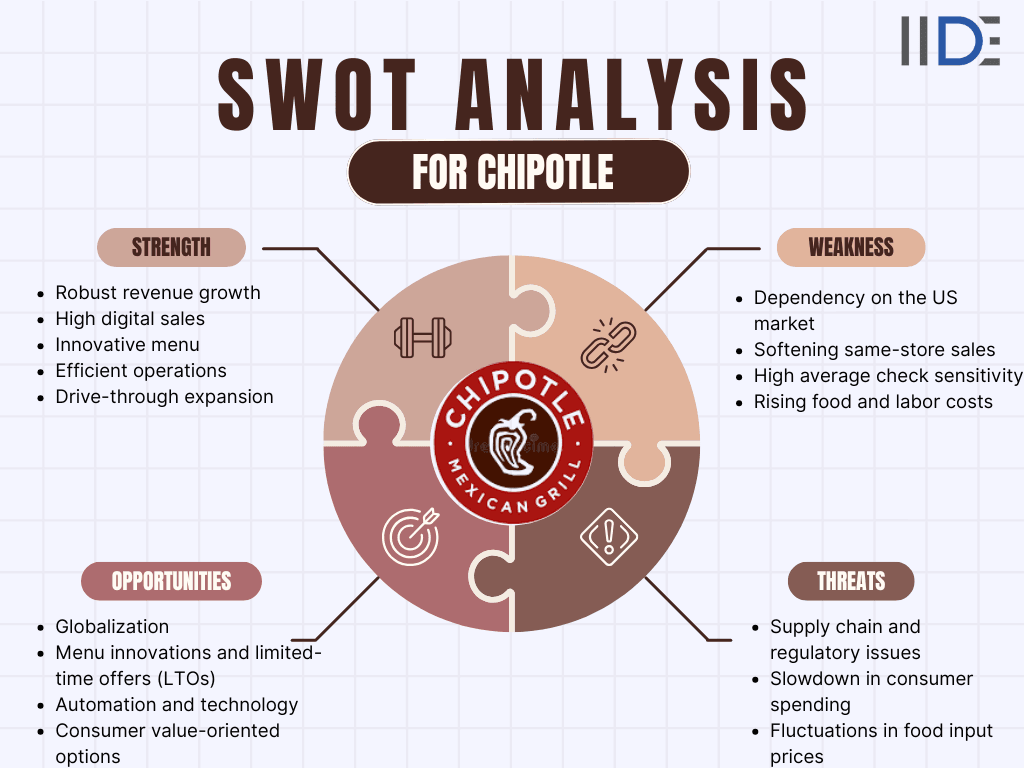
- Solid Financial Performance: In 2024, Chipotle’s total revenue reached US$11.31 billion, up ~14.6% YoY. Comparable restaurant sales grew ~7.4%.
- Expansion & Footprint Growth: It opened 304 company-owned restaurants in 2024, of which 257 had a Chipotlane drive-through pick-up component. Total locations reached 3,726.
- Digital & Convenience Channels: Digital sales represented about 35% of food & beverage revenue in 2024. Chipotlane formats enhance convenience.
- Strong Brand & Menu Innovation: Successful limited time offers (LTOs) like Smoked Brisket, Brisket promotions; culinary credibility; commitment to responsibly sourced ingredients. These maintain customer interest.
- Operational Efficiency & Margin Expansion: Operating margin improved; restaurant-level margins are high in the fast-casual sector; leveraging same-store sales and throughput improvements.
2. Weaknesses
- Rising Food & Labor Costs: Inflation of avocados, dairy, other input items increased costs. Labour wages also rising. These impact margins.
- Margin Pressure on Restaurant Level: While overall margins improved, restaurant level operating margin saw a slight decline (Q4 2024 vs Q4 2023) partly due to food cost shifts and protein mix choices.
- Dependency on US Market & Exchange Rate/Global Risks: Although there is some international presence, the majority of restaurants and revenue are concentrated in the U.S. Any economic or regulatory issues domestically more strongly affect chipotle.
- Weakening Same-Store Sales Growth in Early 2025: Q1 2025 saw comparable restaurant sales drop ~0.4% YoY. That indicates consumers are spending less or visiting less frequently.
- High Price Sensitivity Among Consumers: As average check increases and inflation makes costs visible to consumers, value expectations rise. Chipotle’s positioning as “premium fast casual” means it is more exposed than lower cost alternatives.
Explore the marketing strategy of Chipotle to see how its creative promotions and focus on real, sustainable ingredients set it apart in the industry.
3. Opportunities
- Further International Expansion: Growing presence in Europe, Middle East, and potential other markets with adaptation. This could diversify revenue.
- Menu Innovation and Limited Time Offers (LTOs): New offerings (e.g. honey chipotle chicken, chimichurri sauces) attract adventurous eaters and can drive visits.
- Enhancing Convenience Formats: Continuing expansion of Chipotlane drive-throughs, improving delivery/digital channels; for busy consumers this is critical.
- Technology & Automation: There are moves to improve kitchen equipment, automation in order taking/prep, etc. These can reduce costs, improve throughput, and consistency.
- Value & Promotions: In a tougher economic climate, offering value bundles or tiered pricing might help retain customers who are price conscious.
- Sustainability & Responsible Sourcing: As consumers care more about ethical sourcing, health, environmental impact, Chipotle’s existing commitments could be leveraged for marketing differentiation.
4. Threats
- Inflation & Volatility in Food Costs: Key inputs (meat, dairy, produce, especially items like avocados) are subject to weather, supply chain issues, trade disruptions. This threatens margin stability.
- Consumer Spending Slowdown: With economic uncertainty, inflation, potential recession, consumers may reduce dining out or shift to cheaper options. The drop in same-store sales in early 2025 suggests this risk.
- Competition Intensifying: Other fast-casual chains, fast food chains improving offerings, and local players can erode market share. Also new entrants with tech/delivery focus.
- Regulatory & Supply Chain Risks: Regulations on labour, food safety, imports, sustainability. Any disruption (tariffs, regulatory changes, health-related issues) can impose costs or restrict operations.
- Operational Challenges & Consumer Trends: If menu innovation fails, or digital/drive-through experiences are poor, brand reputation suffers. Also, consumer preferences (health-, diet-trends) may shift away from offerings not aligned.
IIDE Student Takeaway, Conclusion & Recommendations
Key Findings
- With strong revenue growth, efficient expansion, and a significant portion of revenue from digital channels, Chipotle is still financially strong.
- But there are real and growing economic headwinds, slowing comps, and cost pressures.
Biggest Advantage vs Biggest Risk
- Advantage: A strong brand, innovative products, and convenient formats (digital and Chipotlanes) that suit the tastes of modern consumers.
- Risk: Declining same-store sales and rising input costs could reduce margins and profitability if not properly managed.
Recommendations
1. Hedge and manage cost volatility
- Increase the number of suppliers you work with; use locking contracts or buy hedges for ingredients that are volatile (meat, dairy, and avocados).
- Examine menu changes (protein combinations, seasonal dishes) to balance price and appeal.
2. Focused international growth
- Find markets with comparable fast-casual tastes, then modify the format and menu as necessary.
- Expanding internationally contributes to risk diversification.
3. Enhance value perception without diluting brand
- Offer value packages or temporary price reductions to attract customers when the economy is tightening.
- To preserve premium positioning, maintain quality.
4. Invest in operational efficiency and automation
- Continue implementing technology that minimizes waste and expedites order preparation.
- Improve staffing and training, and concentrate on drive-through and Chipotlane throughput.
5. Monitor consumer trends & maintain flexibility
- Observe changes in eating habits and demands for sustainability and health.
- When customer behavior shifts, be prepared to adjust your menu, promotions, and formats.
Future Outlook Question
In a world where consumers are more price-sensitive than ever, can Chipotle successfully strike a balance between cost control and ongoing innovation and growth?
Want to Know Why 2,50,000+ Students Trust Us?
Dive into the numbers that make us the #1 choice for career success



MBA - Level
Post Graduate in Digital Marketing & Business Strategy

Best For
Fresh Graduates

Mode of Learning
On Campus (Mumbai & Delhi)

Starts from
Nov 27, 2026

Duration
11 Months

Live & Online
Advanced Online Digital Marketing Course
Best For
Working Professionals
Mode of Learning
Online
Starts from
Oct 7, 2026
Duration
4-6 Months

Offline
Top AI Courses to Make You Future Ready!
Best For
AI Enthusiasts
Mode of Learning
2–5 Month Program
Starts from
Nov 23, 2026
Duration
Flexiable

Offline
Undergraduate Program in Digital Business & Entrepreneurship
Best For
12th Passouts
Mode of Learning
On Campus (Mumbai)
Starts from
-
Duration
3 Years

Offline
Degree In 2026 ≠ Enough Degree + Digital Skills = Future-Ready
Best For
12th Passouts
Mode of Learning
At IIDE Campus
Starts from
-
Duration
3 Years
Recent Post
Recent menu innovations at Chipotle include the introduction of Lifestyle Bowls, more vegan and vegetarian options, and limited-time offerings that cater to changing customer tastes.
Digital ordering, mobile apps, and partnerships with delivery platforms now account for a significant portion of Chipotle's sales, boosting convenience and customer engagement.
Chipotle invests in sustainable sourcing, eco-friendly packaging, carbon emissions reduction, and ethical ingredient procurement to strengthen its brand and appeal to conscious consumers.
Despite being a market leader in the US, Chipotle's global footprint is still limited, though it is slowly expanding international operations in select regions.
Chipotle sets itself apart with fresh ingredients, a unique brand identity, digital convenience, and a focus on speed and quality - but faces ongoing pressure from other fast-casual and quick-service chains.
Financially, Chipotle boasts healthy profit margins, consistent revenue growth, and strong cash reserves that support expansion and innovation.
Global growth presents risks such as adapting to local tastes, regulatory differences, supply chain challenges, and increased operational costs.

Lead Trainer & Business Development Head at IIDE
Aditya Shastri leads the Business Development segment at IIDE and is a seasoned Content Marketing expert. With over a decade of experience, Aditya has trained more than 20,000 students and professionals in digital marketing, collaborating with prestigious institutions and corporations such as Jet Airways, Godrej Professionals, Pfizer, Mahindra Group, Publicis Worldwide, and many others. His ability to simplify complex marketing concepts, combined with his engaging teaching style, has earned him widespread admiration from students and professionals alike.
Aditya has spearheaded IIDE’s B2B growth, forging partnerships with over 40 higher education institutions across India to upskill students in digital marketing and business skills. As a visiting faculty member at top institutions like IIT Bhilai, Mithibai College, Amity University, and SRCC, he continues to influence the next generation of marketers.
Apart from his marketing expertise, Aditya is also a spiritual speaker, often traveling internationally to share insights on spirituality. His unique blend of digital marketing proficiency and spiritual wisdom makes him a highly respected figure in both fields.