
Students Centric
Placements Report
Trackable results, real numbers
Reviews
Proven success, real voices
Trainers
Expert-led, Industry-Driven Training
Life at IIDE
Vibrant Spirit student life
Alumni
Successful Journeys, Inspiring Stories
Learning Centre
Webinars
Blogs
Case studies
Live, Interactive Masterclasses
Fresh Insights, quick reads
Real-life, Industry relevant
More
Hire from us
Hire Top Digital Marketing Talent
Work with us
Join Our Team, Make an Impact
Customised Training
Personalised digital marketing training for your company
Refer & earn
Simple, easy rewards
Contact us
Get the answers you need
About us
Know more about IIDE
Explore all course options

FOR FRESH GRADUATES
Post Graduation Program in Digital Marketing & Business Strategy- Ideal for Age: 20–25 Years

Can’t decide? Explore all our
Digital Marketing Courses
COMPARE ALL 3 PROGRAMSOnline & Offline
Explore Top AI CoursesIndustry-Aligned TRACKMost Popular
UG Program in Digital Business & Entrepreneurship- Ideal for 12th Pass out / FY Degree Student

PARTNER PROGRAMS







Can’t decide? Explore all
BBA In Digital Marketing Colleges
Orginally Written by Aditya Shastri
Updated on Aug 9, 2025
Share on:


Urban Ladder's business model focuses on curated furniture, premium experiences, and omnichannel retail. Its strategy blends in-house design, online sales, and showroom formats to serve urban consumers. The brand scales through efficient sourcing, quality assurance, and value-based pricing, creating a seamless home shopping journey.

Learn Digital Marketing for FREE

Learn Digital Marketing for FREE
About Urban Ladder

Founded in 2012 by Ashish Goel and Rajiv Srivatsa, Urban Ladder began as an online-first furniture brand aiming to deliver modern, high-quality home solutions for urban India. Its USP lies in offering thoughtfully designed furniture and decor with end-to-end customer service.
As of 2024, Urban Ladder has over 50 retail stores across India and operates a strong digital platform. Acquired by Reliance Retail in 2020, it has grown steadily and generated over ₹1,000 crore in revenue in 2024. The brand's ethos revolves around design, trust, and quality. It caters to aspiring homeowners seeking functional elegance and superior buying experiences.
| Feature | Details |
|---|---|
| Founded | 2012 |
| Founder | Ashish Goel, Rajiv Srivatsa |
| Headquarters | Bengaluru, India |
| Industry | Furniture & Home Decor |
| Revenue (2024) | ₹1,000+ crore |
| Presence | India-wide (online + 50+ stores) |
| Employees | 1,000+ |
| Popular for | Premium furniture, curated design |
How does Urban Ladder make money?
Revenue Stream Breakdown
- Product sales: furniture (sofas, beds, dining, storage), decor, furnishings
- Custom design and modular solutions
- Delivery and installation services
- B2B and institutional furnishing contracts
Revenue Contribution
- Furniture product sales drive ~85% of revenue
- Services and B2B contracts make up the remaining ~15%
Pricing Strategy
Urban Ladder follows a value-based pricing model that balances premium quality with affordability. It prices products based on craftsmanship, materials, and functionality, targeting middle to upper-middle class urban customers.
The business model of IKEA explores how vertical integration and showroom experiences support scalable furniture retail, much like Urban Ladder's hybrid model.
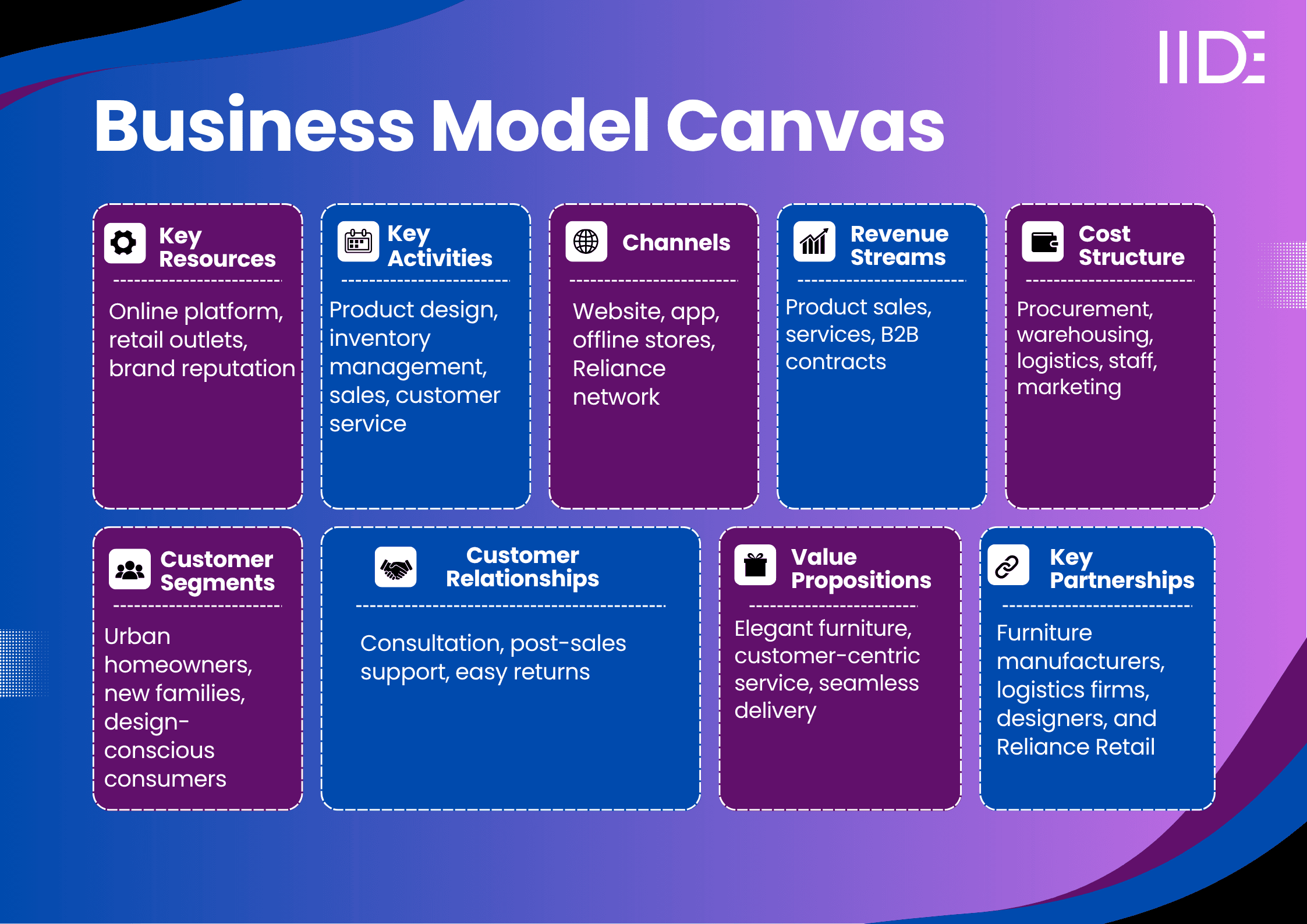
Urban Ladder Business Model Canvas
Urban Ladder Value Proposition
Urban Ladder offers curated furniture with a focus on style, quality, and usability. It addresses the needs of urban consumers seeking reliable furniture with aesthetic appeal. It simplifies the home-buying journey through online tools, design services, and timely installation. Emotionally, it connects by enhancing home spaces and lifestyles. The brand’s competitive edge lies in premium positioning, curated collections, and seamless end-to-end experiences.
Cost Structure
Major expenses include product procurement, warehousing, shipping, retail operations, and marketing. Urban Ladder leverages economies of scale and in-house design to manage margins. Investment in digital tools and customer service enhances efficiency and brand loyalty.
Customer Segment
Urban Ladder targets design-conscious urban customers, especially new homeowners and families aged 28–45. Its B2C model caters to mid and high-income groups looking for reliable and elegant furniture solutions. Key motivators include quality, service, and convenience.
Distribution Channels
Urban Ladder operates through its eCommerce website, mobile app, and 50+ showrooms across metro cities. It follows an omnichannel strategy to integrate online ease with in-store experiences. Its partnership with Reliance Retail further amplifies its distribution footprint.
Key Partnerships
Urban Ladder partners with logistics firms for delivery, manufacturers for sourcing, and designers for creating exclusive product lines. Reliance Retail provides strategic retail support and expansion capabilities. These partnerships enhance scale, innovation, and operational agility.
Want to Know Why 2,50,000+ Students Trust Us?
Dive into the numbers that make us the #1 choice for career success



MBA - Level
Post Graduate in Digital Marketing & Business Strategy

Best For
Fresh Graduates

Mode of Learning
On Campus (Mumbai & Delhi)

Starts from
Jul 31, 2026

Duration
11 Months

Live & Online
Advanced Online Digital Marketing Course
Best For
Working Professionals
Mode of Learning
Online
Starts from
Aug 7, 2026
Duration
4-6 Months

Online
Professional Certification in AI Strategy
Best For
AI Enthusiasts
Mode of Learning
Online
Starts from
Sep 8, 2026
Duration
5 Months

On Campus
Advanced Certification in Artificial Intelligence
Best For
AI Enthusiasts
Mode of Learning
On Campus (Mumbai)
Starts from
Sep 1, 2026
Duration
3 Months

Online or Offline
Top AI Courses to Make You Future Ready!
Best For
AI Enthusiasts
Mode of Learning
2–5 Month Program
Starts from
Sep 8, 2026
Duration
Flexiable

Offline
Undergraduate Program in Digital Business & Entrepreneurship
Best For
12th Passouts
Mode of Learning
On Campus (Mumbai)
Starts from
Aug 19, 2026
Duration
3 Years

Offline
Degree In 2026 ≠ Enough Degree + Digital Skills = Future-Ready
Best For
12th Passouts
Mode of Learning
At IIDE Campus
Starts from
Aug 6, 2026
Duration
3 Years
Recent Post

Lead Trainer & Business Development Head at IIDE
Aditya Shastri leads the Business Development segment at IIDE and is a seasoned Content Marketing expert. With over a decade of experience, Aditya has trained more than 20,000 students and professionals in digital marketing, collaborating with prestigious institutions and corporations such as Jet Airways, Godrej Professionals, Pfizer, Mahindra Group, Publicis Worldwide, and many others. His ability to simplify complex marketing concepts, combined with his engaging teaching style, has earned him widespread admiration from students and professionals alike.
Aditya has spearheaded IIDE’s B2B growth, forging partnerships with over 40 higher education institutions across India to upskill students in digital marketing and business skills. As a visiting faculty member at top institutions like IIT Bhilai, Mithibai College, Amity University, and SRCC, he continues to influence the next generation of marketers.
Apart from his marketing expertise, Aditya is also a spiritual speaker, often traveling internationally to share insights on spirituality. His unique blend of digital marketing proficiency and spiritual wisdom makes him a highly respected figure in both fields.