Application Deadline for 3-Year UG Program closes on 31st Aug. Book a Counselling to know more

Students Centric
Placements Report
Trackable results, real numbers
Reviews
Proven success, real voices
Trainers
Expert-led, Industry-Driven Training
Life at IIDE
Vibrant Spirit student life
Alumni
Successful Journeys, Inspiring Stories
Learning Centre
Webinars
Blogs
Case studies
Live, Interactive Masterclasses
Fresh Insights, quick reads
Real-life, Industry relevant
More
Hire from us
Hire Top Digital Marketing Talent
Work with us
Join Our Team, Make an Impact
Customised Training
Personalised digital marketing training for your company
Refer & earn
Simple, easy rewards
Contact us
Get the answers you need
About us
Know more about IIDE
Explore all course options

FOR FRESH GRADUATES
Post Graduation Program in Digital Marketing & Business Strategy- Ideal for Age: 20–25 Years

Can’t decide? Explore all our
Digital Marketing Courses
COMPARE ALL 3 PROGRAMSOnline & Offline
Explore Top AI CoursesIndustry-Aligned TRACKMost Popular
UG Program in Digital Business & Entrepreneurship- Ideal for 12th Pass out / FY Degree Student

PARTNER PROGRAMS







Can’t decide? Explore all
BBA In Digital Marketing Colleges

Orginally Written by Aditya Shastri
Updated on Dec 11, 2025
Share on:


TripAdvisor's business model revolves around providing valuable travel content and experiences through user-generated reviews, listings, and booking services. With a mix of advertising and transaction-based revenue, TripAdvisor generates revenue from both travel-related content and commission from bookings. Its digital-first model fuels rapid growth, offering a vast customer base across global markets.
About Tripadvisor
Founded in 2000 by Stephen Kaufer, Langley Steinert, and Jason Freedman, Tripadvisor started as a platform for travellers to share their experiences and reviews. Tripadvisor’s unique selling proposition lies in its user-generated content and travel recommendation engine, making it a trusted source for travel planning.
As of 2023, Tripadvisor has over 400 million monthly active users and generates an annual revenue of over $1.5 billion. The company is known for its review-based platform, covering hotels, attractions, restaurants, and experiences in over 190 countries.
Customer experience is centred around building trust through authentic reviews, helpful recommendations, and detailed insights into destinations.
Tripadvisor’s secret to success is its ability to leverage user-generated content and partnerships to drive bookings while maintaining a free, valuable service for travellers.
| Feature | Details |
|---|---|
| Founded | 2000 |
| Founder | Stephen Kaufer, Langley Steinert, Jason Freedman |
| Headquarters | Needham, Massachusetts, USA |
| Industry | Online Travel & Tourism |
| Revenue (2023) | $1.5 Billion |
| Presence | Over 190 countries |
| Employees | 3,000+ |
| Popular for | Hotel reviews, Travel planning |

Is Digital Marketing the Right Career for You?
Find out in a free 45-min masterclass · Career paths, roles and growth explained · By Karan Shah, Founder & CEO, IIDE

Is Digital Marketing the Right Career for You?
Find out in a free 45-min masterclass · Career paths, roles and growth explained · By Karan Shah, Founder & CEO, IIDE
How does Tripadvisor make money?
1. Revenue Stream Breakdown:
- Advertising Revenue: Tripadvisor generates income by allowing hotels, restaurants, and other travel businesses to advertise on its platform
- Booking Revenue: The company earns commissions when users book hotels, flights, or experiences through Tripadvisor’s platform, via partnerships with travel service providers
- Subscription Fees: Hotels and other businesses pay subscription fees for enhanced visibility on the platform, allowing them to access premium features and analytics
2. Revenue Contribution:
- Advertising Revenue: 60% of Tripadvisor’s revenue comes from advertising, where businesses pay for increased exposure and targeted ads
- Booking Revenue: 30% of revenue is derived from commissions earned on bookings made through Tripadvisor
- Subscription Fees: 10% comes from subscription services provided to businesses for premium listings and enhanced visibility
3. Pricing Strategy:
Tripadvisor follows a performance-based pricing model for ads, where businesses pay based on how effectively their advertisements convert into user engagement or bookings.
Tata Motors’ SWOT analysis explores how digital marketing and a strong customer base contribute to brand success, similar to TripAdvisor’s digitally-driven user base.
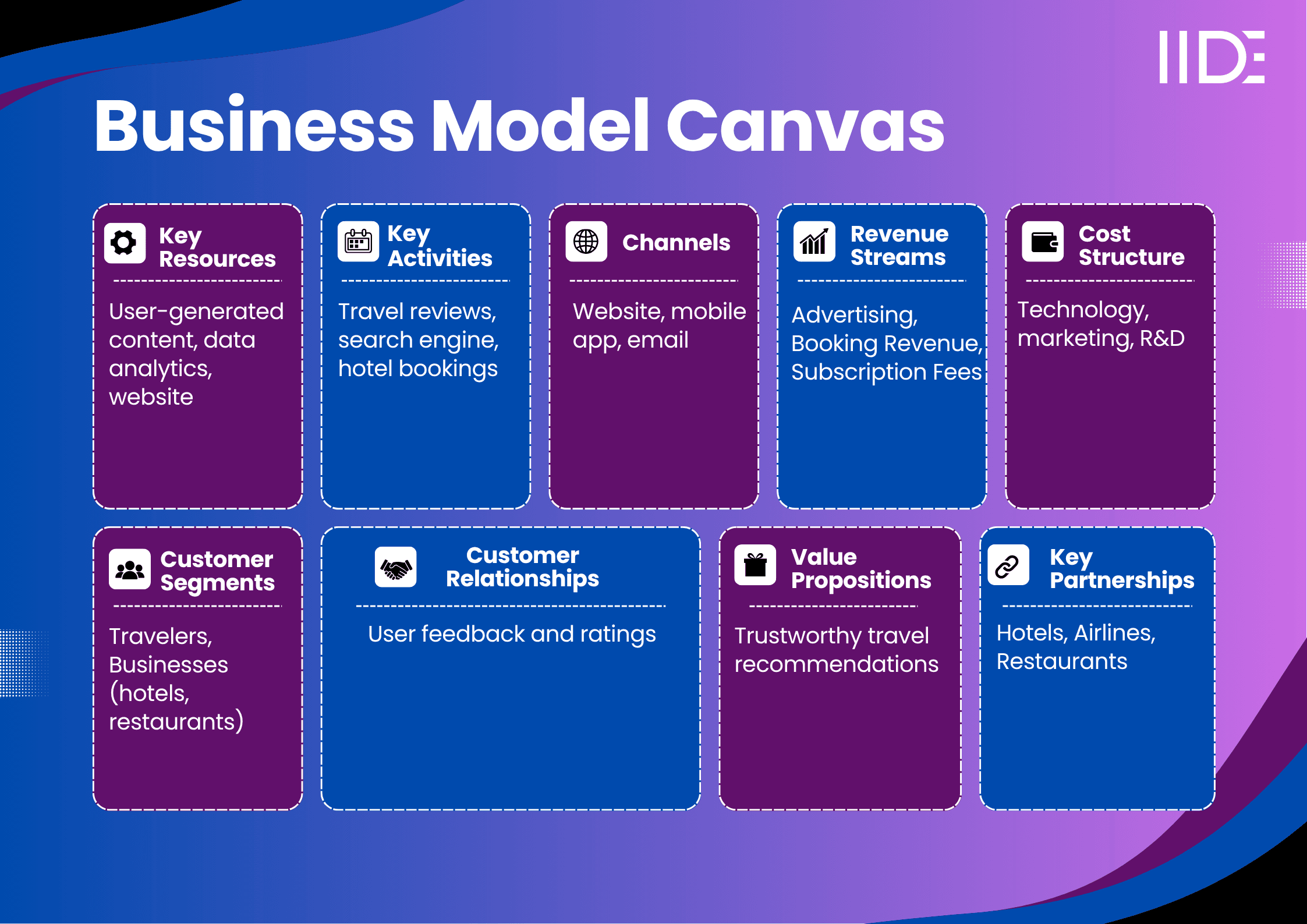
Tripadvisor Business Model Canvas
Tripadvisor Value Proposition
Tripadvisor differentiates itself by offering trusted, user-generated travel reviews and recommendations across a wide range of travel services, from accommodations to attractions. It solves customer pain points by offering a one-stop platform for travellers to research, plan, and book their trips, with unbiased insights from other travellers.
The emotional benefits for users include a sense of confidence and security, knowing they are making informed decisions based on real reviews. Functional benefits include easy access to a large database of hotels, restaurants, and experiences, as well as a streamlined booking process.
Tripadvisor’s competitive advantage lies in its massive user base, rich database of reviews, and its strong partnerships with travel service providers.
Tripadvisor Cost Structure
Tripadvisor’s major expenses include:
- Technology Infrastructure: Significant investments in platform development, data storage, and security to maintain a smooth user experience
- Marketing & Advertising: Expenses to promote the brand and attract users and businesses to the platform
- R&D: Ongoing research and development for new features, tools, and services to enhance the user experience
- Employee Salaries: Compensation for the employees managing the platform, developing technology, and driving customer service
To maintain healthy margins, Tripadvisor focuses on scalability, using its large platform and user base to generate more revenue without significantly increasing operational costs.
Tripadvisor Customer Segment
Tripadvisor operates a B2C and B2B model, serving both individual travellers and businesses (hotels, restaurants, tour operators). Core customers are:
- Travellers: Primarily aged 18-55, tech-savvy individuals looking for information and recommendations on hotels, restaurants, and things to do during their trips
- Businesses: Hotels, airlines, and restaurants looking for visibility and to attract customers through paid listings, ads, and bookings
- Content Creators: Travel bloggers and influencers contributing to Tripadvisor's vast user-generated content base
Distribution Channels of Tripadvisor
- Website & Mobile App: Tripadvisor’s primary channel for delivering content, reviews, and bookings to users
- Affiliate Networks: Tripadvisor collaborates with affiliate partners (e.g., Booking.com) to offer users booking options, driving revenue through affiliate commissions
- Email: Tripadvisor uses email marketing to re-engage users with travel recommendations, offers, and updates
Tripadvisor Key Partnerships
Tripadvisor collaborates with:
- Hotels, Airlines, and Restaurants: These businesses pay for advertisements and enhanced listings on the platform, driving visibility and bookings
- Travel Service Providers: Partnerships with service providers like Booking.com and Viator enable Tripadvisor to offer booking services and earn commissions on each booking
- Affiliate Networks: Tripadvisor uses affiliate marketing to drive additional revenue from booking links
These partnerships help Tripadvisor maintain a large inventory of listings and drive revenue from both advertisements and commissions.
Tesla’s SWOT analysis reveals how innovation and a unique selling proposition can disrupt industries, a concept that also applies to TripAdvisor’s influence in the travel sector.
SWOT Analysis of Tripadvisor
| Strengths | Weaknesses | Opportunities | Threats |
|---|---|---|---|
| Large user base | Dependence on user-generated content | Expansion in emerging travel markets | Competition from OTAs like Expedia |
| Trustworthy reviews | Low conversion from visits to bookings | Increasing mobile travel bookings | Regulatory issues in data usage |
| Strong partnerships | Limited control over businesses' offerings | Diversification into tours & experiences | Threat from review manipulation |
Tripadvisor Competitor Comparison
| Parameter | Tripadvisor | Expedia | Booking.com |
|---|---|---|---|
| Pricing | Free (Ads) | Paid Ads, commission-based | Commission-based |
| Customer Experience | User-generated reviews, detailed insights | Bundled travel services | Wide hotel and booking options |
| Channel Strategy | Reviews, Ads, Bookings | Travel packages | Hotel bookings & advertising |
| Market Focus | Travel reviews & bookings | All-in-one travel services | Hotel bookings & price comparison |
| Innovation | User-generated content, travel planning | All-inclusive travel offerings | Price transparency & smart filtering |
Key Takeaways for Students / Marketers
- Scalability: Tripadvisor’s model thrives on its vast user-generated content, which is leveraged to drive advertising and bookings globally
- Replication for Small Businesses: Small businesses can take inspiration from Tripadvisor’s use of user-generated content and affiliate partnerships to build scalable models
- Strategic Thinking: Tripadvisor’s continuous expansion of its service offerings beyond reviews (e.g., bookings and experiences) highlights the importance of diversifying revenue streams
Want to Know Why 2,50,000+ Students Trust Us?
Dive into the numbers that make us the #1 choice for career success



MBA - Level
Post Graduate in Digital Marketing & Business Strategy

Best For
Fresh Graduates

Mode of Learning
On Campus (Mumbai & Delhi)

Starts from
Oct 1, 2026

Duration
11 Months

Live & Online
Advanced Online Digital Marketing Course
Best For
Working Professionals
Mode of Learning
Online
Starts from
Sep 4, 2026
Duration
4-6 Months

Online
Professional Certification in AI Strategy
Best For
AI Enthusiasts
Mode of Learning
Online
Starts from
Sep 8, 2026
Duration
5 Months

Online or Offline
Top AI Courses to Make You Future Ready!
Best For
AI Enthusiasts
Mode of Learning
2–5 Month Program
Starts from
Sep 8, 2026
Duration
Flexiable

On Campus
Advanced Certification in Artificial Intelligence
Best For
AI Enthusiasts
Mode of Learning
On Campus (Mumbai)
Starts from
Sep 1, 2026
Duration
3 Months

Offline
Undergraduate Program in Digital Business & Entrepreneurship
Best For
12th Passouts
Mode of Learning
On Campus (Mumbai)
Starts from
Aug 19, 2026
Duration
3 Years
Offline
Degree In 2026 ≠ Enough Degree + Digital Skills = Future-Ready
Best For
12th Passouts
Mode of Learning
At IIDE Campus
Starts from
Aug 19, 2026
Duration
3 Years
Recent Post

Lead Trainer & Business Development Head at IIDE
Aditya Shastri leads the Business Development segment at IIDE and is a seasoned Content Marketing expert. With over a decade of experience, Aditya has trained more than 20,000 students and professionals in digital marketing, collaborating with prestigious institutions and corporations such as Jet Airways, Godrej Professionals, Pfizer, Mahindra Group, Publicis Worldwide, and many others. His ability to simplify complex marketing concepts, combined with his engaging teaching style, has earned him widespread admiration from students and professionals alike.
Aditya has spearheaded IIDE’s B2B growth, forging partnerships with over 40 higher education institutions across India to upskill students in digital marketing and business skills. As a visiting faculty member at top institutions like IIT Bhilai, Mithibai College, Amity University, and SRCC, he continues to influence the next generation of marketers.
Apart from his marketing expertise, Aditya is also a spiritual speaker, often traveling internationally to share insights on spirituality. His unique blend of digital marketing proficiency and spiritual wisdom makes him a highly respected figure in both fields.