
Students Centric
Placements Report
Trackable results, real numbers
Reviews
Proven success, real voices
Trainers
Expert-led, Industry-Driven Training
Life at IIDE
Vibrant Spirit student life
Alumni
Successful Journeys, Inspiring Stories
Learning Centre
Webinars
Blogs
Case studies
Live, Interactive Masterclasses
Fresh Insights, quick reads
Real-life, Industry relevant
More
Hire from us
Hire Top Digital Marketing Talent
Work with us
Join Our Team, Make an Impact
Customised Training
Personalised digital marketing training for your company
Refer & earn
Simple, easy rewards
Contact us
Get the answers you need
About us
Know more about IIDE
Explore all course options

FOR FRESH GRADUATES
Post Graduation Program in Digital Marketing & Business Strategy- Ideal for Age: 20–25 Years

Can’t decide? Explore all our
Digital Marketing Courses
COMPARE BOTH OUR PROGRAMSOffline
Offline AI Courses with Dual CertificationsIndustry-Aligned TRACKMost Popular
UG Program in Digital Business & Entrepreneurship- Ideal for 12th Pass out / FY Degree Student

PARTNER PROGRAMS






Can’t decide? Explore all
BBA In Digital Marketing Colleges
Orginally Written by Aditya Shastri
Updated on Jun 4, 2026
Share on:


Tesla is the world's most valuable car brand with a $1.5 trillion company that started with electric cars. Now it also builds self-driving robotaxis, humanoid robots, and energy systems. In 2026, it is also making its long-awaited entry into India with the Model Y.
But Tesla's dominance is being challenged like never before. A Chinese rival has overtaken it in global EV sales, European sales have collapsed, and unsold inventory is at a record high.
This case study breaks down Tesla's 2026 SWOT analysis, what makes it unbeatable, where it is vulnerable, and whether its India and AI bets can secure its future.

Is Digital Marketing the Right Career for You?
Find out in a free 45-min masterclass · Career paths, roles and growth explained · By Karan Shah, Founder & CEO, IIDE

Is Digital Marketing the Right Career for You?
Find out in a free 45-min masterclass · Career paths, roles and growth explained · By Karan Shah, Founder & CEO, IIDE
SWOT Analysis of Tesla
Tesla entered 2026 as the world's most valuable car brand and its most scrutinised. The same company customer base.
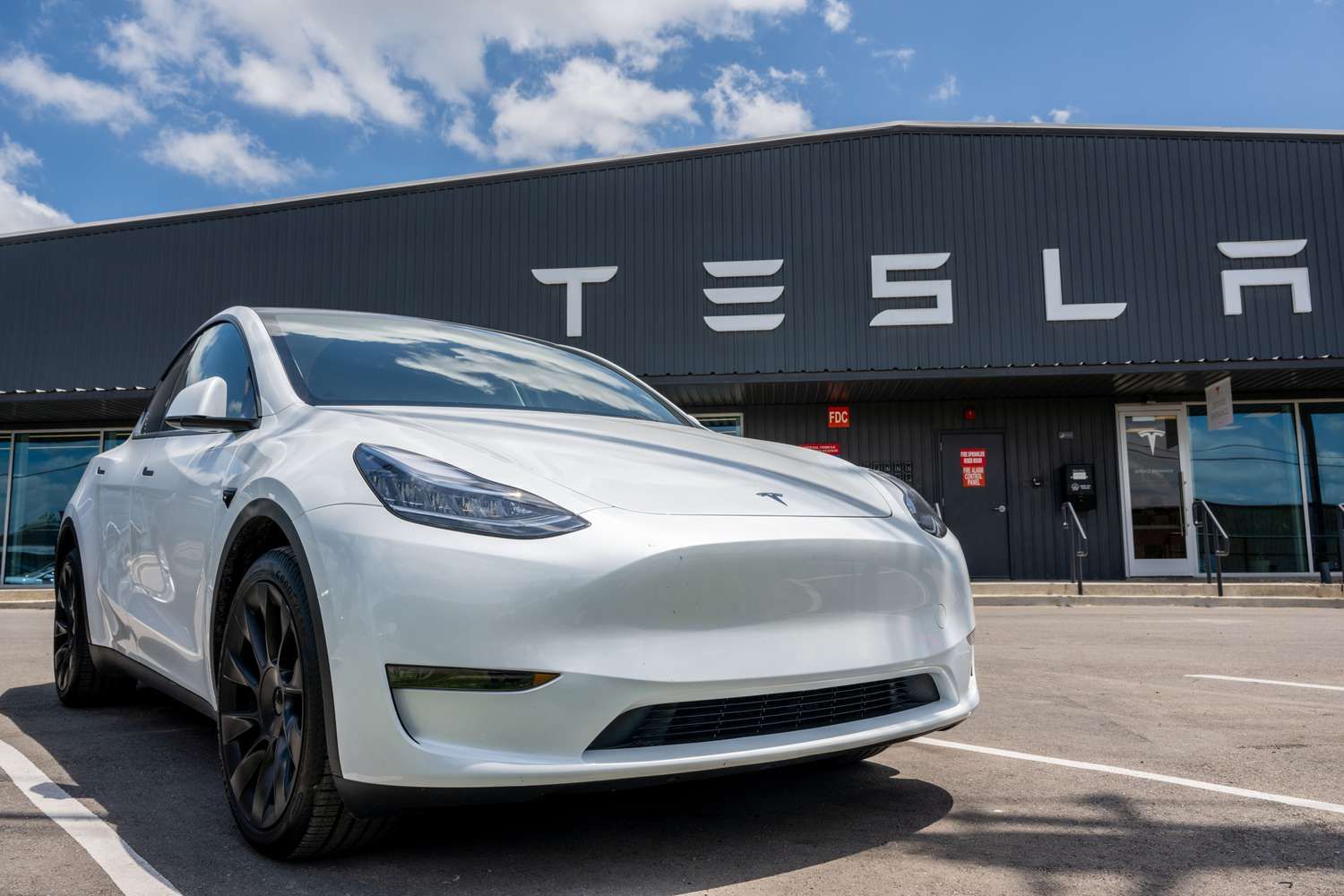
Below is a deep-dive SWOT analysis of Tesla, highlighting its current brand positioning, key strengths, areas for improvement, and future potential in 2026.
1. Strengths of Tesla
Even with turbulence in the global EV market, Tesla continues to stand tall in 2026. Here’s what gives the brand its edge:
- EV Market Leader - Tesla reclaimed the #1 global EV seller position in Q1 2026 with 358,023 deliveries ahead of BYD's 310,000 pure EV units. With 9.2 million cumulative deliveries and a 19.9% global battery EV market share, no single brand comes close to Tesla's combination of scale, brand recognition, and technology leadership.
- Supercharger Network Moat - Tesla operates 8,463 Supercharger stations globally, the world's largest EV charging network. For an Indian buyer considering the Model Y, knowing that a reliable charging network already exists is a purchase confidence factor that no competitor, including Tata Motors, can currently match at this scale.
- Vertical Integration Edge - Tesla designs its own chips, builds its own factories, writes its own software, and runs its own sales network. That vertical integration means faster innovation cycles, lower costs, and quality control that no legacy automaker operating through third-party suppliers can replicate at the same speed.
- Energy Business Growth - Tesla's energy division, Megapack utility storage, and Powerwall home batteries generated $12.8 billion in FY2025, up 27% year-on-year. This segment is growing faster than automotive and represents Tesla's most important long-term revenue diversification away from vehicle sales.
- $44.7 Billion Cash Position - With $44.7 billion in cash and investments, Tesla has the financial firepower to absorb delivery slowdowns, fund the $25 billion AI and Optimus capex plan, enter new markets like India, and still outspend every pure-play EV competitor on R&D simultaneously.
- Full Self-Driving Technology - Tesla owners are collectively driving 14.7 million miles on FSD per day, a 250% increase in three months. That real-world data advantage compounds daily, creating an AI training moat that Waymo, BYD, and every legacy automaker are years behind replicating.
2. Weaknesses of Tesla
Despite its dominant image, Tesla isn’t without its flaws. These weaknesses could affect its longevity if not addressed:
- Declining EV Deliveries - Tesla delivered 1.64 million vehicles in 2025, a 9% drop year-on-year. In Q1 2026, it produced 408,386 vehicles but sold only 358,023, leaving 50,363 cars unsold in a single quarter. Three consecutive quarters of delivery pressure signal a demand problem, not just a supply adjustment.
- Elon Musk Brand Risk - A Yale University study estimates Tesla could lose 1 to 1.26 million US sales over three years due to Musk's political involvement with DOGE. Net brand favourability dropped to -7% in the US. When a CEO's personal brand becomes a liability for the product, it is one of the hardest business problems to solve.
- Europe Sales Collapse - Tesla's European registrations fell 38.8% in early 2026, with Germany down 60% year-on-year. Europe is Tesla's second-largest market and the world's fastest-growing EV region. Losing European customers to Volkswagen, BMW, and BYD at this rate is a structural revenue threat, not a temporary blip.
- Record Unsold Inventory - JPMorgan flagged 164,000 unsold Tesla vehicles in Q1 2026 a record. That inventory build either forces price cuts, compressing already thin margins or signals weakening demand. Either outcome is damaging for a brand that built its premium positioning on scarcity and waitlists.
- Quality Control Issues - Tesla consistently ranks below industry average in J.D. Power initial quality studies. Panel gaps, software glitches, and build inconsistencies remain common customer complaints, a weakness that becomes more damaging as legacy automakers like BMW and Mercedes improve their EV quality to match Tesla's technology advantage.
3. Opportunities for Tesla
Despite challenges, Tesla has multiple growth levers in place. Here’s where the company can win big:
- India Market Entry - India is the world's third-largest car market and its fastest-growing EV market, with EV penetration still under 3%. Tesla's Model Y at Rs 60-68 lakhs targets India's premium SUV buyer, the same person choosing between a BMW X1 and a Mercedes GLA. If Tesla captures even 1% of India's premium segment, it adds a meaningful new revenue corridor.
- Cybercab Robotaxi Launch - Cybercab production started at Gigafactory Texas in April 2026, with commercial launches planned in Austin, Dallas, and Houston. The autonomous ride-hailing market is projected to reach $25 billion by 2030, and Tesla's FSD technology and vehicle manufacturing scale give it a first-mover advantage that Waymo, with its limited fleet, cannot match.
- Optimus Robot Scaling - Tesla's Optimus humanoid robot is already working inside Tesla's own factories. Elon Musk has stated Optimus could eventually be worth more than Tesla's entire automotive business. With a $25 billion capex plan for AI and robotics, Tesla is building the infrastructure for a revenue stream that has no ceiling and no direct competitor at scale.
- FSD Licensing Revenue - Tesla's Full Self-Driving software could be licensed to other automakers, creating a recurring, high-margin software revenue stream similar to how Google licenses Android. Ford and GM have already explored Tesla Supercharger partnerships. FSD licensing is a logical next step that would monetise Tesla's biggest competitive asset beyond its own vehicle sales.
- Energy Storage Boom - Global demand for grid-scale battery storage is growing exponentially as renewable energy capacity expands. Tesla's Megapack, already generating $12.8 billion annually, is the market leader in utility-scale storage. Every new solar farm and wind installation globally is a potential Megapack customer, giving Tesla a massive tailwind that has nothing to do with consumer EV demand.
4. Threats to Tesla
The road ahead isn’t smooth - Tesla must be cautious of several threats that could slow it down:
- BYD Global Dominance - BYD sold 2.26 million pure EVs in 2025, outselling Tesla globally. With lower prices, strong China market dominance, and aggressive expansion into Europe and Southeast Asia, BYD represents the most serious long-term competitive threat Tesla has ever faced, and it is getting stronger every quarter.
- Political Backlash Risk - Elon Musk's DOGE involvement has measurably damaged Tesla's brand in the US and Europe. European registrations crashed 60% in Germany. A Yale study projects over a million lost US sales. Political controversy is now a direct business risk, and Musk's public profile makes it impossible to fully separate the man from the brand.
- Legacy Automaker Push - Volkswagen, BMW, Mercedes, Hyundai, and Ford are all investing tens of billions in EV platforms. As their software range and charging infrastructure improve, the quality gap with Tesla narrows. In premium segments where Tesla competes, legacy brand trust and dealer networks give incumbents a distribution advantage that Tesla's direct sales model cannot easily replicate.
- Waymo Robotaxi Rivalry - Waymo is already operating fully driverless robotaxis commercially in San Francisco, Los Angeles, and Phoenix ahead of Tesla's Cybercab timeline. If Waymo expands faster than Tesla can get regulatory approval for driverless Cybercab operations, Tesla's autonomous vehicle opportunity could be significantly delayed or limited to specific geographies.
- China Market Slowdown - China is Tesla's second-largest market and its most important manufacturing hub via Gigafactory Shanghai. Rising US-China trade tensions, BYD's home market dominance, and Chinese consumer nationalism are all creating headwinds. Any further deterioration in US-China relations could impact both Tesla's China sales and its Shanghai production capacity simultaneously.
To see how a brand can dominate the global conversation without spending a dime on traditional television commercials, you should check out our full breakdown of the marketing strategy of Tesla.
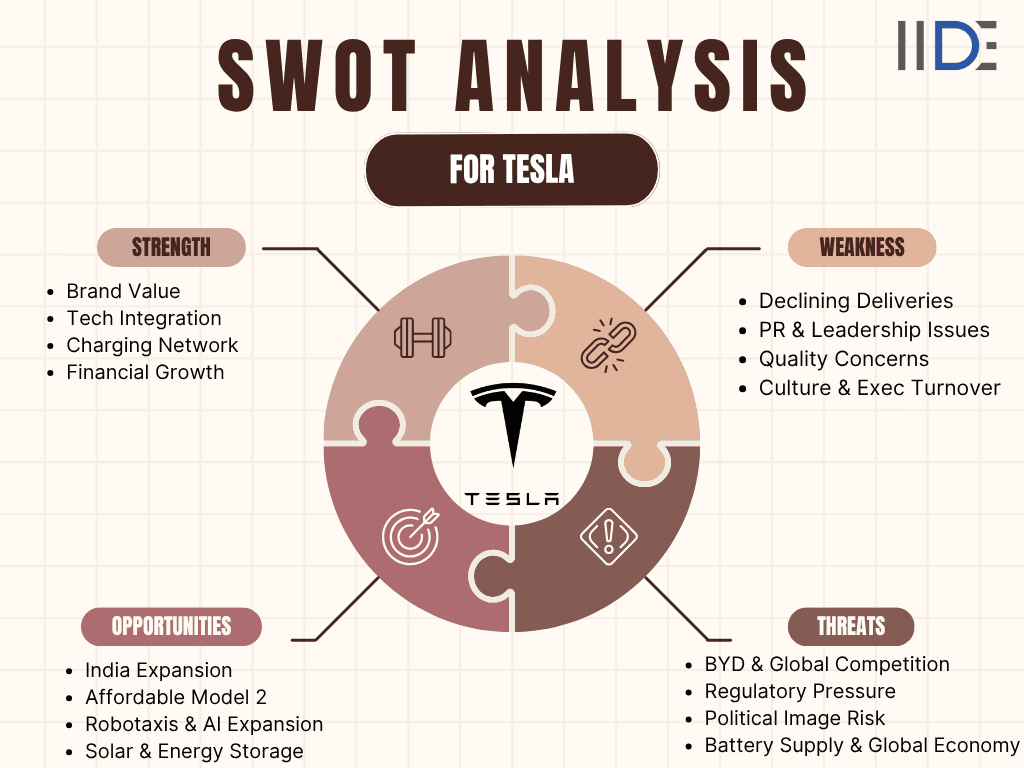
Tesla SWOT Analysis Summed Up
To truly understand how this automotive giant balances engineering excellence with shifting global demands, check out our comprehensive SWOT analysis of BMW.
Conclusion
Tesla is not a company you can easily put in a box. In 2026, it is sitting on $44.7 billion in cash and leading the world in FSD technology but at the same time struggling with falling deliveries, a collapsing European market, and a CEO whose Twitter feed is costing the brand real customers.That tension is actually what makes Tesla so fascinating to study.
The foundation is genuinely strong. The Supercharger network, energy business, and AI ambitions are not hype they are real, compounding advantages. But the brand perception problem and quality concerns are not small issues either.
Cybercab, Optimus, and India could absolutely define Tesla's next decade. But if there is one thing this SWOT analysis shows, it is that even the world's most innovative company still has to earn trust every single day.
Want to Know Why 2,50,000+ Students Trust Us?
Dive into the numbers that make us the #1 choice for career success


MBA - Level
Post Graduate in Digital Marketing & Business Strategy

Best For
Fresh Graduates

Mode of Learning
On Campus (Mumbai & Delhi)

Starts from
Nov 27, 2026

Duration
11 Months

Live & Online
Advanced Online Digital Marketing Course
Best For
Working Professionals
Mode of Learning
Online
Starts from
Nov 2, 2026
Duration
4-6 Months

Offline
Top AI Courses to Make You Future Ready!
Best For
AI Enthusiasts
Mode of Learning
2–5 Month Program
Starts from
Nov 24, 2026
Duration
Flexiable
Offline
Undergraduate Program in Digital Business & Entrepreneurship
Best For
12th Passouts
Mode of Learning
On Campus (Mumbai)
Duration
3 Years
Offline
Degree In 2026 ≠ Enough Degree + Digital Skills = Future-Ready
Best For
12th Passouts
Mode of Learning
At IIDE Campus
Duration
3 Years
Recent Post
Interesting Reads
Rising competition and outdated product lines like the Model S/X are impacting deliveries. Hence, there's a reduction in Tesla's sales.
The cheapest Tesla model costs ₹59.89 Lakh in India.
The Model X (Luxury Electric SUV) is Tesla's SUV.
Yes, Tesla does sell tires, which are available at their Service Centres.
Key opportunities include the expansion into the Indian market, the mass-market launch of a low-cost "Model 2" platform, and the commercialization of the Optimus humanoid robot and Cybercab robotaxi fleet.
Tesla faces aggressive competition from Chinese EV makers (like BYD) offering lower-priced models, and legacy automakers (like BMW and Mercedes) closing the technology gap in the premium segment.
Regulations act as a "Threat" when EV subsidies expire (as seen in some 2025/2026 markets) or a "Strength" when stricter emissions laws force competitors to buy carbon credits from Tesla.

Lead Trainer & Business Development Head at IIDE
Aditya Shastri leads the Business Development segment at IIDE and is a seasoned Content Marketing expert. With over a decade of experience, Aditya has trained more than 20,000 students and professionals in digital marketing, collaborating with prestigious institutions and corporations such as Jet Airways, Godrej Professionals, Pfizer, Mahindra Group, Publicis Worldwide, and many others. His ability to simplify complex marketing concepts, combined with his engaging teaching style, has earned him widespread admiration from students and professionals alike.
Aditya has spearheaded IIDE’s B2B growth, forging partnerships with over 40 higher education institutions across India to upskill students in digital marketing and business skills. As a visiting faculty member at top institutions like IIT Bhilai, Mithibai College, Amity University, and SRCC, he continues to influence the next generation of marketers.
Apart from his marketing expertise, Aditya is also a spiritual speaker, often traveling internationally to share insights on spirituality. His unique blend of digital marketing proficiency and spiritual wisdom makes him a highly respected figure in both fields.