Application Deadline for 3-Year UG Program closes on 31st Aug. Book a Counselling to know more

Students Centric
Placements Report
Trackable results, real numbers
Reviews
Proven success, real voices
Trainers
Expert-led, Industry-Driven Training
Life at IIDE
Vibrant Spirit student life
Alumni
Successful Journeys, Inspiring Stories
Learning Centre
Webinars
Blogs
Case studies
Live, Interactive Masterclasses
Fresh Insights, quick reads
Real-life, Industry relevant
More
Hire from us
Hire Top Digital Marketing Talent
Work with us
Join Our Team, Make an Impact
Customised Training
Personalised digital marketing training for your company
Refer & earn
Simple, easy rewards
Contact us
Get the answers you need
About us
Know more about IIDE
Explore all course options

FOR FRESH GRADUATES
Post Graduation Program in Digital Marketing & Business Strategy- Ideal for Age: 20–25 Years

Can’t decide? Explore all our
Digital Marketing Courses
COMPARE ALL 3 PROGRAMSOnline & Offline
Explore Top AI CoursesIndustry-Aligned TRACKMost Popular
UG Program in Digital Business & Entrepreneurship- Ideal for 12th Pass out / FY Degree Student

PARTNER PROGRAMS






Can’t decide? Explore all
BBA In Digital Marketing Colleges
Orginally Written by Aditya Shastri
Updated on Aug 9, 2025
Share on:


Priceline’s business model thrives on travel aggregation, discount deals, and a strong affiliate ecosystem. It leverages a user-friendly platform, strategic partnerships, and algorithm-driven pricing to attract millions of global travellers. In 2025, it continues scaling through data intelligence and mobile-first innovation.
About Priceline

Founded in 1997 by Jay S. Walker, Priceline revolutionised the online travel space with its Name Your Own Price model. Today, it’s a major player under Booking Holdings, offering flights, hotels, rental cars, and vacation packages. As of 2024, Priceline operates globally, serving millions of users with a revenue base contributing significantly to Booking Holdings’ $21 billion income. It’s known for its discount travel services, strategic use of data, and affiliate networks. Priceline's core values emphasise value, convenience, and digital efficiency.
| Feature | Details |
|---|---|
| Founded | 1997 |
| Founder | Jay S. Walker |
| Headquarters | Norwalk, Connecticut, USA |
| Industry | Online Travel Services |
| Revenue (2024) | Part of Booking Holdings’ $21B total |
| Presence | Global (operates in 40+ countries) |
| Employees | ~2,500 (under Booking Holdings) |
| Popular for | Travel deals, hotel bookings, savings |

Is Digital Marketing the Right Career for You?
Find out in a free 45-min masterclass · Career paths, roles and growth explained · By Karan Shah, Founder & CEO, IIDE

Is Digital Marketing the Right Career for You?
Find out in a free 45-min masterclass · Career paths, roles and growth explained · By Karan Shah, Founder & CEO, IIDE
How does Priceline make money?
Revenue Stream Breakdown
- Hotel and accommodation commissions
- Airline ticket and car rental fees
- Package deals and service markups
- Advertising and affiliate referrals
Revenue Contribution
- Hotel and accommodation bookings make up over 60% of revenue
- Travel packages, flight fees, and advertising account for the remaining 40%
Pricing Strategy
Priceline follows dynamic and value-based pricing. Deals vary based on demand, location, and availability. Its discount model attracts budget-conscious users while enabling higher margins through exclusive partnerships and flash sales.
The business model of Uber shows how digital platforms thrive by connecting consumers and providers through tech-driven efficiency, a key to Priceline’s travel marketplace.
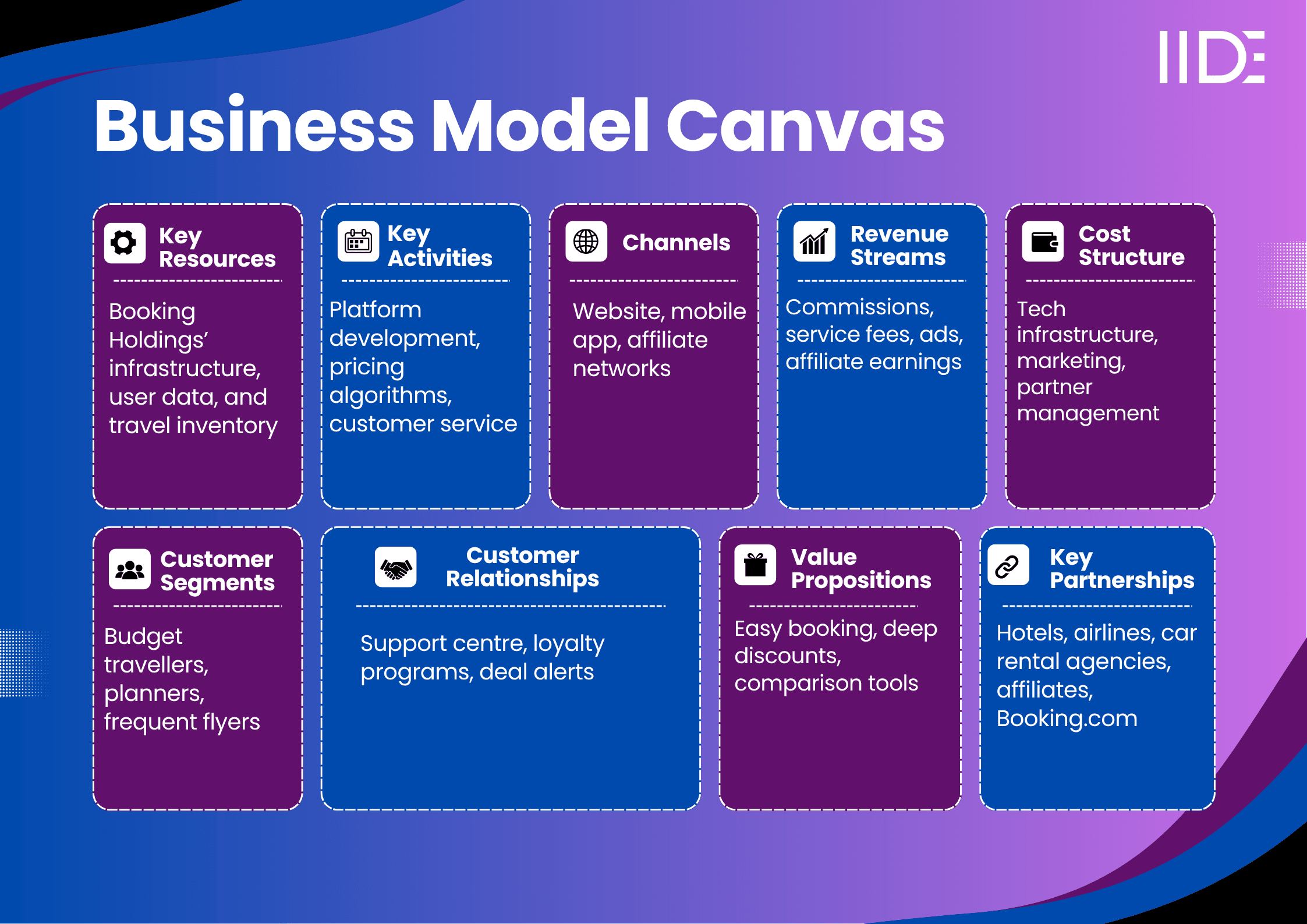
Priceline Business Model Canvas
Priceline Value Proposition
Priceline offers users a one-stop solution for booking hotels, flights, and travel packages at competitive rates. It caters to budget-conscious travellers with limited-time deals, bundled savings, and a seamless interface. Emotional appeal lies in travel convenience and cost savings. Its core advantage is combining large-scale travel inventory with personalisation and dynamic pricing to ensure maximum value.
Cost Structure
Key costs include technology maintenance, performance marketing, and affiliate payouts. Priceline manages profitability through data-led cost optimisation, centralised Booking Holdings support, and scalable digital infrastructure.
Customer Segment
Priceline targets leisure and business travellers looking for affordable travel. Its B2C model attracts digital-first, price-sensitive users from North America, Europe, and Asia. Key motivations include savings, trust in Booking Holdings, and simplified booking processes.
Distribution Channels
Priceline operates via its website, mobile app, and extensive affiliate partner network. SEO, PPC, email marketing, and mobile alerts are core acquisition methods. Its omnichannel presence allows it to reach customers wherever they plan to travel.
Key Partnerships
Priceline collaborates with hotel chains, airlines, car rental companies, and thousands of global affiliates. It also leverages Booking Holdings’ inventory and tech systems. These partnerships expand options, ensure availability, and support price competitiveness.
SWOT Analysis of Priceline
| Strengths | Weaknesses | Opportunities | Threats |
|---|---|---|---|
| Global inventory | Price-sensitive model | Mobile travel growth | High market competition |
| Strong backing | Low brand differentiation | Gen Z traveller trends | Commission dependency |
| Deal-oriented | Narrow luxury appeal | Cross-platform loyalty | Disintermediation by brands |
The business model of Zomato highlights how discovery-based platforms manage multiple user bases and scale through partnerships, much like Priceline in the travel space.
Competitor Comparison
| Competitor | Pricing | Customer Experience | Channel Strategy | Market Focus | Innovation |
|---|---|---|---|---|---|
| Expedia | Competitive | Rich filters | Web + App | Global | Bundling engine |
| Trivago | Low-margin | Hotel metasearch | Affiliate-heavy | Hotels | Ad bidding model |
| Hopper | Dynamic | AI pricing insights | App-first | Young travelers | Predictive pricing |
What’s New With Priceline?
Priceline is expanding its AI tools for price prediction and smart trip planning. It’s revamping its loyalty program, optimising mobile UX, and investing in voice search booking. Integration with Booking.com’s global engine ensures deeper travel data utilisation.
Want to Know Why 2,50,000+ Students Trust Us?
Dive into the numbers that make us the #1 choice for career success



MBA - Level
Post Graduate in Digital Marketing & Business Strategy

Best For
Fresh Graduates

Mode of Learning
On Campus (Mumbai & Delhi)

Starts from
Oct 1, 2026

Duration
11 Months

Live & Online
Advanced Online Digital Marketing Course
Best For
Working Professionals
Mode of Learning
Online
Starts from
Sep 4, 2026
Duration
4-6 Months

Online
Professional Certification in AI Strategy
Best For
AI Enthusiasts
Mode of Learning
Online
Starts from
Sep 8, 2026
Duration
5 Months

Online or Offline
Top AI Courses to Make You Future Ready!
Best For
AI Enthusiasts
Mode of Learning
2–5 Month Program
Starts from
Sep 8, 2026
Duration
Flexiable

On Campus
Advanced Certification in Artificial Intelligence
Best For
AI Enthusiasts
Mode of Learning
On Campus (Mumbai)
Starts from
Sep 1, 2026
Duration
3 Months
Offline
Degree In 2026 ≠ Enough Degree + Digital Skills = Future-Ready
Best For
12th Passouts
Mode of Learning
At IIDE Campus
Starts from
Aug 31, 2026
Duration
3 Years

Offline
Undergraduate Program in Digital Business & Entrepreneurship
Best For
12th Passouts
Mode of Learning
On Campus (Mumbai)
Starts from
Aug 31, 2026
Duration
3 Years
Recent Post

Lead Trainer & Business Development Head at IIDE
Aditya Shastri leads the Business Development segment at IIDE and is a seasoned Content Marketing expert. With over a decade of experience, Aditya has trained more than 20,000 students and professionals in digital marketing, collaborating with prestigious institutions and corporations such as Jet Airways, Godrej Professionals, Pfizer, Mahindra Group, Publicis Worldwide, and many others. His ability to simplify complex marketing concepts, combined with his engaging teaching style, has earned him widespread admiration from students and professionals alike.
Aditya has spearheaded IIDE’s B2B growth, forging partnerships with over 40 higher education institutions across India to upskill students in digital marketing and business skills. As a visiting faculty member at top institutions like IIT Bhilai, Mithibai College, Amity University, and SRCC, he continues to influence the next generation of marketers.
Apart from his marketing expertise, Aditya is also a spiritual speaker, often traveling internationally to share insights on spirituality. His unique blend of digital marketing proficiency and spiritual wisdom makes him a highly respected figure in both fields.