Application Deadline for 3-Year UG Program closes on 31st Aug. Book a Counselling to know more

Students Centric
Placements Report
Trackable results, real numbers
Reviews
Proven success, real voices
Trainers
Expert-led, Industry-Driven Training
Life at IIDE
Vibrant Spirit student life
Alumni
Successful Journeys, Inspiring Stories
Learning Centre
Webinars
Blogs
Case studies
Live, Interactive Masterclasses
Fresh Insights, quick reads
Real-life, Industry relevant
More
Hire from us
Hire Top Digital Marketing Talent
Work with us
Join Our Team, Make an Impact
Customised Training
Personalised digital marketing training for your company
Refer & earn
Simple, easy rewards
Contact us
Get the answers you need
About us
Know more about IIDE
Explore all course options

FOR FRESH GRADUATES
Post Graduation Program in Digital Marketing & Business Strategy- Ideal for Age: 20–25 Years

Can’t decide? Explore all our
Digital Marketing Courses
COMPARE ALL 3 PROGRAMSOnline & Offline
Explore Top AI CoursesIndustry-Aligned TRACKMost Popular
UG Program in Digital Business & Entrepreneurship- Ideal for 12th Pass out / FY Degree Student

PARTNER PROGRAMS






Can’t decide? Explore all
BBA In Digital Marketing Colleges
Orginally Written by Aditya Shastri
Updated on Aug 12, 2025
Share on:


Pinterest’s business model revolves around its visual discovery engine that powers user engagement and targeted advertising. By integrating e-commerce, it enables brands to drive sales while users explore products, ideas, and inspiration. Pinterest’s strategy is underpinned by data-driven personalisation, innovative ad solutions, and a growing social commerce platform. Keep reading to decode its winning model.
Learn From Asia’s #1
Digital Marketing Institute
AI-Based Curriculum
Dive in to the future with the latest AI tools
Placement at top brands and agencies


 & more...

About Pinterest
Founded in 2010 by Ben Silbermann, Evan Sharp, and Paul Sciarra, Pinterest is a visual discovery platform that allows users to share and explore images, or "pins," on virtual boards. Initially launched as a personal inspiration tool, it has evolved into a leading advertising platform and e-commerce powerhouse.
As of 2024, Pinterest has around 450 million monthly active users worldwide, and the platform continues to grow, particularly in e-commerce. Pinterest generates revenue from its advertising model, which allows businesses to promote their products through sponsored pins that reach highly-targeted audiences. It also integrates shopping features that enable users to purchase directly from the platform.
In 2024, Pinterest reported $2.9 billion in revenue, primarily driven by advertising and e-commerce activities. With a strong focus on visual inspiration and targeted marketing, Pinterest connects businesses with consumers, enabling them to discover new products and ideas through a personalised, visually appealing experience.
| Feature | Details |
|---|---|
| Founded | 2010 |
| Founders | Ben Silbermann, Evan Sharp, Paul Sciarra |
| Headquarters | San Francisco, California, USA |
| Industry | Social Media, Visual Discovery, E-commerce |
| Revenue (2024) | $2.9 billion |
| Presence | Global (~450 million monthly active users) |
| Employees | ~2,400 |
| Popular for | Visual discovery, lifestyle inspiration, e-commerce shopping |

Is Digital Marketing the Right Career for You?
Find out in a free 45-min masterclass · Career paths, roles and growth explained · By Karan Shah, Founder & CEO, IIDE

Is Digital Marketing the Right Career for You?
Find out in a free 45-min masterclass · Career paths, roles and growth explained · By Karan Shah, Founder & CEO, IIDE
How does Pinterest make money?
1. Revenue Stream Breakdown
- Advertising Revenue: Sponsored Pins account for approximately 80% of Pinterest's total revenue. These ads allow businesses to promote products to highly-targeted audiences, using the platform’s vast database of user interests and search behaviour
- E-commerce Revenue: Shopable Pins and affiliate sales contribute about 15%. Pinterest is increasingly integrating shopping features, making it a social commerce platform
- Other Revenue: Subscription services (Pinterest Business Accounts) and data analytics services represent the remaining 5% of revenue
2. Revenue Contribution
- Sponsored Pins form the core of Pinterest’s revenue, with ad solutions driving both user engagement and business sales
- E-commerce features are growing quickly, as users move from idea discovery to direct purchasing
- Pinterest is also focusing on advanced targeting tools for businesses, contributing to growing ad revenue
3. Pricing Strategy
Pinterest uses cost-per-click (CPC) and cost-per-impression (CPM) for its ad pricing. Advertisers pay based on user interactions with their promoted content, making it a performance-based advertising platform. E-commerce integrations work through a commission-based model, where Pinterest earns a cut of each sale generated through its shopping pins.
Read the business model of Uber that illustrates how two‑sided marketplaces operate by connecting users and providers, similar to how Pinterest connects content creators and consumers.
Pinterest Business Model Canvas
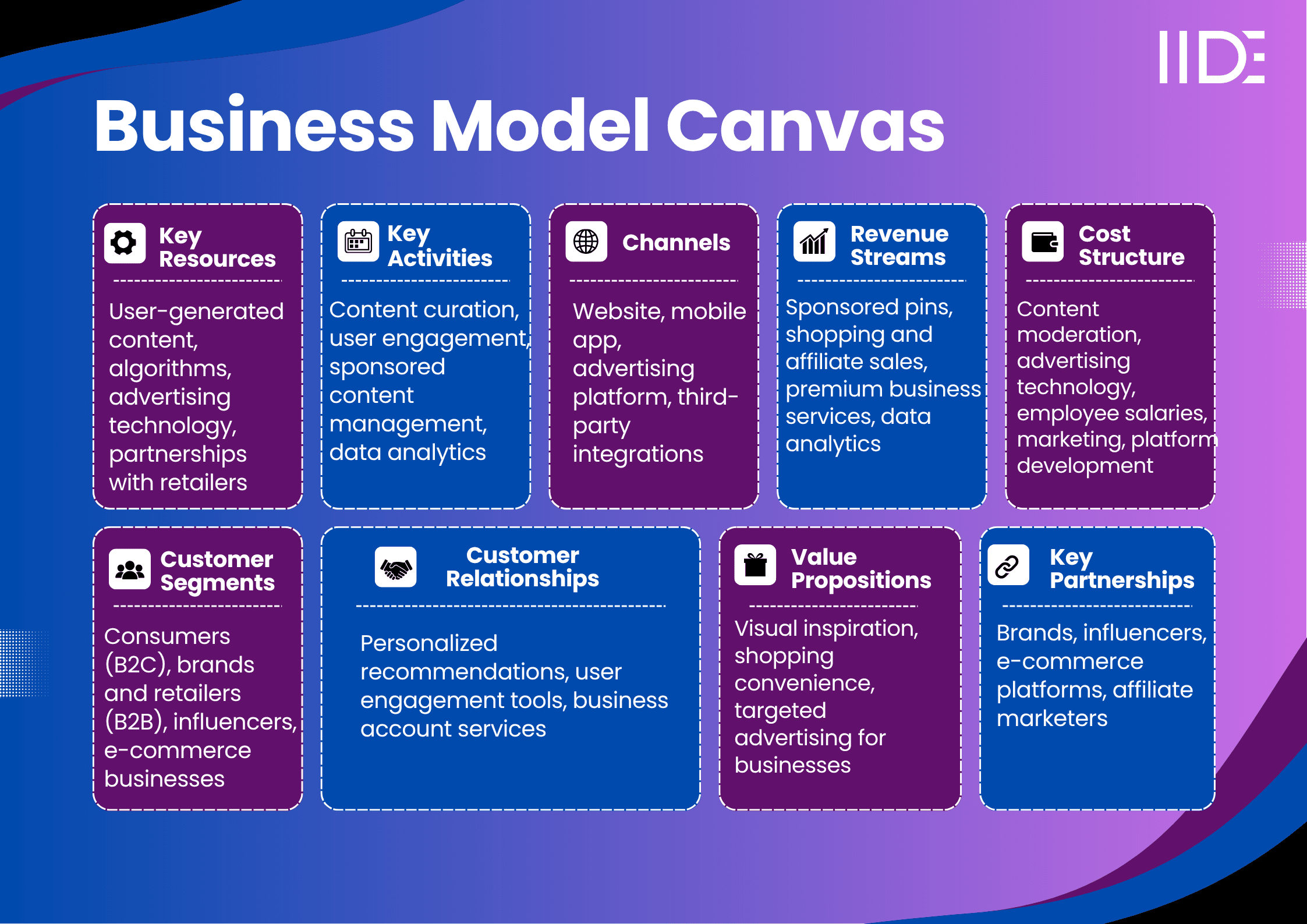
Pinterest Value Proposition
Pinterest offers users a visual discovery engine that inspires people by helping them discover, share, and save ideas. Whether it’s a new recipe, travel destination, or fashion trend, Pinterest provides a unique way to explore ideas visually. The personalisation algorithms tailor this experience, making every user’s feed distinct.
For businesses, Pinterest offers targeted advertising with Sponsored Pins that reach engaged and relevant users. It uses rich user data to match brands with their most interested customers, increasing the likelihood of engagement and sales. With growing shopping integrations, Pinterest allows users to purchase products directly from pins, creating a seamless shopping experience that blends inspiration with action.
In emotional terms, Pinterest’s users feel inspired and empowered to explore and purchase based on their interests. Businesses benefit by connecting directly with consumers through a trusted platform that drives engagement, purchases, and brand visibility. Pinterest's visual-first approach and ad solutions create value on both ends, driving its rapid growth.
Pinterest Cost Structure
Pinterest’s major expenses include content moderation, algorithm and technology development, and advertising infrastructure to support its business model. The platform invests heavily in personalisation technologies, user engagement strategies, and partnerships with e-commerce platforms.
Employee salaries, marketing, and data analytics are additional costs. The company also allocates funds for platform security, regulatory compliance, and scaling its e-commerce features.
Pinterest Customer Segment
Pinterest serves a diverse range of B2C consumers who are looking for inspiration across various categories like lifestyle, fashion, food, and travel. It also targets B2B brands and retailers, offering them a platform to advertise products to highly engaged users. Additionally, affiliates and influencers benefit from Pinterest’s ability to drive traffic and purchases. Its core users are typically between 25 and 44 years old, with a significant skew toward women.
Distribution Channels
Pinterest delivers its services through its website, mobile app, and integrations with third-party platforms. The platform relies on organic content discovery and paid advertising (Sponsored Pins) for user engagement. Pinterest’s e-commerce features allow users to purchase products directly from the platform, creating a seamless shopping experience. Influencers and brands also promote products via affiliate links, extending Pinterest’s reach and product sales potential.
Key Partnerships
Pinterest partners with brands, retailers, influencers, and affiliate marketers to create a comprehensive ecosystem. It collaborates with e-commerce platforms for Shopable Pins and affiliate programs, and with advertisers to deliver targeted campaigns. Pinterest also works closely with social media influencers, enabling them to create content that engages their audiences and drives affiliate sales. These partnerships support Pinterest’s goal of becoming a leading social commerce platform.
SWOT Analysis of Pinterest
| Strengths | Weaknesses | Opportunities | Threats |
|---|---|---|---|
| Visual discovery | Ad-dep >90% reliance | Global ad expansion | Competition (Meta, TikTok) |
| AI targeting | Low intl ARPU | Emerging markets growth | Search engine shifts |
| High-intent users | Narrow demographics | New ad formats | Platform regulation |
The business model of IKEA demonstrates scalable direct‑to‑consumer commerce and ecosystem value, relevant when Pinterest explores e‑commerce integration.
Competitor Comparison
| Competitor | Pricing | Customer Experience | Channel Strategy | Market Focus | Innovation |
|---|---|---|---|---|---|
| Premium ads | Influencer-led | App-first | Lifestyle + retail | AR Shopping | |
| TikTok | Competitive | Viral, short-form | Mobile video | Gen-Z | Visual trends AI |
| Etsy | Listing fees | Creator marketplace | Web/app hybrid | Crafts + retail | Seller community |
What’s New With Pinterest?
Pinterest recently launched new AI tools like Performance+ to optimise ad performance. It expanded shoppable features, personalised content algorithms, and international ad reach. Collaborations with creators and affiliate programs have also increased, improving monetisation and platform engagement.
Key Takeaways for Students / Marketers
- Pinterest scales effectively due to its AI-led ad platform and visual-first design
- Small businesses can emulate success through cost-effective self-serve ad formats
- Visual discovery platforms are an emerging marketing powerhouse
- Prioritising mobile and personalised experiences drives higher engagement
- Leveraging creator and user-generated content builds authentic brand reach
Want to Know Why 2,50,000+ Students Trust Us?
Dive into the numbers that make us the #1 choice for career success



MBA - Level
Post Graduate in Digital Marketing & Business Strategy

Best For
Fresh Graduates

Mode of Learning
On Campus (Mumbai & Delhi)

Starts from
Oct 1, 2026

Duration
11 Months

Live & Online
Advanced Online Digital Marketing Course
Best For
Working Professionals
Mode of Learning
Online
Starts from
Sep 4, 2026
Duration
4-6 Months

Online
Professional Certification in AI Strategy
Best For
AI Enthusiasts
Mode of Learning
Online
Starts from
Sep 8, 2026
Duration
5 Months

Online or Offline
Top AI Courses to Make You Future Ready!
Best For
AI Enthusiasts
Mode of Learning
2–5 Month Program
Starts from
Sep 8, 2026
Duration
Flexiable

On Campus
Advanced Certification in Artificial Intelligence
Best For
AI Enthusiasts
Mode of Learning
On Campus (Mumbai)
Starts from
Sep 1, 2026
Duration
3 Months

Offline
Undergraduate Program in Digital Business & Entrepreneurship
Best For
12th Passouts
Mode of Learning
On Campus (Mumbai)
Starts from
Aug 19, 2026
Duration
3 Years

Offline
Degree In 2026 ≠ Enough Degree + Digital Skills = Future-Ready
Best For
12th Passouts
Mode of Learning
At IIDE Campus
Starts from
Aug 19, 2026
Duration
3 Years
Recent Post
Pinterest's primary revenue source is advertising, including Promoted Pins and Shopping Ads.
Pinterest has 450 million monthly active users as of Q1 2023.
Pinterest offers features like Pins, Boards, Pinterest Lens, and Shop the Look, along with advertising solutions for businesses.
Pinterest's main competitors are Instagram, TikTok, Google Images, Etsy, and Snapchat.
Pinterest's business plan focuses on ad revenue through promoted pins and shopping features, enhancing user engagement and monetization.
Pinterest supports businesses through advertising tools, analytics, and partnerships with e-commerce platforms.
Pinterest ensures user engagement through personalised recommendations, innovative features like Pinterest Lens, and continuous platform improvements.
Pinterest is a social media and visual discovery platform industry, focusing on image sharing and inspiration for various interests.

Lead Trainer & Business Development Head at IIDE
Aditya Shastri leads the Business Development segment at IIDE and is a seasoned Content Marketing expert. With over a decade of experience, Aditya has trained more than 20,000 students and professionals in digital marketing, collaborating with prestigious institutions and corporations such as Jet Airways, Godrej Professionals, Pfizer, Mahindra Group, Publicis Worldwide, and many others. His ability to simplify complex marketing concepts, combined with his engaging teaching style, has earned him widespread admiration from students and professionals alike.
Aditya has spearheaded IIDE’s B2B growth, forging partnerships with over 40 higher education institutions across India to upskill students in digital marketing and business skills. As a visiting faculty member at top institutions like IIT Bhilai, Mithibai College, Amity University, and SRCC, he continues to influence the next generation of marketers.
Apart from his marketing expertise, Aditya is also a spiritual speaker, often traveling internationally to share insights on spirituality. His unique blend of digital marketing proficiency and spiritual wisdom makes him a highly respected figure in both fields.