
Students Centric
Placements Report
Trackable results, real numbers
Reviews
Proven success, real voices
Trainers
Expert-led, Industry-Driven Training
Life at IIDE
Vibrant Spirit student life
Alumni
Successful Journeys, Inspiring Stories
Learning Centre
Webinars
Blogs
Case studies
Live, Interactive Masterclasses
Fresh Insights, quick reads
Real-life, Industry relevant
More
Hire from us
Hire Top Digital Marketing Talent
Work with us
Join Our Team, Make an Impact
Customised Training
Personalised digital marketing training for your company
Refer & earn
Simple, easy rewards
Contact us
Get the answers you need
About us
Know more about IIDE
Explore all course options

FOR FRESH GRADUATES
Post Graduation Program in Digital Marketing & Business Strategy- Ideal for Age: 20–25 Years

Can’t decide? Explore all our
Digital Marketing Courses
COMPARE BOTH OUR PROGRAMSOffline
Offline AI Courses with Dual CertificationsIndustry-Aligned TRACKMost Popular
UG Program in Digital Business & Entrepreneurship- Ideal for 12th Pass out / FY Degree Student

PARTNER PROGRAMS






Can’t decide? Explore all
BBA In Digital Marketing Colleges
Orginally Written by Aditya Shastri
Updated on Aug 12, 2025
Share on:


Patanjali’s business model integrates Ayurveda, cost-leadership, and retail expansion. With affordable pricing and a vast distribution network, it offers ayurvedic alternatives for mass-market consumers. The brand's nationalistic appeal, rural penetration, and self-reliant production have driven rapid growth and strong market presence.
Learn From Asia’s #1
Digital Marketing Institute
AI-Based Curriculum
Dive in to the future with the latest AI tools
Placement at top brands and agencies


 & more...

About Patanjali
Patanjali Ayurved was founded in 2006 by Baba Ramdev and Acharya Balkrishna to promote Ayurveda and indigenous Indian products. Its core USP is delivering ayurvedic and natural alternatives to daily-use consumer goods. As of 2024, Patanjali has over 5,000 exclusive outlets, a presence in more than 20 countries, and annual revenue exceeding ₹90,000 crore. Its core mission is Swadeshi (self-reliance), offering affordable, chemical-free products. Patanjali's success is anchored in its mass appeal, rural penetration, and strategic use of trust in its brand narrative.
| Feature | Details |
|---|---|
| Founded | 2006 |
| Founder | Baba Ramdev, Acharya Balkrishna |
| Headquarters | Haridwar, India |
| Industry | FMCG / Ayurvedic / Health & Wellness |
| Revenue (2024) | ₹90,000+ crore |
| Presence | India + 20+ global markets |
| Employees | 50,000+ |
| Popular for | Ayurvedic & herbal consumer products |

Is Digital Marketing the Right Career for You?
Find out in a free 45-min masterclass · Career paths, roles and growth explained · By Karan Shah, Founder & CEO, IIDE

Is Digital Marketing the Right Career for You?
Find out in a free 45-min masterclass · Career paths, roles and growth explained · By Karan Shah, Founder & CEO, IIDE
How does Patanjali make money?
Revenue Stream Breakdown
- Product sales: FMCG goods (toothpaste, shampoo, ghee, atta, etc.)
- Ayurveda medicines and supplements
- Retail through Patanjali Mega Stores, Arogya Kendras, and e-commerce
- Joint ventures and strategic investments
Revenue Contribution
- FMCG contributes ~75% of the total revenue
- Ayurveda medicines and healthcare products contribute ~15%
- Retail and others contribute ~10%
Pricing Strategy
Patanjali follows a cost-leadership strategy by pricing its products lower than competitors. It leverages direct sourcing, in-house production, and bulk supply to maintain margins and attract mass-market consumers.
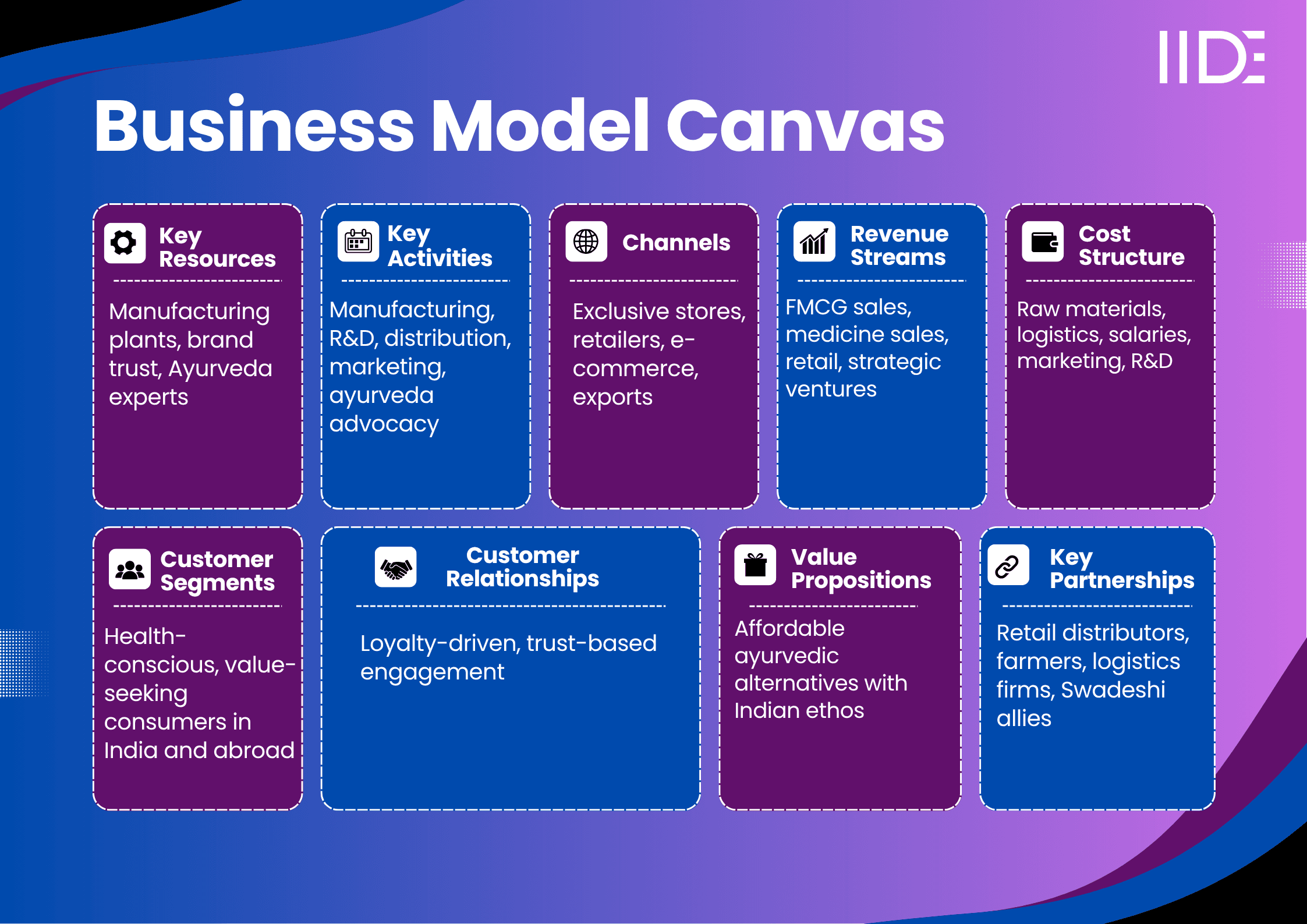
Patanjali Business Model Canvas
SWOT analysis of Dabur helps understand how legacy Ayurvedic brands manage trust, scale, and product diversity - insights that parallel Patanjali's rise.
Patanjali Value Proposition
Patanjali offers an alternative to chemical-laden FMCG products by delivering affordable ayurvedic solutions rooted in Indian tradition. It caters to health-conscious and price-sensitive consumers who value natural, Swadeshi products.
Emotionally, it connects through national pride and spiritual values. Functionally, its offerings are cost-effective, widely accessible, and claim long-term health benefits. Its competitive advantage lies in its brand credibility, vertically integrated operations, and grassroots distribution strategy.
Cost Structure
Key costs include raw materials (herbs, agri-inputs), labour, logistics, manufacturing, and marketing. Patanjali saves costs through vertical integration, mass production, and local sourcing. These strategies help it sustain low pricing while ensuring operational profitability.
Customer Segment
Patanjali serves value-conscious Indian households, rural buyers, and wellness-focused urban customers. Its B2C model caters to health enthusiasts, natural product seekers, and budget-sensitive users. Nationalistic sentiment, product efficacy, and brand association with Baba Ramdev are key motivators.
Distribution Channels
Patanjali uses exclusive outlets (Mega Stores, Arogya Kendras), traditional retailers, supermarkets, and online platforms. It follows an omnichannel approach with presence on Patanjali Ayurved’s website and third-party e-commerce sites. Local supply chains and rural distribution are its backbone.
Key Partnerships
The brand partners with farmers for herb procurement, logistics firms for nationwide reach, and Swadeshi collaborators for mission alignment. It also engages with Ayurveda institutions for research and product validation. These partners support scale, trust, and product innovation.
SWOT Analysis of Patanjali
| Strengths | Weaknesses | Opportunities | Threats |
|---|---|---|---|
| Ayurvedic appeal | Operational strain | Global Ayurveda trend | Regulatory challenges |
| Cost efficiency | Brand controversies | Rural e-commerce rises | Competitive FMCG market |
| Swadeshi trust | Limited R&D depth | Health-conscious shift | Quality perception gaps |
Competitor Comparison
| Competitor | Pricing | Customer Experience | Channel Strategy | Market Focus | Innovation |
|---|---|---|---|---|---|
| Dabur | Affordable | Traditional appeal | Omni-retail | Ayurveda | Product variety |
| HUL | Premium/Fair | Modern convenience | Retail first | Urban/Global | R&D driven |
| Zandu | Moderate | Medicinal trust | Pharma-linked | Health care | Limited SKU |
SWOT analysis of Britannia offers insight into navigating the highly competitive Indian FMCG space, much like Patanjali has done across categories.
Want to Know Why 2,50,000+ Students Trust Us?
Dive into the numbers that make us the #1 choice for career success



MBA - Level
Post Graduate in Digital Marketing & Business Strategy

Best For
Fresh Graduates

Mode of Learning
On Campus (Mumbai & Delhi)

Starts from
Nov 27, 2026

Duration
11 Months

Live & Online
Advanced Online Digital Marketing Course
Best For
Working Professionals
Mode of Learning
Online
Starts from
Nov 2, 2026
Duration
4-6 Months

Offline
Top AI Courses to Make You Future Ready!
Best For
AI Enthusiasts
Mode of Learning
2–5 Month Program
Starts from
Nov 23, 2026
Duration
Flexiable
Offline
Undergraduate Program in Digital Business & Entrepreneurship
Best For
12th Passouts
Mode of Learning
On Campus (Mumbai)
Starts from
-
Duration
3 Years
Offline
Degree In 2026 ≠ Enough Degree + Digital Skills = Future-Ready
Best For
12th Passouts
Mode of Learning
At IIDE Campus
Starts from
-
Duration
3 Years
Recent Post
Patanjali distributes its products through retail stores, franchise outlets, e-commerce platforms, and partnerships with major retail chains.
Patanjali was founded by Baba Ramdev and Acharya Balkrishna in 2006.
Patanjali’s main product categories include personal care, food and beverages, health supplements, and home care.
Patanjali holds an 8.5% share in the Indian FMCG sector.
Patanjali generates revenue through the sale of its products, exports, franchise fees, and media ventures.
Patanjali’s strategic alliances include partnerships with retail chains, e-commerce platforms, and agricultural cooperatives.
Patanjali employs advanced manufacturing technologies, data analytics, and has a state-of-the-art R&D centre for product innovation.
Patanjali supports healthcare and education projects, promotes organic farming, and undertakes environmental initiatives such as tree plantation drives.

Lead Trainer & Business Development Head at IIDE
Aditya Shastri leads the Business Development segment at IIDE and is a seasoned Content Marketing expert. With over a decade of experience, Aditya has trained more than 20,000 students and professionals in digital marketing, collaborating with prestigious institutions and corporations such as Jet Airways, Godrej Professionals, Pfizer, Mahindra Group, Publicis Worldwide, and many others. His ability to simplify complex marketing concepts, combined with his engaging teaching style, has earned him widespread admiration from students and professionals alike.
Aditya has spearheaded IIDE’s B2B growth, forging partnerships with over 40 higher education institutions across India to upskill students in digital marketing and business skills. As a visiting faculty member at top institutions like IIT Bhilai, Mithibai College, Amity University, and SRCC, he continues to influence the next generation of marketers.
Apart from his marketing expertise, Aditya is also a spiritual speaker, often traveling internationally to share insights on spirituality. His unique blend of digital marketing proficiency and spiritual wisdom makes him a highly respected figure in both fields.