
Students Centric
Placements Report
Trackable results, real numbers
Reviews
Proven success, real voices
Trainers
Expert-led, Industry-Driven Training
Life at IIDE
Vibrant Spirit student life
Alumni
Successful Journeys, Inspiring Stories
Learning Centre
Webinars
Blogs
Case studies
Live, Interactive Masterclasses
Fresh Insights, quick reads
Real-life, Industry relevant
More
Hire from us
Hire Top Digital Marketing Talent
Work with us
Join Our Team, Make an Impact
Customised Training
Personalised digital marketing training for your company
Refer & earn
Simple, easy rewards
Contact us
Get the answers you need
About us
Know more about IIDE
Explore all course options

FOR FRESH GRADUATES
Post Graduation Program in Digital Marketing & Business Strategy- Ideal for Age: 20–25 Years

Can’t decide? Explore all our
Digital Marketing Courses
COMPARE ALL 3 PROGRAMSOnline & Offline
Explore Top AI CoursesIndustry-Aligned TRACKMost Popular
UG Program in Digital Business & Entrepreneurship- Ideal for 12th Pass out / FY Degree Student

PARTNER PROGRAMS







Can’t decide? Explore all
BBA In Digital Marketing Colleges
Orginally Written by Aditya Shastri
Updated on Jun 5, 2026
Share on:


Amazon started as an online bookstore in 1994. Today it is a $638 billion global empire and the secret behind that growth is one of the most studied business models in the world. This case study breaks down Amazon's complete business model how it generates revenue across retail, AWS, advertising, and Prime, how it prices its services, who its real customers are, what its value proposition is, and how it keeps reinventing itself year after year. You will also get the latest 2025-2026 updates on Amazon's next big moves. If you want to understand how modern business models are built to scale this is exactly where to start.
Amazon’s business model blends mass-market retail, broad third-party marketplace services, subscription membership (Prime), online advertising, and cloud computing (AWS). This mix enables Amazon to offer a vast selection and low prices, fuel recurring income, and capitalise on high-margin segments. Scalable logistics, strong data analytics, and AWS’s profitability unlock market leadership and long-term growth. Want the full breakdown? Keep scrolling to uncover the strategy secrets behind it.
Learn From Asia’s #1
Digital Marketing Institute
AI-Based Curriculum
Dive in to the future with the latest AI tools
Placement at top brands and agencies


 & more...

About Amazon

Amazon was founded in 1994 by Jeff Bezos as an online bookseller in Bellevue, Washington. Its founding idea - “customer-obsessed convenience at scale” led Amazon to expand into nearly every product category and build the world’s leading e‑commerce platform.
In full-year 2024, Amazon generated approximately US $638 billion in net sales and net income of roughly US $59.2 billion, nearly doubling its 2023 profit. Its cloud arm, AWS, pulled in $107.6 billion in revenue and $39.8 billion in operating income, making it the dominant profit source. The company employs about 1.56 million people globally, with over 300 million active customers, and continues expanding its footprint across North America, Europe, and Asia-Pacific.
Amazon revolves around core values of customer obsession, innovation, and long-term thinking. It emphasises fast delivery, deep product selection, low prices, and data-informed personalisation. Its success stems from marrying retail volume with a high-margin digital services business, fuelled by its global logistics network and technology infrastructure.
| Feature | Details |
|---|---|
| Founded | 1994 |
| Founder | Jeff Bezos |
| Headquarters | Seattle, Washington, USA |
| Industry | E‑commerce, Cloud Services, Digital Advertising |
| Revenue (2024) | US$638 billion |
| Presence | Global 200 countries; 300M active users |
| Employees | 1.56 million (2024) |
| Popular for | Fast delivery, retail scale, AWS cloud dominance |

Learn Digital Marketing for FREE


Learn Digital Marketing for FREE
How does Amazon make money?
1. Revenue Stream Breakdown
- First-Party Retail (Online & Physical Stores) - Amazon sells products directly to consumers from its own inventory. In 2025, online stores generated around $280 billion. Physical stores including Whole Foods added $24 billion more, making Amazon the second largest grocer in the US with over $150 billion in grocery gross sales.
- Third‑party seller services - Amazon lets millions of businesses sell on its platform and charges commissions, fulfilment, and storage fees in return. In 2025, third-party sellers made up 62% of all units sold, generating over $174 billion a high-volume, recurring revenue stream that grows stronger every quarter.
- AWS cloud services - AWS is Amazon's cloud arm and its biggest profit engine. It provides storage, computing, and AI tools to businesses globally. In Q4 2025, AWS grew 24% to $35.6 billion its fastest growth in 13 quarters with an annualised run rate now hitting $142 billion.
- Advertising operations - Brands pay to appear in Amazon's search results, product pages, and Prime Video. In 2025, advertising revenue hit $69.2 billion up 22% year-on-year. It is high margin, fast growing, and sits directly inside the shopping journey where purchase intent is at its highest.
- Subscription services (Amazon Prime) -Prime members pay a flat fee for free delivery, Prime Video, music, and exclusive deals. By mid-2026, Prime crossed 240 million members globally. Beyond revenue, Prime is Amazon's loyalty engine Prime members spend significantly more and shop far more frequently than non-members.
2. Revenue Contribution
- Retail sales account for the highest volume but have slim margins.
- AWS contributes nearly 60% of Amazon’s operating profits, making it the powerhouse for profitability.
- Advertising margins are high and growing fast.
- Subscriptions provide reliable recurring cash flow that strengthens customer stickiness.
3. Pricing Strategy
Amazon employs low-cost pricing across its retail catalogue, reducing prices through scale and efficiency. AWS operates on a pay-per-usage model, tailored to enterprise needs. Subscription services like Prime are priced for perceived value - locked-in benefits justify membership fees. Advertising is priced on performance and targeting efficacy.
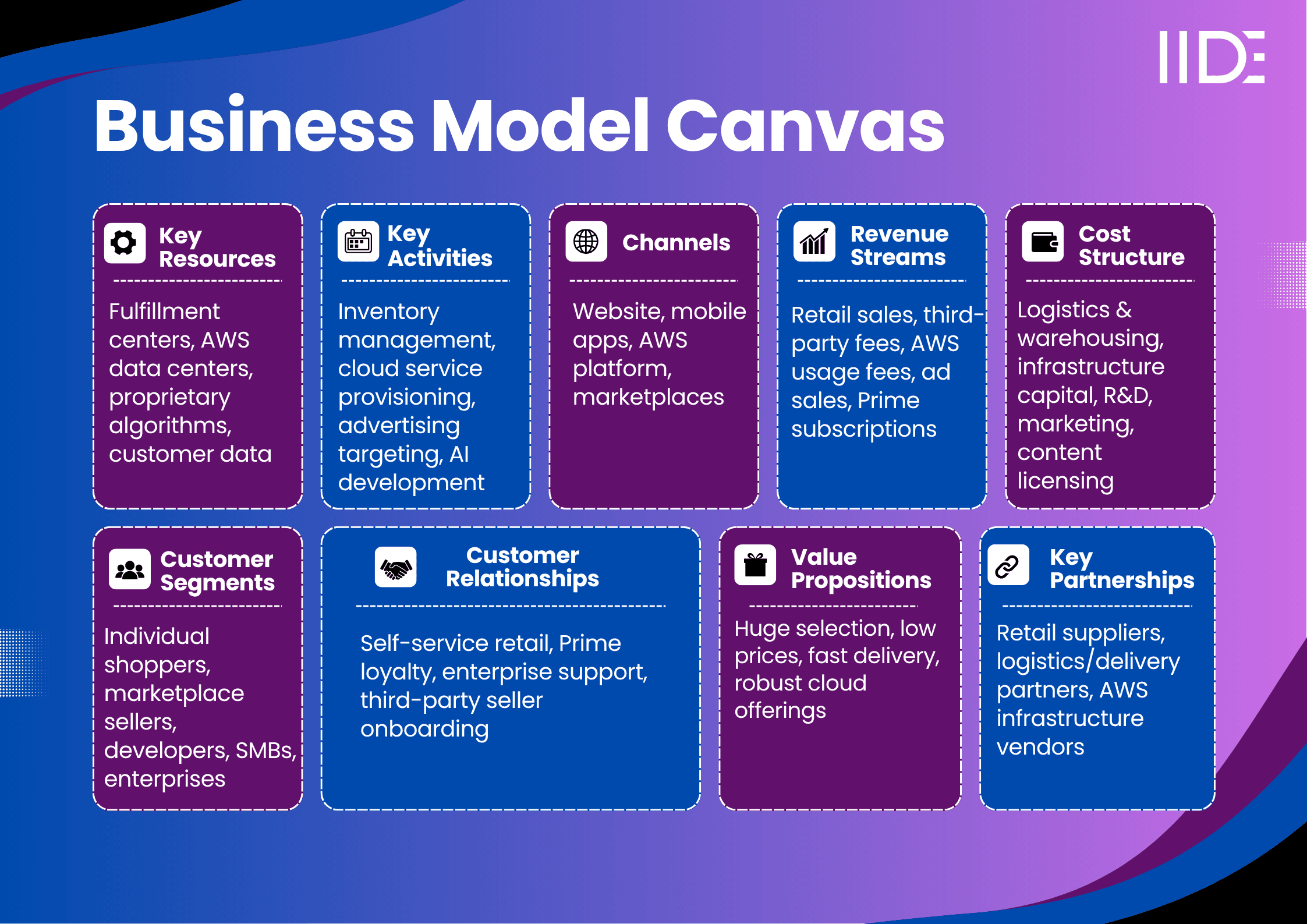
Amazon Business Model Canvas
Amazon Value Proposition
Amazon offers a massive product selection and convenience, backed by a logistics network that enables delivery at competitive prices. It solves key customer pain points: low prices for everyday goods, reliable fast delivery, one-stop shopping with easy returns, and personalised recommendations. For enterprises and developers, AWS delivers enterprise-grade cloud services on a flexible, usage-based modeleliminating infrastructure burdens while scaling quickly.
Emotionally, customers trust Amazon for its consistency, simplicity, and innovation. Shoppers feel confident using Amazon because they expect reliability, fast resolution, and a sense of being valued through Prime perks. AWS clients benefit emotionally from confidence in security, scalability, and global reach.
Functionally, Amazon cuts friction: one-click ordering, frictionless checkout, fast delivery, and rich digital services. AWS offers scalable computing, storage, and AI tools across the globe. Amazon’s edge lies in its unmatched logistics infrastructure, data intelligence platform, and ecosystem lock-in via Prime and marketplace services - a combination competitors find difficult to replicate.
Read the SWOT analysis of eBay, which sheds light on the dynamics of global e-commerce platforms, offering context that parallels Amazon’s competitive landscape.
Amazon Cost Structure
Amazon’s major cost drivers include global logistics and warehousing, cloud infrastructure investment, R&D in AI and digital, content acquisition and licensing, and marketing/selling expenses. Cost efficiencies come from automation (robotic fulfilment), bulk logistics operations, and negative working capital cycles. Technology investment and scale help maintain healthy margins even as Amazon reinvests heavily in AI and growth.
Amazon Customer Segment
Amazon serves a global B2C audience - mainly middle- to upper-income urban and suburban shoppers across age groups. It also targets businesses and developers via AWS for B2B and B2B2C services. Early adopters and tech-savvy consumers appreciate Amazon’s convenience, broad selection, and frictionless experience. Buyers choose Amazon for its price competitiveness, fast delivery, rich ecosystem, and trusted reliability, making it the default platform for everyday needs and enterprise infrastructure alike.
Distribution Channels
Amazon is primarily digital-first, reaching customers via its website and mobile app. It also uses third-party seller integrations to expand choice. Though Amazon operates physical stores (e.g., Amazon Fresh, Whole Foods), these are a small part of revenue. It follows an omnichannel approach - customers can shop online, pick up in-store, or order through Alexa and WhatsApp. Innovative tools include one-click ordering, app-based shopping, voice agents, and fast-delivery networks such as same-day or two-hour Prime options.
Key Partnerships
Amazon collaborates with manufacturers and suppliers, logistics and delivery partners, third-party sellers, and technology vendors for cloud infrastructure and AI tools. It partners with payment providers, media licensors (for Prime content), and sustainability organisations. It also invests in startups like AI firms. These alliances enhance its reach, supply chain efficiency, innovation pace, and global expansion, while reinforcing its customer-focused and tech-led ethos.
SWOT Analysis of Amazon
| Strengths | Weaknesses | Opportunities | Threats |
|---|---|---|---|
| Scale dominance | Narrow AWS margins | AI-powered growth | Rising cloud competition |
| Logistics network | Thin retail margins | New marketplaces also use AI | Tariffs and regulation |
| Platform ecosystem | High capex costs | Enterprise services growth | Macroeconomic pressures |
Competitor Comparison
| Brand | Pricing | Customer Experience | Channel Strategy | Market Focus | Innovation |
|---|---|---|---|---|---|
| Amazon | Low cost/value | Fast, personalised | Digital-first + formats | Global multi‑segment | AI, logistics |
| Walmart | Competitive | Physical & digital | Strong offline+online | Mass-market retail | Omnichannel pickup |
| Microsoft Azure | Usage-based | Enterprise-grade | B2B cloud-first | B2B services | AI cloud leadership |
| Google Cloud | Flexible | Developer-focused | Cloud platform | Cloud/AI heavy users | ML/AI tooling |
What’s New With Amazon?
Recently, Amazon has accelerated investment in AI infrastructure, developing agents like DeepFleet and platforms such as Strands and Bedrock AgentCore for scalable AI tools. Advertising and subscription segments are growing double-digits. Capital expenditures for 2025 are projected at $118 billion to support AI and cloud expansion. Sustainability remains a priority, with Amazon using renewable energy in data centres and exploring circular-economy packaging.
Examining the business model of Uber offers an interesting perspective on platform-based scalability and logistics efficiency, much like Amazon’s approach.
Want to Know Why 2,50,000+ Students Trust Us?
Dive into the numbers that make us the #1 choice for career success



MBA - Level
Post Graduate in Digital Marketing & Business Strategy

Best For
Fresh Graduates

Mode of Learning
On Campus (Mumbai & Delhi)

Starts from
Oct 1, 2026

Duration
11 Months

Live & Online
Advanced Online Digital Marketing Course
Best For
Working Professionals
Mode of Learning
Online
Starts from
Aug 7, 2026
Duration
4-6 Months

Online
Professional Certification in AI Strategy
Best For
AI Enthusiasts
Mode of Learning
Online
Starts from
Sep 8, 2026
Duration
5 Months

On Campus
Advanced Certification in Artificial Intelligence
Best For
AI Enthusiasts
Mode of Learning
On Campus (Mumbai)
Starts from
Sep 1, 2026
Duration
3 Months

Online or Offline
Top AI Courses to Make You Future Ready!
Best For
AI Enthusiasts
Mode of Learning
2–5 Month Program
Starts from
Sep 8, 2026
Duration
Flexiable

Offline
Undergraduate Program in Digital Business & Entrepreneurship
Best For
12th Passouts
Mode of Learning
On Campus (Mumbai)
Starts from
Aug 19, 2026
Duration
3 Years

Offline
Degree In 2026 ≠ Enough Degree + Digital Skills = Future-Ready
Best For
12th Passouts
Mode of Learning
At IIDE Campus
Starts from
Aug 6, 2026
Duration
3 Years
Recent Post
Amazon makes money through product sales, AWS, Prime subscriptions, and advertising fees.
Amazon’s main products include consumer electronics, books, groceries, AWS, Prime Video, and Kindle.
Amazon’s top competitors include Walmart, Alibaba, eBay, Microsoft, and Google.
Amazon Prime is a subscription service offering benefits like free shipping, exclusive deals, and access to streaming services.
Amazon uses technology for logistics, AI, cloud computing, and customer service, enhancing efficiency and user experience.
Amazon Web Services (AWS) is a cloud computing platform providing scalable solutions to businesses and developers.
Amazon’s CSR initiatives focus on sustainability, renewable energy, community support, and employee welfare.
Amazon targets a broad audience through personalised marketing, Prime membership, and diverse product offerings.
Amazon holds approximately 39% of the US online retail market.

Lead Trainer & Business Development Head at IIDE
Aditya Shastri leads the Business Development segment at IIDE and is a seasoned Content Marketing expert. With over a decade of experience, Aditya has trained more than 20,000 students and professionals in digital marketing, collaborating with prestigious institutions and corporations such as Jet Airways, Godrej Professionals, Pfizer, Mahindra Group, Publicis Worldwide, and many others. His ability to simplify complex marketing concepts, combined with his engaging teaching style, has earned him widespread admiration from students and professionals alike.
Aditya has spearheaded IIDE’s B2B growth, forging partnerships with over 40 higher education institutions across India to upskill students in digital marketing and business skills. As a visiting faculty member at top institutions like IIT Bhilai, Mithibai College, Amity University, and SRCC, he continues to influence the next generation of marketers.
Apart from his marketing expertise, Aditya is also a spiritual speaker, often traveling internationally to share insights on spirituality. His unique blend of digital marketing proficiency and spiritual wisdom makes him a highly respected figure in both fields.