
Students Centric
Placements Report
Trackable results, real numbers
Reviews
Proven success, real voices
Trainers
Expert-led, Industry-Driven Training
Life at IIDE
Vibrant Spirit student life
Alumni
Successful Journeys, Inspiring Stories
Learning Centre
Webinars
Blogs
Case studies
Live, Interactive Masterclasses
Fresh Insights, quick reads
Real-life, Industry relevant
More
Hire from us
Hire Top Digital Marketing Talent
Work with us
Join Our Team, Make an Impact
Customised Training
Personalised digital marketing training for your company
Refer & earn
Simple, easy rewards
Contact us
Get the answers you need
About us
Know more about IIDE
Explore all course options

FOR FRESH GRADUATES
Post Graduation Program in Digital Marketing & Business Strategy- Ideal for Age: 20–25 Years

Can’t decide? Explore all our
Digital Marketing Courses
COMPARE ALL 3 PROGRAMSOnline & Offline
Explore Top AI CoursesIndustry-Aligned TRACKMost Popular
UG Program in Digital Business & Entrepreneurship- Ideal for 12th Pass out / FY Degree Student

PARTNER PROGRAMS






Can’t decide? Explore all
BBA In Digital Marketing Colleges
Orginally Written by Kartik Mittal
Updated on Apr 7, 2026
|8,657K+ views
Share on:


In 2026, high-income skills will be driven by technology. Digital Marketing is one of the Top Skills, helping businesses grow through online strategies. Artificial Intelligence (AI) is transforming industries with automation and data insights.
Skills like Data Science, Software Development, Cybersecurity, Cloud Computing, SEO, UX/UI Design, Project Management, and Content Creation are essential for business growth and innovation. Mastering these skills ensures competitiveness and opens up future career opportunities.
How to Make Money Online for Students?
As a college student or recent graduate, you might be wondering how to earn money online. Many students seek out the most profitable skills to make money online.
If you’re one of them, your search ends here. In this blog, I’ve compiled a list of top money-making skills. We’ll outline the most profitable skills to learn from home and explain how you can develop these skills to boost your online earning potential.
Equipping yourself with these high-income skills can pave the way to a job with one of India's top companies. So, stay with me until the end of this blog to discover the best skills for earning money online.
Before diving into the detailed list of online money-making skills, let’s first quickly understand what high-income skills are and why it’s essential to develop them.
Many people want to equip themselves with profitable skills to learn to make money online. Needless to say, they enrol for a free digital marketing certification to explore what the industry has in store for them.
Best Skills to Earn Money Online: Quick Comparison (2026)
| Skill | Monthly Earning Range (India) | Time to Learn | Best Free Starting Point |
| SEO | Rs 25K - Rs 80K | 8-12 weeks | HubSpot SEO certificate |
| Google Ads / PPC | Rs 30K - Rs 1.2L | 6-10 weeks | Google Skillshop Ads certification |
| AI & Prompt Engineering | Rs 40K - Rs 1.5L | 4-8 weeks | DeepLearning.AI free courses |
| Social Media Marketing | Rs 20K - Rs 70K | 6-10 weeks | Meta Blueprint free certification |
| Content Writing & Copywriting | Rs 20K - Rs 60K | 8-12 weeks | HubSpot Content Marketing certificate |
| Data Analysis | Rs 35K - Rs 1L | 10-16 weeks | Google Data Analytics on Coursera |
| Web Development | Rs 30K - Rs 90K | 12-20 weeks | Code Camp full-stack path |
| UI/UX Design | Rs 35K - Rs 1L | 10-16 weeks | Google UX Design on Coursera |
| Cybersecurity | Rs 40K - Rs 1.5L | 16-24 weeks | Google Cybersecurity certification |
| Email Marketing Automation | Rs 25K - Rs 80K | 4-6 weeks | HubSpot Email Marketing certification |
Scroll down for detailed breakdowns of all 21 skills, including salary data by job title, week-by-week self-study roadmaps, and real student success stories.

Learn Digital Marketing for FREE
- 45 Mins Masterclass
- Watch Anytime, Anywhere
- 1,00,000+ Students Enrolled

Learn Digital Marketing for FREE
- 45 Mins Masterclass
- Watch Anytime, Anywhere
- 1,00,000+ Students Enrolled
What Is a High-Income Skill?
A high-income skill is an ability that creates significant value for businesses, leading to substantial earnings for the skilled individual, often due to high demand, limited supply, and a direct impact on an organisation's bottom line.
These skills are frequently technical (like AI, data science, or software development) or business-focused (such as sales, project management, or digital marketing).
In 2026, high-income skills have become more critical than ever, particularly as industries evolve with rapid technological advancements.
In the post-COVID economy, the demand for specialised skills has skyrocketed, as businesses require professionals who can help them adapt and thrive in a digital-first world.
The connection to digital transformation is undeniable. As companies continue to shift to online platforms and embrace automation, high-income skills like digital marketing, AI, and data analysis are directly driving innovation and growth, making them essential for future job opportunities and career advancement.
Why Do You Need to Develop High-Income Skills in 2026
- Offers Flexible Work Opportunities: Learning high-income skills opens doors to flexible work opportunities, allowing individuals to manage multiple responsibilities and earn money easily.
- Career Advancement: Mastering high-income skills opens up significant career advancement opportunities in the future, enhancing job prospects and earning potential.
- Adaptability in the Digital Age: In today’s digital age, possessing high-income skills equips professionals and individuals with the ability to adapt to changing market trends and demands.
- Empowerment and Confidence: Mastering high-income skills instils a sense of empowerment and confidence in individuals, knowing that they possess the in-demand skills for making money and succeeding on their terms.
Many aspirants want to learn the technical skills for earning money, encouraging them to look for online marketing courses in India.
Now that we understand why high-income skills are vital, let’s dive into the list of the Top 21 Highly Profitable Skills for making money online in 2026.
21 High-Income Skills to Learn to Make Money in 2026
Choosing from a range of money-making skills can be overwhelming. To make it easier, we’ve researched and compiled the Top 21 skills to help you earn money in 2026:
| Skills | Average Annual Salary (INR) | Recommended Free Course | Recommended Paid Course |
|---|---|---|---|
| Search Engine Optimisation (SEO) | ₹4,80,000 - ₹9,20,000 | Simplilearn / Skillwaala Free SEO Course with Certificate | IIDE Online Digital Marketing Course (SEO track), Semrush Academy, Google Skillshop |
| Pay-Per-Click Advertising (Google Ads) | ₹4,80,000 - ₹20,50,000 | Google Ads Free Course (YouTube / Google Skillshop) | IIDE Online Digital Marketing Course (PPC track), Google Ads Certification, HubSpot Ads |
| Social Media Marketing | ₹6,50,000 - ₹10,80,000 | Skillwaala Free Social Media Marketing Course | IIDE Online Digital Marketing Course (Social Media track), Meta Certified, HubSpot Social Media |
| Content Marketing & Copywriting | ₹7,00,000 - ₹10,80,000 | Simplilearn Free Content Marketing Course (SkillUp) | IIDE Online Digital Marketing Course (Content track), UpGrad Content Marketing, HubSpot Content |
| Email Marketing Automation | ₹7,65,000 - ₹13,20,000 | WsCubeTech Free Email Marketing Course | IIDE Online Digital Marketing Course (Email track), HubSpot Email Marketing, Mailchimp Automation |
| AI & Prompt Engineering | ₹6,00,000 - ₹21,50,000 | Simplilearn Free Prompt Engineering Course (SkillUp) | IIDE Online AI Courses (Prompt Engineering & Generative AI), Google AI Courses, Coursera AI Prompting |
| Data Analysis & Visualisation | ₹7,00,000 - ₹16,75,000 | NPTEL / IIT Free Data Science & Analytics Courses | Google Data Analytics Professional Certificate, Coursera IBM Data Analyst, upGrad Data Science |
| Web Development (Full Stack) | ₹6,00,000 - ₹10,80,000 | Skillwaala Free Full Stack Web Development Course | Coursera Meta Front-End Developer, freeCodeCamp Full Stack, upGrad Full Stack Development |
| UI/UX Design | ₹8,60,000 - ₹13,00,000 | Simplilearn Free UI/UX Design Course (YouTube / SkillUp) | Google UX Design Professional Certificate, Coursera Google UX/UI, Interaction Design Foundation |
| Graphic Design & Branding | ₹3,80,000 - ₹8,60,000 | CIIM Free Graphic Designing Course with Certification | Canva Pro Certifications, Adobe Creative Cloud Suite (Graphic Design), Coursera Graphic Design |
| Video Editing & Motion Graphics | ₹4,30,000 - ₹10,80,000 | Free YouTube-based Video Editing Course (Basic, certificate on completion) | LinkedIn Learning Video Editing, Udemy Premiere Pro & After Effects, DaVinci Resolve Certification |
| Project Management | ₹6,50,000 - ₹16,00,000 | Google Project Management (free audit) on Coursera / OpenLearn Project Management | Google Project Management Professional Certificate, PMP Certification, PRINCE2 |
| Sales & Business Development | ₹6,50,000 - ₹16,00,000 | HubSpot Free Sales Training (Sales Enablement / Sales Representative) | Salesforce Sales Development Representative Certificate, HubSpot Sales Software, upGrad Sales Leadership |
| Financial Analysis & Planning | ₹6,50,000 - ₹16,00,000 | upGrad Free Financial Analysis Course | CFA Program Level 1, CFI Financial Modeling, IIMBx Financial Analysis |
| Public Speaking & Communication | ₹5,30,000 - ₹13,00,000 | NPTEL / Swayam Public Speaking Course | Coursera Dynamic Public Speaking, upGrad Communication Skills, Toastmasters Advanced |
| Cloud Computing (AWS, Azure, GCP) | ₹8,60,000 - ₹21,50,000 | Free Cloud Computing with AWS / GCP / Azure (CatchWisdom / Cloud-vendor basics) | AWS Certified Cloud Practitioner, Google Cloud Associate Cloud Engineer, Microsoft Azure Fundamentals |
| Cybersecurity & Ethical Hacking | ₹8,60,000 - ₹21,50,000 | IIT Kharagpur Ethical Hacking on SWAYAM | CompTIA Security+, CEH (Certified Ethical Hacker), Google Cybersecurity Certificate |
| Blockchain Development | ₹10,80,000 - ₹27,00,000 | Simplilearn Free Blockchain Basics Course | Blockchain Council Certified Blockchain Expert, Coursera IBM Blockchain, upGrad Blockchain |
| Digital Product Management | ₹12,80,000 - ₹27,00,000 | upGrad Free Introduction to Product Management Course | Product School Certified Product Manager, Pragmatic Institute Foundations, Coursera Digital Product Management |
| App Development (iOS/Android) | ₹8,60,000 - ₹19,50,000 | Simplilearn Free Mobile App Development Course (Android-focused) | Google Android Developer Associate, Apple Swift/iOS Developer, Udacity Android Nanodegree |
| E-commerce Management | ₹6,50,000 - ₹13,00,000 | eMarketing Institute Free E-commerce Certification Course | IIDE Online Digital Marketing Course (E-commerce track), Google E-commerce Marketing, Shopify Academy |
1. Search Engine Optimisation (SEO)
SEO is the practice of optimising websites and content to rank higher in search engine results. It involves keyword research, technical improvements, content optimisation, and link-building to drive organic traffic and boost online visibility.
SEO is one of the most reliable skills to make money for students because it directly increases a business’s organic leads and revenue. Once you can rank pages on Google, you can charge monthly retainers for local businesses, e‑commerce brands, and international clients while working remotely or alongside your studies.
The SEO sector in India is booming due to increased digitisation and the fierce competition for online attention. Businesses of all sizes seek SEO professionals to enhance their Rankings and Generate Organic Leads.
According to industry statistics, the Indian SEO market is projected to grow at a CAGR of over 17% from 2023 to 2028, with thousands of job postings each month in major cities.
Salary Range Based on Job Title (Updated Snapshot 2026 - India)
| Job Role | Average Base Salary (INR / year) | Type of Work / What You Will Learn |
|---|---|---|
| SEO Executive | ₹3,00,000 - ₹4,00,000 | Implement on‑page SEO, basic keyword research, and reporting. |
| SEO Analyst | ₹4,50,000 - ₹6,50,000 | Deeper audits, technical fixes, and content planning. |
| SEO Manager | ₹8,00,000 - ₹12,00,000 | Strategy, team coordination, cross‑channel planning. |
| SEO Lead / Head | ₹12,00,000 - ₹20,00,000+ | Owns overall organic growth and forecasting. |
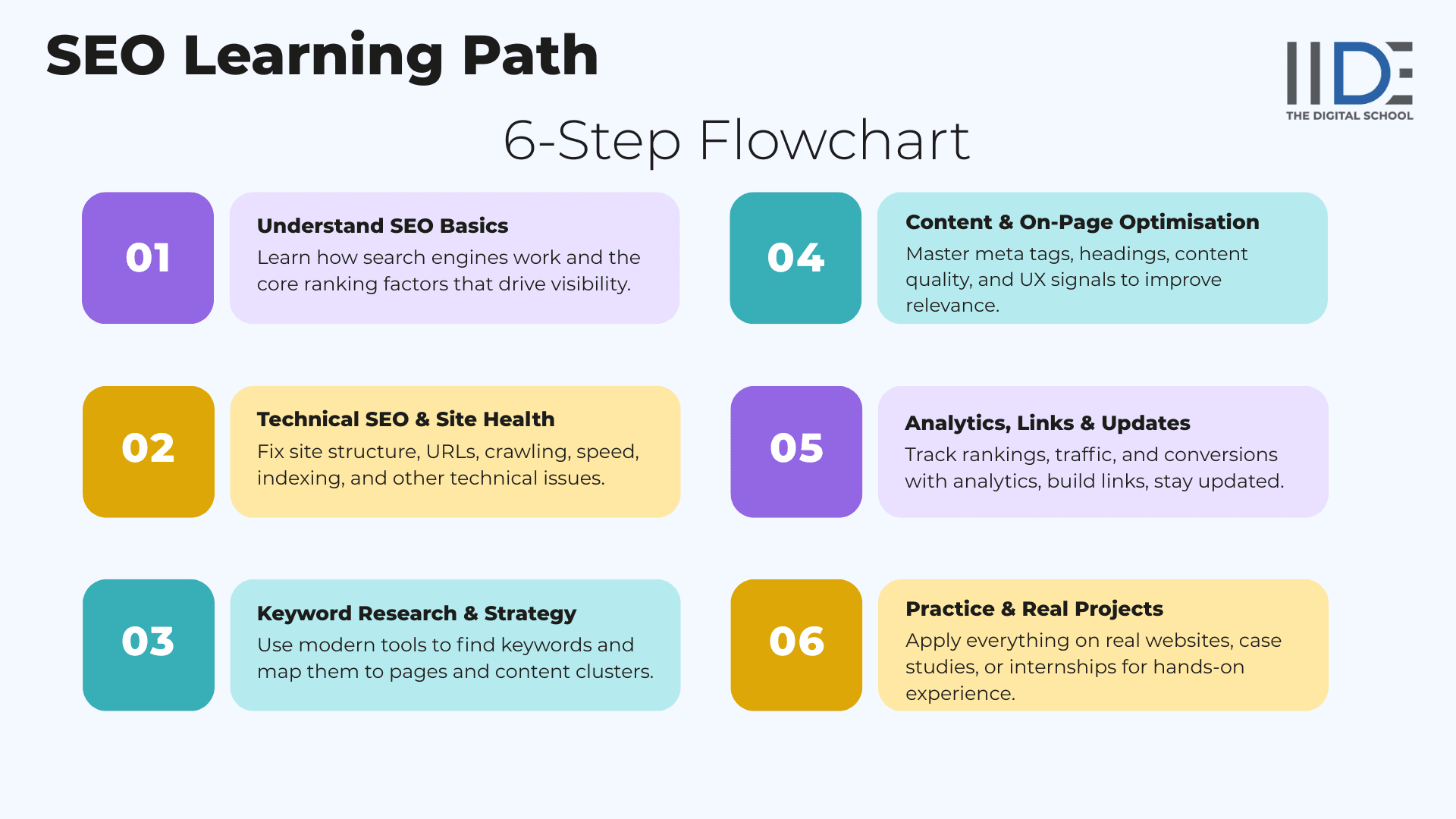
SEO Learning Path - 6 Step Learning Flowchart
This 6-step SEO Learning Path flowchart from IIDE provides a practical roadmap for mastering search engine optimisation.
It covers everything from core ranking factors and technical health checks, through keyword research and on-page optimisation, to analytics, traffic tracking, and real-world project application.
IIDE’s Digital Marketing Course provide a robust SEO module, where learners master on-page and off-page techniques, tools, and case studies under expert guidance.
With a focus on modern practices and live projects, the IIDE program bridges skill gaps and connects students to real-world SEO opportunities, accelerating career growth.
FREE SEO Course Options
1) IIDE Free Masterclass: Digital Marketing Fundamentals - by Karan Shah
Course Overview
A 45‑minute, free masterclass that introduces the core pillars of digital marketing, SEO, social media, content, and analytics, with a special focus on how search works and why SEO is critical for long‑term growth.
Course Outcome
Get a clear mental model of the digital funnel and understand where SEO fits, so you don’t treat SEO in isolation but as part of a money‑making system for brands and students.
Link to Masterclass: Fundamentals Of Digital Marketing Course With Certification
2) SEO Certification Course by HubSpot Academy (Free)
Course Overview
A comprehensive free course covering how search engines work, on‑page SEO, technical SEO, keyword research, link building, and SEO reporting.
Course Outcome
Learn to run basic SEO audits, research keywords, optimise pages, and measure organic performance, skills you can immediately apply on your own site or client projects.
Link to course page: HubSpot
PAID Option (Best ROI): IIDE + Supporting Course
1) Online Digital Marketing Course by IIDE
Course Overview
IIDE’s flagship Online Digital Marketing Course
covers SEO in depth (on‑page, off‑page, technical) along with content, PPC, social media, analytics, and AI, taught live + recorded with projects and placement support.
Course Outcome
Become job‑ready for SEO Executive / Analyst roles while also understanding how SEO connects with other channels, making you more valuable to agencies and brands. Build a portfolio of real projects and case studies.
Course Fees (EMI)
Recent listings for IIDE’s online programs show total fees in the ₹1.25-1.8 lakh range for 4-6 months of training, with EMIs starting from roughly ₹8,000-₹24,000 per month depending on course level and tenure.
Self-Learning Path (Free): SEO Roadmap (8 Weeks)
Week 1-2: Foundations
- Watch IIDE’s Digital Marketing Fundamentals Masterclass.
- Complete HubSpot’s SEO course basics to understand ranking factors, keyword intent, and on‑page optimisation.
Week 3-4: Keyword Research & On‑Page SEO
- Practise keyword research using Google Keyword Planner and Ubersuggest.
- Optimise 5-10 blog posts (titles, meta, H1-H3, internal links, image alt text).
Week 5-6: Technical SEO & Link Building
- Use Screaming Frog (free tier) to identify crawl errors, redirect chains, and sitemap issues.
- Secure your first 3-5 backlinks via guest posts or niche directories.
Week 7-8: Portfolio & Freelancing
- Document before/after performance using Google Search Console.
- Create 1-2 case studies and start pitching SEO audits to local businesses or on freelance platforms.
Success Story: Riddhi Kalantri - From Intern to Assistant Manager at McDonald's India
Riddhi Kalantri graduated with a Bachelor of Business Administration (BBA) in Marketing from Ashoka Centre for Business and Computer Studies (2020-2023). She had completed multiple internships but was seeking to transition into a full-time digital marketing role.
Career Growth Timeline
- November 2023: Started as Social Media Intern at Yog Love (while pursuing IIDE)
- February 2024: Began freelancing while continuing her education
- February 2025: Secured Digital Marketing Intern position at McDonald's India
- June 2025: Promoted to Assistant Manager - Digital Marketing at McDonald's India (current role)
Professional Experience
Rapid career progression from intern to management level:
- Assistant Manager - Digital Marketing - McDonald's India (June 2025 - Present)
- Digital Marketing Intern - McDonald's India (Feb 2025 - Apr 2025)
- Freelance Digital Marketer - Self-employed (Feb 2024 - June 2025)
- Social Media Intern - Yog Love (worked with Ira Trivedi on brand collaborations, SEO optimization - increased SEO score by 23% in 1 month)
- Marketing and Branding Intern - Talerang (Aug 2023 - Nov 2023)
"Stay focused on continuous learning and building real-world experience. I balanced freelancing with my IIDE program, which helped me land my dream role. Don't wait to apply what you learn - start creating campaigns immediately."
Tools & Resources
For SEO as a money‑making skill for students, master Google Search Console, Google Analytics, Ahrefs, Semrush, Screaming Frog and Ubersuggest. Combine these tools with consistent blogging, guest posting, and local SEO projects to create proof of rankings and justify monthly retainers from clients.
2. Pay-Per-Click Advertising (Google Ads)
Pay-Per-Click (PPC) is a digital marketing model where advertisers pay a fee each time their ad is clicked. It includes managing Google Ads campaigns by researching keywords, setting budgets, optimising ad creatives, and analysing performance to maximise ROI.
PPC and Google Ads are among the fastest ways to generate measurable results for clients. If you can turn ad spend into profitable conversions, you can charge performance fees or retainers. This makes PPC one of the most scalable skills to make money for students, especially in India’s performance‑driven market.
Salary Range Based on Job Title (2026, India)
| Job Role | Average Base Salary (INR / year) | Type of Work / What You Will Learn |
|---|---|---|
| PPC Executive | ₹3,60,000 - ₹4,50,000 | Campaign setup, daily optimisation, basic reporting. |
| PPC Analyst | ₹5,00,000 - ₹7,50,000 | Deep analysis, testing, multi‑channel optimisation. |
| SEM / PPC Manager | ₹8,00,000 - ₹15,00,000 | Strategy, handling bigger budgets, team & client management. |
| Digital Marketing Head | ₹18,00,000 - ₹25,00,000+ | Owns all paid growth channels and performance teams. |
PPC Learning Path - 6 Step Learning Flowchart
This 6-step PPC Learning Path flowchart from IIDE provides a practical roadmap for mastering pay-per-click advertising.
It covers PPC basics and ad auctions, keyword research and planning, Google Ads setup and targeting, plus budget control and automation, optimisation with performance tracking, and live campaign projects. Perfect for beginners wanting structured PPC expertise from foundation to execution.
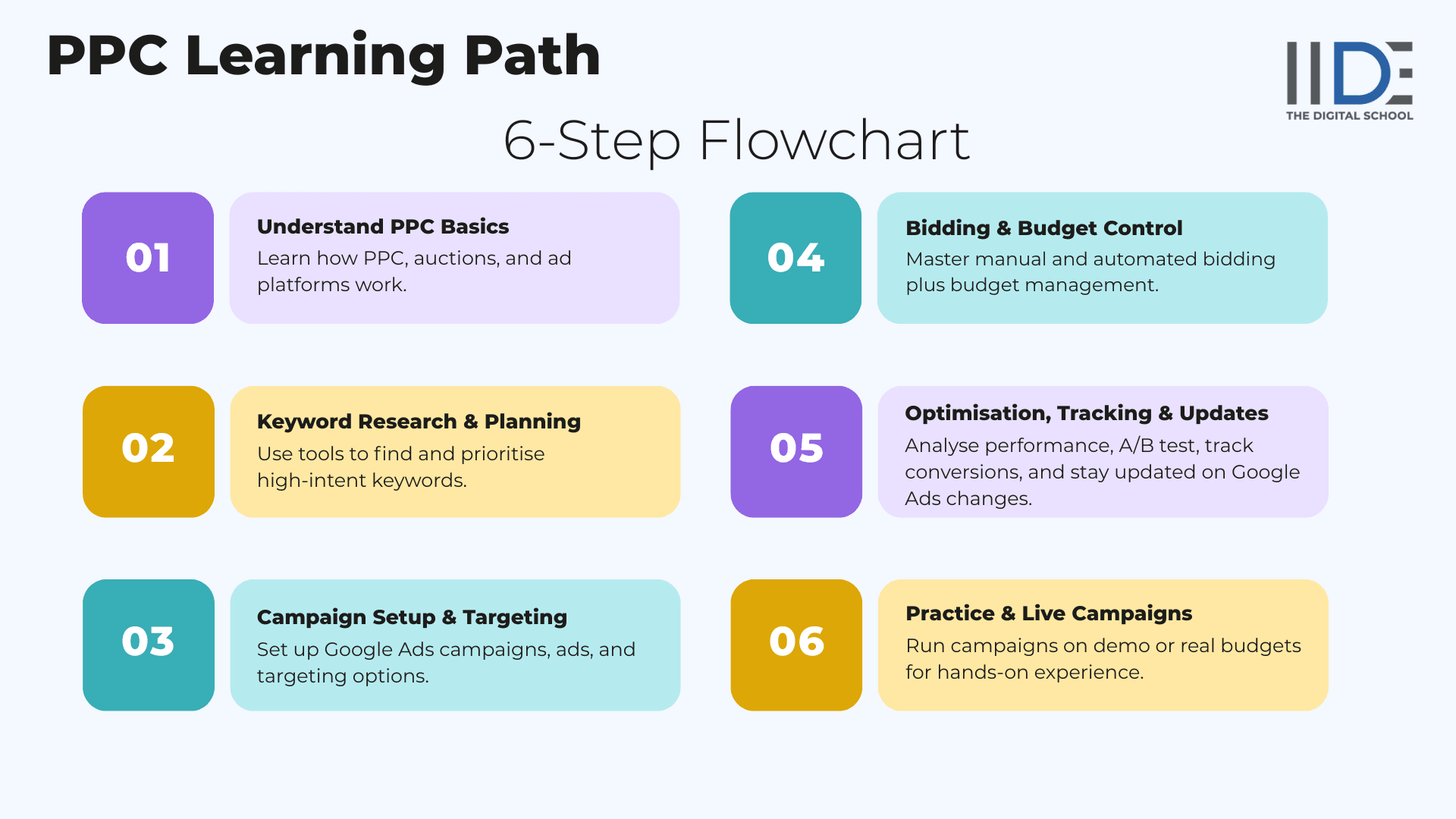
IIDE’s Digital Marketing Courses offer in-depth PPC and Google Ads modules with project-based learning, certifications, and live simulation campaigns. This hands-on approach empowers learners to confidently run and analyse paid search campaigns and meet industry standards.
According to Statista, India’s digital advertising market is projected to cross ₹600 billion by 2026, almost doubling from its 2016 levels as brands rapidly shift budgets online.
FREE Google Ads / PPC Options
1) IIDE Free Masterclass: Fundamentals of Meta Advertising
Course Overview: A 12‑lecture, free masterclass that covers the fundamentals of running profitable Meta (Facebook & Instagram) campaigns, audiences, creatives, budgeting, and optimisation.
Course Outcome: Build solid paid media thinking (targeting, testing, scaling) that directly translates to Google Ads and other PPC platforms.
Link to masterclass: Fundamentals of Meta Advertising with Certification
2) Google Ads Search Certification - Skillshop (Free)
Course Overview
Official Google training on Search Ads, campaign setup, keyword strategy, bidding models, and optimisation, ending with a free certification exam.
Course Outcome
Learn to create and optimise search campaigns for leads and sales, gaining a credential widely recognised by agencies and brands.
PAID Option (Best ROI): IIDE + Supporting Course
1) Online Digital Marketing Course - IIDE (Performance Marketing Focus)
Course Overview
IIDE’s Online Digital Marketing Course has strong modules on Google Ads, Meta Ads, performance marketing, and analytics, taught via live projects, simulations, and case studies.
Course Outcome
Become job‑ready as a PPC / Performance Marketing Executive who can run and scale campaigns across platforms, not just Google.
Course Fees (EMI)
Similar fee and EMI structure as above: approximately ₹1.25-1.8 lakh with EMIs starting around ₹8,000-₹24,000/month depending on program and tenure.
Self-Learning Path (Free): PPC Roadmap (8 Weeks)
Week 1-2: Foundations & Meta Ads
- Watch IIDE’s Fundamentals of Meta Advertising Masterclass end‑to‑end.
- Complete Google’s introductory modules on how the Google Ads auction works.
Week 3-4: Basic Campaigns & Keywords
- Set up a dummy Google Ads search campaign (even without going live).
- Practise keyword research and match types using Google Keyword Planner.
Week 5-6: Optimisation & Tracking
- Learn conversion tracking via Google Tag Manager + Analytics.
- Run a small real campaign (₹1,000-₹2,000) and optimise based on CTR, CPC, and CPA.
Week 7-8: Case Studies & Clients
- Build 1-2 case studies (before/after performance).
- Pitch PPC audits and test campaigns to local businesses, agencies, and freelancers.
Tools & Resources
To use PPC as a money‑making skill for students, get fluent in Google Ads, Microsoft Ads, Google Keyword Planner, Semrush, SpyFu, and Google Analytics. Focus on measurable results (CPL, ROAS) so clients clearly see the value you generate from their ad spend.
3. Social Media Marketing
Social Media Marketing involves using platforms like Facebook, Instagram, LinkedIn, and Twitter to promote brands, create engagement, manage communities, and drive leads or sales through targeted organic and paid content.
In India’s rapidly digitising market, brands leverage social media for brand visibility, customer engagement, and influencer partnerships. According to industry reports, Indian businesses are spending over 20% of their marketing budget on social media, with platforms like Instagram and LinkedIn seeing exponential advertiser growth.
Every brand, creator, and coach needs a strong social presence. Students who can handle content calendars, community management, and basic ads can quickly earn from retainers, UGC work, and consulting, making social media one of the most accessible skills to make money for students in India.
Demand for social media managers, strategists, and content creators is rising, with over 50,000 related job openings recently listed on job portals in major metros. Effective social media marketing has become a must-have skill for businesses of all sizes.
Salary Range Based on Job Title for Social Media Marketing (2026, India)
| Job Role | Average Base Salary (INR / year) | Type of Work / What You Will Learn |
|---|---|---|
| Social Media Executive | ₹3,60,000 - ₹4,50,000 | Content posting, basic design, community replies. |
| Social Media Strategist | ₹6,00,000 - ₹7,50,000 | Campaign planning, content pillars, influencer coordination. |
| Social Media Manager | ₹8,00,000 - ₹12,00,000 | Multi‑platform strategy, team handling, reporting. |
| Head of Social | ₹15,00,000 - ₹22,00,000+ | Owns social media across the brand, budget, and teams. |
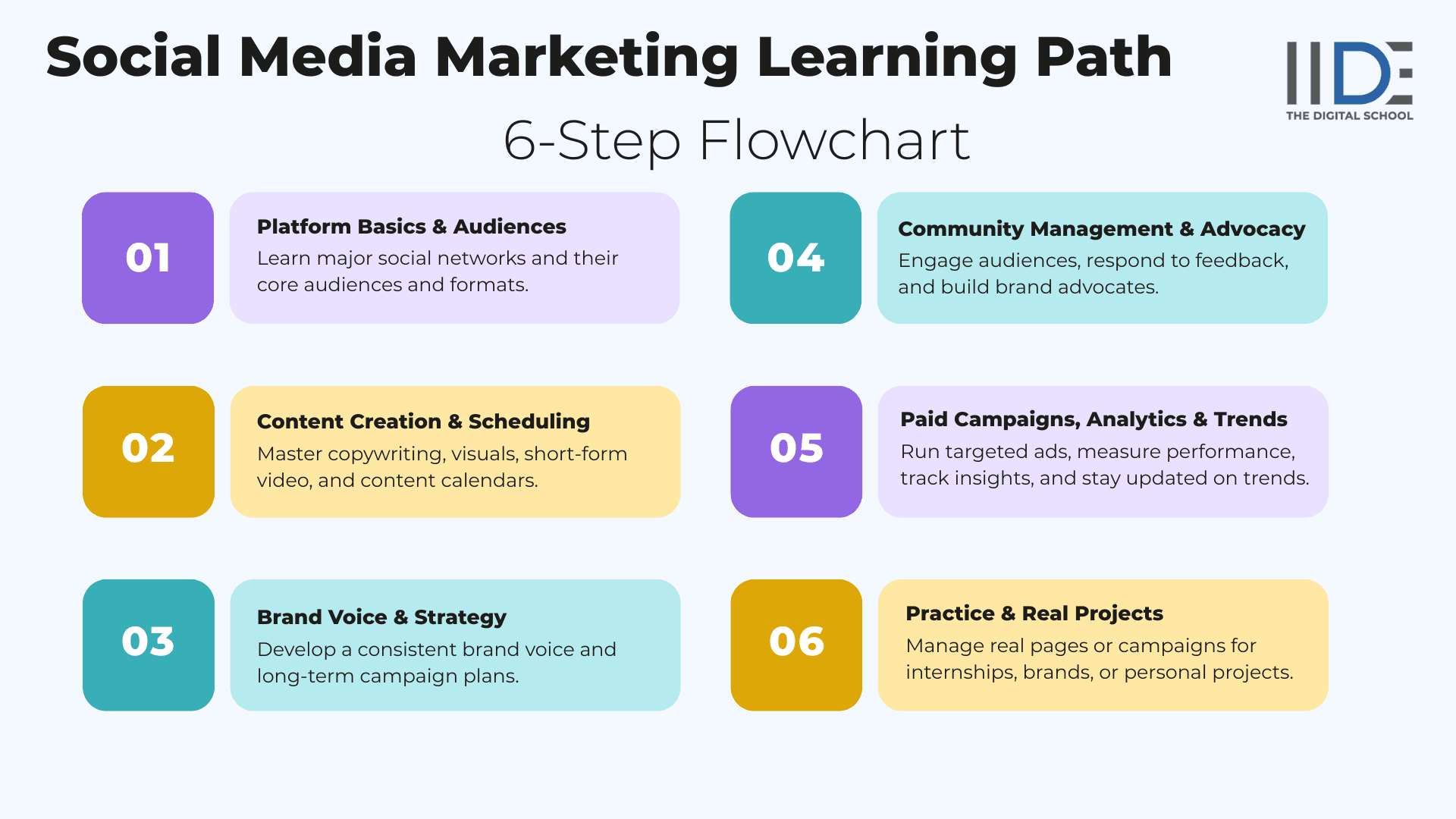
Social Media Marketing Learning Path - 6‑Step Flowchart
This 6-step Social Media Marketing Learning Path flowchart from IIDE offers a comprehensive roadmap to master digital engagement.
It covers major platforms and audiences, content creation with short-form videos and calendars, brand voice strategies, community management with paid ads and analytics, campaign performance tracking, and real-world projects for internships or personal brands. Ideal for building complete social media expertise.
FREE Social Media Options
1) IIDE Free Masterclass: Instagram Marketing - by Vir Saini
Course Overview
- A focused masterclass on decoding Instagram’s algorithm, content formats, and growth strategies to 2x your presence in 2026.
Course Outcome
- Learn exactly how to plan content, use Reels, and optimise posting to grow followers and leads on Instagram, a key platform for social media freelancers.
Link to masterclass: Instagram Marketing Strategies to Future-Proof Yourself in 2025
2) IIDE Free Masterclass: Digital Marketing Fundamentals - by Karan Shah
Course Overview
- Builds a foundation across channels, highlighting how social media integrates with SEO, email, and paid media.
Course Outcome
Understand social’s role in the funnel, so your strategies go beyond vanity metrics.
Link: Fundamentals Of Digital Marketing Course With Certification
(You can then add a free Social Media Marketing Certification from HubSpot or Meta as a next step.)
PAID Option (Best ROI): IIDE + Supporting Course
1) Online Digital Marketing Course - IIDE (Social Media + Strategy)
Course Overview
Includes in‑depth modules on social media strategy, content planning, influencer marketing, ORM, and paid campaigns across major platforms, with live projects and assessments.
Course Outcome
Become job‑ready as a Social Media Executive or Strategist who can plan, execute, and report on full campaigns, not just post content.
Course Fees (EMI)
Same ballpark as other IIDE digital marketing programs: ₹1.25-1.8 lakh, with EMI options starting from about ₹8,000/month upwards depending on course and plan.
Link to course page: Digital Marketing Courses
Self-Learning Path (Free): Social Media Roadmap (8 Weeks)
Week 1-2: Basics & Instagram Focus
- Watch IIDE’s Instagram Marketing Masterclass.
- Analyse 5 successful Indian brand accounts to understand content pillars and posting cadence.
Week 3-4: Content Creation & Scheduling
- Use Canva to design 30 posts (static, carousels, stories).
- Schedule posts via Meta Business Suite; monitor basic metrics.
Week 5-6: Community & Paid Experiments
- Manage comments & DMs for a small page (your own or a friend’s).
- Run a low‑budget Meta ad campaign to learn targeting and creative testing.
Week 7-8: Portfolio & Clients
- Prepare a portfolio: content calendar, example posts, and performance screenshots.
- Approach cafes, salons, trainers, or local brands offering 30‑day management at a starter fee.
Success Story: Risha Jain - From Mass Media Graduate to Senior Digital Marketing Professional
Background
Risha Jain graduated with a Bachelor of Mass Media (Advertising) from KC College, Mumbai (2019), with a passion for creativity and communication but no prior professional digital marketing experience.
Skill Learned
Digital Marketing through IIDE's comprehensive program (June 2022), specializing in Social Media & Influencer Marketing.
Career Growth Timeline
- July 2022: Started as Influencer Marketing Intern at IIDE
- April 2023: Promoted to Influencer Marketing Associate at IIDE (Full-time)
- December 2023: Joined White Rivers Media as Senior Influencer Executive
- January 2025: Promoted to Assistant Account Manager at White Rivers Media
Professional Experience
She has worked with multiple clients including IIDE and White Rivers Media in roles such as:
- Assistant Account Manager - White Rivers Media (Jan 2025 - Present)
- Senior Influencer Executive - White Rivers Media (Dec 2023 - Dec 2024)
- Influencer Marketing Associate - IIDE (Apr 2023 - Jun 2024)
- Social Media Manager - Toujourss, Traxive Official
Proof of Success
- LinkedIn: Risha Jain - LinkedIn
- Consistent career growth with multiple promotions
- 2+ years of proven experience in influencer marketing and social media management
Her Advice
"Start with one niche - I chose influencer & social media strategy. Learn consistently, manage clients with data, and stay visible on LinkedIn."
Tools & Resources for Social Media Marketing
For social media as a money‑making skill for students, Master Meta Business Suite, Instagram Insights, LinkedIn Analytics, Canva, Hootsuite/Buffer and basic short‑form editing apps. Pair strong ideas and storytelling with consistent posting and engagement to retain clients on monthly retainers.
4. Content Marketing & Copywriting![]()
Content marketing focuses on creating and distributing valuable, relevant content to attract and retain audiences. Copywriting is the art of crafting persuasive text for marketing materials, such as websites, ads, and emails.
Businesses are increasingly relying on high-quality content to educate, engage, and convert customers. In India, content marketing is projected to grow at an annual rate of over 14%, with brands allocating larger budgets for storytelling, long-form content, and SEO-led content.
Every touchpoint, websites, blogs, ads, scripts, emails, depends on words. This makes content and copywriting highly monetisable skills to make money for students, through freelance gigs, agency work, and in‑house roles across almost every industry.
Skilled writers, strategists, and editors are in high demand to produce high-ROI content. According to Naukri and LinkedIn data, job postings for content writers and content strategists have doubled in the last three years, reflecting robust demand for skilled communicators.
Updated Salary Snapshot & Type of Work (2026, India)
| Job Role | Avg. Base Salary (INR / year) | Type of Work / What You Will Learn |
|---|---|---|
| Content Writer | ₹4,00,000 - ₹4,50,000 | Blogs, website content, social captions, basic research‑driven writing. |
| Copywriter | ₹5,00,000 - ₹7,00,000 | Ad copy, landing pages, email copy, hooks, and CTAs that drive conversions. |
| Content Strategist | ₹9,00,000 - ₹11,00,000 | Content planning, calendars, funnels, and performance analysis across channels. |
| Head of Content | ₹14,00,000 - ₹20,00,000+ | Owns editorial direction, manages teams, and aligns content with business goals. |
(Freelancers with strong portfolios often report monthly incomes from ₹25,000 to ₹80,000+ depending on clients, niches, and retainer mix.)
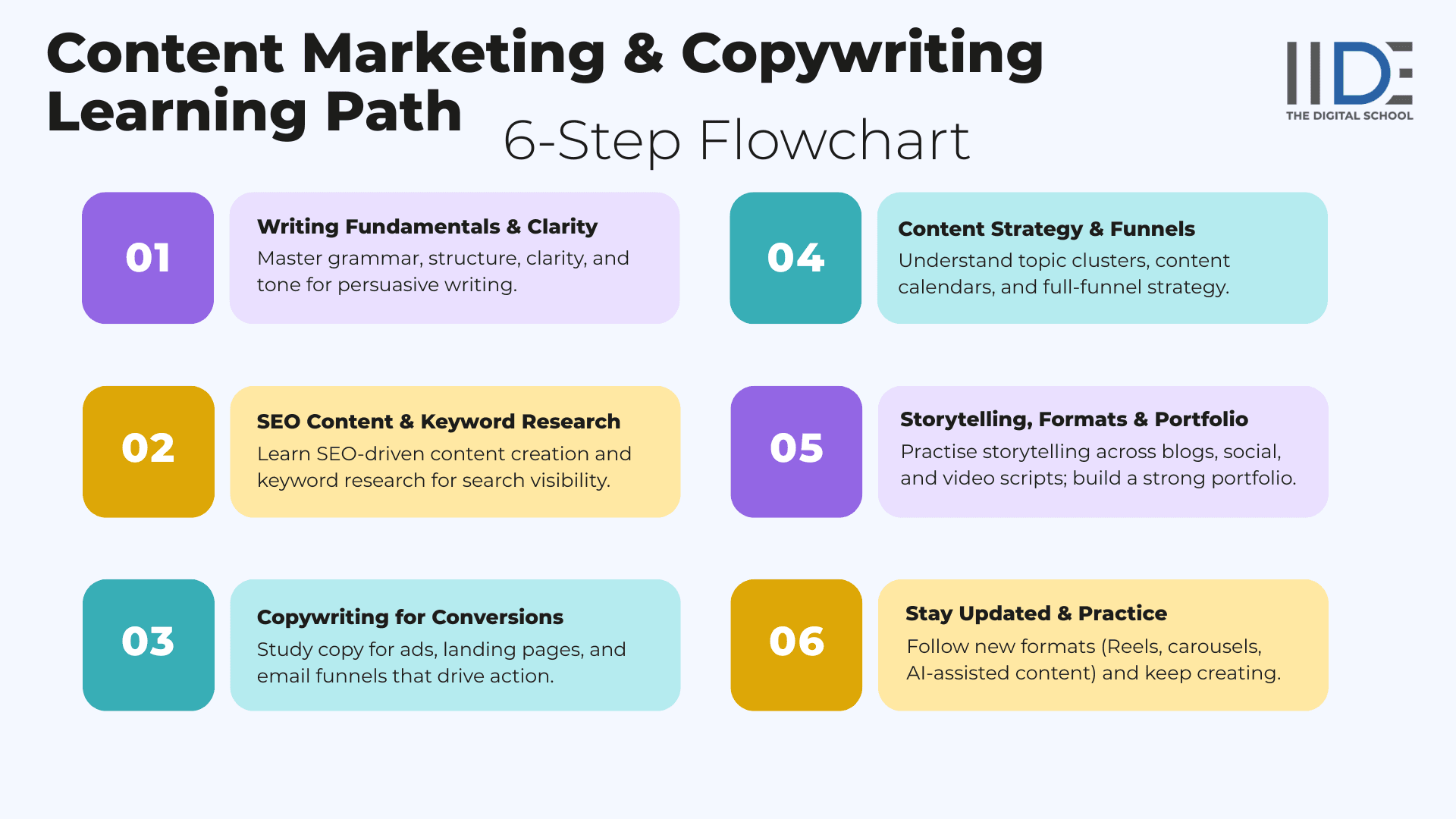
Content Marketing & Copywriting Learning Path - 6‑Step Flowchart
This 6-step Content Marketing & Copywriting Learning Path flowchart from IIDE provides a complete roadmap to create impactful content.
It covers writing grammar, clarity and tone, SEO-driven content with keyword research, conversion-focused copywriting, topic clusters and content calendars, storytelling for blogs and video scripts, plus staying updated with trends. Perfect for building professional content creation skills.
FREE Content Marketing & Copywriting Option: Digital Marketing Fundamentals Masterclass by IIDE
Course Overview
The Digital Marketing Fundamentals masterclass by IIDE (conducted by Karan Shah) is a free, 45‑minute session that covers the core pillars of digital marketing, including how content and copywriting fuel SEO, social media, email, and paid campaigns. It breaks down the customer journey and shows where different content types fit in the funnel.
Course Outcome
Students understand how strategic content attracts, educates, and converts audiences across channels. This is ideal for beginners who want to see the “big picture” before specialising in blogs, ads, or email copy, and it sets a strong foundation for building content as a money‑making skill.
Link to course page: Digital Marketing Fundamentals Masterclass - IIDE
PAID Option (Best ROI): Content Writing Course by IIDE
Course Overview
IIDE’s Content Writing Course is a specialised program focused on modern digital content: SEO blogs, website copy, ad copy, social media captions, emailers, and basic scripting. Learners go through live/recorded sessions, practical assignments, and feedback from expert trainers, with a strong emphasis on clarity, persuasion, and search‑friendliness.
Course Outcome
By the end, students build a polished writing portfolio across multiple formats, understand how to write both informative and conversion‑oriented content, and are prepared for roles such as Content Writer, Copywriter, or freelance content specialist. The course bridges the gap between “good writing” and “writing that brings results and revenue.”
Course Fees
The course is typically priced around the mid five‑figure range in INR, with periodic discounts and EMI options available through IIDE’s financing partners. This makes it accessible for students who want a focused content‑writing upskill without committing to a full‑length PG program.
Link to course page: Content Writing Course - IIDE
Self-Learning Path (Free): 8‑Week Content Marketing & Copywriting Roadmap
Week 1-2 - Fundamentals & Inspiration
- Complete IIDE’s Digital Marketing Fundamentals masterclass to understand where content fits in the funnel.
- Read high‑quality blogs and landing pages from top brands; analyse headlines, structure, and CTAs.
Week 3-4 - Writing Practice & SEO Basics
- Write one short blog or LinkedIn post every day in a chosen niche.
- Learn basic on‑page SEO: keyword placement, headings, meta descriptions, and internal linking.
Week 5-6 - Conversion Copy & Offers
- Practise writing ad copy (Google, Meta) and simple landing pages for imaginary products or services.
- Re‑write 10-15 existing ads/landing pages you find online to make them clearer and more benefit‑driven.
Week 7-8 - Portfolio, Positioning & Monetisation
- Compile your best blogs, ad copies, and web copy into a simple portfolio (Google Drive, Notion, or a basic site).
- Reach out to small businesses, agencies, or startups offering a trial blog or landing page in exchange for a testimonial and then transition into paid retainers.
Success Story: Yves Marin - From 12 Years in Sports to Digital Marketing Mastery
Background
Yves Marin is a seasoned professional with 12 years of expertise in the sports industry, holding a Master's degree in Marketing & Sport Management from University of Strasbourg. He has worked with elite sports brands including On, Adidas, and Puma in product management and marketing roles.
Skill Learned
Professional Certificate in Digital Marketing & Strategy from IIDE - The Digital School (July 2023 - April 2024), adding digital expertise to his extensive sports industry background.
Career Growth Timeline
- Pre-IIDE: Product Manager at Adidas (6+ years), working with trail running footwear and apparel
- During IIDE: Continued advancing his career while upskilling in digital marketing
- May 2024: Promoted to Athlete Product Manager at On (current role)
- Present: Leading high-performance athlete product strategies at On, Zurich
Professional Experience
Working with world-class sports brands in senior positions:
- Athlete Product Manager - On (May 2024 - Present)
- Product Manager Trail Running (Footwear & Apparel) - Adidas (2021 - 2023)
- Manager Go-To-Market Milestone Management - Adidas (2017 - 2021)
- Marketing Manager France - Horizon Vertical (2011 - 2015)
- Key Account & Trade Marketing - Puma (2010 - 2011)
Proof of Success
- LinkedIn: Yves Marin - LinkedIn
- 12+ years of proven leadership in sports industry
- Career progression from marketing assistant to senior product management roles
- Currently shaping product strategies for elite athletes at On
His Advice
"Continuous learning is key. Even with 12 years of experience, upskilling in digital marketing opened new dimensions in product strategy and athlete engagement. Never stop evolving."
Tools for Content Marketing & Copywriting
To convert content into a money‑making skill for students, use Google Docs, Grammarly, Hemingway, WordPress, SEMrush/BuzzSumo for topic research, and basic AI tools for ideation. Combine these with a clear niche and strong portfolio to consistently attract higher‑paying clients and roles.
5. Email Marketing Automation
Email Marketing Automation involves creating automated email campaigns using tools to nurture leads, segment audiences, personalise content, and track engagement for better customer retention and conversions.
Indian businesses increasingly rely on email marketing automation to drive ROI. The sector is expected to grow at a 20%+ CAGR, driven by rising adoption across e-commerce, SaaS, and BFSI.
Professionals skilled in platforms such as Mailchimp and HubSpot see increasing demand in metro cities, where personalised email campaigns are key to customer loyalty.
Updated Salary Snapshot & Type of Work in Email Marketing Automation (2026, India)
| Job Role | Avg. Base Salary (INR / year) | Type of Work / What You Will Learn |
|---|---|---|
| Email Marketing Executive | ₹4,50,000 - ₹5,50,000 | Campaign setup, list hygiene, basic segmentation, and reporting. |
| Automation Specialist | ₹7,00,000 - ₹8,50,000 | Workflow design, behaviour‑based triggers, integrations with CRM/e‑commerce. |
| Campaign Manager | ₹12,00,000 - ₹14,00,000+ | Channel strategy, experimentation, performance ownership across multiple brands. |
| Email Marketing Head | ₹15,00,000 - ₹22,00,000+ | Owns lifecycle marketing, retention, and revenue from email/CRM channels. |
(Freelancers who manage email flows for multiple brands can often earn ₹30,000-₹1,00,000+ per month, depending on retainers and performance bonuses.)
Learning Path for Email Marketing Automation
- Understand email marketing fundamentals and list‑building best practices.
- Learn segmentation and automation workflows (welcome, nurture, cart recovery, win‑back).
- Practise designing responsive email templates and basic HTML editing.
- Study deliverability basics: sender reputation, spam filters, and compliance.
- Analyse key metrics (opens, clicks, conversions, revenue per send).
- Implement A/B testing and continuous optimisation.
- Gain hands‑on experience with real campaigns or demo accounts.
FREE Email Marketing Automation Option: Strategic Digital Marketing Masterclass by IIDE
Course Overview
The Strategic Digital Marketing masterclass by IIDE (by Karan Shah) is a free, 45‑minute session that dives into building complete digital strategies, acquisition, nurturing, and retention. Email and automation are positioned as critical levers to increase customer lifetime value and maximise ROI from paid and organic channels.
Course Outcome
Students learn how email fits into a full‑funnel strategy: capturing leads, nurturing them with value‑driven content, and re‑engaging past customers. This bird’s‑eye view ensures you approach email as a strategic revenue channel, not just “sending newsletters,” which is key for higher‑value roles and consulting.
Link to course page: Strategic Digital Marketing Masterclass - IIDE
PAID Option (Best ROI): Online Digital Marketing Course by IIDE (Email & Automation Module)
Course Overview
IIDE’s Online Digital Marketing Course includes dedicated modules on email marketing and marketing automation. Learners work on building lists, designing templates, creating automated workflows (welcome, nurture, cart‑abandoned, re‑engagement), and integrating email with other channels such as social media and performance marketing.
Course Outcome
Graduates can plan and execute complete email strategies for brands: from opt‑in mechanisms and lead magnets to automation flows and performance reporting. This prepares students for roles like Email Marketing Executive, CRM Specialist, or Lifecycle Marketer, and also helps freelancers offer higher‑ticket “done‑for‑you” email funnel services.
Course Fees
The program generally falls in the ₹1,25,000 - ₹1,80,000 fee bracket depending on batch and inclusions, with flexible EMI options available. Given it covers 360° digital marketing (including email), it offers strong ROI for students aiming at broader digital roles with specialisation opportunities in automation.
Link to course page: Online Digital Marketing Course - IIDE
Self-Learning Path (Free): 8‑Week Email Marketing Automation Roadmap
Week 1-2 - Foundations & Setup
- Watch IIDE’s Strategic Digital Marketing masterclass to understand email’s role in the funnel.
- Create a free account on Mailchimp, Brevo (Sendinblue), or similar; set up a basic list and a simple signup form.
Week 3-4 - Basic Campaigns & Segmentation
- Design and send 3-5 broadcast campaigns (newsletters, product updates, content round‑ups).
- Segment your list by engagement (opens/clicks) and simple interest tags.
Week 5-6 - Automation & Optimisation
- Build at least three flows: Welcome Series, Cart Recovery (if e‑commerce), and Re‑engagement.
- Implement A/B tests on subject lines, preview text, and send times to understand what improves performance.
Week 7-8 - Case Studies & Monetisation
- Document screenshots, flows, and results from your experiments as 1-2 case studies.
- Offer email setup + 1-2 automation flows as a fixed‑price package to small businesses, creators, or local shops, then move to monthly optimisation retainers.
Tools for Email Marketing Automation:
To convert email into a money‑making skill for students, start with Mailchimp, Brevo/Sendinblue, ActiveCampaign, HubSpot, basic HTML editors, and Google Analytics for performance tracking. Package your skills as “end‑to‑end email setup + automation + reporting” to justify recurring monthly fees.
6. AI & Prompt Engineering - Course Paths & Learning Plan
AI & Prompt Engineering deals with crafting precise inputs (prompts) for AI models like GPT to generate accurate and creative outputs, enabling applications in writing, coding, chatbots, and data analysis.
As AI adoption in India accelerates, prompt engineering is among the fastest-growing skills. Industries including IT, marketing, and healthcare seek experts who can fine-tune AI prompts for tasks like automated content generation and customer service bots.
Demand is projected to grow rapidly with startups and enterprises integrating AI solutions, making it a highly specialised and lucrative field.
Updated Salary Snapshot & Type of Work in AI & Prompt Engineering (2026, India)
| Job Role | Avg. Base Salary (INR / year) | Type of Work / What You Will Learn |
|---|---|---|
| AI Prompt Engineer | ₹8,00,000 - ₹15,00,000 | Designing, testing, and refining prompts and workflows for LLMs. |
| AI Specialist | ₹12,00,000 - ₹22,00,000 | Selecting tools, building AI solutions, and integrating them into business processes. |
| Machine Learning Engineer | ₹18,00,000 - ₹30,00,000+ | Model development, deployment, and performance optimisation. |
| AI Research Lead | ₹30,00,000 - ₹45,00,000+ | Advanced R&D, AI product strategy, and leading AI/ML teams. |
(Consultants and freelancers offering AI workflow design and automation can often earn project‑based fees or retainers well above typical entry‑level salaries, especially for global clients.)
AI & Prompt Engineering Learning Path
This 6-step AI & Prompt Engineering Learning Path flowchart from IIDE offers a comprehensive roadmap to harness artificial intelligence effectively. It covers AI/LLM fundamentals and language models, prompt design principles for system messages, best practices for writing prompts, AI tool APIs and automation workflows, ethics and safety guidelines, plus end-to-end project deployment. Ideal for building practical AI implementation skills.
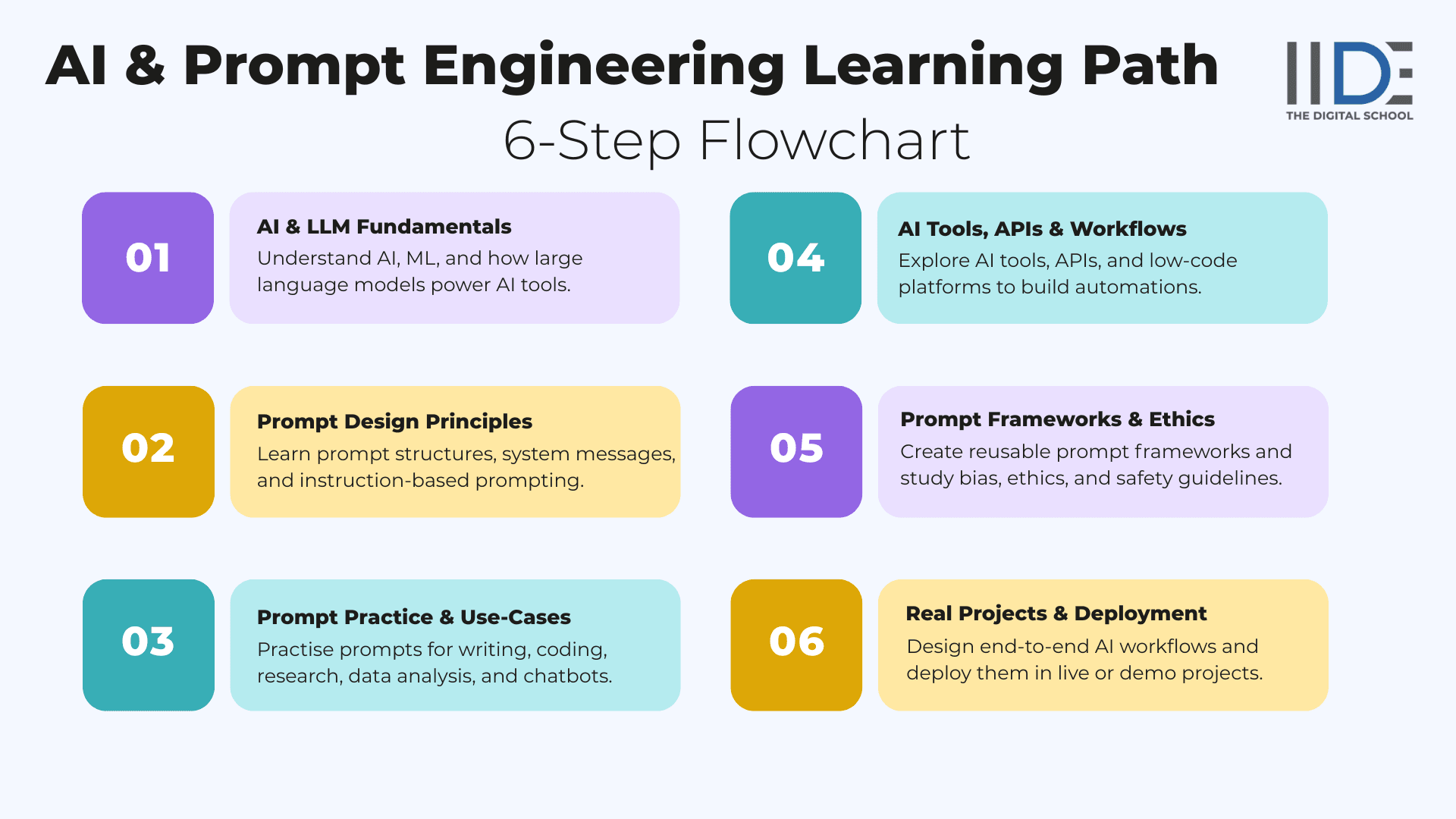
While numerous YouTube tutorials and free resources are available for learning AI, enrolling in a structured course will help you upskill more quickly and gain a deeper, practical understanding.
At IIDE - Digital Business School, we offer an Online AI course designed to equip you with the skills needed to excel in AI and data science engineering.
FREE AI & Prompt Engineering Option: AI in Digital Marketing Masterclass by IIDE
Course Overview
The AI in Digital Marketing masterclass by IIDE (by Jay Dattani) is a free, 25‑minute session that shows how AI tools and prompts can transform ideation, content creation, ad optimisation, and reporting in digital marketing. It demonstrates practical use‑cases using popular AI tools, with a strong focus on real‑world application.
Course Outcome
Students learn how to think in terms of “AI‑assisted workflows”: using prompts to generate angles, outlines, creatives, and insights faster and better. This is an ideal first step into prompt engineering because it links prompts to actual business outcomes, not just experimentation.
Link to course page: AI in Digital Marketing Masterclass - IIDE
PAID Option (Best ROI): Online AI Course by IIDE
Course Overview
IIDE’s Online AI Course (and its advanced AI programs) focus on practical AI adoption: understanding generative AI, mastering prompt engineering, using AI tools across marketing and business functions, and building automated workflows.
Training is delivered via industry‑relevant projects, scenario‑based exercises, and guidance from experienced AI practitioners.
Course Outcome
Learners gain the ability to:
- Design effective prompts for multiple use‑cases (content, analysis, ideation, chatbots).
- Build AI‑powered workflows that save time and increase output quality.
- Apply AI thinking to real business contexts, making them valuable as Prompt Engineers, AI Specialists, or AI Automation Consultants.
Course Fees
Depending on level (foundation vs advanced/professional), IIDE’s AI programs typically range from mid‑five‑figure to low‑six‑figure fees in INR, with EMI options available. Given the earning potential of AI‑powered roles and consulting, these programs are positioned as high‑ROI upskilling options.
Link to course page: Online AI Course - IIDE
Self-Learning Path (Free): 8‑Week AI & Prompt Engineering Roadmap
Week 1-2 - Fundamentals & Use‑Cases
- Watch IIDE’s AI in Digital Marketing masterclass to see concrete marketing use‑cases.
- Start experimenting with a popular LLM tool (like ChatGPT) for ideation, rewriting, and summarising.
Week 3-4 - Prompt Frameworks & Patterns
- Create reusable prompt templates for blogs, ad copy, outlines, research summaries, and email sequences.
- Practise chaining prompts (follow‑ups, refinements) to improve accuracy and depth.
Week 5-6 - Workflow Design & Automation
- Use no‑code tools (such as Zapier, Make, or n8n) to connect AI with forms, spreadsheets, and email tools.
- Build at least one mini‑solution (e.g., an internal content brief generator or FAQ assistant).
Week 7-8 - Portfolio, Demonstrations & Monetisation
- Record short Loom videos demonstrating your best prompts and workflows.
- Offer “AI audit + prompt pack + workflow design” services to agencies, solopreneurs, and small businesses, positioning yourself as someone who can save them time and increase output.
Tools for AI & Prompt Engineering
To turn AI and prompt engineering into a money‑making skill for students, work with LLM tools (like ChatGPT/other GPT‑based apps), AI image tools, no‑code automation platforms (Zapier, Make, n8n), and documentation tools (Notion, Google Docs) for prompt libraries. Package your expertise as end‑to‑end AI workflow design, not just “writing prompts.”
IIDE AI course Highlights:
- Hands-on Experience: Work on real-time projects and assignments for every course topic.
- Expert Faculty: Learn from industry veterans with real-world AI experience.
- Scenario-Based Learning: Work on AI projects relevant to your industry to maximise your career prospects..
- Industry Certification: Earn a globally recognised certificate to validate your expertise and boost your career.
You can also check out IIDE's PG Course in Digital Marketing & Business Strategy where you will learn to automate business marketing in depth.
7. Data Analysis & Visualisation
Every serious business is becoming data‑driven. Data analysts help founders and managers make better decisions with dashboards and insights. For students, this is a powerful skill to make money via freelance dashboards, analytics roles, and remote work for global teams.
Data Analysis & Visualisation is about interpreting datasets to uncover trends and insights, and creating visual representations such as charts and dashboards to communicate findings effectively.
India's growing data-driven economy fuels demand for analysts skilled in Excel, Power BI, and Tableau. Financial services, e-commerce, and healthcare are experiencing significant hiring for data professionals. The sector's CAGR exceeds 18%, reflecting the push towards strategic decision-making.
Updated Salary Snapshot & Type of Work in Data Analysis & Visualisation (2026 - India)
According to PayScale, Data Analysts in India earn an average base salary of about ₹5.7 lakh per year in 2026, with entry‑level roles starting lower and senior analysts crossing ₹10 lakh annually.
Learning Path Data Analysis & Visualisation
- Master statistics and data wrangling.
- Learn SQL and Excel for data manipulation.
- Get familiar with visualisation tools.
- Understand business metrics and KPIs.
- Practice storytelling with data.
- Build dashboards and reports.
- Study predictive analytics basics.
- Apply knowledge to projects or internships.
Tools for Data Analysis & Visualisation:
Excel, SQL, Power BI, Tableau, Python (Pandas, Matplotlib), Google Data Studio.
FREE Data Analysis Course Option: Data Analysis with Python (freeCodeCamp + YouTube Bootcamps)
- Course Overview: FreeCodeCamp’s Data Analysis with Python content and 4-19 hour free bootcamps teach Python, NumPy, Pandas, visualisation, and real projects.
- Course Outcome: Learn to clean, transform, and visualise data, and build small analysis projects you can showcase to employers and freelance clients.
- Link to course page: Freecodecamp
PAID Data Analytics Course Option (Best ROI): Google Data Analytics Professional Certificate (Coursera)
- Course Overview: A comprehensive, job‑oriented program teaching spreadsheets, SQL, Tableau, R/Python, dashboards, and case studies, with AI‑enhanced analytics lessons.
- Course Outcome: Build end‑to‑end data projects, complete a capstone case study, and become employable for junior data analyst roles in India and abroad.
- Course Fees: Coursera allows you to enrol and learn for free (audit); full certificate access typically requires a monthly subscription in INR that varies by discounts and region.
- Link to course page: Coursera
Self-Learning Path (Free): Data Analysis Roadmap for 8 Weeks
Week 1-2 - Foundations & Excel / Sheets
- Learn basic statistics (mean, median, standard deviation, distributions).
- Practise Excel/Google Sheets formulas and charts on real datasets.
Week 3-4 - SQL & Python Basics
- Work through SQL basics (SELECT, WHERE, GROUP BY, JOIN).
- Follow freeCodeCamp’s Data Analysis with Python lessons to learn Pandas and Matplotlib.
Week 5-6 - Dashboards & Storytelling
- Build 2-3 dashboards in Power BI or Tableau Public for realistic datasets (sales, marketing, finance).
- Write short narratives explaining insights and business recommendations.
Week 7-8 - Portfolio & Monetisation
- Publish dashboards and notebooks on GitHub and Tableau Public, linked via a simple portfolio site or Notion page.
- Offer analytics help to small ecommerce brands, coaching institutes, or NGOs, starting with free audits, then moving into retainers.
Tools & Resources for Data Analysis & Visualisation
For students, data analysis becomes a money-making skill once you’re fluent with Excel, SQL, Power BI/Tableau, Python (Pandas, Matplotlib), and Google Data Studio/Looker Studio. These tools let you turn messy business data into clear insights and dashboards that founders are willing to pay for.
8. Web Development (Full Stack)
Full Stack Web Development covers building complete web applications, including front-end client-side) and back-end (server-side) development, databases, and deployment.
Full stack web development is one of the most direct skills to make money for students. With just a laptop and internet, you can build landing pages, business websites, dashboards, and SaaS-style tools. Indian and global startups regularly hire student developers or pay on a project basis, and full stack skills also open doors to remote jobs.
India’s booming IT industry demands full-stack developers for startup and enterprise projects. Digital transformation initiatives and the rapid development of apps sustain growth.
Salary trends indicate steady increases, with demand particularly high in cities like Bangalore and Hyderabad.
Updated Salary Snapshot & Type of Work in Web Development (Full Stack) (2026, India)
| Job Role | Avg. Base Salary (INR / year) | Type of Work / What You Will Learn |
|---|---|---|
| Junior Developer | ₹4,50,000 - ₹7,00,000 | Assist senior devs, fix bugs, build small features, learn APIs, Git, and basic deployment. |
| Front‑end Developer | ₹6,00,000 - ₹12,00,000 | Build responsive UIs with HTML/CSS/JS + React/Angular; focus on performance and accessibility. |
| Back‑end Developer | ₹6,00,000 - ₹12,00,000+ | Design and maintain APIs, databases, authentication, background jobs, and server performance. |
| Full Stack Developer | ₹8,00,000 - ₹20,00,000+ | Own end‑to‑end features across front‑end, back‑end, and deployment; work closely with product and design. |
(Actual numbers vary by city, company size, and stack; top product companies and funded startups often exceed the upper ranges.)
Learning Path for Web Development (Full Stack)
- Start with HTML, CSS, and JavaScript basics.
- Learn front-end frameworks (React, Angular).
- Understand server-side languages (Node.js, Python).
- Study databases (SQL, NoSQL).
- Build REST APIs and authentication.
- Explore deployment and DevOps basics.
- Work on full projects end-to-end.
- Contribute to open source or internships.
FREE Web Development Option: Responsive Web Design Certification by freeCodeCamp
Course Overview
The Responsive Web Design Certification by freeCodeCamp is a completely free, browser‑based program that teaches semantic HTML, modern CSS, Flexbox, Grid, accessibility, and responsive layouts by building multiple real projects. It has been redesigned to include 20+ projects and hundreds of coding challenges learners complete directly online.
Course Outcome
By completing this certification, students can create clean, responsive websites (landing pages, documentation sites, portfolios) that look good on mobile and desktop. This gives a solid foundation to start charging for simple website builds and prepares you to move into JavaScript and full‑stack frameworks.
Link to course page: Freecodecamp
PAID Option (Best ROI): IBM Full Stack Software Developer / IBM Full‑Stack JavaScript Developer Professional Certificates (Coursera)
Course Overview
IBM’s Full Stack Software Developer and Full‑Stack JavaScript Developer Professional Certificates on Coursera are job‑oriented programs that cover:
- Front‑end: HTML, CSS, JavaScript, React
- Back‑end: Node.js, Express, Python, Django (depending on track)
- Databases: SQL, NoSQL, MongoDB
- Cloud & DevOps: containerisation (Docker), microservices, CI/CD basics, deployment to cloud platforms
Learners build multiple full stack applications, deploy them to the cloud, and complete a capstone project.
Course Outcome
You graduate with a portfolio of real projects (front‑end + back‑end + cloud deployment) that demonstrate employable full stack skills. The programs are designed so beginners can become job‑ready for junior developer roles in under 6 - 9 months, especially attractive to Indian service companies, startups, and remote employers.
Course Fees
Coursera offers these as Professional Certificates under a monthly subscription. You can typically enrol and start with a free trial, audit some content for free, or subscribe monthly; the exact INR amount changes with region and discounts, but many learners complete them in 3 - 6 months to keep total cost lower.
Links to course pages
Self-Learning Path (Free): 8‑Week Full Stack Roadmap for Students
Week 1 - 2 - HTML, CSS & Responsive Design
- Complete freeCodeCamp’s Responsive Web Design certification (HTML, CSS, Flexbox, Grid, accessibility).
- Rebuild 3 - 5 existing landing pages (from Indian startups/SaaS tools) using only HTML + CSS to understand layout and spacing.
Week 3 - 4 - Core JavaScript & Version Control
- Learn JavaScript fundamentals (variables, functions, arrays, objects, DOM) via freeCodeCamp or MDN’s JavaScript tutorials.
- Set up Git and GitHub. Push all practice projects to GitHub; aim for frequent, meaningful commits so recruiters can see your learning curve.
Week 5 - 6 - Front-end Framework + Simple API
Start React (or another modern framework) through free resources or The Odin Project, which offers a full, open‑source full stack curriculum.
Build a simple API with Node.js + Express (e.g., todo list or notes API) and connect it to MongoDB or another database.
Week 7 - 8 - Real Projects, Deployment & Freelancing
- Build 2 - 3 full stack projects: for example, a blog CMS, a task manager, or a basic booking system. Deploy using platforms like Vercel, Netlify, Render or Railway so everything is publicly accessible.
- Create a one‑page portfolio (could be a React site or simple HTML) linking GitHub repos and live demos. Start pitching website/app builds to local businesses and on freelancing sites, this is where full stack turns into a real money‑making skill for students.
Tools for Web Development (Full Stack)
To turn full-stack web development into a money‑making skill for students, master VS Code, Git/GitHub, HTML, CSS, JavaScript, React, Node.js/Express, MongoDB or SQL, and deployment platforms like Vercel/Netlify/Render. Showcasing clean GitHub repos and live projects dramatically increases your chances of paid work.
9. UI/UX Design
UI/UX Design sits at the intersection of creativity, psychology, and business. Well‑designed products convert better, retain users longer, and build strong brands.
That’s why startups, SaaS companies, fintechs, and D2C brands pay well for designers who can own user journeys, making UI/UX a premium money‑making skill for students in India.
UI/UX Design focuses on creating user-friendly, aesthetically pleasing interfaces, optimising user experience through research, wireframing, prototyping, and usability testing.
Indian startups and product companies increasingly prioritise UI/UX to differentiate apps. The sector has grown sharply, with UI/UX designers earning competitive salaries and being involved early in product life cycles.
Updated Salary Snapshot & Type of Work in UI/UX Design (2026, India)
| Job Role | Avg. Base Salary (INR / year) | Type of Work / What You Will Learn |
|---|---|---|
| UI Designer | ₹4,50,000 - ₹9,00,000 | Visual design, layouts, typography, iconography, design systems in Figma/XD. |
| UX Designer | ₹6,50,000 - ₹12,00,000 | User research, journey mapping, wireframes, prototypes, usability testing |
| UI/UX Designer | ₹6,30,000 - ₹12,00,000+ | End‑to‑end product design: from insights to high‑fi UI and developer handoff. |
| UX / Product Design Lead | ₹18,00,000 - ₹25,00,000+ | Leading design teams, shaping product vision, design ops and stakeholder management. |
Learning Path for UI/UX Design
- Study design principles and user psychology.
- Learn tools like Figma, Sketch, and Adobe XD.
- Practice wireframing and prototyping.
- Conduct user research and interviews.
- Test usability and iterate on designs.
- Develop design portfolios.
- Collaborate with developers.
- Stay updated on trends and accessibility.
FREE UI/UX Option: Google UX Design Professional Certificate (Audit) by Google on Coursera
Course Overview
The Google UX Design Professional Certificate is a seven‑course program (200+ hours) that covers UX foundations, user research, personas, user journeys, wireframes, low‑ and high‑fidelity prototypes, usability testing, accessibility, and job search preparation. It is designed specifically for beginners seeking entry‑level UX roles.
Course Outcome
Learners complete at least three end‑to‑end UX projects, including a mobile app, responsive website, and cross‑platform experience, and assemble them into a professional UX portfolio suitable for junior product design, UX design, or UI/UX roles.
Free Access (Audit / Financial Aid)
On Coursera, you can audit most course content for free (videos and readings) and, in many regions, apply for financial aid to access graded assignments and the certificate. Some learners also use limited‑time discounts or local pricing to reduce total cost.
Link to course page: Coursera
PAID Option (Best ROI): Google UX Design Professional Certificate (Full Access) by Google
Course Overview
With full paid access (subscription or Coursera Plus), the Google UX Design Certificate includes graded assignments, peer‑reviewed projects, and completion certificates for each course and the overall program. It moves from basics to project‑based learning, ending in a job search module tailored to UX careers.
Course Outcome
Graduates build a polished portfolio, understand the complete UX process (research → define → ideate → prototype → test → iterate), and are prepared to apply for roles like UX Designer, UI/UX Designer, Product Designer, UX Researcher, and design internships.
Course Fees
Coursera notes that most learners finish the program in under 6 months at about 10 hours/week, paying via a monthly subscription. The exact INR subscription amount varies by country and discounts, but Google emphasises that the certificate is designed to be “job‑ready” and cost‑effective compared to traditional degrees.
Link to course information (Google): Google UX design
Self-Learning Path (Free): 8‑Week UI/UX Roadmap for Students
Week 1-2 - UX Mindset & Fundamentals
- Audit “Foundations of User Experience (UX) Design” (Course 1 in the Google UX Certificate).
- Learn key concepts: human‑centred design, accessibility, heuristics, and UX vs UI.
- Analyse 5-10 Indian apps you use daily; map out user flows and pain points.
Week 3-4 - Wireframing, Prototyping & Tools
- Learn Figma basics through Figma’s own free tutorials and Google UX modules on wireframing.
- Take 2-3 flawed app experiences (e.g., clunky forms or confusing onboarding) and redesign them:
- Sketch on paper → low‑fi wireframes → clickable prototypes in Figma.
Week 5-6 - UX Research & Usability Testing
- Follow the research and testing modules from the Google UX program to learn interviews, surveys, and usability testing.
- Conduct at least 5 usability tests with friends/classmates on your prototypes, note issues, prioritise them, and iterate designs.
Week 7-8 - Case Studies, Portfolio & Freelancing
- Convert your best 2-3 projects into detailed case studies: problem, constraints, process, design decisions, and outcomes.
- Build a simple portfolio on Behance, Dribbble, or Notion + a basic site, then approach early‑stage startups, student ventures, and NGOs with UI/UX audit offers. This is where UI/UX turns into a serious money‑making skill for students.
Tools for UI/UX Design:
To convert UI/UX into a money‑making skill for students, focus on Figma, FigJam/Miro for ideation, Adobe XD (optional), Notion for documentation, and simple usability‑testing setups with Zoom or in‑person sessions. When combined with strong case‑study storytelling, these tools make you highly competitive for junior design roles.
10. Graphic Design & Branding
Graphic Design and Branding involve creating visual content to communicate messages and build brand identity through logos, colour schemes, and marketing materials.
Every brand needs compelling visuals, logos, social posts, ads, packaging, and pitch decks. That makes graphic design and branding highly practical skills to make money for students. You can start with Canva, move to Adobe tools, and charge per project, per brand kit, or as a monthly design retainer for startups and creators.
With India’s digital marketing maturity, professionals skilled in Adobe Creative Suite and branding enjoy numerous opportunities in agencies, startups, and enterprises, especially in metros.
Updated Salary Snapshot & Type of Work in Graphic Design & Branding (2026, India)
| Job Role | Avg. Base Salary (INR / year) | Type of Work / What You Will Learn |
|---|---|---|
| Graphic Designer | ₹3,00,000 - ₹6,00,000 | Social creatives, posters, print/digital ads, basic branding, deck design. |
| Brand / Visual Designer | ₹6,00,000 - ₹10,00,000 | Brand identity systems, visual direction, web/app visuals, campaigns. |
| Senior Designer | ₹8,00,000 - ₹12,00,000+ | Lead campaigns, mentor juniors, multi‑channel brand systems and guidelines. |
| Creative / Design Head | ₹12,00,000 - ₹18,00,000+ | Owns creative strategy, manages design teams, works directly with founders/CMOs. |
(Freelancers with strong portfolios often report monthly incomes from ₹25,000 to ₹80,000+, depending on clients and project mix.)
Learning Path for Graphic Design & Branding
- Master design fundamentals and colour theory.
- Learn Adobe Photoshop and Illustrator.
- Build branding and marketing assets.
- Understand client communication.
- Develop a portfolio and case studies.
- Follow industry trends.
- Gain freelancing or agency experience.
FREE Graphic Design Option: Canva Design School by Canva
Course Overview
Canva Design School is Canva’s free learning hub, offering beginner‑friendly courses and tutorials on design basics, social media graphics, presentations, branding, and visual storytelling. Lessons cover layout, colour, typography, hierarchy, and practical tips for non‑designers using Canva templates and tools.
Course Outcome
Students learn to create professional‑looking posts, banners, presentations, and simple brand assets using Canva’s free plan. This is ideal for quick monetisation: you can start offering social media creatives, thumbnails, posters, and simple branding kits to small businesses and content creators even if you’re new to design.
Link to course page: Canva
PAID Option (Best ROI): Graphic Design specialisation by CalArts (Coursera)
Course Overview
The Graphic Design specialisation from the California Institute of the Arts (CalArts) on Coursera is a five‑course sequence covering:
- Fundamentals of graphic design (composition, hierarchy, grids)
- Typography basics and advanced type usage
- Image‑making and visual language
- Brand identity and design history
- A capstone project called “Brand New Brand”, where you create a full brand identity system
Course Outcome
Learners develop strong conceptual thinking in addition to software skills. The capstone guides you through building a complete brand identity, logo, colour system, type, and application, which becomes a flagship portfolio piece and is directly applicable to client branding projects in India and globally.
Course Fees
The specialisation is available under Coursera’s subscription model. You can audit content for free, but graded assignments and certificates require a paid subscription. 2026 reviews note that many learners complete it in about 2-3 months at 5-10 hours/week to keep total subscription cost manageable.
Link to course page: Coursera
Self-Learning Path (Free): 8‑Week Graphic Design & Branding Roadmap
Week 1-2 - Design Fundamentals & Canva Practice
- Complete Canva Design School’s introductory lessons on design basics and social media graphics.
- Recreate 10-15 posts and posters from top Indian brands in Canva to learn alignment, spacing, and type hierarchy.
Week 3-4 - Move into Adobe & Logo Basics
- Start learning Adobe Photoshop and Illustrator (or free equivalents like Photopea and Inkscape).
- Study logo design and colour theory through reputable YouTube channels and blogs. Recreate 10-20 logos to train your eye and hand.
Week 5-6 - Build Brand Identity Case Studies
- Create 3 complete brand projects for imaginary or local businesses, including: logo, colour palette, typography system, business card, basic stationery, and social media templates.
- Present each as a mini case study with concept exploration and final mockups.
Week 7-8 - Portfolio, Platforms & Monetisation
- Upload your best projects to Behance and Dribbble, and optionally build a simple portfolio website.
- Offer fixed‑price packages like “Logo + basic brand kit” or “30 social media creatives/month” to local businesses, solopreneurs, and creators. This is where design turns into a scalable money‑making skill for students.
Success Story: Siddhi Shah - From Law Graduate to Brand Strategist at Dentsu Creative
Background
Siddhi Shah is a lawyer-turned-marketer who graduated with a Bachelor of Laws (LLB) from Pravin Gandhi College of Law (2017-2022). Despite her legal background, she was passionate about marketing and brand storytelling.
Skill Learned
Postgraduate Degree in Digital Marketing from IIDE - Indian Institute of Digital Education (September 2022 - August 2023), specializing in brand strategy and web design.
Career Growth Timeline
- February 2021: Co-Founded Reframe (entrepreneurial venture while studying law)
- January 2023: Web Design Intern at IIDE (during her IIDE program)
- October 2023: Joined Dentsu Creative as Junior Brand Strategist (2 months post-graduation)
- July 2025: Promoted to Senior Executive - Brand Strategy at Dentsu Creative (current role)
Professional Experience
Transitioned from law to marketing with rapid career advancement:
- Senior Executive - Brand Strategy - Dentsu Creative (July 2025 - Present)
- Junior Brand Strategist - Dentsu Creative (Oct 2023 - July 2025)
- Web Design Intern - IIDE (Jan 2023 - July 2023)
- Co-Founder - Reframe (Feb 2021 - Sept 2023)
Key Achievements:
- Developed marketing strategies for major brands: VISA, Skore, Mschief, Complan, Swiggy Genie, Amway, SBI Life
- Built IIDE's placement portal (hire.iide.co) from scratch, helping 1,000+ students secure placements at 400+ companies
- Designed ChatGPT Masterclass curriculum for 1,000+ students at IIDE
- Managed end-to-end operations for Reframe including product development, marketing, and sales
Proof of Success
- LinkedIn: Siddhi Shah - LinkedIn
- Career switch from law to marketing within 1 year of IIDE graduation
- Promoted to senior role within 2 years at Dentsu Creative
- Built functional placement portal serving 1,000+ students and 400+ companies
Her Advice
"Don't be afraid of career pivots. My law background gave me analytical skills that strengthened my marketing strategies. IIDE gave me the technical and strategic foundation to make the switch confidently. Start building real projects while learning - that's what gets you hired."
Tools for Graphic Design & Branding
To convert graphic design into a money‑making skill for students, start with Canva for speed, then move to Adobe Photoshop, Illustrator, Figma, and high‑quality mockup resources. Combine solid fundamentals (layout, colour, typography) with clearly packaged services (brand kits, social packs, pitch decks) to charge more and build recurring design retainers.
11. Video Editing & Motion Graphics
Video Editing & Motion Graphics involve cutting and assembling video footage combined with animated graphics and effects to create engaging media.
Short‑form video, YouTube, Reels, and OTT content have exploded in India. Brands, influencers, creators, agencies, and startups all need editors and motion designers who can turn raw footage into high‑retention content.
This makes video editing and motion graphics one of the most practical skills to make money for students, with opportunities ranging from YouTube channels to ad agencies and D2C brands.
The growth of digital video content on platforms like YouTube and Instagram boosts demand for editors proficient in Adobe Premiere, After Effects, and Final Cut Pro in India’s content creation ecosystem.
Updated Salary Snapshot & Type of Work in Video Editing & Motion Graphics (2026, India)
| Job Role | Avg. Base Salary (INR / year) | Type of Work / What You Will Learn |
|---|---|---|
| Video Editor | ~₹3,00,000 - ₹6,00,000 | Cutting and assembling footage, basic colour & audio, social videos. |
| Motion Graphics Artist | ~₹4,00,000 - ₹9,00,000 | Animated titles, explainer graphics, ad creatives, logo animations. |
| Senior Video Producer | ~₹7,00,000 - ₹12,00,000+ | Oversee concepts, shoots, post‑production, manage editors & motion team. |
| Creative Director (Video) | ₹12,00,000 - ₹20,00,000+ | Own video strategy, storytelling, and brand film direction across channels. |
(Top creators, agencies, and product companies often pay higher, especially for editors who understand YouTube analytics and performance marketing.)
Learning Path Video Editing & Motion Graphics
- Learn video editing software basics.
- Practice cutting and sequencing footage.
- Create animations and effects.
- Study storytelling and pacing.
- Produce various video formats.
- Build showreels and client projects.
- Keep current with new tools and trends.
FREE Video Editing Option: DaVinci Resolve Video Editing for Beginners by freeCodeCamp (YouTube)
Course Overview
freeCodeCamp’s “DaVinci Resolve Course - Video Editing for Beginners” is a 3-4 hour, completely free YouTube course that walks you through installing DaVinci Resolve, navigating the interface, editing timelines, trimming footage, adding transitions, basic colour correction, text, and exporting a polished video.
Course Outcome
By the end, students can confidently edit complete videos in DaVinci Resolve’s free version, sufficient for YouTube, Instagram, and client projects. You’ll understand timelines, cuts, basic audio, colour tweaks and simple effects, giving you enough skill to start charging for basic edits and social media videos.
Link to course page: DaVinci Resolve Course - Video Editing for Beginners
(You can also use the newer 2026 “DaVinci Resolve 20 - Complete Tutorial for Beginners”, which covers updated features and motion graphics in the free editor.)
PAID Option (Best ROI): DaVinci Resolve specialisation (Coursera)
Course Overview
- The DaVinci Resolve specialisation on Coursera is a structured multi‑course program that covers editing, colour grading, audio, and delivery using DaVinci Resolve 19.
- Learners move from fundamentals to more advanced creative techniques, following guided projects and assignments.
Course Outcome
- On completion, you can handle professional‑grade editing, colour correction, and basic motion graphics for client projects, agencies, and content creators.
- This helps you move beyond simple cuts into cinematic edits and branded video packages that command higher fees.
Course Fees
- The specialisation is available under Coursera’s subscription model.
- You can enrol and start for free, then pay a monthly subscription to access graded projects and certificates.
- Completing it in 2-3 months keeps overall cost relatively low compared to long diplomas.
Link to course page: DaVinci Resolve specialisation
Self-Learning Path (Free): 8‑Week Video Editing & Motion Graphics Roadmap
Week 1-2 - Editing Foundations & Interface
- Install DaVinci Resolve (free) and complete the freeCodeCamp beginner course to learn timelines, cuts, basic transitions, and exporting.
- Edit 3-4 practice videos (vlogs, reels compilations, or college event footage) to understand pacing and storytelling.
Week 3-4 - Colour, Audio & Storytelling
- Practise colour correction and basic grading using DaVinci’s Color page and free online tutorials.
- Learn audio basics: volume balancing, noise reduction, music placement, and smooth fades.
- Re‑edit one earlier project focusing only on colour and sound quality.
Week 5-6 - Motion Graphics & Effects
- Explore Fusion in DaVinci Resolve for lower thirds, animated titles, and simple motion graphics.
- Create 5-10 short assets: logo reveals, animated text, simple transitions.
- Study motion reels from top Indian agencies and replicate 2-3 effects.
Week 7-8 - Showreel & Monetisation
- Compile a 1-2 minute showreel featuring your best edits and motion work.
- Offer editing packages to:
- YouTubers and podcasters (per‑video or monthly retainers)
- Local businesses and coaches (ad creatives, reels, promo videos) - List your services on LinkedIn and freelance platforms, highlighting fast turnaround and data‑driven improvements (higher watch‑time, better hooks).
Tools for Video Editing & Motion Graphics:
To turn video editing into a money‑making skill for students, master DaVinci Resolve, Adobe Premiere Pro, After Effects, basic audio tools, and stock libraries for footage, music, and sound effects. Pair clean editing with strong hooks, good pacing, and analytics (retention curves) to justify premium rates for content creators and brands.
12. Project Management
Project Management oversees planning, execution, and closure of projects, managing teams, budgets, and timelines to meet goals.
Project management is the engine behind IT projects, construction, digital transformations, and product launches. Organisations pay well for people who can deliver on time and within budget.
For students, project management becomes a strong skill to make money through coordination roles, freelance ops work, and fast‑track leadership careers.
Indian industries require project managers across IT, construction, and business services. PMP and Agile certifications are highly valued and increase job prospects with competitive pay.
Updated Salary Snapshot & Type of Work in Project Management (2026, India)
| Job Role | Avg. Base Salary (INR / year) | Type of Work / What You Will Learn |
|---|---|---|
| Project Coordinator | ₹5,00,000 - ₹8,00,000 | Support documentation, schedules, reports, stakeholder updates. |
| Project Manager | ₹10,00,000 - ₹22,00,000 | Own scope, time, cost, risks, change control, cross‑functional coordination. |
| Agile Coach / Scrum Master | ₹15,00,000 - ₹28,00,000 | Implement Agile/Scrum, coach teams, improve delivery processes. |
| Program / Portfolio Manager | ₹20,00,000 - ₹35,00,000+ | Oversee multiple projects, strategy alignment, senior stakeholder management. |
Learning Path in Project Management
- Understand project lifecycles and methodologies.
- Learn tools like MS Project and JIRA.
- Develop scheduling and budgeting skills.
- Gain leadership and communication skills.
- Get certified in PMP, PRINCE2, or Agile.
- Manage projects and teams practically.
- Refine risk and quality management.
Tools for Project Management
To turn project management into a money‑making skill for students, learn Trello, Asana, Jira, MS Project, Notion, Google Sheets, and basic Agile boards. Pair these with strong communication and reporting skills so founders trust you to “own” timelines and keep everyone aligned.
13. Sales & Business Development
Sales and Business Development involve acquiring customers, building partnerships, and driving revenue growth through relationship management and strategic planning.
Sales and business development are some of the most direct skills to make money for students. You get paid to bring in revenue, through lead generation, demos, negotiations, and closing deals. High performers can earn strong fixed pay plus incentives, and these skills translate across industries like SaaS, fintech, edtech, and B2B services.
India’s diverse economy demands skilled sales professionals with expertise in CRM tools and negotiation, which is important for startups, enterprises, and export businesses.
Updated Salary Snapshot & Type of Work in Sales & Business Development (2026, India)
| Job Role | Avg. Base Salary (INR / year) | Type of Work / What You Will Learn |
|---|---|---|
| Sales Executive | ₹3,00,000 - ₹4,80,000 | Field/inside sales, lead follow‑up, demos, driving monthly targets. |
| Business Development Manager | ₹6,00,000 - ₹12,00,000 | Pipeline building, key accounts, strategic partnerships, team coordination. |
| Sales Manager | ₹8,00,000 - ₹18,00,000+ | Manage teams, set quotas, forecast revenue, design incentive plans. |
| Sales Director / Head of Sales | ₹18,00,000 - ₹30,00,000+ | Own national/region sales strategy, large teams, major enterprise accounts. |
Learning Path in Sales & Business Development
- Study the fundamentals of sales and lead generation.
- Learn CRM systems and sales funnels.
- Master negotiation and closing techniques.
- Understand market research and competition.
- Build relationships and business networks.
- Analyse sales metrics.
- Gain real-world experience managing clients.
FREE Sales & BD Option: Inbound Sales Certification Course by HubSpot Academy
Course Overview
HubSpot Academy’s Inbound Sales Certification is a 100% free online program covering modern, buyer‑centric sales. It teaches prospecting, qualification, discovery calls, personalised outreach, and running effective sales presentations using an inbound methodology.
Course Outcome
You learn how to identify high‑intent prospects, ask better questions, personalise communication, handle objections, and structure sales conversations that feel like consulting instead of pushy selling, perfect for SDR, BDR, and junior sales roles as well as freelance closers.
Link to course page: Hubspot
PAID Option (Best ROI): The Art of Sales - Mastering the Selling Process specialisation
(Northwestern University, Coursera)
Course Overview
“The Art of Sales: Mastering the Selling Process” is a four‑course specialisation on Coursera from Northwestern University. It covers customer segmentation, prospecting, connecting with prospects, building trust, handling objections, negotiating, and closing, with case studies and a final project.
Course Outcome
Learners understand the complete B2B selling process, from building a pipeline to winning deals and improving team performance. By the end, you can apply structured methods to generate leads, run discovery calls, and close sales, massively increasing your earning potential as a salesperson or business development professional.
Course Fees
The specialisation runs on Coursera’s subscription model. You can audit video content for free, but graded assignments and certificates require a monthly subscription; most students finish in 3-4 months at a few hours per week.
Link to course page: Coursera
Self-Learning Path (Free): 8‑Week Sales & Business Development Roadmap
Week 1-2 - Inbound & Sales Foundations
- Complete HubSpot’s Inbound Sales Certification to understand inbound vs outbound, buyer’s journey, and consultative selling.
- Define a simple Ideal Customer Profile (ICP) and buyer persona for the industry you want to target (e.g., SaaS, agencies, coaching).
Week 3-4 - Prospecting & Outreach
- Draft 5-10 cold email templates and LinkedIn connection messages tailored to your ICP.
- Practise building lead lists using LinkedIn, Apollo, or manual research; track everything in a free CRM like HubSpot or Zoho.
Week 5-6 - Discovery, Objections & Closing
- Role‑play discovery calls with friends or classmates; record and review for clarity, listening, and objection handling.
- Learn basic negotiation frameworks (anchoring, BATNA, win‑win deals) from sales books and free online content.
Week 7-8 - Real Deals & Portfolio
- Partner with a freelancer, small agency, or startup to help them generate leads or set appointments in exchange for commission.
- Document your pipeline numbers (outreach, replies, meetings, deals) as a “mini sales portfolio” you can show to employers, this is when sales truly becomes a high‑impact money‑making skill for students.
Tools for Sales & Business Development
To turn sales into a money‑making skill for students, learn HubSpot CRM, Zoho or Salesforce basics, LinkedIn Sales Navigator, email outreach tools, and simple pipeline tracking in Sheets. Combine these with consistent outreach and strong discovery skills to book more meetings and close more deals.
14. Financial Analysis & Planning
Financial Analysis & Planning includes budgeting, forecasting, and evaluating financial data to guide business decisions and investments.
Financial analysis and planning roles sit at the core of business decision‑making. Analysts help founders and CXOs understand profitability, cash flow, valuation, and risk. For students, this is a high‑value skill to make money, via corporate finance roles, FP&A, equity research, or freelance modelling work for startups and investors.
Indian companies increasingly rely on analysts and planners for strategic management amid volatile markets. Skills in Excel, financial modelling, and ERP software are highly sought.
Updated Salary Snapshot of Financial Analysis & Planning & Type of Work (2026, India)
| Job Role | Avg. Base Salary (INR / year) | Type of Work / What You Will Learn |
|---|---|---|
| Financial Analyst | ₹4,80,000 - ₹7,00,000 | Financial statement analysis, basic modelling, budgeting support, MIS. |
| Finance Manager / FP&A | ₹10,00,000 - ₹18,00,000 | Forecasts, budgets, variance analysis, board decks, business partnering. |
| Corporate Planner / Strategy Analyst | ₹12,00,000 - ₹20,00,000+ | Long‑term planning, scenario modelling, capital allocation decisions. |
| CFO / Head of Finance | ₹30,00,000 - ₹60,00,000+ | Owns financial strategy, fundraising, investor relations, risk and governance. |
(High‑growth startups, Big 4, and bulge‑bracket finance roles may sit at or above the upper ranges.)
Learning Path Financial Analysis & Planning
- Learn accounting and financial principles.
- Understand budgeting and cash flow.
- Master Excel and financial modelling.Analyse statements and ratios.
- Study investment and risk management.
- Use ERP and planning software.
- Participate in simulations and case studies.
Tools for Financial Analysis & Planning:
To convert finance into a money‑making skill for students, master Excel/Google Sheets, basic Power BI/Tableau, financial statement analysis, and at least one structured financial modelling curriculum (e.g., FMVA®). Combine clean models with clear storytelling so decision‑makers rely on your numbers for real business choices.
If you're interested in expanding your knowledge, explore the best AI in Finance insights and take your skills to the next level
15. Public Speaking & Communication
This skill focuses on effectively conveying ideas, presenting clearly, and engaging audiences in professional environments.
Public speaking and communication sit on top of every other career skill. Strong communicators close more deals, lead better teams, and get more opportunities. For students, this quickly becomes a skill to make money through corporate training, facilitation, coaching, YouTube/content creation, and leadership roles in any industry.
In India, the rise of entrepreneurship and corporate training fuels demand for communicators skilled in leadership talks, client presentations, and webinars.
Updated Salary Snapshot in Public Speaking & Communication & Type of Work (2026, India)
| Job Role | Avg. Base Salary (INR / year) | Type of Work / What You Will Learn |
|---|---|---|
| Communication Specialist | ₹3,50,000 - ₹7,00,000 | Internal/external communication, PR content, presentations, stakeholder communication. |
| Corporate Trainer | ₹6,00,000 - ₹10,00,000+ | Conduct workshops, onboarding, soft‑skills training, leadership sessions. |
| Public Speaking Coach | ₹3,00,000+ (wide freelance range) | 1:1 coaching, group programs, presentation design, confidence building. |
| Leadership / Executive Coach (with public speaking expertise) | ₹20,00,000 - ₹50,00,000+ | High‑ticket coaching, keynote speaking, corporate advisory. |
(Earnings for coaches and trainers vary widely based on niche, reputation, and client base; top professionals often earn far more than salary medians.)
Learning Path for Public Speaking & Communication
- Practice voice modulation and speech structure.
- Learn body language and audience engagement.
- Develop storytelling and persuasion skills.
- Gain experience through speaking clubs.
- Get trained in virtual presentations.
- Collect feedback and keep improving.
- Use multimedia aids effectively.
FREE Public Speaking Course Option: Introduction to Public Speaking (University of Washington, Coursera - Audit)
Course Overview
“Introduction to Public Speaking” by the University of Washington on Coursera provides a proven framework for crafting and delivering impactful presentations. It covers speech structure, making ideas memorable, illustrating points, and overcoming fear.
Course Outcome
Learners reduce speaking anxiety, practise structuring talks, and develop stronger delivery skills. You finish with a clear, repeatable process you can use for class presentations, interviews, webinars, and client pitches.
Link to course page: Coursera
(You can audit much of the content for free and only pay if you want the certificate.)
PAID Public Speaking Course Option (Best ROI): Dynamic Public Speaking specialisation (University of Washington, Coursera)
Course Overview
The Dynamic Public Speaking specialisation is a four‑course program from the University of Washington on Coursera. It takes you from foundational public speaking to informative, persuasive, and inspirational speeches with multiple practice assignments and peer reviews.
Course Outcome
You build a portfolio of recorded speeches (informative, persuasive, ceremonial) and gain confidence speaking in professional and academic settings. This specialisation is particularly valuable for students aiming to become trainers, coaches, leaders, or content creators.
Course Fees
The specialisation is available via Coursera’s subscription. Most learners complete it in around 2 months at ~10 hours/week, keeping total subscription cost modest. Audit options allow you to preview content before committing.
Link to course page: Coursera
Self-Learning Path (Free): 8‑Week Public Speaking & Communication Roadmap
Week 1-2 - Fundamentals & Mindset
- Work through the first modules of “Introduction to Public Speaking”.
- Record a 2-3 minute self‑introduction video; watch it back focusing only on structure (opening, body, close) and clarity, not perfection.
Week 3-4 - Storytelling & Body Language
- Practise 3-5 short stories from your own life (failures, learnings, wins) using clear openings, tension, and resolution.
- Study basic body language and voice techniques from free YouTube playlists; re‑record your stories applying one improvement at a time (eye contact, pauses, gestures).
Week 5-6 - Persuasion & Slides
- Draft and deliver a persuasive 5-7 minute talk on a topic you care about (e.g., why a founder should invest in a certain marketing channel).
- Build simple, clean slides in PowerPoint or Google Slides; focus on one clear idea per slide instead of dense text.
Week 7-8 - Real Audiences & Monetisation
- Speak in at least 3 real contexts: college events, online webinars, small workshops, or Toastmasters/club meetings.
- Capture testimonials and recordings; package yourself as a student trainer or coach for topics you know (e.g., LinkedIn basics, exam productivity, intro to digital marketing), this is how public speaking becomes a concrete money‑making skill for students.
Tools for Public Speaking & Communication
To monetise public speaking as a money‑making skill for students, use PowerPoint or Google Slides, Zoom/Meet for online sessions, simple audio/video setups, and tools like Audacity for audio cleanup. Combine strong structure, storytelling, and consistent practice to become the go‑to presenter or trainer in your niche.
16. Cloud Computing (AWS, Azure, GCP)
Cloud Computing includes designing, deploying, and managing applications and infrastructure on cloud platforms like AWS, Azure, and Google Cloud.
Companies across India are rapidly migrating to AWS, Azure, and GCP to cut infrastructure costs and scale faster. This has created strong demand for cloud engineers, DevOps engineers, and cloud architects. Entry‑level cloud engineers in India typically start around ₹3-9 LPA and can grow to ₹15 - 25 LPA with experience, with top product companies paying much more. That makes cloud one of the most lucrative, globally portable skills to make money for students.
With Indian enterprises moving workloads to the cloud, certified professionals in AWS and Azure are heavily in demand. Cloud skills rank among the most sought-after in IT recruitments.
Updated Salary Snapshot in Cloud Computing & Type of Work (2026, India)
| Role | Typical Base Range (₹ / year) | Type of Work / What You Learn |
|---|---|---|
| Cloud Engineer | ~₹3,00,000 - ₹14,00,000 (1-3 yrs) | Provisioning VMs, storage, networking, basic automation. |
| Senior Cloud Engineer | ~₹15,00,000 - ₹25,00,000+ | Designing architectures, cost optimisation, security, CI/CD. |
| Cloud Architect | ~₹20,00,000 - ₹40,00,000+ (varies) | Multi‑account design, migration strategy, governance. |
Learning Path in Cloud Computing
- Understand cloud service models and architecture.
- Learn the fundamentals of AWS, Azure, or GCP.
- Study networking, storage, and security.
- Get hands-on with deployments and automation.
- Achieve cloud certifications.
- Explore serverless and container tech.
- Build cloud-native projects.
FREE Option: Cloud Computing Basics (Cloud 101) - LearnQuest (Coursera, Free with Certificate)
Course Overview
“Cloud Computing Basics (Cloud 101)” by LearnQuest on Coursera is a beginner‑level, ~12‑hour course covering what cloud computing is, service models (IaaS, PaaS, SaaS, FaaS), deployment models (public, private, hybrid), Azure services, and how major platforms like AWS, Azure, IBM Cloud, GCP, and Salesforce compare.
Course Outcome
You learn core vocabulary (compute, storage, managed services), understand when to use each service model, and gain a high‑level view of all major cloud platforms. It is vendor‑neutral and ideal before committing deeply to AWS, Azure, or GCP.
Link to course page: Cloud Computing Basics (Cloud 101)
PAID Option (Best ROI): AWS Fundamentals specialisation (AWS on Coursera)
Course Overview
The AWS Fundamentals specialisation (Amazon Web Services, on Coursera) is a multi‑course series taught by AWS instructors. It covers core AWS services (EC2, S3, RDS, Lambda), security (IAM, GuardDuty, CloudTrail), migration strategies, and basics of building serverless applications.
Course Outcome
You gain practical experience using AWS for compute, storage, networking, security, and serverless architectures through labs and exercises. This directly supports roles like Cloud Engineer, DevOps Engineer, and AWS Solutions Architect Associate preparation.
Course Fees
The specialisation runs under Coursera’s subscription model. Content can be “enrolled for free” to preview; graded labs and certificates require a paid subscription, which is usually economical if finished in 2-4 months.
Link to course page: AWS Fundamentals specialisation
Self-Learning Path (Free): 8‑Week Cloud Computing Roadmap
Week 1-2 - Cloud & Service Model Basics
- Complete Cloud Computing Basics (Cloud 101) to understand core concepts, deployment models, and platform comparisons.
- Map examples from your daily life (Google Drive, Netflix, Swiggy) to SaaS/PaaS/IaaS.
Week 3-4 - Intro to AWS, Azure, GCP
- Create free‑tier accounts on AWS and Azure; explore consoles, regions, and basic services (EC2/VMs, S3/Blob Storage).
- Follow 1-2 free YouTube crash courses for AZ‑900 Azure Fundamentals and basic GCP (Associate Cloud Engineer) concepts.
Week 5-6 - Hands‑On Projects
- Deploy a simple static website on S3 or Azure Storage, and a basic web app on EC2 or Azure App Service.
- Practise IAM: create users, roles, and policies with least‑privilege access.
Week 7-8 - Portfolio & Certification Prep
- Document 2-3 mini‑projects (architecture diagrams, cost estimates, security decisions).
- Start targeted prep for AWS Cloud Practitioner or Azure AZ‑900 using free AWS Skill Builder / Microsoft Learn content, aiming to sit for an entry‑level cloud exam.
Tools for Cloud Computing (AWS, Azure, GCP):
To turn cloud into a money‑making skill for students, focus on AWS Management Console, Azure Portal, basic Linux, Terraform or CloudFormation, and at least one CI/CD tool (GitHub Actions, GitLab CI). Build small but real deployments and cost‑optimised architectures you can showcase to employers.
17. Cybersecurity & Ethical Hacking
Cybersecurity protects systems from attacks, while Ethical Hacking involves proactive vulnerability testing to improve security.
Breaches and ransomware are now board‑level risks, so organisations invest heavily in cybersecurity. In India, fresh cybersecurity professionals often start around ₹4 - 6 LPA, with mid‑level roles in the ₹8 -15 LPA range and senior security architects/CISOs reaching ₹30 - 90 LPA+ depending on sector and city. Ethical hackers and penetration testers also command strong pay as specialised experts.
India’s cybersecurity sector grows rapidly amid rising threats. Certified ethical hackers and security analysts are in demand across sectors, including finance, government, and IT.
Updated Salary Snapshot of Cybersecurity & Ethical Hacking & Type of Work (2026, India)
| Role | Typical Base Range (₹ / year) | Type of Work / What You Learn |
|---|---|---|
| Cyber Security Analyst | ~₹4,00,000 - ₹8,00,000 (entry) | Monitoring alerts, triage, incident response, reporting. |
| Ethical Hacker / Pentester | ~₹7,00,000 - ₹15,00,000+ | Vulnerability assessment, exploit dev, reporting. |
| Security Engineer / Architect | ~₹10,00,000 - ₹26,00,000+ | Designing secure networks, hardening, tooling, automation. |
Learning Path Cybersecurity & Ethical Hacking
- Learn the fundamentals of networks and systems.
- Study cybersecurity principles.
- Get hands-on with vulnerability scanning.
- Practice penetration testing and exploits.
- Gain certifications like CEH and CISSP.
- Stay updated on the latest threats.
- Conduct security audits.
FREE Option: Cisco Networking Academy - Junior Cybersecurity Analyst / Cybersecurity Essentials (Free)
Course Overview
Cisco’s Junior Cybersecurity Analyst Career Path and related courses (Introduction to Cybersecurity, Cybersecurity Essentials, Network Defense, Cyber Threat Management, Endpoint Security, etc.) provide around 120 hours of free training with hands‑on labs via the Cisco Networking Academy / Skills for All platform.
Course Outcome
You learn networking basics, threat types, endpoint security, network defense, and incident response. Completing the path prepares you for entry‑level SOC Analyst / Junior Cybersecurity Analyst roles and aligns with Cisco’s CCST Cybersecurity certification.
Info page (start here): Netacad
PAID Option (Best ROI): Google Cybersecurity Professional Certificate (Coursera)
Course Overview
The Google Cybersecurity Professional Certificate is an 8‑course, beginner‑friendly program that covers foundations, security risks, networks and network security, Linux & SQL, assets/threats/vulnerabilities, detection & response, automating tasks with Python, and job‑readiness.
Course Outcome
You gain hands‑on experience with Linux, SQL, SIEM tools (e.g., Splunk/Chronicle), IDS/IPS, packet capture (tcpdump/Wireshark), and basic Python automation. The program targets roles like Cybersecurity Analyst, SOC Analyst, and Information Security Analyst.
Course Fees
Delivered via Coursera’s subscription. Google states it can be completed in under 6 months at 5-10 hours/week; financial aid and local pricing often reduce effective cost.
Link to course page: Coursera
Self-Learning Path (Free): 8‑Week Cybersecurity & Ethical Hacking Roadmap
Week 1-2 - Foundations & Networking
- Take Cisco’s Introduction to Cybersecurity + Networking Basics.
- Learn TCP/IP, ports, common protocols, and basic command‑line tools (ping, traceroute, netstat).
Week 3-4 - System Security & Blue‑Team Skills
- Complete Endpoint Security and Network Defense modules from the Cisco path.
- Practise in virtual labs: harden a Windows/Linux VM (patching, firewall, user permissions).
Week 5-6 - Threats, SIEM & Intro to Ethical Hacking
- Work through Google Cybersecurity sample labs (if auditing) or other SIEM labs to query logs and investigate incidents.
- Start safe ethical‑hacking basics: OWASP Top 10, simple web‑app vulnerabilities in intentionally vulnerable labs (DVWA, Juice Shop).
Week 7-8 - Portfolio & Certification Prep
- Document 2-3 incident investigations or lab walkthroughs (screenshots, steps, findings).
- Begin focused preparation for an entry‑level cert (Google Cybersecurity, CompTIA Security+, or Cisco CCST Cybersecurity).
Tools & Resources (Cybersecurity & Ethical Hacking)
To monetise cybersecurity as a money‑making skill for students, learn Linux, Wireshark, Nmap, Burp Suite Community, Metasploit, a SIEM (e.g., Splunk/Chronicle), and basic Python scripting. Combine blue‑team monitoring with beginner‑friendly web‑app hacking in safe labs, then document investigations and findings as portfolio case studies.
18. Blockchain Development
Blockchain Development builds decentralised applications and smart contracts using blockchain platforms like Ethereum.
Blockchain developers are still relatively scarce compared with demand from Web3 startups, DeFi, exchanges, and enterprises exploring smart contracts.
In India, average blockchain developer salaries often start around ₹6-7 LPA for juniors and can reach ₹14-25 LPA+ for experienced engineers, with specialist roles (smart contract engineer, architect) paid even higher.
India’s growing fintech and enterprise blockchain interest creates demand for developers with Solidity and blockchain infrastructure skills. The sector offers some of the highest salaries in tech.
Updated Salary Snapshot in Blockchain Development & Type of Work (2026, India / Global Web3)
| Role | Typical Range (₹ / year, India) | Type of Work / What You Learn |
|---|---|---|
| Blockchain Developer | ~₹6,00,000 - ₹14,00,000+ | Core protocol/app development, integrations. |
| Smart Contract Developer | ~₹8,00,000 - ₹12,00,000+ (India) | Solidity/Rust contracts, audits, gas optimisation. |
| Blockchain Architect / Consultant | ~₹18,00,000 - ₹25,00,000+ | System design, security, integration strategy |
Learning Path of Blockchain Development
- Understand blockchain basics and cryptography.
- Learn Ethereum, Solidity, and smart contracts.
- Build DApps and test on testnets.
- Study consensus algorithms.
- Explore blockchain platforms like Hyperledger.
- Implement security best practices.
- Engage in blockchain projects or hackathons.
FREE Option: Blockchain Basics (University at Buffalo, Coursera - Audit) + 101 Blockchains Free Course
Course Overview
“Blockchain Basics” (course 1 of the University at Buffalo blockchain series on Coursera) introduces Bitcoin, blockchain structure, basic operations, cryptography, and consensus. It includes readings, quizzes, and a simple Ethereum programming assignment; content can be audited for free.
“Blockchain Fundamentals” - 101 Blockchains (free) gives a concise overview of blockchain concepts, smart contracts, and leading use‑case verticals.
Course Outcome
You gain a conceptual foundation: how blocks, hashes, public‑key cryptography, transactions, and consensus work, plus what smart contracts are and where blockchain is used in industry.
Key course links
PAID Option (Best ROI): Blockchain specialisation (University at Buffalo & SUNY, Coursera)
Course Overview
The Blockchain specialisation (UB School of Engineering & Applied Sciences on Coursera) is a 4‑course series: Blockchain Basics, Smart Contracts, Decentralised Applications (dApps), and Blockchain Platforms.
It prepares you to program on Ethereum, design smart contracts, and build simple dApps.
Course Outcome
By the end, you can write and deploy smart contracts, understand Ethereum internals, design decentralised applications, and compare various blockchain platforms, skills directly tied to blockchain engineer and smart contract developer roles.
Course Fees
Runs on Coursera’s subscription (audit free, graded work + certificate paid). Completing in 3-4 months keeps total cost reasonable relative to blockchain salaries.
Link to specialisation: Coursera
Self-Learning Path (Free): 8‑Week Blockchain Development Roadmap
Week 1-2 - Concepts & Cryptography
- Complete Blockchain Basics modules on definitions, structure, and basic operations.
- Learn public‑key cryptography, hashing, Merkle trees, and why immutability matters.
Week 3-4 - Ethereum & Smart Contracts
- Study Ethereum basics, accounts, gas, and EVM from UB’s course or official docs.
- Install MetaMask and connect to a testnet; deploy a “Hello World” smart contract using Remix IDE and Solidity.
Week 5-6 - dApps & Security
- Build a simple dApp (e.g., todo list, token faucet) with a frontend (React or plain JS) interacting with a Solidity contract.
- Read about common smart contract vulnerabilities (reentrancy, integer overflow, access control flaws) and practise safe patterns.
Week 7-8 - Portfolio & Advanced Topics
- Create 2-3 small public GitHub projects (tokens, NFT contracts, or mini DeFi primitives).
- Explore one advanced area: NFTs, DeFi, or Layer‑2 scaling, and document a mini research note plus code demo.
Tools for Blockchain Development
To turn blockchain into a money‑making skill for students, learn Solidity, Remix, Hardhat or Foundry, MetaMask, basic React, and testing frameworks (Mocha/Chai). Focus on writing secure, gas‑efficient contracts and publishing clean GitHub repos plus short technical write‑ups that showcase your thinking.
19. Digital Product Management
Product Management oversees the planning, development, and launch of digital products, focusing on user needs and business goals.
Digital product managers sit at the intersection of business, technology, and UX. They translate customer insights into features, prioritise roadmaps, and coordinate teams. In India, entry‑level PMs typically start around ₹8-15 LPA, with mid‑level PMs at ₹20-35 LPA and senior roles crossing ₹50-100 LPA+ in top tech firms.
Indian startups and tech firms require efficient product managers to improve user acquisition and retention. Demand is growing for professionals adept in Agile and user-driven strategies.
Updated Salary Snapshot in Digital Product Management & Type of Work (2026, India)
| Role | Typical Range (₹ / year) | Type of Work / What You Learn |
|---|---|---|
| Associate / Junior PM | ~₹8,00,000 - ₹20,00,000 | Feature ownership, specs, coordination, basic analytics. |
| Product Manager | ~₹20,00,000 - ₹35,00,000 | Roadmaps, experiments, stakeholder management. |
| Digital Product Manager (mid/senior) | ~₹22,00,000 - ₹48,00,000+ (avg ~₹28-36L) | End‑to‑end ownership of digital products, growth, P&L. |
Learning Path in Digital Product Management
- Learn product lifecycle and Agile fundamentals.
- Understand market and user research.
- Master roadmap creation and backlog management.
- Develop MVP and go-to-market strategies.
- Use tools like Jira and Confluence.
- Collaborate with cross-functional teams.
- Analyse metrics to drive improvements.
FREE Option: Digital Product Management - Modern Fundamentals (University of Virginia, Coursera - Audit)
Course Overview
“Digital Product Management: Modern Fundamentals” (UVA Darden, Coursera) introduces modern PM practices,creating actionable product focus, managing new vs existing products, agile, experimentation, and basic product analytics. The course can be audited for free (videos, readings, some assignments).
Course Outcome
You learn how to define product vision, build and refine a roadmap, run experiments, and align stakeholders,ideal as a first step into product thinking.
Link to course page: Coursera
PAID Option (Best ROI): Digital Product Management specialisation (University of Virginia, Coursera)
Course Overview
The Digital Product Management specialisation (UVA Darden) is a 5‑course program: Modern Fundamentals, Agile Meets Design Thinking, Hypothesis‑Driven Development, Agile Analytics, and Managing an Agile Team.
Course Outcome
You learn to:
- Create team charters and align stakeholders
- Blend agile with design thinking
- Run hypothesis‑driven experiments
- Use product analytics to drive decisions and manage agile teams in real product scenarios.
Course Fees
Available via Coursera subscription (audit for free; certificate and graded work via paid plan). Estimated effort is ~60 hours over about 5 months at ~3 hours/week.
Link to specialisation: Coursera
Self-Learning Path (Free): 8‑Week Digital Product Management Roadmap
Week 1-2 - Fundamentals & Mindset
- Take Modern Fundamentals modules on product vision, focus, and lifecycle.
- Pick a product you use daily (e.g., Swiggy, Zomato) and write a 1‑page “product brief” (target user, problem, value).
Week 3-4 - Discovery & Design Thinking
- Learn basic user research methods and design thinking from UVA’s “Agile Meets Design Thinking” (audit).
- Interview 5-10 users (friends/classmates) about a problem; summarise insights in a short report.
Week 5-6 - Roadmaps, Experiments & Analytics
- Draft a simple product roadmap and prioritise features using a framework (RICE, MoSCoW).
- Define 2-3 key metrics (activation, retention, conversion) and sketch how you’d measure them (using Mixpanel/GA type tools in theory).
Week 7-8 - Portfolio & Applications
- Turn your work into a mini PM case study: problem, research, roadmap, metrics.
- Apply for Associate Product Manager / Product Intern / Growth PM roles at startups, highlighting structured thinking and user‑centric approach.
Tools For Digital Product Management: To make product management a money‑making skill for students, learn Notion or Confluence for docs, Jira/Trello for boards, Figma for basic wireframes, and Google Analytics / Mixpanel‑style analytics concepts. Combine these with strong problem‑framing, prioritisation, and written communication so founders trust you with product decisions.
20. App Development (iOS/Android)
Mobile App Development creates applications for smartphones and tablets using native languages or cross-platform tools.
Mobile apps dominate how people in India shop, pay, learn, and entertain themselves. Android and iOS developers are in constant demand across startups, agencies, and enterprises. Entry‑level Android and iOS devs often earn around ₹3.5-7 LPA, with mid‑career roles reaching ₹8-20 LPA and top mobile engineers significantly more, especially at product companies.
With smartphone penetration in India surging, mobile app developers are in high demand, especially those familiar with iOS Swift, Android Kotlin, or React Native.
Updated Salary Snapshot in App Development (iOS/Android) & Type of Work (2026, India)
| Role | Typical Range (₹ / year) | Type of Work / What You Learn |
|---|---|---|
| Junior Android / iOS Dev | ~₹3,00,000 - ₹7,00,000 | Implement features, fix bugs, basic UI, API integration. |
| Mid‑Level Mobile Developer | ~₹8,00,000 - ₹15,00,000 | Own modules, architecture choices, mentoring juniors. |
| Senior Android / iOS Engineer | ~₹15,00,000 - ₹25,00,000+ (often higher in top firms) | Performance, scalability, leading app strategy. |
Top mobile specialists at leading product companies can cross ₹30-50 LPA with stock.
Learning Path (App Development (iOS/Android)
- Learn programming languages Swift (iOS) or Kotlin (Android).
- Study mobile UI/UX design principles.
- Build and test mobile apps.
- Understand APIs and data storage.
- Explore cross-platform tools like Flutter.
- Publish apps to App Store/Play Store.
- Optimise app performance and security.
FREE Option: Android Basics in Kotlin (Google) + Free 60‑Hour Kotlin/Android Course
Course Overview
Android Basics in Kotlin from Google is a free course for beginners that teaches Kotlin and how to build simple Android apps using Android Studio.
freeCodeCamp’s 60‑Hour Kotlin & Android Development Masterclass on YouTube teaches Kotlin from scratch and modern Android development patterns (RecyclerView, Room, Retrofit, Firebase, MVVM, Jetpack Compose) through multiple real projects.
Course Outcome
You move from zero programming to building functional Android apps, understanding app lifecycle, UI layout, navigation, data storage, and networking,enough to start freelance work or internships as a junior Android dev.
Key course links
PAID Option (Best ROI): Meta Android Developer Professional Certificate (Coursera)
Course Overview
The Meta Android Developer Professional Certificate (Coursera) is a 12‑course program taking learners from beginner to job‑ready Android developer. It covers Kotlin, Android Studio, UI design, app lifecycle, data persistence, web APIs, React Native, and interview preparation.
Course Outcome
You graduate with a portfolio of Android apps, knowledge of Kotlin and React Native, and practice in real hiring scenarios. The certificate also connects you to Meta’s Career Programs Job Board with 200+ hiring partners.
Course Fees
Delivered via Coursera subscription (some regions even advertise it as effectively free to start). Designed to be completed in about 7-9 months at ~7 hours/week.
Link to certificate: Meta Android Developer Professional Certificate
(For iOS, Stanford’s CS193p “Developing Apps for iOS” is an excellent free resource with lectures and materials openly available online.)
Self-Learning Path (Free): 8‑Week App Development Roadmap
Week 1-2 - Programming & Android Basics
- Work through Android Basics in Kotlin, Unit 1, to learn Kotlin syntax and simple UIs.
- Build a very simple app (e.g., tip calculator, counter).
Week 3-4 - Layouts, Navigation & Data
- Continue Android Basics + freeCodeCamp’s Android sections to learn multi‑screen navigation, RecyclerView, and basic persistence (Room or SharedPreferences).
- Build a small CRUD app (notes or tasks).
Week 5-6 - APIs, Architecture & Polish
- Add networking with Retrofit and handle JSON APIs.
- Structure your app using MVVM; focus on error handling, loading states, and clean UI.
Week 7-8 - Portfolio & Monetisation
- Publish 1 app to the Play Store (even a small but polished tool).
- Offer to build or improve simple apps for local businesses, coaches, or creators,this is where mobile dev becomes a very tangible money‑making skill for students.
Tools for App Development (iOS/Android)
To turn app development into a money‑making skill for students, focus on Android Studio, Kotlin, basic Jetpack libraries, and optionally Swift/Xcode for iOS. Add version control (GitHub) and simple UI/UX principles. Ship small apps quickly and iterate based on real user feedback.
21. E-commerce Management
E-commerce Management involves overseeing online selling platforms, managing product listings, customer experience, and logistics.
India’s e‑commerce market keeps growing as D2C brands, marketplaces, and social commerce scale up. Businesses need people who can set up stores, manage catalogues, run campaigns, and optimise conversion.
E‑commerce Managers in India typically average around ₹8.5-15 LPA, while more senior managers reach ₹20-40 LPA+ depending on company and scope.
India’s booming e-commerce market drives demand for managers who handle online operations, digital marketing integration, and supply chain.
Updated Salary Snapshot of E-commerce Management & Type of Work (2026, India)
| Role | Typical Range (₹ / year) | Type of Work / What You Learn |
|---|---|---|
| E‑commerce Executive | ~₹4,00,000 - ₹8,50,000 | Catalogue, orders, basic campaigns, reporting. |
| E‑commerce Manager | ~₹8,50,000 - ₹23,00,000+ (avg ~₹15L-23L) | P&L ownership, strategy, channel management. |
| Senior E‑commerce / Head of E‑commerce | ~₹20,00,000 - ₹40,00,000+ | Multi‑channel strategy, team leadership, partnerships. |
Learning Path of E-commerce Management
- Learn online retail fundamentals.
- Understand e-commerce platforms.
- Manage product catalogues and pricing.
- Study digital marketing for e-commerce.
- Oversee order fulfilment and logistics.
- Use analytics to improve sales.
- Coordinate with vendors and customer service.
FREE Option: Shopify Academy / Shopify Compass Courses (Official, Free)
Course Overview
Shopify Academy / Compass offers a suite of free courses on store setup, design, merchandising, email list growth, international selling, automation (Shopify Flow), checkout optimisation, and more.
Course Outcome
You learn how to:
- Set up and design a Shopify store
- Manage products, collections, and fulfilment
- Use apps, bundles, and automations to improve revenue and efficiency.
- These skills are directly applicable to freelancing for merchants and building your own stores.
Learning portal:
PAID Option (Best ROI): Google Digital Marketing & E‑commerce Professional Certificate (Coursera)
Course Overview
The Google Digital Marketing & E‑commerce Professional Certificate is an 8‑course program covering: foundations of digital marketing & e‑commerce, content marketing, SEO/SEM, email, marketing analytics, and building/managing e‑commerce stores (including Shopify).
Course Outcome
You learn to:
- Design and launch online stores
- Run campaigns across search, social, and email
- Measure and improve performance
- Build customer loyalty.
- It prepares you for roles like Digital Marketing Associate, E‑commerce Specialist, or E‑commerce Manager.
Course Fees
Offered via Coursera subscription, with Google stating it can be completed in under six months at your own pace; audit options and financial aid reduce upfront cost.
Link to certificate - Google Digital Marketing & E-commerce Professional Certificate
Self-Learning Path (Free): 8‑Week E‑commerce Management Roadmap
Week 1-2 - Store Setup & Basics
- Follow a Shopify Academy “Getting Started” course and set up a test store: theme, basic pages, products, payments, shipping.
- Study at least one full Shopify tutorial (YouTube) end‑to‑end.
Week 3-4 - Product, UX & Analytics
- Learn product photography basics, description writing, and pricing from Shopify content.
- Integrate Google Analytics/GA4; define basic KPIs (sessions, add‑to‑cart, conversion rate, AOV).
Week 5-6 - Traffic & Conversion
- Implement simple email capture and welcome flows using a free email tool (Klaviyo/Mailchimp).
- Run basic campaigns: discount launch, festive sale, or “new arrivals” using organic social plus a small ad budget if possible.
Week 7-8 - Portfolio & Client Work
- Create one polished demo store for a fake or real brand, documenting setup, merchandising, and one simple campaign.
- Pitch local businesses or D2C brands to improve their existing store (speed, UX, basic email flows) as a low‑cost consultant, e‑commerce becomes a very direct money‑making skill for students.
Tools for E-commerce Management
To turn e‑commerce into a money‑making skill for students, master Shopify (or WooCommerce), Google Analytics, basic Meta/Google Ads, email tools (Mailchimp/Klaviyo), and simple CRO techniques (A/B testing headlines, images, offers). Combine store‑building with measurable revenue improvements to justify retainers and revenue‑share deals.
How to Develop Online Skills to Make Money?
1. Enrol In a Course
While you might find free resources, nothing compares to a structured course that thoroughly teaches high-income skills from scratch.
These courses follow a structure and have specific objectives for their students. A structured system aims to improve its learners’ abilities, making them industry-ready for professional challenges.
So, if you’re seriously considering learning the top money-making skills, you should go for a formal course.
2. Research With Free Resources
Take advantage of the internet’s vast resources to gauge in-demand skills for making money. This exploration helps you decide whether to continue learning the best skill for earning money or switch topics.
3. Find a Mentor
A mentor offers valuable guidance and insights on mastering top money-making skills. Their advice can enhance your entrepreneurial skills for profit, helping you develop marketable skills for 2026 and navigate professional challenges.
Want to Know Why 5,00,000+ Students Trust Us?
Dive into the numbers that make us the #1 choice for career success



MBA - Level
Post Graduate in Digital Marketing & Business Strategy

Best For
Fresh Graduates

Mode of Learning
On Campus (Mumbai & Delhi)

Starts from
Oct 1, 2026

Duration
11 Months

Live & Online
Advanced Online Digital Marketing Course
Best For
Working Professionals
Mode of Learning
Online
Starts from
Sep 4, 2026
Duration
4-6 Months

Online
Professional Certification in AI Strategy
Best For
AI Enthusiasts
Mode of Learning
Online
Starts from
Sep 8, 2026
Duration
5 Months

Online or Offline
Top AI Courses to Make You Future Ready!
Best For
AI Enthusiasts
Mode of Learning
2–5 Month Program
Starts from
Sep 8, 2026
Duration
Flexiable

On Campus
Advanced Certification in Artificial Intelligence
Best For
AI Enthusiasts
Mode of Learning
On Campus (Mumbai)
Starts from
Sep 1, 2026
Duration
3 Months
Offline
Undergraduate Program in Digital Business & Entrepreneurship
Best For
12th Passouts
Mode of Learning
On Campus (Mumbai)
Starts from
-
Duration
3 Years

Offline
Degree In 2026 ≠ Enough Degree + Digital Skills = Future-Ready
Best For
12th Passouts
Mode of Learning
At IIDE Campus
Starts from
-
Duration
3 Years
Recent Post
You May Also Like
Here is the list of top money-making skills to learn at home:
- Digital Marketing
- Social Media Marketing
- Website Development
- Affiliate Marketing
- Content Writing
- Copywriting
- Email Marketing
- SEO
- SEM
- Graphic Design
Digital marketing is among the most profitable skills to learn due to the growing demand. It is one of the in-demand skills for making money online and provides substantial opportunities.
Follow these steps to acquire high-income skills and secure a lucrative job:
- Learn profitable skills to make money
- Gain experience in the chosen marketable skills for 2024
- Network with industry professionals
- Remain persistent and continue upskilling
Some of the best skills for earning money online include digital marketing, affiliate marketing, freelance content writing, SEO, and graphic design. These skills that are in demand for making money are highly marketable and offer flexibility in terms of remote work.
Technical skills for high-income include data analysis, AI engineering, web development, and cloud computing. These skills are crucial for tech-oriented roles and are among the skills that pay well in 2026.
Students can focus on easy skills to learn for money, like freelance writing, social media management, and content creation. Developing these skills for online income can offer financial independence while balancing academic commitments.
If you have to pick one, go with SEO. It takes about 8-12 weeks of focused study to get functional, and even a beginner can start landing small clients within 3 months.
The reason SEO works so well for students is that every business with a website needs it, the results are measurable (you can show a client their traffic going up), and you can work remotely on your own schedule.
A junior SEO freelancer in India typically charges Rs 15,000-30,000 per month per client, and most handle 2-4 clients simultaneously.
Social media marketing and content writing have the lowest barrier to entry. You can learn the fundamentals in 4-6 weeks using free certifications from Meta Blueprint and HubSpot, then start freelancing on platforms like Fiverr or Upwork.
Google Ads is another fast-to-monetise skill since Google Skillshop offers the full certification at no cost. Most students who complete these certifications and build a small portfolio land their first paid gig within 60 days.
Yes, and that is actually one of its biggest advantages. Unlike coding or data science, digital marketing does not require a technical background. If you can write clearly and are comfortable with basic spreadsheets, you have enough to get started.
The learning curve is steeper for paid advertising (Google Ads, Meta Ads) than for organic channels (SEO, social media, content), so most beginners start with organic skills and add paid media later.
For India specifically, SEO, social media marketing, and content writing have the highest demand relative to supply. Indian businesses are going online faster than trained marketers can keep up, which means freelancers with even basic competence find work easily.
AI prompt engineering is a newer addition that pays well because very few people in India have formalized this skill yet. Data analysis is strong if you are comfortable with numbers since Indian startups are constantly hiring analysts on project-based contracts.
Most students who follow a structured learning path can land their first paid project within 2-3 months. The typical timeline looks like this: weeks 1-4 for learning fundamentals and getting certified, weeks 5-8 for building a portfolio with practice projects or pro bono work, and weeks 9-12 for pitching clients and landing the first paid gig.
Some skills are faster. Email marketing and social media posting can turn into paid work within 4-6 weeks if you are proactive about outreach.

Partner & CEO at One Impact and Digital Marketing Trainer
Kartik is a certified digital marketer and an experienced marketing trainer with a strong passion for imparting knowledge in the field of digital marketing. As a marketing leader, he brings expertise in SEO (Search Engine Optimization), ASO (App Store Optimization), Website Development & much more. His curiosity and commitment to staying updated with industry trends have made him a dedicated digital marketing educator.
Kartik's dedication to teaching has led him to train over 55,000 students globally. His students range from engineers, MBA graduates, start-up entrepreneurs, marketing managers, and even those new to the world of digital marketing. His sessions have reached learners across India, Canada, Dubai, the USA, and other parts of the globe.
Kartik is committed to helping students and professionals alike understand the complexities of digital marketing, empowering them to advance their careers and businesses in this dynamic industry. His deep knowledge and practical approach have earned him a reputation as top 1% digital marketing trainer.