Newly Launched: Post Graduation Program in Digital Marketing & Business Strategy.

Students Centric
Placements Report
Trackable results, real numbers
Reviews
Proven success, real voices
Trainers
Expert-led, Industry-Driven Training
Life at IIDE
Vibrant Spirit student life
Alumni
Successful Journeys, Inspiring Stories
Learning Centre
Webinars
Blogs
Case studies
Live, Interactive Masterclasses
Fresh Insights, quick reads
Real-life, Industry relevant
More
Hire from us
Hire Top Digital Marketing Talent
Work with us
Join Our Team, Make an Impact
Customised Training
Personalised digital marketing training for your company
Refer & earn
Simple, easy rewards
Contact us
Get the answers you need
About us
Know more about IIDE
Explore all course options

FOR FRESH GRADUATES
Post Graduation Program in Digital Marketing & Business Strategy- Ideal for Age: 20–25 Years

Can’t decide? Explore all our
Digital Marketing CoursesTrending

Professional Certification in AI Strategy
- Ideal for AI Enthusiast










Orginally Written by Aditya Shastri
Updated on Dec 12, 2025
Share on:


Xiaomi Corporation, one of the most influential consumer electronics brands globally, continues its journey from being a “budget smartphone disruptor” to an integrated tech ecosystem player in 2026. With strong roots in smartphones, smart homes, IoT, and now electric vehicles (EVs), Xiaomi is redefining its position in the competitive global market.
In this blog, we’ll explore Xiaomi’s internal strengths and weaknesses, as well as the external opportunities and threats it faces in 2026. Whether you’re a business student, marketing enthusiast, or tech strategist, this analysis offers valuable insights into how Xiaomi balances growth, innovation, and brand transformation.
Before diving into the blog, we would like to inform that the research and analysis of this content is done by Srishti Kumari, who is a studen on IIDE's Online Digital Marketing Course. If you like this read, please reach out to Srishti on LinkedIn to apprecieate her. She will be over the moon.
About Xiaomi Corporation
Xiaomi Corporation was founded in 2010 by Lei Jun and Lin Bin in Beijing, China. Over time, it evolved from a smartphone brand into a global smart-device and IoT powerhouse, offering products that combine affordability with innovation. Its mission, “Innovation for everyone,” continues to guide its push toward smarter living ecosystems.
In 2026, Xiaomi’s strategic focus revolves around:
- Expanding its IoT ecosystem and smart home portfolio
- Entering the electric vehicle (EV) segment
- Strengthening premium smartphone offerings
- Leveraging AI and data analytics for product personalization
A noteworthy update: in Q1 2025, Xiaomi recorded a notable rebound in global shipments and continued profitability in IoT and lifestyle products, reflecting diversification beyond mobile devices.
| Metric | Value / Description |
|---|---|
| Official Name | Xiaomi Corporation |
| Year Founded | 2010 |
| Headquarters | Beijing, China |
| Core Industries |
Smartphones, Smart Home/IoT, Smart Appliances, EVs, Internet Services |
| 2024 Revenue | Approx. US $38.5 billion (estimated consolidated) |
| Strategic Focus (2025) |
IoT expansion, EV launch, premium segment growth |
| Global Market Rank |
Among top 3 smartphone manufacturers worldwide |
| Employees | ~33,000+ |
| Key Competitors |
Apple, Samsung, Huawei, Oppo, Vivo, BYD (EVs) |
Why SWOT Analysis of Xiaomi Matters in 2026?
- The global smartphone market is maturing, pushing brands like Xiaomi to innovate beyond devices and focus on ecosystems.
- EV and AI integration are opening new verticals, but also demanding huge R&D and capital commitments.
- Geopolitical and regulatory challenges, including chip supply constraints and export restrictions have added complexity to global operations.
- Xiaomi’s transition offers an essential business case: how a challenger brand scales sustainably without losing agility.

Learn Digital Marketing for FREE


SWOT Analysis of Xiaomi 2026
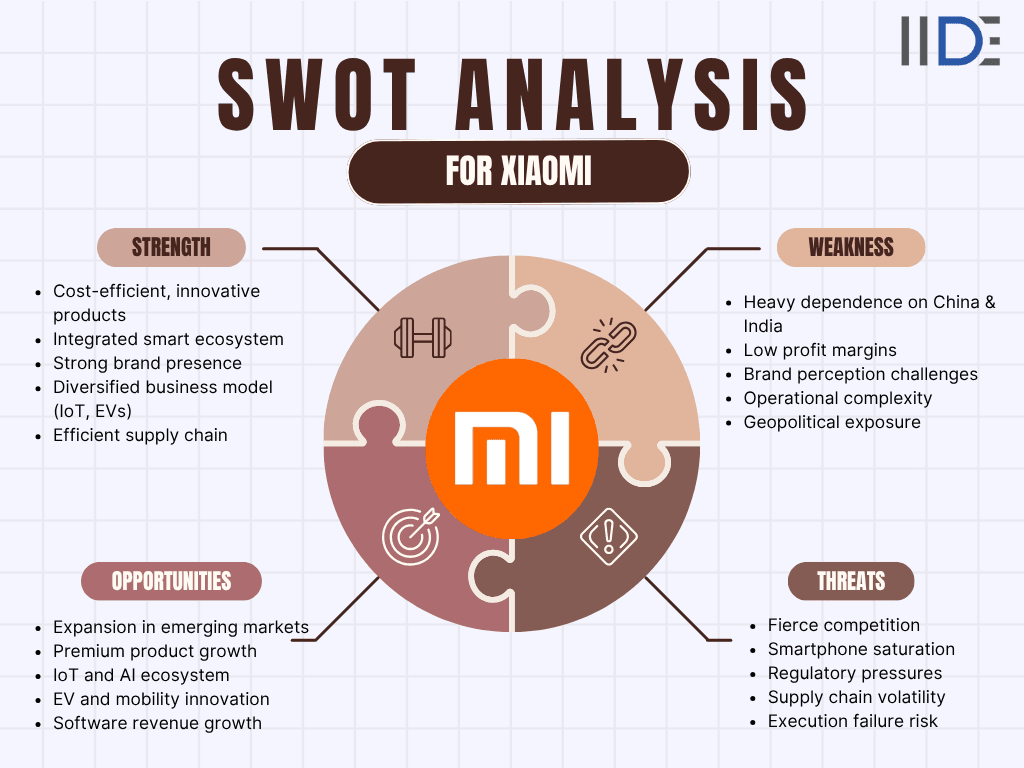
1. Strengths: How Xiaomi’s Ecosystem & Cost-Efficiency Drive Its Global Reach
- Value-for-Money Product Strategy: Xiaomi’s brand promise of “innovation for everyone” positions it as a global leader in affordability and innovation. It dominates markets like India, Southeast Asia, and Eastern Europe with cost-efficient, feature-rich products.
- Integrated Ecosystem (Smartphones + IoT + EV): Xiaomi’s strength lies in its interconnected product universe - smartphones, wearables, home appliances, and now electric vehicles - connected through the Mi Home ecosystem.
- Strong Market Presence: The brand ranks among the top three smartphone vendors globally, maintaining strong brand loyalty and active user communities.
- Innovation & Cost Control: Xiaomi’s Internet + hardware + new retail model ensures tight cost control while maintaining rapid innovation cycles and competitive pricing.
- Diversification into High-Growth Segments: With EV production and AI-driven smart home growth, Xiaomi’s strategic diversification strengthens its long-term resilience.
Xiaomi’s biggest long-term strength is its ability to blend hardware, software, and AI ecosystems into a seamless consumer experience - positioning it for leadership in connected living.
2. Weaknesses: Can Xiaomi Balance Growth with Premium Brand Transformation?
- Dependence on Chinese and Indian Markets: A large share of Xiaomi’s sales still comes from price-sensitive regions, exposing it to local economic and political risks.
- Low Operating Margins: Its cost-leadership model results in tight margins, leaving limited room for premium differentiation.
- Premium Brand Perception Challenges: Despite new flagship products, Xiaomi still struggles to shift its image from “budget-friendly” to “premium technology.”
- Operational Complexity: Managing smartphones, IoT, EVs, and services simultaneously requires substantial resources, creating execution risk.
- Exposure to Geopolitical & Regulatory Tensions: Trade restrictions, data compliance laws, and export bans can impact Xiaomi’s component supply and global reach.
The same affordability that powered Xiaomi’s rise can restrict its premium ambitions if not managed through brand storytelling, product excellence, and market segmentation.
Discover how the marketing strategy of Xiaomi leverages innovative technology, aggressive pricing, and a strong online community to disrupt markets and build unstoppable brand loyalty worldwide.
3. Opportunities: Xiaomi’s Path to Global Tech Leadership by 2030
- Expansion in Emerging Markets: With rising digital adoption in regions like Africa and Southeast Asia, Xiaomi can grow its smartphone and IoT footprint further.
- Premiumisation & Flagship Devices: Launching high-end models under the Xiaomi 14 and 15 series improves profit margins and brand prestige.
- IoT & Smart Home Growth: The global shift to connected devices provides recurring revenue streams from smart homes and appliances.
- Electric Vehicle Segment: Xiaomi’s EV venture leverages its brand ecosystem to create connected, AI-driven mobility experiences.
- AI and Software Monetization: AI, predictive analytics, and digital services can boost margins and improve user experience.
By 2030, Xiaomi’s evolution into a full-scale “smart life company” could redefine its place among global tech titans, provided it scales its software and AI ecosystem effectively.
4. Threats: Competition, Regulation, and Market Saturation Risks
- Intense Industry Competition: Global giants like Apple, Samsung, and Huawei dominate the premium market, while local competitors squeeze margins in lower tiers.
- Smartphone Market Saturation: Slowing smartphone growth globally increases dependence on diversification efforts.
- Regulatory and Trade Restrictions: As a Chinese tech brand, Xiaomi faces increasing scrutiny over data privacy and cross-border trade policies.
- Rising Component Costs: Semiconductor and logistics cost volatility can impact profitability.
- Execution Risks in New Ventures: Failure to deliver on EV or AI projects could dilute investor confidence and brand equity.
Xiaomi’s future success depends on its ability to withstand competitive intensity and regulatory shocks while maintaining innovation momentum.
IIDE Student Takeaway, Conclusion & Recommendations
Key Takeaways
- Biggest Strength: Xiaomi’s interconnected ecosystem of devices and cost innovation.
- Biggest Risk: Balancing scale, profitability, and premium positioning amid global competition.
Recommendations
- Elevate Brand Perception - Focus marketing on quality, design, and innovation storytelling.
- Invest in AI & Software - Diversify income streams beyond hardware sales.
- Expand in High-Growth Regions - Strengthen offline presence and distribution in emerging markets.
- Optimize Supply Chain Resilience - Build redundancy and diversify component sourcing.
- Execute EV Strategy Cautiously - Scale gradually while ensuring brand and tech alignment.
Future Outlook Question
As the world shifts toward AI-driven, ecosystem-based living, will Xiaomi’s integrated model be its strongest moat, or will diversification challenges slow down its race to the top?
Want to Know Why 2,50,000+ Students Trust Us?
Dive into the numbers that make us the #1 choice for career success


MBA - Level
Post Graduate in Digital Marketing & Business Strategy

Best For
Fresh Graduates

Mode of Learning
On Campus (Mumbai & Delhi)

Starts from
May 29, 2026

Duration
11 Months
Live & Online
Advanced Online Digital Marketing Course
Best For
Working Professionals
Mode of Learning
Online
Starts from
Apr 6, 2026
Duration
4-6 Months

Online
Professional Certification in AI Strategy
Best For
AI Enthusiasts
Mode of Learning
Online
Duration
5 Months
Offline
Undergraduate Program in Digital Business & Entrepreneurship
Best For
12th Passouts
Mode of Learning
On Campus (Mumbai)
Duration
3 Years
Recent Post
Xiaomi offers a wide range of products, including smartphones, smart home devices, wearables, AIoT, and software services, building a diverse smart-tech ecosystem.
Xiaomi competes through aggressive pricing, innovative features, strong online sales channels, and a robust Redmi sub-brand targeting the budget to mid-range segments.
Xiaomi holds a significant market share in India and is a leading smartphone brand by volume, with a strong mix of budget and mid-range models popular among Indian consumers.
Xiaomi smartphones sold outside China come with Google Mobile Services, including Play Store, Google Maps, and Google Pay, ensuring a full Android experience.
Xiaomi invests heavily in AI, camera technology, fast charging, foldable displays, and AIoT integration, positioning itself as a leading innovator in consumer electronics.

Aditya Shastri
Lead Trainer & Business Development Head at IIDE
Aditya Shastri leads the Business Development segment at IIDE and is a seasoned Content Marketing expert. With over a decade of experience, Aditya has trained more than 20,000 students and professionals in digital marketing, collaborating with prestigious institutions and corporations such as Jet Airways, Godrej Professionals, Pfizer, Mahindra Group, Publicis Worldwide, and many others. His ability to simplify complex marketing concepts, combined with his engaging teaching style, has earned him widespread admiration from students and professionals alike.
Aditya has spearheaded IIDE’s B2B growth, forging partnerships with over 40 higher education institutions across India to upskill students in digital marketing and business skills. As a visiting faculty member at top institutions like IIT Bhilai, Mithibai College, Amity University, and SRCC, he continues to influence the next generation of marketers.
Apart from his marketing expertise, Aditya is also a spiritual speaker, often traveling internationally to share insights on spirituality. His unique blend of digital marketing proficiency and spiritual wisdom makes him a highly respected figure in both fields.