
Students Centric
Placements Report
Trackable results, real numbers
Reviews
Proven success, real voices
Trainers
Expert-led, Industry-Driven Training
Life at IIDE
Vibrant Spirit student life
Alumni
Successful Journeys, Inspiring Stories
Learning Centre
Webinars
Blogs
Case studies
Live, Interactive Masterclasses
Fresh Insights, quick reads
Real-life, Industry relevant
More
Hire from us
Hire Top Digital Marketing Talent
Work with us
Join Our Team, Make an Impact
Customised Training
Personalised digital marketing training for your company
Refer & earn
Simple, easy rewards
Contact us
Get the answers you need
About us
Know more about IIDE
Explore all course options

FOR FRESH GRADUATES
Post Graduation Program in Digital Marketing & Business Strategy- Ideal for Age: 20–25 Years

Can’t decide? Explore all our
Digital Marketing Courses
COMPARE ALL 3 PROGRAMSOnline & Offline
Explore Top AI CoursesIndustry-Aligned TRACKMost Popular
UG Program in Digital Business & Entrepreneurship- Ideal for 12th Pass out / FY Degree Student

PARTNER PROGRAMS







Can’t decide? Explore all
BBA In Digital Marketing Colleges
Orginally Written by Aditya Shastri
Updated on Nov 14, 2025
Share on:


WhatsApp, founded in 2009 by Brian Acton and Jan Koum, is among the most popular global internet-based messaging apps, providing free, secure messaging and calling services across smartphones and desktops.
Serving over 2.7 billion users globally, it’s redefining communication. How does WhatsApp stay ahead amid rising competition and evolving technology trends?
This analysis offers entrepreneurs and business students key insights into WhatsApp’s strategic standing in 2025.
Before diving into the article, I would like to inform you that the research and initial analysis for this piece were conducted by Vanshika Gupta. She is a current student in IIDE's PG in Digital Marketing, March Batch 2025.
If you found this helpful, feel free to reach out to Vanshika Gupta to send a quick note of appreciation for his fantastic research. She will appreciate the kudos!
About WhatsApp

WhatsApp was launched in 2009 by Brian Acton and Jan Koum, headquartered in Mountain View, California. It evolved from a basic messaging app to a global hub combining personal and business communication. Its slogan highlights privacy and simplicity, with end-to-end encryption ensuring secure conversations.
In 2025, WhatsApp boasts 2.7+ billion users and continues innovating in conversational commerce and payments. SWOT stands for Strengths, Weaknesses, Opportunities, and Threats - key strategic pillars to appraise WhatsApp’s market position.
Overview Table
| Attribute | Details |
|---|---|
| Official Name | WhatsApp Inc. |
| Founded Year | 2009 |
| Founders | Brian Acton, Jan Koum |
| Headquarters | Mountain View, California, USA |
| Website | www.whatsapp.com |
| Industries Served | Messaging, Communication, Commerce |
| Geographic Areas Served | Global (180+ countries) |
| Users | 2.7+ billion (2025 est.) |
| Parent Company | Meta Platforms, Inc. |
| Main Competitors | Telegram, Signal, WeChat, iMessage |

Learn Digital Marketing for FREE

Learn Digital Marketing for FREE
SWOT Analysis of WhatsApp

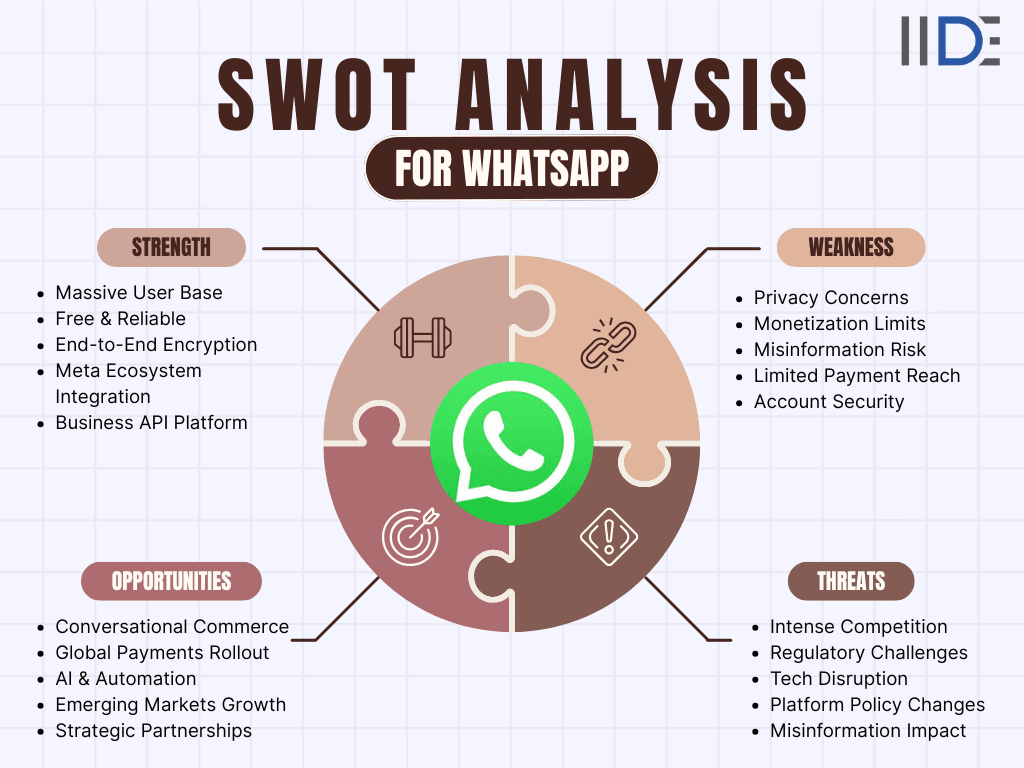
Brand Strength:
- Massive global user base with strong network effects, especially in emerging countries like India and Brazil.
- Free, reliable messaging and calling with end-to-end encryption as a privacy and security differentiator.
- Integration within Meta’s ecosystem, leveraging resources, infrastructure, and advertising platforms.
- Robust WhatsApp Business API enabling conversational commerce for diverse businesses globally.
- Leading platform for secure, cost-effective communication for individuals and companies alike.
Brand Weakness:
- Ongoing privacy trust challenges due to Meta’s data policies prompt user attrition to competitors like Signal.
- Limited monetisation scope beyond the business API and payments restricts revenue growth.
- The platform is exploited for misinformation and scams, negatively impacting its reputation.
- WhatsApp Payments is not universally available, limiting comprehensive super-app usage.
- Phone number-based accounts are prone to security risks, including SIM-swap fraud.
Brand Opportunities:
- Expansion of conversational commerce as digital customer engagement grows.
- Increasing adoption of WhatsApp Payments in new markets can unlock significant revenue.
- Growing smartphone and internet penetration in emerging markets drives user base expansion.
- Integration of generative AI to enhance customer support, marketing, and automation.
- Partnerships with fintech and e-commerce firms to enrich platform utility and stickiness.
Brand Threats:
- Aggressive competition from Telegram, Signal, WeChat, and platform-specific apps like iMessage.
- Regulatory scrutiny is expanding globally, including GDPR, data localisation, and content laws.
- Risk of technological obsolescence due to disruptive new messaging platforms.
- Policy changes by Apple and Google could reduce WhatsApp’s OS-level advantages.
- Persistent misinformation threats may provoke regulatory action and user distrust.
SWOT Analysis of WhatsApp
IIDE Student Takeaway, Recommendations & Conclusion:
- WhatsApp maintains its leadership with a massive user base of over 2.7 billion globally, supported by trusted end-to-end encryption.
- Its integration within Meta’s ecosystem and the expanding Business API position it well for growth in conversational commerce.
- Privacy concerns related to Meta's ownership and regulatory scrutiny continue to be significant challenges affecting user trust.
- Limited monetisation beyond business APIs and payments constrains revenue growth potential.
- Misinformation and scam vulnerabilities pose reputational risks that require proactive management.
- Expanding WhatsApp Payments beyond India and Brazil is critical to establishing a whole super-app experience.
- Rapid AI integration will enhance personalised customer service and scalable business interactions.
- Strengthening account security and improving misinformation controls are necessary to maintain credibility.
- Transparent privacy policies and collaborative engagement with regulators will help ensure compliance and foster trust.
- WhatsApp’s future success depends on striking a balance between innovation in commerce and AI, while maintaining privacy and simplicity, thereby solidifying its role as a key global communication and commerce platform.
Want to Know Why 5,00,000+ Students Trust Us?
Dive into the numbers that make us the #1 choice for career success


MBA - Level
Post Graduate in Digital Marketing & Business Strategy

Best For
Fresh Graduates

Mode of Learning
On Campus (Mumbai & Delhi)

Starts from
Oct 1, 2026

Duration
11 Months

Live & Online
Advanced Online Digital Marketing Course
Best For
Working Professionals
Mode of Learning
Online
Starts from
Aug 7, 2026
Duration
4-6 Months

Online
Professional Certification in AI Strategy
Best For
AI Enthusiasts
Mode of Learning
Online
Starts from
Sep 8, 2026
Duration
5 Months

On Campus
Advanced Certification in Artificial Intelligence
Best For
AI Enthusiasts
Mode of Learning
On Campus (Mumbai)
Starts from
Sep 1, 2026
Duration
3 Months

Online or Offline
Top AI Courses to Make You Future Ready!
Best For
AI Enthusiasts
Mode of Learning
2–5 Month Program
Starts from
Sep 8, 2026
Duration
Flexiable
Offline
Undergraduate Program in Digital Business & Entrepreneurship
Best For
12th Passouts
Mode of Learning
On Campus (Mumbai)
Starts from
Aug 19, 2026
Duration
3 Years
Offline
Degree In 2026 ≠ Enough Degree + Digital Skills = Future-Ready
Best For
12th Passouts
Mode of Learning
At IIDE Campus
Starts from
Aug 6, 2026
Duration
3 Years
Recent Post

Lead Trainer & Business Development Head at IIDE
Aditya Shastri leads the Business Development segment at IIDE and is a seasoned Content Marketing expert. With over a decade of experience, Aditya has trained more than 20,000 students and professionals in digital marketing, collaborating with prestigious institutions and corporations such as Jet Airways, Godrej Professionals, Pfizer, Mahindra Group, Publicis Worldwide, and many others. His ability to simplify complex marketing concepts, combined with his engaging teaching style, has earned him widespread admiration from students and professionals alike.
Aditya has spearheaded IIDE’s B2B growth, forging partnerships with over 40 higher education institutions across India to upskill students in digital marketing and business skills. As a visiting faculty member at top institutions like IIT Bhilai, Mithibai College, Amity University, and SRCC, he continues to influence the next generation of marketers.
Apart from his marketing expertise, Aditya is also a spiritual speaker, often traveling internationally to share insights on spirituality. His unique blend of digital marketing proficiency and spiritual wisdom makes him a highly respected figure in both fields.