Newly Launched: Post Graduation Program in Digital Marketing & Business Strategy.

Students Centric
Placements Report
Trackable results, real numbers
Reviews
Proven success, real voices
Trainers
Expert-led, Industry-Driven Training
Life at IIDE
Vibrant Spirit student life
Alumni
Successful Journeys, Inspiring Stories
Learning Centre
Webinars
Blogs
Case studies
Live, Interactive Masterclasses
Fresh Insights, quick reads
Real-life, Industry relevant
More
Hire from us
Hire Top Digital Marketing Talent
Work with us
Join Our Team, Make an Impact
Customised Training
Personalised digital marketing training for your company
Refer & earn
Simple, easy rewards
Contact us
Get the answers you need
About us
Know more about IIDE
Explore all course options

FOR FRESH GRADUATES
Post Graduation Program in Digital Marketing & Business Strategy- Ideal for Age: 20–25 Years

Can’t decide? Explore all our
Digital Marketing CoursesTrending

Professional Certification in AI Strategy
- Ideal for AI Enthusiast










Orginally Written by Aditya Shastri
Updated on Nov 18, 2025
Share on:


UPS was founded more than a century ago and has always been considered among the leading companies in logistics and parcel delivery worldwide. It has undertaken a major strategic reset as of 2024-25.
In a world of e-commerce growth, shifting supply chains, and accelerating automation, UPS’s positioning is rapidly changing.
Whether you’re a marketing student, business strategist or budding entrepreneur, understanding UPS’s strengths, weaknesses, opportunities and threats offers a real-world case of how legacy firms evolve in the digital age.
Before diving in the blog, I would like to inform that this content was researched and analysed by Akshay Sawant, who is a student of IIDE's Online Digital Marketing Course, May Batch 2025. Feel free to reach out to him on LinkedIn if you find this read useful, he will appreciate the gesture.
Founded in 1907 in Seattle (by James E. Casey), UPS is headquartered in Atlanta, Georgia (USA). The brand slogan “Moving logistics forward” reflects its global footprint and operational scale.
In 2024–25, UPS handles millions of daily shipments across 220+ countries and territories, with a workforce approaching half a million.
A notable stat: in Q4 2024 its consolidated revenue hit US $25.3 billion, up about 1.5 % year-on-year.
| Item | Details |
|---|---|
| Official Name | United Parcel Service, Inc. |
| Founded | 1907 |
| Headquarters | Atlanta, Georgia, USA |
| Website | ups.com (investors site) |
| Industries |
Parcel and freight transport; supply-chain services |
| Geography | Global – North America dominant |
| Revenue | ~$25.3 billion in Q4 2024 |
| Net Income | ~$1.72 billion in Q4 2024 |
| Employees | ~500,000 (approx) |
| Key Competitors |
FedEx Corporation, DHL International GmbH, new-age logistics players |
Why SWOT Analysis of UPS Matters?
- Competitive landscape: Traditional parcel carriers face disruption from digital platforms, last-mile aggregators and in-house logistics by big e-commerce players.
- Consumer shift: Rising demand for fast, trackable, flexible delivery places pressure on cost structures and innovation.
- Technology impact: Automation, AI routing, electric vehicles and drone-delivery initiatives reshape logistics economics.
- Economic & regulatory pressures: Global trade is under strain from tariffs, labour costs, unions, fuel/energy inflation and sustainability mandates. For a legacy operator like UPS, adapting or risk falling behind.
In other words, this SWOT provides a timely lens on how UPS is balancing tradition with transformation and what that means to the business world in 2025. It offers a timely lens into how UPS is balancing tradition with transformation, and what it means for the business world in 2025.

Learn Digital Marketing for FREE


SWOT Analysis of UPS
1. Strengths
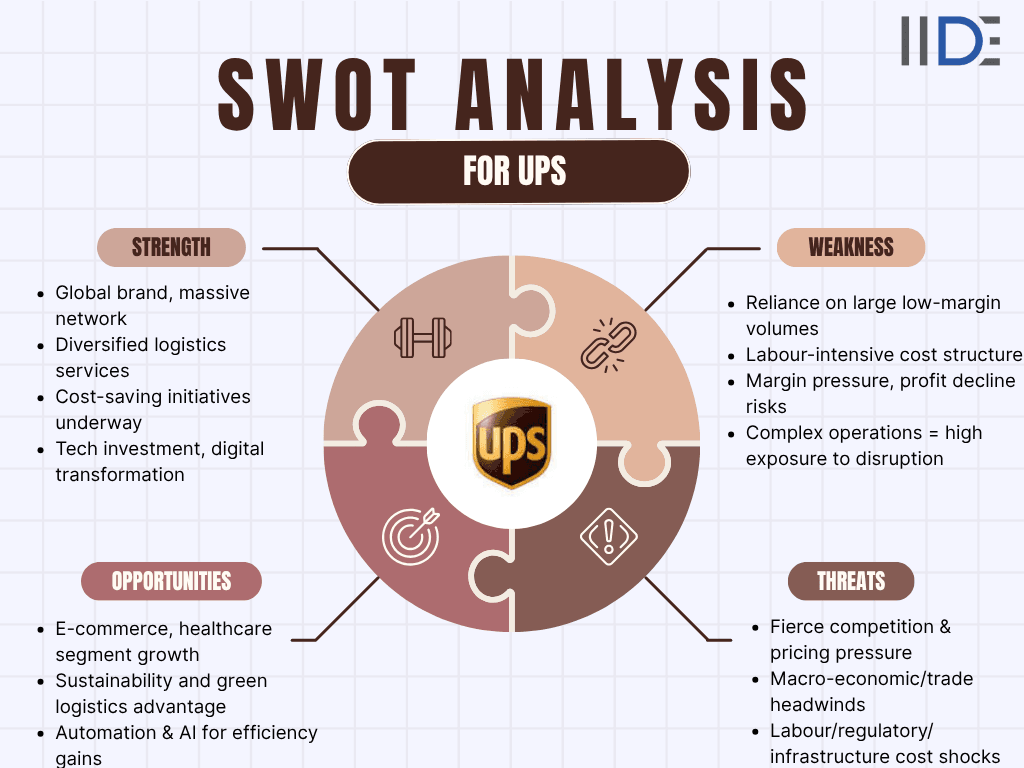
- Global scale & brand recognition: UPS is one of the most visible logistics brands worldwide - trust and reliability are built-in.
- Strong financials and network reach: With revenue nearing ~$25 billion in Q4 2024 and solid earnings, UPS has the muscle to invest and adapt.
- Integrated logistics capability: Besides parcel delivery, UPS offers freight, supply-chain, e-commerce fulfilment, and healthcare logistics, thus giving diversified revenue streams.
- Operational restructuring underway: UPS is actively cutting costs and streamlining its network through its “Network of the Future” initiative. It expects ~$3.5 billion in savings in 2025.
- Innovation and digital investment: Adoption of AI in logistics, route optimisation and automation elevates UPS’s operational edge.
2. Weaknesses
- Over-reliance on large customers: UPS is reducing its business with Amazon.com, Inc. (which was ~11.8 % of revenue in 2024) to avoid low-margin volume. While this is a smart move strategically, it creates short-term revenue risk.
- Aging workforce & high labour costs: A legacy unionized workforce and driver/warehouse labor intensity add cost rigidity.
- Complex global operations under stress: Tariffs, zone-changes in shipping, postal-service contract shifts and rate increases create unpredictability. For example, UPS Mail Innovations announced rate hikes of 20-40 % in 2025.
- Profit margin pressure: Although revenue grows at a slow pace, margin gains are tougher to come by with cost headwinds; Q1 2024 saw operating profit down ~36 % vs year prior.
Read DHL’s SWOT analysis that reveals a logistics giant leveraging its vast global network and strong foothold in e-commerce logistics, while embracing technological innovations like AI and automation to enhance efficiency.
3. Opportunities
- Growing e-commerce & healthcare logistics: With global e-commerce still expanding and temperature-sensitive health shipments rising, UPS can capture high-yield segments. For instance, its acquisition plan of Canada’s Andlauer Healthcare Group (~US $1.6 billion) underscores this.
- Sustainability & green logistics: Electric delivery vans, carbon-neutral shipping options and sustainable supply chains allow UPS to differentiate and meet regulatory demands.
- Technology-enabled efficiencies: Further investment in automation, robotics at sort facilities and AI routing will reduce cost per package and improve service levels.
- Emerging markets expansion: As UPS strengthens its presence in Asia, Latin America and Africa, these markets offer long-term growth beyond saturated US/EU zones.
4. Threats
- Intense competition: Competitors like FedEx, DHL and disruptive players (last-mile tech firms) threaten volume growth and pricing.
- Global economic slowdown & trade uncertainty: Macro-headwinds such as tariffs, supply-chain disruptions, and inflation impose risks. UPS has already cited tariffs as a major disruption.
- Labour, regulatory & infrastructure challenges: Union negotiations, worker shortages, facility closures and regulatory changes (postal agreements, zone changes) could raise costs. Example: UPS closed 93 facilities and cut ~48,000 jobs in 2025 to manage cost.
- Volume decline from major partners: With UPS reducing Amazon-related volume by ~50 % by mid-2026, the revenue gap must be replaced by higher-margin activities.
IIDE Student Takeaway, Recommendations & Conclusion
Takeaway
UPS’s biggest advantage lies in its brand power, scale, and its active restructuring to move into higher-margin logistics segments. Its largest risk lies in navigating a complex global environment while replacing revenue lost from major customers like Amazon and adapting to rising cost pressures.
Recommendation:
- Accelerate revenue shift: UPS should continue focusing on healthcare logistics, temperature-controlled shipments and customised supply-chain services - these segments command higher margins.
- Lean into tech: Prioritise automation and AI across the board - from parcel sorting to route planning to reduce cost per shipment and protect margins.
- Manage customer mix: While reducing dependence on low-margin customers is smart, UPS must quickly ramp up new high-yield volume to offset the drop.
- Enhance sustainability narrative: Use green fleet investments and carbon-neutral shipping to appeal to eco-conscious clients and meet regulatory demands
Future Outlook Question
As UPS continues to reshape itself, will it emerge as the logistics partner of choice for premium, high-value segments - or will the cost and complexity of transformation slow its progress? Food for thought.
Want to Know Why 2,50,000+ Students Trust Us?
Dive into the numbers that make us the #1 choice for career success


MBA - Level
Post Graduate in Digital Marketing & Business Strategy

Best For
Fresh Graduates

Mode of Learning
On Campus (Mumbai & Delhi)

Starts from
May 29, 2026

Duration
11 Months
Live & Online
Advanced Online Digital Marketing Course
Best For
Working Professionals
Mode of Learning
Online
Starts from
Apr 22, 2026
Duration
4-6 Months

Online
Professional Certification in AI Strategy
Best For
AI Enthusiasts
Mode of Learning
Online
Duration
5 Months

Offline
Undergraduate Program in Digital Business & Entrepreneurship
Best For
12th Passouts
Mode of Learning
On Campus (Mumbai)
Duration
3 Years
Recent Post
UPS offers comprehensive logistics services including parcel delivery, freight forwarding, supply chain management, warehousing, and healthcare logistics globally.
UPS operates in over 220 countries and territories, handling millions of shipments daily with an expansive global logistics network.
UPS employs advanced technologies like AI-powered route optimization, automation in sorting facilities, and real-time tracking to enhance efficiency and accuracy.
UPS uses data analytics and predictive algorithms for route planning and operational scheduling, ensuring on-time and day-definite deliveries.
UPS invests in electric delivery vehicles, green supply chain solutions, and carbon-neutral shipping options to reduce environmental impact.
UPS provides customs brokerage, consolidated shipments, and flexible transport modes (air, ocean, road) to smoothly manage cross-border logistics.
Labor union negotiations and high workforce costs contribute to operational challenges, impacting profit margins.
UPS navigates trade disruptions through network flexibility, regional hubs, and partnerships to mitigate tariff impacts.
UPS employs strict security protocols, including package screening, real-time tracking, and secure warehouses to protect shipments.
AI improves route optimization, demand forecasting, automated sorting, and operational efficiency at UPS.

Aditya Shastri
Lead Trainer & Business Development Head at IIDE
Aditya Shastri leads the Business Development segment at IIDE and is a seasoned Content Marketing expert. With over a decade of experience, Aditya has trained more than 20,000 students and professionals in digital marketing, collaborating with prestigious institutions and corporations such as Jet Airways, Godrej Professionals, Pfizer, Mahindra Group, Publicis Worldwide, and many others. His ability to simplify complex marketing concepts, combined with his engaging teaching style, has earned him widespread admiration from students and professionals alike.
Aditya has spearheaded IIDE’s B2B growth, forging partnerships with over 40 higher education institutions across India to upskill students in digital marketing and business skills. As a visiting faculty member at top institutions like IIT Bhilai, Mithibai College, Amity University, and SRCC, he continues to influence the next generation of marketers.
Apart from his marketing expertise, Aditya is also a spiritual speaker, often traveling internationally to share insights on spirituality. His unique blend of digital marketing proficiency and spiritual wisdom makes him a highly respected figure in both fields.