
Students Centric
Placements Report
Trackable results, real numbers
Reviews
Proven success, real voices
Trainers
Expert-led, Industry-Driven Training
Life at IIDE
Vibrant Spirit student life
Alumni
Successful Journeys, Inspiring Stories
Learning Centre
Webinars
Blogs
Case studies
Live, Interactive Masterclasses
Fresh Insights, quick reads
Real-life, Industry relevant
More
Hire from us
Hire Top Digital Marketing Talent
Work with us
Join Our Team, Make an Impact
Customised Training
Personalised digital marketing training for your company
Refer & earn
Simple, easy rewards
Contact us
Get the answers you need
About us
Know more about IIDE
Explore all course options

FOR FRESH GRADUATES
Post Graduation Program in Digital Marketing & Business Strategy- Ideal for Age: 20–25 Years

Can’t decide? Explore all our
Digital Marketing Courses
COMPARE ALL 3 PROGRAMSOnline & Offline
Explore Top AI CoursesIndustry-Aligned TRACKMost Popular
UG Program in Digital Business & Entrepreneurship- Ideal for 12th Pass out / FY Degree Student

PARTNER PROGRAMS







Can’t decide? Explore all
BBA In Digital Marketing Colleges
Orginally Written by Aditya Shastri
Updated on Oct 16, 2025
Share on:


Tommy Hilfiger is one of the most well-known names in global fashion. Loved for its timeless American cool aesthetic, the brand has built a legacy that resonates with millions of customers across the world.
But in 2025, the question is - can Tommy Hilfiger keep up with today’s fast-changing fashion scene? With Gen Z driving new trends, growing demands for sustainability, and ever-evolving consumer preferences, the brand faces both exciting opportunities and tough challenges.
About Tommy Hilfiger
Tommy Hilfiger, founded in 1985, is a renowned American luxury fashion brand and a subsidiary of PVH Corp. Originally known for its inclusive spirit with the slogan “For the People, By the People,” the brand evolved to embody “Classic American Cool,” reflecting modern sophistication and timeless style. By 2025, Tommy Hilfiger has expanded its presence across 100+ countries, offering a wide range of clothing, accessories, footwear, and fragrances that define contemporary global fashion.
Key Highlights of Tommy Hilfiger
| Aspect | Details |
|---|---|
| Founded | 1985 |
| Founder | Tommy Hilfiger |
| Parent Company | PVH Corp. |
| Headquarters | Amsterdam, Netherlands |
| Global Presence | 100+ countries |

Learn Digital Marketing for FREE

Why SWOT Analysis Matters for Tommy Hilfiger?
Fashion in 2025 is being shaped by sustainability and digital-first purchasing. Consumers now seek out brands that feel culturally relevant, eco-friendly options, and online convenience.
Consumer behaviour is rapidly evolving. Legacy brands like Tommy Hilfiger must change more quickly to remain relevant in the face of resale platforms, AI-driven personalisation, and rising environmental consciousness.
Tommy Hilfiger's Strengths
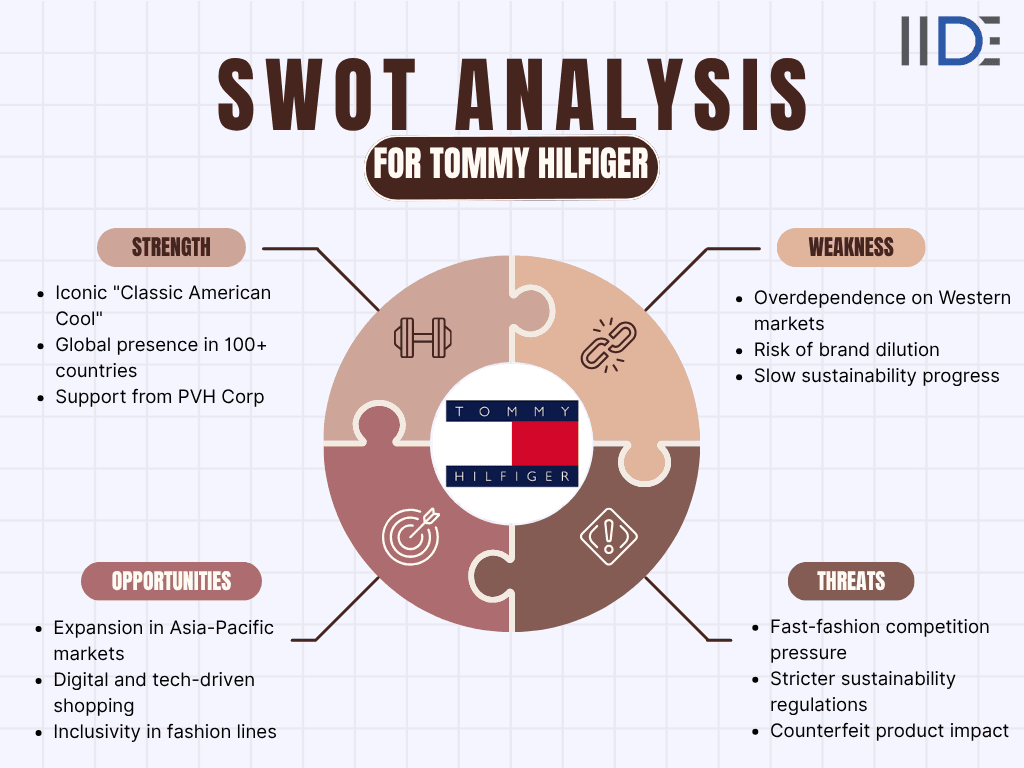
1. Worldwide Appeal & Iconic Identity
Tommy Hilfiger has built a timeless identity around its “Classic American Cool” positioning. Its preppy yet versatile designs resonate with a wide audience, making the brand relevant across generations and cultures.
2. Global Presence
- With a strong retail and digital footprint, Tommy Hilfiger operates in over 100 countries worldwide.
- Its robust distribution network - flagship stores, department store tie-ups, and e-commerce platforms ensures accessibility across developed and emerging markets.
3. Parent Company Support ([translate:PVH Corp.])
- Being part of [translate:PVH Corp.], one of the world’s largest apparel groups, provides Tommy Hilfiger with significant advantages.
- From financial stability to global expansion resources, PVH’s backing ensures that the brand can invest in innovation, marketing, and sustainability at scale.
Weakness Of Tommy Hilfiger
1. Overdependence on Western Markets
A significant share of Tommy Hilfiger’s sales still comes from North America and Europe. This reliance leaves the brand vulnerable to economic slowdowns, inflation, or market saturation in these regions, limiting overall growth.
2. Risk of Brand Dilution Through Excessive Collaborations
Frequent celebrity tie-ups and capsule collections generate short-term hype, but they risk overshadowing Tommy Hilfiger’s core identity. Too many seasonal collaborations may confuse consumers about what the brand truly stands for.
3. Slow Progress in Sustainability
While the brand has made commitments toward eco-friendly practices, it is moving slower compared to rivals like Levi’s or Patagonia. This lag may impact its credibility with younger, eco-conscious consumers who value transparency and responsibility in fashion.
For a comprehensive understanding of competitive positioning, you can refer to the SWOT analysis of Zara, which highlights how fast-fashion giants adapt to evolving consumer trends and market demands, complementing the insights from the SWOT analysis of Tommy Hilfiger.
Opportunities for Tommy Hilfiger
1. Expanding in Asia-Pacific
Countries like India, China, and Indonesia are experiencing a fashion boom with growing middle-class buyers. By creating localized collections and more accessible price points, Tommy Hilfiger can build a stronger foothold in these fast-growing markets.
2. Digital & Tech-Driven Shopping Experiences
With AR try-ons, virtual stores, and AI personalization becoming mainstream, Tommy Hilfiger has an opportunity to merge tech with fashion. A stronger omnichannel presence can help the brand stay exciting for customers who shop both online and offline.
3. Inclusivity as a Growth Driver
Today’s fashion is about everyone. Gender-neutral clothing lines, adaptive wear, and better size inclusivity can make Tommy Hilfiger more relevant and loved by a wider audience.
Threats to Tommy Hilfiger
1. Intense Fast-Fashion Competition
Brands like Zara, H&M, and especially Shein are reshaping the fashion industry with speed, affordability, and constant newness. Their ability to deliver trends at lightning pace puts pressure on Tommy Hilfiger’s premium positioning.
2. Sustainability Pressure & Regulations
Governments worldwide are tightening rules around sustainability and labor practices. If Tommy Hilfiger lags in meeting these stricter standards, it could face higher costs, fines, or reputational setbacks compared to faster-moving rivals.
3. Counterfeit & Copycat Products
Fake Tommy Hilfiger products flood global markets, especially in Asia. These imitations not only hurt revenue but also dilute the brand’s exclusivity and can damage trust if customers mistake them for genuine products.
IIDE Student Takeaway, Recommendations & Conclusion
The SWOT analysis of Tommy Hilfiger in 2025 highlights the brand’s enduring strength and global influence within the luxury fashion industry. With decades of heritage, a powerful brand image, and a presence in over 100 countries, Tommy Hilfiger continues to resonate with consumers. Its diversified product line - spanning apparel, accessories, shoes, and fragrances ensures it remains relevant across multiple demographics.
However, the study also points out crucial challenges. The brand’s increasing dependence on celebrity collaborations and capsule collections risks weakening its core identity, making it vulnerable to trend fatigue. In addition, mounting pressure from fast-fashion leaders like Zara, H&M, and Shein threatens to erode its market dominance by appealing to the same youth-driven consumer base with faster turnaround times and lower prices.
To maintain its edge, Tommy Hilfiger must focus on sustainable innovation, leverage digital marketing to connect with younger audiences, and uphold brand authenticity amid evolving market expectations.
Recommendations
- Develop exclusive digital-only capsule collections using user-generated content and influencer collaborations to enhance community engagement.
- Launch a circular fashion program that incentivizes customers to return used apparel for discounts, promoting sustainability and repeat sales.
- Integrate augmented reality (AR) shopping features to enable virtual try-ons, bridging online and in-store experiences for tech-savvy consumers.
- Diversify marketing to reduce over-reliance on celebrity partnerships and reinforce core brand identity.
- Invest in faster product turnaround to compete with fast-fashion rivals while maintaining quality and brand values.
- Enhance transparency and storytelling around sustainability efforts to build deeper consumer trust and loyalty.
Key Takeaways
- Strong global presence and brand heritage.
- Expanding opportunities in sustainability and digital fashion.
- Need for reduced dependency on collaborations.
- Rising competition from fast-fashion and online brands.
- Emphasis on innovation and authenticity for future growth.
Want to Know Why 2,50,000+ Students Trust Us?
Dive into the numbers that make us the #1 choice for career success



MBA - Level
Post Graduate in Digital Marketing & Business Strategy

Best For
Fresh Graduates

Mode of Learning
On Campus (Mumbai & Delhi)

Starts from
Jul 31, 2026

Duration
11 Months

Live & Online
Advanced Online Digital Marketing Course
Best For
Working Professionals
Mode of Learning
Online
Starts from
Aug 7, 2026
Duration
4-6 Months

Online
Professional Certification in AI Strategy
Best For
AI Enthusiasts
Mode of Learning
Online
Starts from
Jul 28, 2026
Duration
5 Months

Online or Offline
Top AI Courses to Make You Future Ready!
Best For
AI Enthusiasts
Mode of Learning
2–5 Month Program
Starts from
Jul 28, 2026
Duration
Flexiable

On Campus
Advanced Certification in Artificial Intelligence
Best For
AI Enthusiasts
Mode of Learning
On Campus (Mumbai)
Starts from
Aug 31, 2026
Duration
3 Months
Offline
Undergraduate Program in Digital Business & Entrepreneurship
Best For
12th Passouts
Mode of Learning
On Campus (Mumbai)
Starts from
Aug 19, 2026
Duration
3 Years
Offline
Degree In 2026 ≠ Enough Degree + Digital Skills = Future-Ready
Best For
12th Passouts
Mode of Learning
At IIDE Campus
Starts from
Aug 6, 2026
Duration
3 Years
Recent Post

Lead Trainer & Business Development Head at IIDE
Aditya Shastri leads the Business Development segment at IIDE and is a seasoned Content Marketing expert. With over a decade of experience, Aditya has trained more than 20,000 students and professionals in digital marketing, collaborating with prestigious institutions and corporations such as Jet Airways, Godrej Professionals, Pfizer, Mahindra Group, Publicis Worldwide, and many others. His ability to simplify complex marketing concepts, combined with his engaging teaching style, has earned him widespread admiration from students and professionals alike.
Aditya has spearheaded IIDE’s B2B growth, forging partnerships with over 40 higher education institutions across India to upskill students in digital marketing and business skills. As a visiting faculty member at top institutions like IIT Bhilai, Mithibai College, Amity University, and SRCC, he continues to influence the next generation of marketers.
Apart from his marketing expertise, Aditya is also a spiritual speaker, often traveling internationally to share insights on spirituality. His unique blend of digital marketing proficiency and spiritual wisdom makes him a highly respected figure in both fields.