
Students Centric
Placements Report
Trackable results, real numbers
Reviews
Proven success, real voices
Trainers
Expert-led, Industry-Driven Training
Life at IIDE
Vibrant Spirit student life
Alumni
Successful Journeys, Inspiring Stories
Learning Centre
Webinars
Blogs
Case studies
Live, Interactive Masterclasses
Fresh Insights, quick reads
Real-life, Industry relevant
More
Hire from us
Hire Top Digital Marketing Talent
Work with us
Join Our Team, Make an Impact
Customised Training
Personalised digital marketing training for your company
Refer & earn
Simple, easy rewards
Contact us
Get the answers you need
About us
Know more about IIDE
Explore all course options

FOR FRESH GRADUATES
Post Graduation Program in Digital Marketing & Business Strategy- Ideal for Age: 20–25 Years

Can’t decide? Explore all our
Digital Marketing Courses
COMPARE BOTH OUR PROGRAMSOffline
Explore Top AI CoursesIndustry-Aligned TRACKMost Popular
UG Program in Digital Business & Entrepreneurship- Ideal for 12th Pass out / FY Degree Student

PARTNER PROGRAMS






Can’t decide? Explore all
BBA In Digital Marketing Colleges
Orginally Written by Aditya Shastri
Updated on Jan 7, 2026
Share on:


Tencent is one of the most powerful tech companies in the world in 2026. From WeChat and QQ to online gaming, cloud and fintech, Tencent touches almost every part of digital life in China and has strong influence globally.
So why does Tencent still stand out in 2026? Are there growing challenges that could slow it down?
In this SWOT Analysis of Tencent, we break down its strengths, weaknesses, opportunities and threats in simple language. Entrepreneurs, marketers and students can use this blog to understand how a digital giant builds an ecosystem, faces regulation and still looks for new growth.
By the end, you will see how Tencent’s strategies can inspire you to think about innovation, diversification and risk management for your own projects or career.
Before we dive into the analysis, it is important to acknowledge the effort behind this blog. The research and initial analysis for this SWOT Analysis of Tencent 2026 have been conducted by Komal Solanke, a student of IIDE’s Professional Certification in Digital Marketing & Strategy (PCDMS), June Batch 2.
About Tencent
Tencent Holdings, founded in 1998, commands China's digital landscape through WeChat (1.4B users), gaming leadership, and fintech. As Asia's largest tech firm by market cap, it faces intense regulatory scrutiny. Can Tencent sustain global expansion amid U.S.-China tensions? This analysis reveals strategic insights essential for entrepreneurs and business students navigating tech ecosystems.

Overview Table
| Attribute | Details |
|---|---|
| Official Company Name | Tencent Holdings Limited |
| Founded Year | 1998 |
| Website URL | www.tencent.com |
| Industries Served | Social Media, Gaming, Fintech, Cloud, AI |
| Geographic Areas Served | Global (China-dominant) |
| Revenue (2025) | $92B USD |
| Net Income (2025) | $19B USD |
| Employees | 110,000+ |
| Main Competitors | ByteDance, Alibaba, Meta, Sony |

Is Digital Marketing the Right Career for You?
Find out in a free 45-min masterclass · Career paths, roles and growth explained · By Karan Shah, Founder & CEO, IIDE

Is Digital Marketing the Right Career for You?
Find out in a free 45-min masterclass · Career paths, roles and growth explained · By Karan Shah, Founder & CEO, IIDE
Why SWOT Analysis Of Tencent Matters In 2026
The tech industry in 2026 is full of rapid change and strict rules. For Tencent, this matters a lot.
Competitive Landscape
Tencent faces heavy competition from:
- Alibaba in cloud and fintech
- ByteDance in social media and short video
- Meta and Google in global ad tech and social platforms
These players push Tencent to innovate faster and protect its market share.
Shifts In Customer Preferences
Users now:
- Care more about privacy and data control
- Spend more time on short video platforms
- Prefer high quality content and smooth digital experiences over just basic chat
Tencent has to keep improving WeChat, QQ, mini programs and content platforms to stay relevant.
Technology And Innovation
Tencent invests in:
- Artificial intelligence for recommendations, ads and automation
- Cloud computing to support developers and businesses
- Gaming technology and virtual worlds
This helps the brand stay competitive and create new revenue streams.
Economic And Cost Pressures
- Slower growth in China can reduce spending on games and digital services
- Currency changes and inflation affect global investments and operations
Tencent needs to manage costs while still investing in innovation.
Regulations, Sustainability And Ethics
- China’s regulations on gaming time for minors and data usage affect Tencent’s business
- Global governments look closely at Chinese tech brands on privacy and security
- Sustainability expectations are growing, including cleaner data centers and ethical AI
A SWOT Analysis in 2026 makes sense because Tencent stands at a turning point. It has great power but also faces serious pressure. Understanding this balance is useful for anyone interested in tech strategy.
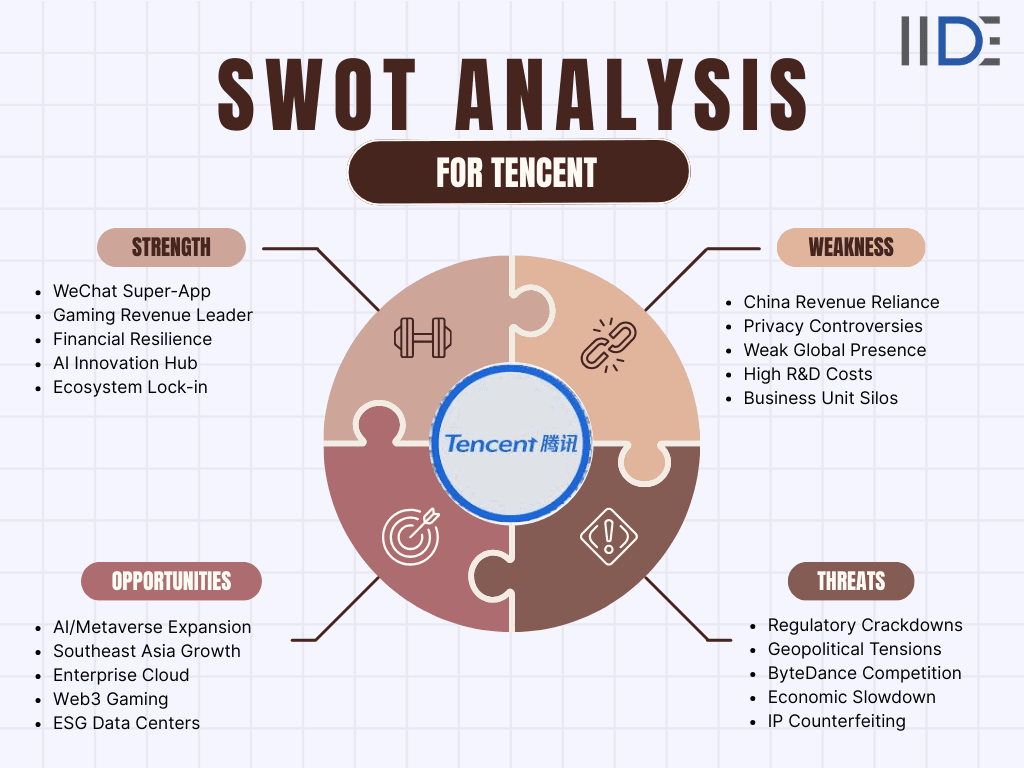
SWOT Analysis of Tencent
Tencent's Strengths: Digital Empire's Unrivaled Power
Tencent has several strong points that keep it at the top of the tech world.
1. Massive User Ecosystem
- WeChat has more than 1.3 billion active users, which gives Tencent huge reach.
- QQ still has millions of users, especially among younger segments and gamers.
- Many users stay inside Tencent’s ecosystem for chat, payments, content and mini programs.
- This ecosystem allows Tencent to cross promote services and collect valuable customer data.
2. Diversified Revenue Streams
- Income comes from gaming, social media, advertising, fintech and cloud services.
- This reduces risk, because Tencent is not dependent on only one product.
- Subscription models, in game purchases and ads create multiple income layers.
- Diversification helps Tencent stay stable even if one category slows down.
3. Global Gaming Powerhouse
- Tencent owns or holds major stakes in Riot Games (League of Legends), Epic Games (Fortnite) and Supercell (Clash of Clans).
- It is one of the biggest gaming companies in the world by revenue.
- E sports, mobile games and global franchises keep users engaged and spending.
- Gaming also supports Tencent’s metaverse and virtual experience ambitions.
4. Strong R and D And AI Focus
- Tencent spends billions of dollars every year on research and development.
- It works on AI, computer vision, natural language processing and cloud tech.
- This helps build better recommendations, fraud detection and smarter services.
- Innovation keeps Tencent ahead of smaller or slower rivals.
5. Financial Strength
- Tencent’s revenue is above 80 billion USD and net income is above 25 billion USD in recent years.
- This gives the company enough cash to invest, acquire and experiment.
- Strong cash flow also supports long term bets in AI, cloud and content.
These strengths show why Tencent remains a major digital force in 2026.
Weaknesses Of Tencent: Challenges Inside The Empire
Even a giant like Tencent has weaknesses that can slow growth.
1. Heavy Regulatory Dependence In China
- A big part of Tencent’s business depends on Chinese rules and approvals.
- Gaming time limits for minors cut into game usage and revenue.
- Data and antitrust rules can block certain features or deals.
- This makes planning and expansion more complex.
2. Trust And Image Issues In Western Markets
- Some Western users and governments see Tencent as too close to the Chinese state.
- There are concerns about how data is stored and who can access it.
- This limits Tencent’s ability to grow deeply in markets like the US and Europe.
- It also increases the risk of bans or restrictions on apps and investments.
3. Reliance On Gaming For Profits
- While diversification is strong, gaming still contributes a very large share of profits.
- Any slowdown in gaming regulations or user interest can hit margins.
- This dependence makes Tencent vulnerable to policy changes and market shifts.
4. Data Privacy Concerns
- Users are more aware of how their data is used.
- If Tencent faces a major data leak or misuse scandal, trust can fall very fast.
- This could impact WeChat, payments and cloud services all at once.
5. Complex Corporate Structure
- Tencent owns stakes in many companies across sectors and countries.
- Managing all these investments and business units is complicated.
- Communication and strategic focus can suffer across such a large group.
These weaknesses show that Tencent must handle internal risks with care to keep growing.
Opportunities For Tencent: Where Future Growth Can Come From
There are many exciting directions where Tencent can grow in 2026 and beyond.
1. AI And Cloud Computing Expansion
- The global AI market is expected to grow sharply by 2030.
- Tencent can use its experience and data to offer AI tools for businesses.
- Tencent Cloud can compete more strongly with Alibaba Cloud and global players.
- Enterprise solutions can reduce dependence on consumer gaming.
2. Growth In Southeast Asia And Other Emerging Markets
- Countries like Indonesia, Vietnam and Thailand have fast growing digital adoption.
- Tencent can expand WeChat Pay, games and content in these markets.
- Partnerships with local firms can help it understand culture and regulations.
3. Metaverse, Virtual Reality And New Experiences
- With strong gaming IP, Tencent is well placed to build immersive virtual worlds.
- It can create social experiences, concerts, events and digital goods.
- This trend can support both revenue and brand positioning.
4. Strategic Partnerships And Investments
- Tencent already invests in many global tech and gaming companies.
- It can deepen these ties and form new alliances in AI, fintech and entertainment.
- Smart partnerships can give access to ideas and customers outside China.
5. Sustainability And ESG Focus
- Investors and users now care about environmental and social impact.
- Tencent can invest in green data centers and responsible AI practices.
- Strong ESG performance can attract long term investors and improve brand trust.
These opportunities show that Tencent still has many paths to scale even further.
Threats To Tencent: External Risks In 2026
Tencent also faces serious external threats that are mostly outside its control.
1. Regulatory Crackdowns
- China has already tightened rules on gaming and internet platforms.
- Further rules can limit ad targeting, data usage or product launches.Large fines or forced changes can hurt profitability.
2. Geopolitical Tensions
- Relations between China and Western countries remain tense.
- Some governments could restrict Tencent’s deals or apps for security reasons.
- This may slow down global expansion and M and A activity.
3. Strong Domestic And Global Competition
- ByteDance competes strongly in short video and social content.
- Alibaba competes in cloud, fintech and digital services.
- Meta and Google fight for ad budgets and user time across borders.
- This competition puts pressure on Tencent’s innovation and pricing.
4. Cybersecurity Risks
- As Tencent grows in cloud and fintech, it becomes a more attractive target.
- Any major data breach or security incident can cause huge damage.
- Fixing such issues can be very costly and reduce user confidence.
5. Economic Slowdown
- A weaker Chinese economy means less spending on games and digital extras.
- Global slowdowns can also affect ad budgets and investment returns.
These threats mean Tencent must stay flexible, secure and transparent to protect its position.
SWOT Analysis of Tencent
IIDE Student Takeaway, Recommendations And Conclusion
The SWOT Analysis of Tencent shows a brand that is both very powerful and under real pressure. Tencent’s biggest advantage is its deep ecosystem and massive user base. Its biggest tension is between fast innovation and strict regulation plus global trust issues.
Key Recommendations As An IIDE Student
Build global trust: Communicate clearly about privacy, data security and ethical AI. Work with independent auditors and publish transparency reports.
- Reduce profit dependence on gaming: Grow cloud, B2B AI tools and enterprise services to balance income.
- Expand in emerging markets with local partnerships: Use local insights to launch tailored versions of services.
- Strengthen ESG and sustainability: Invest in green tech and social programs to appeal to young, aware consumers.
Future Outlook
Tencent can remain a central player in the global digital economy if it respects regulations, protects user data and continues to innovate in AI, cloud and content. If it fails to manage these tensions, smaller, more trusted or more flexible players may take its place over time.
Want to Know Why 5,00,000+ Students Trust Us?
Dive into the numbers that make us the #1 choice for career success



MBA - Level
Post Graduate in Digital Marketing & Business Strategy

Best For
Fresh Graduates

Mode of Learning
On Campus (Mumbai & Delhi)

Starts from
Oct 1, 2026

Duration
11 Months

Live & Online
Advanced Online Digital Marketing Course
Best For
Working Professionals
Mode of Learning
Online
Starts from
Oct 7, 2026
Duration
4-6 Months

Offline
Top AI Courses to Make You Future Ready!
Best For
AI Enthusiasts
Mode of Learning
2–5 Month Program
Starts from
Sep 29, 2026
Duration
Flexiable

Offline
Undergraduate Program in Digital Business & Entrepreneurship
Best For
12th Passouts
Mode of Learning
On Campus (Mumbai)
Starts from
-
Duration
3 Years
Offline
Degree In 2026 ≠ Enough Degree + Digital Skills = Future-Ready
Best For
12th Passouts
Mode of Learning
At IIDE Campus
Starts from
-
Duration
3 Years
Recent Post

Lead Trainer & Business Development Head at IIDE
Aditya Shastri leads the Business Development segment at IIDE and is a seasoned Content Marketing expert. With over a decade of experience, Aditya has trained more than 20,000 students and professionals in digital marketing, collaborating with prestigious institutions and corporations such as Jet Airways, Godrej Professionals, Pfizer, Mahindra Group, Publicis Worldwide, and many others. His ability to simplify complex marketing concepts, combined with his engaging teaching style, has earned him widespread admiration from students and professionals alike.
Aditya has spearheaded IIDE’s B2B growth, forging partnerships with over 40 higher education institutions across India to upskill students in digital marketing and business skills. As a visiting faculty member at top institutions like IIT Bhilai, Mithibai College, Amity University, and SRCC, he continues to influence the next generation of marketers.
Apart from his marketing expertise, Aditya is also a spiritual speaker, often traveling internationally to share insights on spirituality. His unique blend of digital marketing proficiency and spiritual wisdom makes him a highly respected figure in both fields.