Application Deadline for 3-Year UG Program closes on 31st Aug. Book a Counselling to know more

Students Centric
Placements Report
Trackable results, real numbers
Reviews
Proven success, real voices
Trainers
Expert-led, Industry-Driven Training
Life at IIDE
Vibrant Spirit student life
Alumni
Successful Journeys, Inspiring Stories
Learning Centre
Webinars
Blogs
Case studies
Live, Interactive Masterclasses
Fresh Insights, quick reads
Real-life, Industry relevant
More
Hire from us
Hire Top Digital Marketing Talent
Work with us
Join Our Team, Make an Impact
Customised Training
Personalised digital marketing training for your company
Refer & earn
Simple, easy rewards
Contact us
Get the answers you need
About us
Know more about IIDE
Explore all course options

FOR FRESH GRADUATES
Post Graduation Program in Digital Marketing & Business Strategy- Ideal for Age: 20–25 Years

Can’t decide? Explore all our
Digital Marketing Courses
COMPARE ALL 3 PROGRAMSOnline & Offline
Explore Top AI CoursesIndustry-Aligned TRACKMost Popular
UG Program in Digital Business & Entrepreneurship- Ideal for 12th Pass out / FY Degree Student

PARTNER PROGRAMS







Can’t decide? Explore all
BBA In Digital Marketing Colleges

Orginally Written by Aditya Shastri
Updated on Mar 30, 2026
Share on:


Launched in 1991, Shoppers Stop is recognised as India's pioneering department store, having successfully evolved from a single-brand entity into a leading fashion and lifestyle retail destination.
The brand was established with a strong market presence by consistently delivering premium-quality items that remain accessible and attainable to the mass Indian consumer.
Before diving into the article, I would like to inform you that the research and initial analysis for this piece were conducted by Bhavesh Dudeja. He is a current student in IIDE's PG in Digital Marketing, March Batch 2025.
If you found this helpful, feel free to reach out to him to send a quick note of appreciation for his fantastic research. He will appreciate the kudos!
About Shopper Stop
Since its inception in 1991, Shoppers Stop has established itself as a trusted and iconic Indian brand. As a pioneer of modern retail in India, they have set the benchmark for premium lifestyle and department store shopping experiences. They view shopping not just as a transaction but as a form of self-expression. Their philosophy, "Start Something New," encourages every customer to reinvent their personal style, celebrate their individuality, and embrace transformation through fashion.
Shoppers Stop serves as a curated hub for the Indian lifestyle, offering over 500 leading international and national brands across key categories such as apparel, beauty, and home décor. Their apparel range includes high-fashion, contemporary, and everyday wear, while their beauty section features prestige skincare, fragrances, and cosmetics. HomeStop, their dedicated home décor and furnishings segment, completes the lifestyle offering.
In today’s competitive market, Shoppers Stop has evolved from a traditional brick-and-mortar retailer into a true omnichannel innovator. They provide a seamless and engaging shopping experience across all touchpoints. Their extensive network of stores across India offers immersive, sensory-driven retail environments. Complementing this, their robust e-commerce platform and mobile app deliver convenience and instant access.
Additionally, their customer-first services, including the renowned 'First Citizen' loyalty program and bespoke 'Personal Shopper' service, provide unmatched value and personalized shopping experiences.

Is Digital Marketing the Right Career for You?
Find out in a free 45-min masterclass · Career paths, roles and growth explained · By Karan Shah, Founder & CEO, IIDE

Is Digital Marketing the Right Career for You?
Find out in a free 45-min masterclass · Career paths, roles and growth explained · By Karan Shah, Founder & CEO, IIDE
SWOT Analysis of Shoppers Stop (2025)
The main purpose of conducting a SWOT Analysis for Shoppers Stop is to get to know the position of the brand where it is standing right now.
- Validate Strategy: To check if the current strategy aligns with its core Strengths (Brand Equity, First Citizen loyalty) and market Opportunities (rising affluent class).
- Expose Vulnerabilities: To clearly identify and address critical Weaknesses (high fixed costs, slow digital penetration, poor profitability trends) that prevent it from competing effectively with asset-light e-commerce and value-fashion rivals.
- Guide Investment: To direct capital away from underperforming areas and toward high-growth Opportunities, such as its omnichannel platform, the new INTUNE value format, or further digital transformation.
- Assess Market Position: To understand if its traditional "department store" model is resilient enough to withstand major external Threats (e-commerce dominance and economic slowdowns).
Strengths of Shoppers Stop
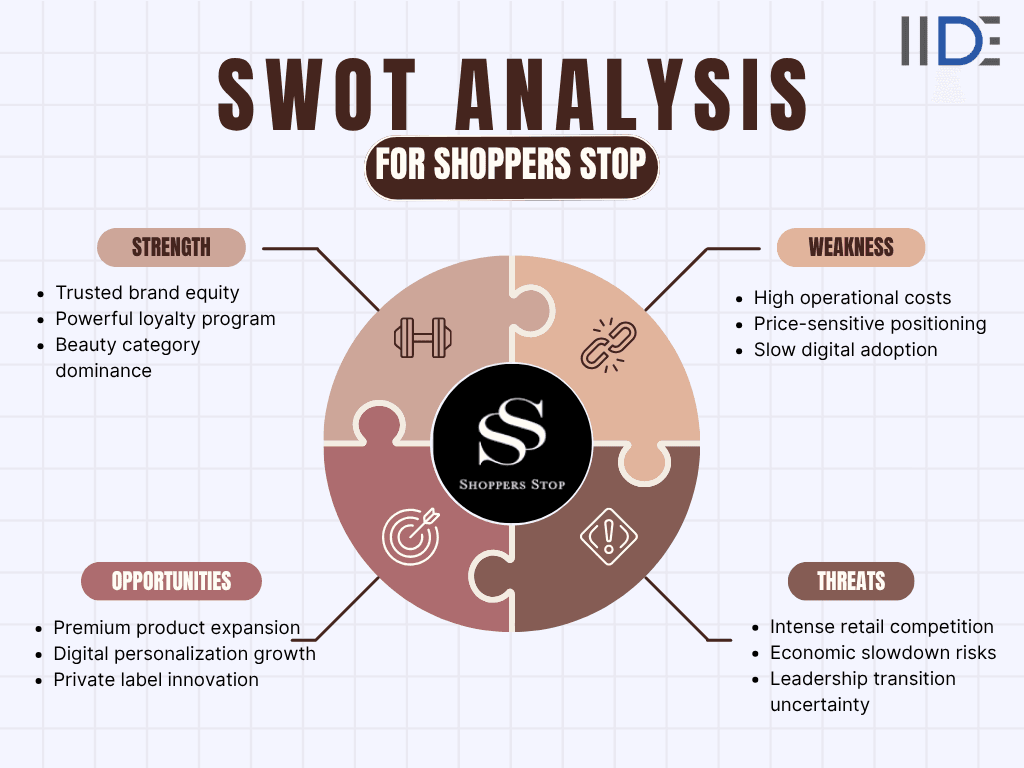
- Established Brand Equity and Trust: Shoppers Stop is one of India's oldest and most recognisable department store chains, having built a reputation for trust, quality, and authenticity over three decades.
- Powerful Loyalty Program: The First Citizen loyalty program is one of the most successful and longest-running in Indian retail, boasting over 12 million members and contributing to over 80% of total sales.
- Dominance in High-Growth Categories: The Beauty vertical is a major strength, providing higher margins and driving foot traffic. It's a key growth driver, supported by exclusive international brand partnerships.
- Strategic Retail Footprint: Its network of department stores and specialty stores are typically located in high-traffic, premium malls across major cities, ensuring visibility and accessibility to the target demographic.
Weaknesses of Shoppers Stop
- High Operational and Fixed Costs: Maintaining a large network of department stores in prime metropolitan locations results in extremely high fixed costs (rent, maintenance, utilities), significantly squeezing profit margins compared to asset-light e-commerce rivals or smaller-format competitors.
- Competitive Disadvantage in Pricing and Discounts: Indian retail is highly price-sensitive. Shoppers Stop's premium positioning and high costs make it challenging to offer deep, continuous discounts and aggressive pricing adopted by e-commerce giants like Amazon, Flipkart, and value-fashion players like Zudio, Max.
- Vulnerability of Private Labels: While focusing on improving Private Brands, their contribution to the overall apparel segment remains relatively low with challenges in profitability, inventory management, and market relevance compared to successful private labels of competitors.
- Perceived Pace of Digital Transformation: Although Shoppers Stop has implemented an omnichannel strategy, the pace of adoption and digital excellence is often perceived as slower than digitally native competitors, requiring continuous heavy investment in technology for a seamless and personalised digital experience.
For insights on how global retailers drive growth and customer loyalty, explore the marketing strategy of Uniqlo to see how innovative product positioning and omnichannel engagement can inspire Shoppers Stop’s own approach.
Opportunities for Shoppers Stop
- Premiumization and Beauty Segment Growth: With rising affluence and evolving consumer aspirations in India, Shoppers Stop can capitalize on the premiumization trend by expanding its premium product portfolio, especially in beauty and luxury categories. This focus can drive higher margins and strengthen brand positioning as a destination for aspirational shoppers.
- Digital Personalization and Experiential Retail: Continued investment in digital transformation, such as enhancing the Shoppers Stop app, leveraging data analytics for personalized recommendations, and integrating online-offline experiences can boost customer engagement and loyalty. Experiential retail initiatives, like immersive in-store events and exclusive launches, can differentiate the brand in a crowded marketplace.
- Expansion of Private Brands and New Formats: Growing the contribution of private labels and launching innovative retail formats (such as INTUNE) can improve profitability, offer unique value propositions, and attract new customer segments. Localized assortments and exclusive collections can help tap into emerging markets and under-served regions.
Threats to Shoppers Stop
- Intensifying Competition and Price Wars: The Indian retail landscape is highly competitive, with aggressive discounting and deep-pocketed e-commerce players (Amazon, Flipkart) and value-fashion chains (Zudio, Max) putting pressure on margins and market share. Sustaining premium positioning while remaining price-competitive is a persistent challenge.
- Economic Slowdowns and Consumer Sentiment: Macroeconomic headwinds, such as inflation, fluctuating consumer demand, and global uncertainties, can impact discretionary spending on premium and lifestyle products. Prolonged downturns may lead to inventory build-up and reduced profitability.
- Leadership Transitions and Operational Risks: Recent senior-level exits and leadership changes, including the retirement of long-serving chairman B.S. Nagesh, may create short-term uncertainty and disrupt strategic continuity. Operational risks, such as supply chain disruptions and rising fixed costs, further threaten stability and growth.
IIDE Student Takeaway & Recommendations
- In 2025, Shoppers Stop must balance its established brand legacy with the evolving retail landscape driven by digital transformation and shifting consumer preferences.
- The rise of e-commerce giants and agile value-fashion players demands continuous innovation in omnichannel experiences and personalized customer engagement.
- Expanding premium product offerings, especially in high-growth categories like beauty and lifestyle, is crucial for sustaining margins and attracting aspirational consumers.
- Embracing data-driven digital personalization and immersive in-store experiences can differentiate Shoppers Stop in a crowded market.
- Targeting emerging tier-2 and tier-3 cities with localized assortments and exclusive private label collections can unlock new growth avenues.
- Prioritizing operational efficiency, technology adoption, and strategic partnerships will strengthen the brand’s resilience and future readiness.
- Success depends on integrating Shoppers Stop’s trusted heritage with forward-looking strategies focused on innovation, customer centricity, and market adaptability.
Conclusion
The SWOT analysis of Shoppers Stop in 2025 highlights a brand with strong legacy, premium positioning, and a robust omnichannel presence, giving it a competitive edge in India’s evolving retail landscape. However, the company faces significant challenges from high operational costs, intense competition from both global and local players, and the rapid rise of e-commerce and value-fashion chains.
To sustain growth and market relevance, Shoppers Stop must capitalize on opportunities such as expanding into tier-2 and tier-3 cities, enhancing its digital and e-commerce capabilities, and developing exclusive private labels and sustainable product lines.
At the same time, it must address threats from economic fluctuations, rising costs, and the growing influence of online-only retailers. Ultimately, Shoppers Stop’s future success will depend on its ability to integrate its trusted heritage with forward-looking strategies focused on innovation, operational efficiency, and customer-centricity in a dynamic retail environment.
Want to Know Why 2,50,000+ Students Trust Us?
Dive into the numbers that make us the #1 choice for career success


MBA - Level
Post Graduate in Digital Marketing & Business Strategy

Best For
Fresh Graduates

Mode of Learning
On Campus (Mumbai & Delhi)

Starts from
Oct 1, 2026

Duration
11 Months

Live & Online
Advanced Online Digital Marketing Course
Best For
Working Professionals
Mode of Learning
Online
Starts from
Sep 4, 2026
Duration
4-6 Months

Online
Professional Certification in AI Strategy
Best For
AI Enthusiasts
Mode of Learning
Online
Starts from
Sep 8, 2026
Duration
5 Months

Online or Offline
Top AI Courses to Make You Future Ready!
Best For
AI Enthusiasts
Mode of Learning
2–5 Month Program
Starts from
Sep 8, 2026
Duration
Flexiable

On Campus
Advanced Certification in Artificial Intelligence
Best For
AI Enthusiasts
Mode of Learning
On Campus (Mumbai)
Starts from
Sep 1, 2026
Duration
3 Months
Offline
Undergraduate Program in Digital Business & Entrepreneurship
Best For
12th Passouts
Mode of Learning
On Campus (Mumbai)
Starts from
Aug 19, 2026
Duration
3 Years
Offline
Degree In 2026 ≠ Enough Degree + Digital Skills = Future-Ready
Best For
12th Passouts
Mode of Learning
At IIDE Campus
Starts from
Aug 19, 2026
Duration
3 Years
Recent Post

Lead Trainer & Business Development Head at IIDE
Aditya Shastri leads the Business Development segment at IIDE and is a seasoned Content Marketing expert. With over a decade of experience, Aditya has trained more than 20,000 students and professionals in digital marketing, collaborating with prestigious institutions and corporations such as Jet Airways, Godrej Professionals, Pfizer, Mahindra Group, Publicis Worldwide, and many others. His ability to simplify complex marketing concepts, combined with his engaging teaching style, has earned him widespread admiration from students and professionals alike.
Aditya has spearheaded IIDE’s B2B growth, forging partnerships with over 40 higher education institutions across India to upskill students in digital marketing and business skills. As a visiting faculty member at top institutions like IIT Bhilai, Mithibai College, Amity University, and SRCC, he continues to influence the next generation of marketers.
Apart from his marketing expertise, Aditya is also a spiritual speaker, often traveling internationally to share insights on spirituality. His unique blend of digital marketing proficiency and spiritual wisdom makes him a highly respected figure in both fields.