
Students Centric
Placements Report
Trackable results, real numbers
Reviews
Proven success, real voices
Trainers
Expert-led, Industry-Driven Training
Life at IIDE
Vibrant Spirit student life
Alumni
Successful Journeys, Inspiring Stories
Learning Centre
Webinars
Blogs
Case studies
Live, Interactive Masterclasses
Fresh Insights, quick reads
Real-life, Industry relevant
More
Hire from us
Hire Top Digital Marketing Talent
Work with us
Join Our Team, Make an Impact
Customised Training
Personalised digital marketing training for your company
Refer & earn
Simple, easy rewards
Contact us
Get the answers you need
About us
Know more about IIDE
Explore all course options

FOR FRESH GRADUATES
Post Graduation Program in Digital Marketing & Business Strategy- Ideal for Age: 20–25 Years

Can’t decide? Explore all our
Digital Marketing Courses
COMPARE BOTH OUR PROGRAMSOffline
Offline AI Courses with Dual CertificationsIndustry-Aligned TRACKMost Popular
UG Program in Digital Business & Entrepreneurship- Ideal for 12th Pass out / FY Degree Student

PARTNER PROGRAMS






Can’t decide? Explore all
BBA In Digital Marketing Colleges
Hyatt SWOT Analysis [Year]: Decoding the Strategy Behind One of Hospitality's Most Powerful Names
Orginally Written by Aditya Shastri
Updated on May 18, 2026
Share on:


About Hyatt

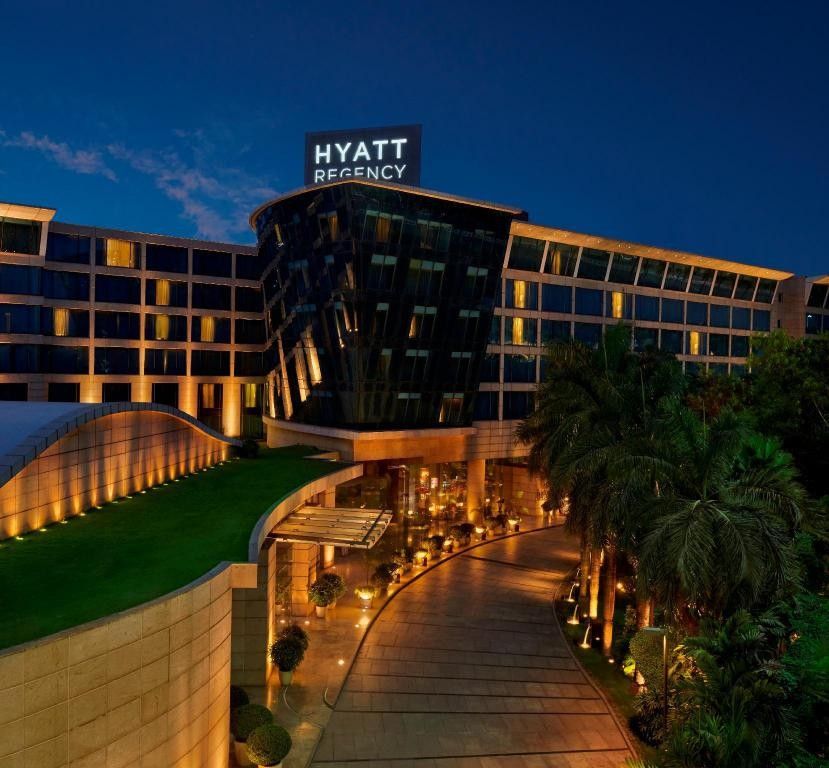
The Hyatt Regency is the oldest brand in the company, with the Grand Hyatt and Park Hyatt brands made known in 1980. Some of these are styled as “resort” properties and may have spas or other amusement facilities. One of the earliest was Hyatt Regency Maui in 1980.
Today, Hyatt operates over 1,300+ properties across 75+ countries, making it one of the most recognised premium hospitality brands in the world. According to Hyatt’s Annual Report (2024), the company is steadily growing in high-demand travel markets while strengthening its position in the all-inclusive resort segment.
Its slogan, “Care for People So They Can Be Their Best,” reflects its commitment to customer experience, employee well-being, and personalised service.
A major milestone in Hyatt’s growth was the acquisition of Apple Leisure Group, which added over 100 all-inclusive resorts and expanded its presence in leisure travel destinations. This move helped Hyatt tap into the rising demand for experience-driven vacations.
Key Highlights Table
| Particulars | Details |
|---|---|
| Official Name | Hyatt Hotels Corporation |
| Founded | 1957 |
| Founder | Jay Pritzker |
| Headquarters | Chicago, USA |
| Properties | 1,300+ |
| Countries | 75+ |
| Industry | Hospitality |
| Revenue (2024) | $6.7+ billion (Hyatt Annual Report 2024) |
| Net Income | $200M+ (approx.) |
| Employees | 200,000+ |
| Key Competitors | Marriott, Hilton, Accor |

Is Digital Marketing the Right Career for You?
Find out in a free 45-min masterclass · Career paths, roles and growth explained · By Karan Shah, Founder & CEO, IIDE

Is Digital Marketing the Right Career for You?
Find out in a free 45-min masterclass · Career paths, roles and growth explained · By Karan Shah, Founder & CEO, IIDE
What Does SWOT Analysis Mean for Hyatt?
Before we dive deeper, let’s understand what SWOT means in this context:
- Strengths = What gives Hyatt a competitive advantage
- Weaknesses = Where Hyatt faces limitations
- Opportunities = Future growth areas Hyatt can explore
- Threats = External risks that may impact its business
This SWOT analysis of Hyatt will help you evaluate how the brand performs in a competitive and evolving hospitality market.
Why SWOT Analysis Matters Now?
- Hyatt is in a major transition - Just completed the Playa Hotels Acquisition and shifted from owning hotels to earning fees from managing and franchising them.
- Performance is uneven by region - Asia Pacific is growing strongly; Mexico and the Middle East are weak. SWOT clarifies which trends are temporary vs. structural.
- Competition has expanded beyond hotels - Airbnb, AI travel tools, and lifestyle brands now compete for the same customer alongside Marriott and Hilton.
- Capital is tight- $4.3 billion in debt against $2.2 billion in liquidity means Hyatt cannot invest in every direction - it must pick its bets
To better understand how alternative accommodation platforms are disrupting the hospitality industry, you can also explore this detailed SWOT analysis of Marriott.
This makes a SWOT analysis of Hyatt essential to understand how it can balance luxury positioning, innovation, and long-term growth in a rapidly changing market.
SWOT Analysis of Hyatt
Hyatt is a premium hospitality brand that has built a strong position through its luxury offerings, global presence, and asset-light strategy. However, like any global company, it faces a mix of internal challenges and external pressures in a rapidly evolving market.
This SWOT analysis of Hyatt provides a clear overview of its key strengths, weaknesses, opportunities, and threats, helping us understand how the brand can sustain its growth and competitive edge in 2026.
1. Strengths of Hyatt
Hyatt has built a strong reputation as a premium hospitality brand by focusing on luxury experiences, customer satisfaction, and strategic expansion. Its strengths lie in its global presence, asset-light model, and ability to adapt to evolving travel trends.
1. Strong Global Brand & Premium Positioning
- Hyatt is recognised as one of the leading luxury hospitality brands worldwide. As of 2024, it operates 1,300+ properties across 75+ countries (Hyatt Annual Report 2024), reinforcing its strong international presence.
- Backed by the scale and legacy of Hyatt Hotels Corporation, the brand benefits from strong leadership, global expertise, and decades of industry experience.
- Its focus on high-end and lifestyle segments helps it maintain a premium brand image and command stronger pricing power in competitive markets.
2. Asset-Light Business Model
- Hyatt has successfully shifted towards an asset-light strategy, where it focuses more on management and franchising rather than owning properties.
- This reduces operational risk, improves margins, and allows faster global expansion compared to traditional hotel ownership models.
- By minimising capital investment, Hyatt can scale efficiently while channelling resources towards brand building and guest experience.
3. Strong Brand Portfolio & Acquisitions
- Hyatt has expanded its offerings through multiple brands and strategic acquisitions to serve diverse traveller needs.
- Its portfolio includes lifestyle brands like Andaz and Hyatt Centric, luxury brands like Park Hyatt and Grand Hyatt, and the acquisition of Apple Leisure Group, adding over 100 all-inclusive resorts.
- This diversification helps Hyatt cater to different customer segments and travel experiences, strengthening its competitive position across categories.
4. Loyalty Program & Customer Retention
- Hyatt's World of Hyatt loyalty program plays a key role in customer retention and repeat bookings.
- It offers personalised rewards, exclusive benefits, and global redemption options, helping build a loyal customer base.
This program also drives direct bookings, reduces dependence on third-party platforms, and improves overall profitability.
5. Focus on Customer Experience & Service Excellence
- Hyatt's brand purpose, "Care for People So They Can Be Their Best," drives its service culture across all properties.
- From personalised services to premium amenities, Hyatt consistently delivers high-quality guest experiences.
- This service-led approach strengthens customer trust, enhances brand loyalty, and differentiates Hyatt in a crowded hospitality market.
Weaknesses of Hyatt
Despite its strong premium positioning, Hyatt faces several internal challenges that can impact its growth and competitiveness in the evolving hospitality industry. Understanding these weaknesses is important to evaluate where the brand may fall behind compared to its competitors.
1. Limited Global Scale Compared to Competitors
- Hyatt operates around 1,300+ properties, which is significantly lower than competitors like Marriott and Hilton that have a much larger global footprint.
- This limits Hyatt's market reach and reduces its ability to capture a wider customer base, especially in emerging and mid-scale markets.
- As a result, Hyatt may miss out on volume-driven revenue opportunities that larger chains capture through wider distribution.
2. Premium Pricing Limits Mass Market Reach
- Hyatt's focus on luxury and upscale segments makes its offerings more expensive than many competitors.
- Brands like Marriott and Hilton offer stronger mid-range and budget options, allowing them to attract a broader audience.
- This narrow positioning puts pressure on Hyatt's occupancy rates during economic slowdowns when travellers shift towards affordable alternatives.
3. High Dependence on Premium Travellers
- Hyatt relies heavily on high-income travellers and business customers for the majority of its revenue.
- During economic uncertainty or reduced corporate travel, this dependence can directly impact revenue and profitability.
- Without a strong mid-market cushion, the brand becomes more vulnerable to industry downturns compared to diversified competitors.
4. Operational Complexity in Maintaining Service Standards
- Maintaining consistent luxury service across global properties is challenging, especially with varied local conditions and workforce dynamics.
- Variations in service quality across locations can affect customer satisfaction and brand perception.
- This becomes critical when compared to competitors with more standardised operations and centralised quality controls.
5. High Operational and Labour Costs
- The hospitality industry requires a large workforce, and Hyatt invests heavily in employee training and service quality.
- Rising labour costs and employee turnover can increase operational expenses and impact profit margins over time.
- Balancing premium service delivery with cost efficiency remains an ongoing challenge as wages and operational expenses continue to rise globally.
Opportunities For Hyatt
The global hospitality industry in 2026 is being driven by experience-led travel, digital transformation, and changing consumer expectations. Hyatt, with its strong brand equity and global presence, is well-positioned to leverage these trends and unlock new growth opportunities.
1. Expansion in Emerging Markets
- Rapid growth in regions like India, Southeast Asia, and the Middle East is increasing demand for premium and business travel.
- Hyatt is already expanding aggressively in these markets, with plans to significantly grow its presence in India.
- Leveraging its global reputation, Hyatt can capture high-growth markets and increase long-term revenue streams.
2. Rise of Experience-Driven and Gen Z Travel
- Gen Z travellers prefer personalised, Instagram-worthy, and culturally immersive experiences over traditional luxury stays.
- Hyatt’s lifestyle brands like Andaz and Hyatt Centric are designed to meet these expectations.
- By focusing on design, local experiences, and social media appeal, Hyatt can attract younger, experience-focused travellers.
3. Growth of All-Inclusive and Leisure Travel
- Post-pandemic travel trends show a strong shift towards leisure and all-inclusive vacations.
- Hyatt’s acquisition of Apple Leisure Group has already expanded its all-inclusive portfolio with over 100+ resorts.
- This allows Hyatt to tap into high-margin leisure travel and diversify beyond business travel.
4. Digital Transformation and Personalisation
- Technology is reshaping the hospitality experience, with guests expecting seamless and customised services.
- Hyatt can leverage its World of Hyatt loyalty program to deliver personalised recommendations, increase direct bookings, and improve customer retention.
- Continued investment in digital tools can enhance operational efficiency and guest satisfaction.
5. Growing Demand for Sustainable and Responsible Tourism
- Modern consumers, especially Gen Z, prefer brands that align with environmental and social values.
- Hyatt can strengthen its sustainability initiatives, such as energy-efficient operations and responsible sourcing, to attract eco-conscious travellers.
- This not only enhances brand perception but also ensures long-term compliance with global regulations.
Threats to Hyatt
Hyatt operates in a highly competitive and volatile hospitality industry, where external factors like economic conditions, changing travel trends, and digital disruption can significantly impact its growth. Understanding these threats is essential to evaluating where the brand is most vulnerable in the long term.
1. Intense Competition from Global Hotel Chains
- Hyatt faces strong competition from larger players like Marriott and Hilton, which have a significantly bigger global footprint and stronger presence across multiple price segments.
- This puts pressure on Hyatt's market share and limits its ability to scale as aggressively, especially in emerging and mid-range markets.
- To stay competitive, Hyatt must continuously differentiate through service quality, brand experience, and strategic expansion.
2. Disruption from Alternative Accommodation Platforms
- Platforms like Airbnb have transformed the travel industry by offering flexible, affordable, and localised stay options.
- This shift is especially popular among younger travellers, reducing demand for traditional hotel stays and affecting Hyatt's occupancy rates.
- As home-sharing and boutique alternatives grow, Hyatt must continuously innovate its guest experience to remain relevant.
To better understand how alternative accommodation platforms are disrupting the hospitality industry, you can also explore this detailed SWOT Analysis of Airbnb.
3. Economic Uncertainty and Decline in Travel Spending
- The hospitality industry is highly sensitive to economic conditions such as inflation, recession, and geopolitical tensions.
- Since Hyatt focuses on premium travellers, any decline in discretionary spending can directly impact its revenue and profitability.
- Such economic shifts can also delay expansion plans and slow recovery in key markets.
4. Rising Customer Expectations and Experience Pressure
- Modern travellers expect highly personalised, tech-enabled, and seamless experiences across every touchpoint.
- Failure to consistently deliver across all properties can affect customer satisfaction and weaken brand loyalty in a competitive market.
- Meeting these expectations requires continuous investment in technology, staff training, and service innovation.
5. Regulatory and Sustainability Pressures
- Increasing global regulations around environmental impact, energy usage, and sustainable tourism are reshaping the hospitality industry.
- Hyatt must continuously invest in sustainability initiatives, which can increase operational costs while also being critical for long-term brand perception.
- Non-compliance or slow adaptation could lead to reputational risks and regulatory penalties in key markets.
IIDE Student Takeaway & Recommendations
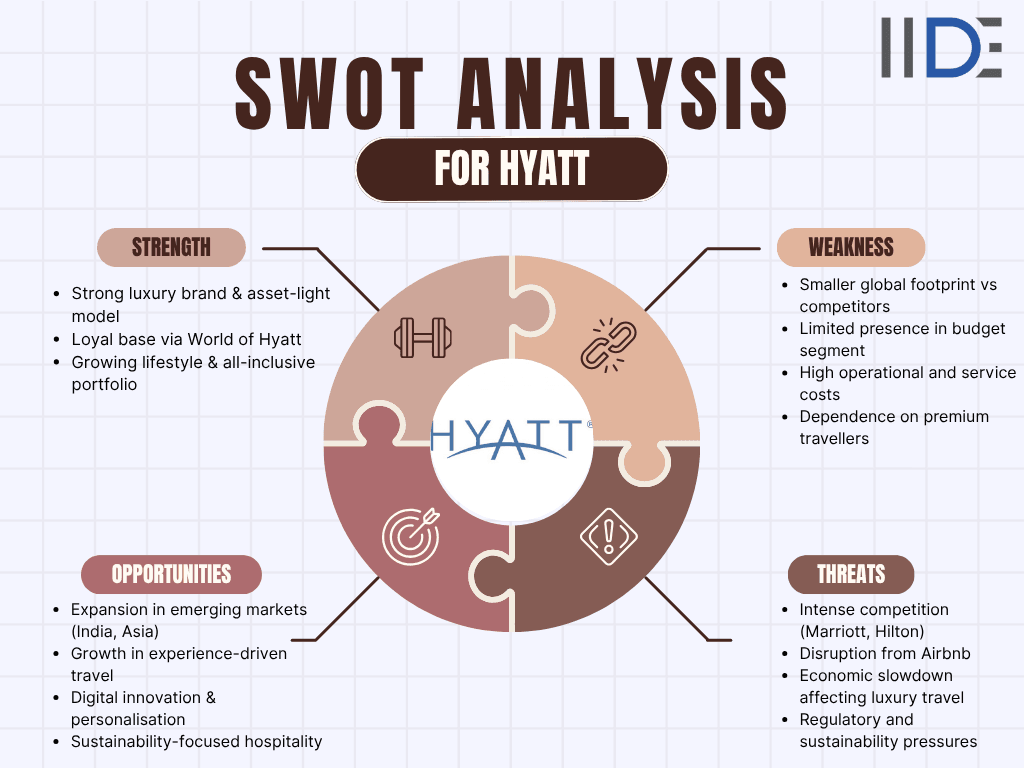
Hyatt's SWOT analysis highlights a strong premium brand, a growing global presence, and a successful asset-light strategy as its key strengths. However, limited scale compared to competitors and dependence on high-end travellers remain critical weaknesses.
At the same time, opportunities like experience-driven travel, Gen Z preferences, and digital innovation offer strong growth potential, while competition from global chains and platforms like Airbnb continues to pose serious threats.
The core challenge for Hyatt lies in balancing its luxury positioning with scalability and accessibility in an increasingly competitive market.
From an IIDE student perspective, Hyatt should focus on expanding its mid-scale offerings to capture a wider audience while leveraging its strong brand equity. Strengthening digital personalisation through the World of Hyatt program and investing in sustainability can further enhance customer loyalty. Additionally, aggressive expansion in emerging markets can help drive long-term growth.
Conclusion
Hyatt stands at an important crossroads where its premium positioning meets the demands of a rapidly evolving global hospitality industry. Its strong brand equity, asset-light model, and loyal customer base give it a solid foundation, but scalability, competition, and shifting traveller preferences will define its next phase of growth.
Looking ahead, if Hyatt successfully leverages its strengths and adapts to evolving consumer trends, it has the potential to remain a leading player in the global hospitality industry.
Want to Know Why 2,50,000+ Students Trust Us?
Dive into the numbers that make us the #1 choice for career success



MBA - Level
Post Graduate in Digital Marketing & Business Strategy

Best For
Fresh Graduates

Mode of Learning
On Campus (Mumbai & Delhi)

Starts from
Nov 27, 2026

Duration
11 Months

Live & Online
Advanced Online Digital Marketing Course
Best For
Working Professionals
Mode of Learning
Online
Starts from
Nov 2, 2026
Duration
4-6 Months

Offline
Top AI Courses to Make You Future Ready!
Best For
AI Enthusiasts
Mode of Learning
2–5 Month Program
Starts from
Nov 23, 2026
Duration
Flexiable
Offline
Undergraduate Program in Digital Business & Entrepreneurship
Best For
12th Passouts
Mode of Learning
On Campus (Mumbai)
Duration
3 Years
Offline
Degree In 2026 ≠ Enough Degree + Digital Skills = Future-Ready
Best For
12th Passouts
Mode of Learning
At IIDE Campus
Duration
3 Years
Recent Post

Lead Trainer & Business Development Head at IIDE
Aditya Shastri leads the Business Development segment at IIDE and is a seasoned Content Marketing expert. With over a decade of experience, Aditya has trained more than 20,000 students and professionals in digital marketing, collaborating with prestigious institutions and corporations such as Jet Airways, Godrej Professionals, Pfizer, Mahindra Group, Publicis Worldwide, and many others. His ability to simplify complex marketing concepts, combined with his engaging teaching style, has earned him widespread admiration from students and professionals alike.
Aditya has spearheaded IIDE’s B2B growth, forging partnerships with over 40 higher education institutions across India to upskill students in digital marketing and business skills. As a visiting faculty member at top institutions like IIT Bhilai, Mithibai College, Amity University, and SRCC, he continues to influence the next generation of marketers.
Apart from his marketing expertise, Aditya is also a spiritual speaker, often traveling internationally to share insights on spirituality. His unique blend of digital marketing proficiency and spiritual wisdom makes him a highly respected figure in both fields.