Newly Launched: Post Graduation Program in Digital Marketing & Business Strategy.

Students Centric
Placements Report
Trackable results, real numbers
Reviews
Proven success, real voices
Trainers
Expert-led, Industry-Driven Training
Life at IIDE
Vibrant Spirit student life
Alumni
Successful Journeys, Inspiring Stories
Learning Centre
Webinars
Blogs
Case studies
Live, Interactive Masterclasses
Fresh Insights, quick reads
Real-life, Industry relevant
More
Hire from us
Hire Top Digital Marketing Talent
Work with us
Join Our Team, Make an Impact
Customised Training
Personalised digital marketing training for your company
Refer & earn
Simple, easy rewards
Contact us
Get the answers you need
About us
Know more about IIDE
Explore all course options

FOR FRESH GRADUATES
Post Graduation Program in Digital Marketing & Business Strategy- Ideal for Age: 20–25 Years

Can’t decide? Explore all our
Digital Marketing CoursesTrending

Professional Certification in AI Strategy
- Ideal for AI Enthusiast










Orginally Written by Aditya Shastri
Updated on Dec 12, 2025
Share on:


Ferrari - the symbol of luxury, speed, and Italian craftsmanship continues to dominate the global supercar market in 2026. Known for its iconic Prancing Horse logo and unmatched engineering, Ferrari blends tradition with innovation as it moves toward electrification. But in an era of changing mobility and sustainability demands, can Ferrari keep leading the race? Let’s dive into the SWOT Analysis of Ferrari to uncover the power behind its enduring legacy.
This article’s research and analysis were conducted by Shruti Tiwari, a dedicated student of IIDE’s Online Digital Marketing Course May Batch 2025.
If this SWOT analysis provided useful insights, don’t hesitate to send Shruti Tiwari a note of appreciation - your feedback will be warmly received!
About Ferrari
Ferrari is an Italian luxury sports car manufacturer known for its high-performance vehicles, racing heritage, and exclusive brand image.
Ferrari represents speed, precision, innovation, and Italian craftsmanship. The brand is built around the philosophy of “driving passion and performance to perfection.” Its prancing horse logo (“Cavallino Rampante”) is one of the most recognizable symbols in the automotive world.
Ferrari’s core identity lies in its perfect blend of luxury, performance, and exclusivity. Every car reflects the brand’s deep racing heritage, where speed, precision, and craftsmanship come together to create an unmatched driving experience.
The company limits production to preserve its elite status, ensuring each model feels rare and special. Today, Ferrari continues to innovate with hybrid and electric technologies while staying true to its legacy of delivering emotion, power, and Italian excellence.
Ferrari isn’t just another car brand - it’s a feeling, a dream on wheels. What truly sets Ferrari apart is how it blends heritage, exclusivity, and pure emotion into every creation.
Unlike luxury carmakers that focus on mass appeal, Ferrari keeps its production limited. Each car is handcrafted in Maranello, Italy, where tradition meets innovation. It’s not just built; it’s sculpted with passion and precision.
Ferrari’s heart beats on the racetrack. Its Formula 1 DNA runs through every model, giving drivers that rush of speed and control that few cars can match. But owning a Ferrari goes beyond performance - it’s about status, pride, and the thrill of belonging to an elite legacy.
Why Does Ferrari SWOT Analysis Matter in 2026?
1. Competitive Landscape & Industry Disruptors
Ferrari faces fierce competition from traditional luxury brands like Lamborghini, McLaren, Porsche, and Aston Martin. Yet, the real disruption comes from new electric supercar makers such as Rimac, Ferrari's second fully electric car is delayed until 2028, reflecting the brand’s desire to maintain demand and emotional appeal. However, its hybrid lineup continues to grow, blending tradition with innovation.
2. Shifts in Customer Preferences & Adaptation
Today’s luxury car buyers are changing fast. Around 40% of Ferrari’s new customers are under 40, and they care about technology, sustainability, and brand experience as much as raw performance.
Ferrari is meeting this demand by developing hybrid models and investing heavily in battery research through its new “Cell Lab.” The brand is balancing emotion and innovation to stay desirable for a new generation.
3. Impact of Technology on Innovation and Efficiency
Ferrari’s future depends on technology - not just in its cars but in how it builds them. Its new “e-building” in Maranello will produce petrol, hybrid, and electric models under one roof, offering flexibility as market demands shift.
The company is also investing in advanced materials, automation, and renewable energy to make its production cleaner and more efficient.
4. Economic Conditions & Consumer Behavior
Even ultra-luxury brands feel the pressure of global economics. Rising inflation, higher interest rates, and changing buyer confidence can affect sales. Ferrari’s strength lies in its ability to stay desirable even when times are tough, but it must balance exclusivity with resilience in an unpredictable economy.
5. Regulation, Laws & Sustainability
Regulations around emissions and sustainability are tightening worldwide. Ferrari is adapting by reducing its carbon footprint, using cleaner materials, and aligning with stricter EU and global standards. Sustainability is no longer optional for luxury brands; it’s a core expectation.
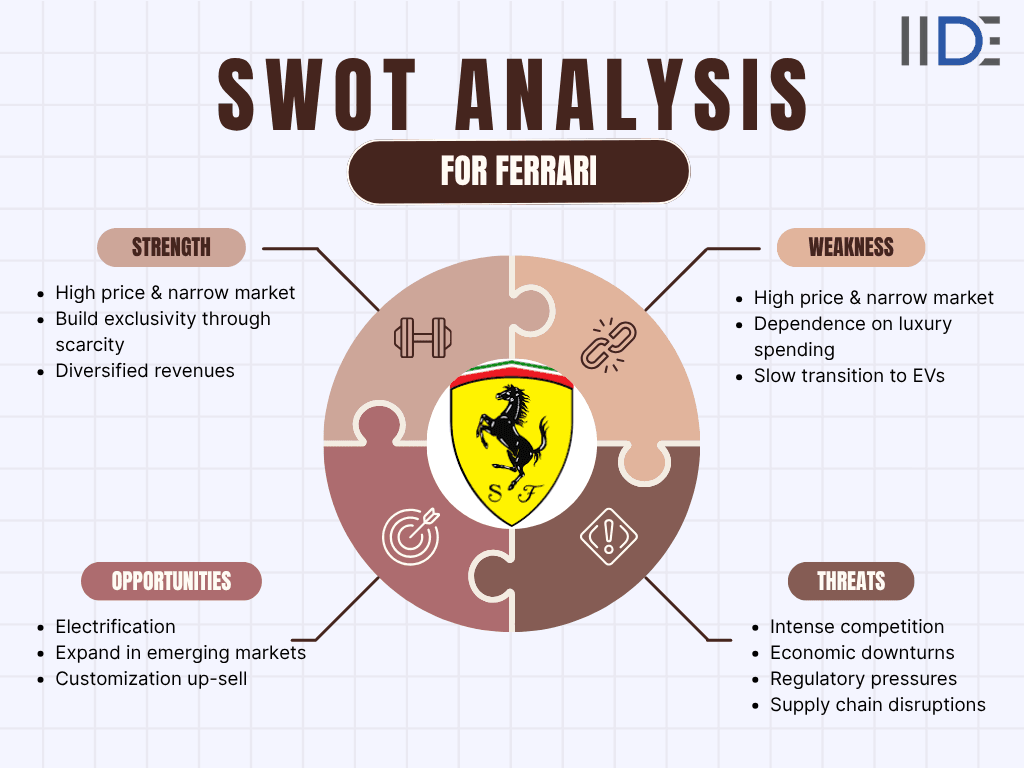
Ferrari remains a global symbol of luxury and performance, powered by its motorsport legacy, strong financials, and exclusive production strategy. The brand’s blend of heritage and innovation keeps it at the forefront of the supercar world.
However, Ferrari faces challenges like a niche market focus, slow EV transition, and economic sensitivity. Its future growth depends on addressing these weaknesses while expanding into emerging markets, sustainable mobility, and personalized experiences.
In short, Ferrari’s strength lies in its legacy and innovation, but sustaining its dominance will require adapting swiftly to the new era of electric and eco-luxury performance.

Learn Digital Marketing for FREE

SWOT Analysis of Ferrari
1. Strengths of Ferrari
- Ferrari’s legendary brand is built on a rich motorsport heritage, especially with Formula 1 success, which fuels its aspirational status and customer loyalty worldwide.
- The iconic prancing horse logo is an instantly recognizable symbol, boosting brand recall and desirability across global luxury markets.
- Ferrari boasts a lineage of iconic cars like the 250 GTO and LaFerrari that appeal to collectors and enthusiasts, reinforcing emotional brand attachment.
- Backed by the strong financial support of parent company Exor N.V., Ferrari enjoys stability and strategic direction that aid global expansion.
- Financially, Ferrari reports premium operating margins (~28.3% in 2024) and robust free cash flow, enabling sustained investment in R&D and exclusive motorsport ventures.
- Ferrari deliberately limits production volume to ensure rarity and exclusivity, which maintains high demand and strong resale value for its cars.
- It continuously integrates motorsport technology such as hybrid powertrains and aerodynamic innovations into its road cars, sustaining competitive technological leadership.
- Diversified income beyond car sales comes from licensing, merchandising, brand partnerships, and lifestyle events, deepening customer engagement and brand reach.
- Its vast global dealership and experience network ensures wide market access while maintaining the brand’s elite status.
- Ferrari’s blend of innovation with heritage ensures it remains a top luxury car brand, adapting to trends such as hybrid tech while maintaining its performance DNA.
2. Weaknesses of Ferrari
- Ferrari’s luxury market positioning limits its customer base, as the extremely high prices make its cars accessible only to a niche group of affluent buyers, restricting sales volume and broader market reach.
- The brand has a relatively limited product line focused mainly on high-performance sports cars, which reduces product diversification and makes Ferrari vulnerable to shifts in consumer preferences and market fluctuations.
- Ferrari’s progress in electrification has been slower than competitors. Its emphasis on hybrid vehicles rather than fully electric cars may hinder its competitiveness in the growing EV market, especially with rising regulatory demands for green technology.
- Quality and maintenance issues persist in certain Ferrari models, including problems related to oil leaks, clutch, air conditioning, and electrical components, leading to higher ownership costs and potential customer dissatisfaction.
- Ferrari’s meticulous and slow development cycles, while ensuring quality, also limit its ability to rapidly innovate and respond to emerging trends, putting it at a potential disadvantage compared to faster-moving rivals in technology adoption and model launches.
Explore BMW’s SWOT analysis to uncover how the iconic luxury carmaker leverages innovation, global expansion, and sustainability to steer through market challenges and accelerate its electric and autonomous vehicle ambitions.
3. Opportunities for Ferrari
- Ferrari can expand its luxury market footprint by extending its product range, such as launching its first fully-electric vehicle and increasing SUV offerings like the Purosangue to attract broader client segments including families and female buyers.
- Growth opportunities exist in emerging markets where rising wealth is increasing demand for luxury goods, and Ferrari can capitalize by strengthening dealership networks and localized marketing.
- The brand’s focus on innovation and hybrid technology positions it well to meet growing environmental regulations and consumer preferences for sustainable yet high-performance vehicles.
- Ferrari can leverage advancements in customization and personalization programs to deliver unique client experiences, building stronger emotional connections and brand loyalty.
- Collaborations and partnerships with technology firms, materials innovators, and racing teams can accelerate product development and maintain Ferrari’s cutting-edge status in automotive performance and design.
4. Threats to Ferrari
- Increasing competition from luxury and performance automakers such as Lamborghini, Porsche, Audi, and Mercedes, who continually innovate and target similar affluent customers.
- Emerging electric vehicle (EV) competitors pose a challenge as Ferrari’s transition to fully electric cars is still developing, leading to risks in the rapidly growing EV market dominated by brands like Tesla.
- Regulatory challenges including stringent emission norms and safety standards, especially in Europe and North America, require continuous adaptation and investment in greener technologies.
- Potential adverse effects of U.S. and international tariffs and trade policies may increase costs, squeeze margins, and disrupt supply chains, creating uncertainty in profitability.
- Economic fluctuations and geopolitical issues can affect demand for luxury goods, as luxury car sales are sensitive to global economic stability and high-net-worth consumer confidence.
- Customer expectations for both performance and sustainability are rising, putting pressure on Ferrari to balance its signature power and style with environmental responsibility and innovation.
- Supply chain disruptions, rising raw material costs, and skilled labor shortages may impact production efficiency and delivery schedules, affecting customer satisfaction and profitability.
IIDE Student Takeaway, Recommendations & Conclusion for Ferrari in 2026 and Beyond
Ferrari’s SWOT analysis highlights a brand that remains iconic and financially strong, yet faces significant challenges in adapting to a rapidly evolving automotive market. Its legendary heritage, global prestige, and association with motorsport provide a strong foundation, while innovations in hybrid technology and customization reinforce its competitive edge.
Core Tension
While Ferrari’s exclusivity, brand equity, and financial stability ensure continued success, the increasing demand for electric mobility, sustainability, and high-performance EVs poses a challenge to its traditional combustion-engine dominance.
Future Outlook
To maintain leadership in the luxury automotive segment, Ferrari must focus on electrification, expand into emerging luxury markets, and deepen its experiential and lifestyle offerings while preserving scarcity and premium positioning.
Recommendations
- Accelerate Electrification & Marketing of Hybrid/EVs: Expand hybrid and electric supercars and showcase them through premium campaigns to appeal to environmentally conscious luxury buyers.
- Emerging Market Expansion: Strengthen presence in Asia, the Middle East, and Latin America with exclusive dealerships, tailored experiences, and localized marketing strategies.
- Enhanced Customization & Brand Experiences: Grow Tailor Made programs, immersive driving events, and lifestyle tie-ins to deepen loyalty and reinforce exclusivity.
- Sustainability Initiatives: Integrate eco-friendly materials, carbon offset programs, and green production methods to align with global environmental trends and enhance brand perception.
- Supply Chain Resilience & Brand Protection: Diversify sourcing and carefully manage licensing to maintain premium pricing and protect Ferrari’s legendary brand image.
Ferrari’s unmatched heritage, innovation, and financial strength position it well for long-term relevance. However, rising competition from luxury EV makers and regulatory pressures require proactive adaptation.
Looking ahead, Ferrari’s success will depend on how it balances tradition with modern innovation.
By embracing electrification, expanding into emerging markets, enhancing customer experiences, and focusing on sustainability, Ferrari can maintain its status as the ultimate symbol of luxury and performance, securing its place as a leader in the high-end automotive world for decades to come.
Want to Know Why 2,50,000+ Students Trust Us?
Dive into the numbers that make us the #1 choice for career success


MBA - Level
Post Graduate in Digital Marketing & Strategy

Best For
Fresh Graduates

Mode of Learning
On Campus (Mumbai & Delhi)

Duration
11 Months
Live & Online
Advanced Online Digital Marketing Course
Best For
Working Professionals
Mode of Learning
Online

Starts from
Apr 6, 2026
Duration
4-6 Months

Online
Professional Certification in AI Strategy
Best For
AI Enthusiasts
Mode of Learning
Online
Duration
5 Months

Offline
Undergraduate Program in Digital Business & Entrepreneurship
Best For
12th Passouts
Mode of Learning
On Campus (Mumbai)
Duration
3 Years
Recent Post
Ferrari is famous for its luxury sports cars, iconic brand, and exceptional motorsport heritage, particularly in Formula 1 racing.
Ferrari was founded in 1939 by Enzo Ferrari; the first car under its own name was produced in 1947.
Ferrari’s headquarters is located in Maranello, Italy.
Ferrari limits production volumes and uses premium pricing to ensure exclusivity and high resale values, making its cars highly desirable and rare.
Ferrari maintains high operating margins and strong net profits, benefiting from diversified revenue streams beyond just car sales.
Ferrari is gradually transitioning toward electrification, investing in hybrid and future electric vehicle technologies, but progress is slower than some competitors.
Ferrari’s impressive motorsport achievements, legendary founders, and iconic models have created a strong brand with unparalleled desirability among car enthusiasts worldwide.

Aditya Shastri
Lead Trainer & Business Development Head at IIDE
Aditya Shastri leads the Business Development segment at IIDE and is a seasoned Content Marketing expert. With over a decade of experience, Aditya has trained more than 20,000 students and professionals in digital marketing, collaborating with prestigious institutions and corporations such as Jet Airways, Godrej Professionals, Pfizer, Mahindra Group, Publicis Worldwide, and many others. His ability to simplify complex marketing concepts, combined with his engaging teaching style, has earned him widespread admiration from students and professionals alike.
Aditya has spearheaded IIDE’s B2B growth, forging partnerships with over 40 higher education institutions across India to upskill students in digital marketing and business skills. As a visiting faculty member at top institutions like IIT Bhilai, Mithibai College, Amity University, and SRCC, he continues to influence the next generation of marketers.
Apart from his marketing expertise, Aditya is also a spiritual speaker, often traveling internationally to share insights on spirituality. His unique blend of digital marketing proficiency and spiritual wisdom makes him a highly respected figure in both fields.