
Students Centric
Placements Report
Trackable results, real numbers
Reviews
Proven success, real voices
Trainers
Expert-led, Industry-Driven Training
Life at IIDE
Vibrant Spirit student life
Alumni
Successful Journeys, Inspiring Stories
Learning Centre
Webinars
Blogs
Case studies
Live, Interactive Masterclasses
Fresh Insights, quick reads
Real-life, Industry relevant
More
Hire from us
Hire Top Digital Marketing Talent
Work with us
Join Our Team, Make an Impact
Customised Training
Personalised digital marketing training for your company
Refer & earn
Simple, easy rewards
Contact us
Get the answers you need
About us
Know more about IIDE
Explore all course options

FOR FRESH GRADUATES
Post Graduation Program in Digital Marketing & Business Strategy- Ideal for Age: 20–25 Years

Can’t decide? Explore all our
Digital Marketing Courses
COMPARE BOTH OUR PROGRAMSOffline
Explore Top AI CoursesIndustry-Aligned TRACKMost Popular
UG Program in Digital Business & Entrepreneurship- Ideal for 12th Pass out / FY Degree Student

PARTNER PROGRAMS






Can’t decide? Explore all
BBA In Digital Marketing Colleges

Orginally Written by Aditya Shastri
Updated on Aug 9, 2025
Share on:


Bridgestone, a global leader in tire manufacturing, has an impressive legacy of innovation. In this 2025 SWOT analysis, we explore how Bridgestone has maintained its position in the highly competitive tire and rubber industry, while facing new challenges. Curious about Bridgestone’s future strategies?
Let’s break down the SWOT analysis of Bridgestone to understand what keeps it strong, where it struggles, and what it needs to look out for. A must-read for every business student and entrepreneur aiming to learn from legacy brand strategies.
About Bridgestone

(Founder – Shojiro Ishibashi, Source: IIDE)
Founded in 1931, Bridgestone is a Japanese multinational corporation specialising in tire manufacturing and other rubber products. Bridgestone's commitment to quality and innovation has kept it at the forefront of the automotive and tire industries, serving customers worldwide.
In 2025, the company’s slogan, "Your Journey, Our Passion," underscores its dedication to enhancing travel safety and comfort. What does the future hold for Bridgestone in a changing industry?
| Official Name | Bridgestone Corporation |
|---|---|
| Founded Year | 1931 |
| Website URL | www.bridgestone.com |
| Industry | Tire and Rubber |
| Geography | Global |
| Revenue | $32.9 billion (2024) |
| Net Income | $2.5 billion (2024) |
| Employees | 140,000+ |
| Competitors | Michelin, Goodyear, Continental, Pirelli |

Is Digital Marketing the Right Career for You?
Find out in a free 45-min masterclass · Career paths, roles and growth explained · By Karan Shah, Founder & CEO, IIDE

Is Digital Marketing the Right Career for You?
Find out in a free 45-min masterclass · Career paths, roles and growth explained · By Karan Shah, Founder & CEO, IIDE
SWOT Analysis of Bridgestone
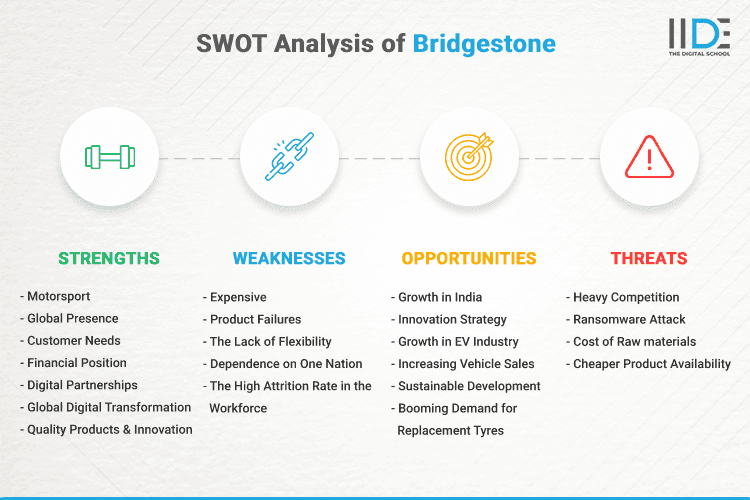
Below is a step-by-step detailed guide to help you with the SWOT analysis of Bridgestone.
SWOT analysis of Tata Motors reveals how leveraging both local roots and global reach can impact business growth.
Brand Strengths

Brand Reputation & Market Position:
- Bridgestone has built a strong brand reputation over decades, offering reliable, high-performance tires.
- Its market leadership is bolstered by innovation in tire technology and a strong retail presence.
Global Reach:
- As the world’s largest tire manufacturer, Bridgestone enjoys a substantial market share in both developed and emerging markets.
Technological Innovations:
- Bridgestone invests significantly in research and development, focusing on smart tire technology, sustainability, and enhanced vehicle safety features.
Diverse Product Range:
- From automotive tires to industrial rubber products, Bridgestone has diversified its portfolio to cater to multiple sectors.
Sustainability Initiatives:
- The company has been at the forefront of sustainable tire production, focusing on reducing environmental impact through innovations like eco-friendly tire compounds.
SWOT analysis of Honda underscores the significance of a diversified product line in maintaining market stability.
Brand Weaknesses
Dependence on Automotive Industry:
- A significant portion of Bridgestone's revenue comes from the automotive industry, making it vulnerable to economic downturns or shifts in consumer behaviour (e.g., decline in car ownership).
Supply Chain Challenges:
- Global supply chain disruptions, particularly in the wake of the COVID-19 pandemic, have impacted the availability of raw materials and production timelines.
Cost Structure:
- High production costs for high-quality materials and R&D can affect profit margins, particularly during periods of reduced demand.
Limited Digital Transformation:
- While Bridgestone has made strides in digitalisation, it lags behind some competitors in embracing AI and data analytics for consumer personalisation and operational efficiencies.
Brand Opportunities
Expansion in Emerging Markets:
- There is substantial growth potential in emerging markets like India, China, and Africa, where Bridgestone can expand its presence.
Electric Vehicle (EV) Tires:
- With the increasing adoption of electric vehicles, Bridgestone can focus on developing specialised tires for electric vehicles, tapping into a growing market.
Sustainability Growth:
- Expanding its sustainable product lines, such as tires made from renewable materials or those designed for improved fuel efficiency, aligns with the growing consumer demand for eco-friendly products.
Strategic Partnerships and M&A:
- Bridgestone could further strengthen its position through strategic partnerships with automotive manufacturers or acquisitions that complement its product offerings.
Brand Threats
Intensified Competition:
- Bridgestone faces strong competition from other global tire manufacturers such as Michelin, Goodyear, and Continental, which continuously innovate and push for market share.
Raw Material Price Volatility:
- The fluctuating prices of raw materials like rubber and steel can significantly affect Bridgestone’s profit margins.
Economic Downturns:
- As a global player, Bridgestone is susceptible to economic recessions, particularly in regions where consumer spending on automobiles and tires may decrease.
Geopolitical and Supply Chain Risks:
- Political instability or trade restrictions in key markets can affect Bridgestone’s global supply chain, impacting production and distribution.
SWOT Summary Table
| Strengths | Weaknesses |
|---|---|
| Strong brand reputation | High dependency on the automotive sector |
| Global market leader in tires | Supply chain disruptions |
| Technological innovation in tire design | High production costs |
| Diverse product portfolio | Slower adoption of digital tools |
| Commitment to sustainability |
SWOT analysis of BMW shows how innovation and performance branding contribute to resilience in the auto sector.
| Opportunities | Threats |
|---|---|
| Growth in emerging markets | Intense competition from rivals |
| Electric vehicle market | Volatility in raw material prices |
| Expansion of sustainable tire solutions | Vulnerability to economic downturns |
| Strategic M&A and partnerships | Geopolitical risks affecting global supply |
IIDE Student Takeaway
Bridgestone’s current standing in the global tire market is robust due to its technological advancements, substantial brand equity, and commitment to sustainability. However, its dependency on the automotive industry and the volatility in raw material costs are significant weaknesses that could affect long-term growth.
To capitalise on its strengths, Bridgestone should continue to invest in emerging markets, where demand for tires remains high, and focus on expanding its electric vehicle tire offerings. Additionally, a stronger emphasis on digital transformation can help streamline operations and increase consumer engagement.
By diversifying into electric vehicle-specific products and enhancing its sustainability initiatives, Bridgestone can future-proof its operations against economic fluctuations and intensifying competition. Partnerships with EV manufacturers and technological collaborations will also help Bridgestone stay ahead in the competitive landscape.
Want to Know Why 2,50,000+ Students Trust Us?
Dive into the numbers that make us the #1 choice for career success



MBA - Level
Post Graduate in Digital Marketing & Business Strategy

Best For
Fresh Graduates

Mode of Learning
On Campus (Mumbai & Delhi)

Starts from
Oct 1, 2026

Duration
11 Months

Live & Online
Advanced Online Digital Marketing Course
Best For
Working Professionals
Mode of Learning
Online
Starts from
Oct 9, 2026
Duration
4-6 Months

Offline
Top AI Courses to Make You Future Ready!
Best For
AI Enthusiasts
Mode of Learning
2–5 Month Program
Starts from
Sep 29, 2026
Duration
Flexiable

On Campus
Advanced Certification in Artificial Intelligence
Best For
AI Enthusiasts
Mode of Learning
On Campus (Mumbai)
Starts from
Sep 29, 2026
Duration
3 Months
Offline
Undergraduate Program in Digital Business & Entrepreneurship
Best For
12th Passouts
Mode of Learning
On Campus (Mumbai)
Starts from
-
Duration
3 Years
Offline
Degree In 2026 ≠ Enough Degree + Digital Skills = Future-Ready
Best For
12th Passouts
Mode of Learning
At IIDE Campus
Starts from
-
Duration
3 Years
Recent Post
Yes. Shojiro Ishibashi founded Bridgestone, the company that is now one of the world's largest tire and rubber companies, on March 1, 1931, in Kurume, Fukuoka, Japan.
Firestone is known to be the sister brand of Bridgestone. Both come under BSA and its subsidiaries develop, manufacture and market them.
Bridgestone tires contain advanced technology and premium materials, which add to their cost. However, the product quality is top-notch, offering a premium experience to customers.
The following is the list of car brands using the Bridgestone tyres:
- Acura
- Alfa Romeo
- AM General
- American Motors
- Aston Martin
- Audi
- Avanti
- Bentley

Lead Trainer & Business Development Head at IIDE
Aditya Shastri leads the Business Development segment at IIDE and is a seasoned Content Marketing expert. With over a decade of experience, Aditya has trained more than 20,000 students and professionals in digital marketing, collaborating with prestigious institutions and corporations such as Jet Airways, Godrej Professionals, Pfizer, Mahindra Group, Publicis Worldwide, and many others. His ability to simplify complex marketing concepts, combined with his engaging teaching style, has earned him widespread admiration from students and professionals alike.
Aditya has spearheaded IIDE’s B2B growth, forging partnerships with over 40 higher education institutions across India to upskill students in digital marketing and business skills. As a visiting faculty member at top institutions like IIT Bhilai, Mithibai College, Amity University, and SRCC, he continues to influence the next generation of marketers.
Apart from his marketing expertise, Aditya is also a spiritual speaker, often traveling internationally to share insights on spirituality. His unique blend of digital marketing proficiency and spiritual wisdom makes him a highly respected figure in both fields.