Newly Launched: Post Graduation Program in Digital Marketing & Business Strategy.

Students Centric
Placements Report
Trackable results, real numbers
Reviews
Proven success, real voices
Trainers
Expert-led, Industry-Driven Training
Life at IIDE
Vibrant Spirit student life
Alumni
Successful Journeys, Inspiring Stories
Learning Centre
Webinars
Blogs
Case studies
Live, Interactive Masterclasses
Fresh Insights, quick reads
Real-life, Industry relevant
More
Hire from us
Hire Top Digital Marketing Talent
Work with us
Join Our Team, Make an Impact
Customised Training
Personalised digital marketing training for your company
Refer & earn
Simple, easy rewards
Contact us
Get the answers you need
About us
Know more about IIDE
Explore all course options

FOR FRESH GRADUATES
Post Graduation Program in Digital Marketing & Business Strategy- Ideal for Age: 20–25 Years

Can’t decide? Explore all our
Digital Marketing CoursesTrending

Professional Certification in AI Strategy
- Ideal for AI Enthusiast










Orginally Written by Aditya Shastri
Updated on Mar 30, 2026
Share on:
Bosch is a global leader in engineering and technology, with strong positions in automotive solutions, consumer goods, and smart technologies. In 2025, Bosch is focused on sustainable mobility, digitalisation, AI, and connected solutions, while investing in EVs, IoT, and Industry 4.0 innovations.
Its diversified portfolio and commitment to sustainability, including carbon-neutral operations and hydrogen fuel cell investments, make it well-positioned for growth.
However, Bosch faces challenges like high dependence on the automotive sector, intense global competition, rising R&D costs, and economic uncertainties that may affect profitability.
Before diving into the article, I would like to inform you that the research and initial analysis for this piece were conducted by Monisha Ghosh. She is a current student in IIDE's PGDMS, MARCH Batch 2025.
If you found this helpful, feel free to reach out to Monisha Ghosh to send a quick note of appreciation for her fantastic research, she will appreciate the kudos!
About BOSCH
Bosch, founded in 1886 with electrical equipment repairs, quickly became a pioneer in automotive innovations like the magneto ignition system and spark plug.
Over the 20th century, it expanded globally and diversified into power tools, household appliances, and industrial technology. With the slogan “Invented for life”, Bosch focuses on innovation that enhances quality of life, sustainability, and long-term value.
Notably, it became the first global industrial company to achieve carbon neutrality in 2020 across 400+ locations, setting a benchmark in sustainable manufacturing.

Learn Digital Marketing for FREE


Key Factors Shaping Bosch’s Strategy in 2025
- Relevance in 2025: A SWOT analysis reveals how Bosch is adapting to changing market and industry dynamics.
- Emerging Opportunities: There is growing demand for electric vehicles, smart home solutions, and sustainable products.
- Innovation Strength: Bosch’s strong R&D capabilities in AI, IoT, and Industry 4.0 drive efficiency and support advanced product development.
- Key Risks: The company faces economic fluctuations, rising operational costs, and a heavy reliance on the automotive sector.
- Regulatory Impact: Evolving global regulations and stricter sustainability requirements are shaping Bosch’s strategic decisions.
SWOT Analysis of BOSCH
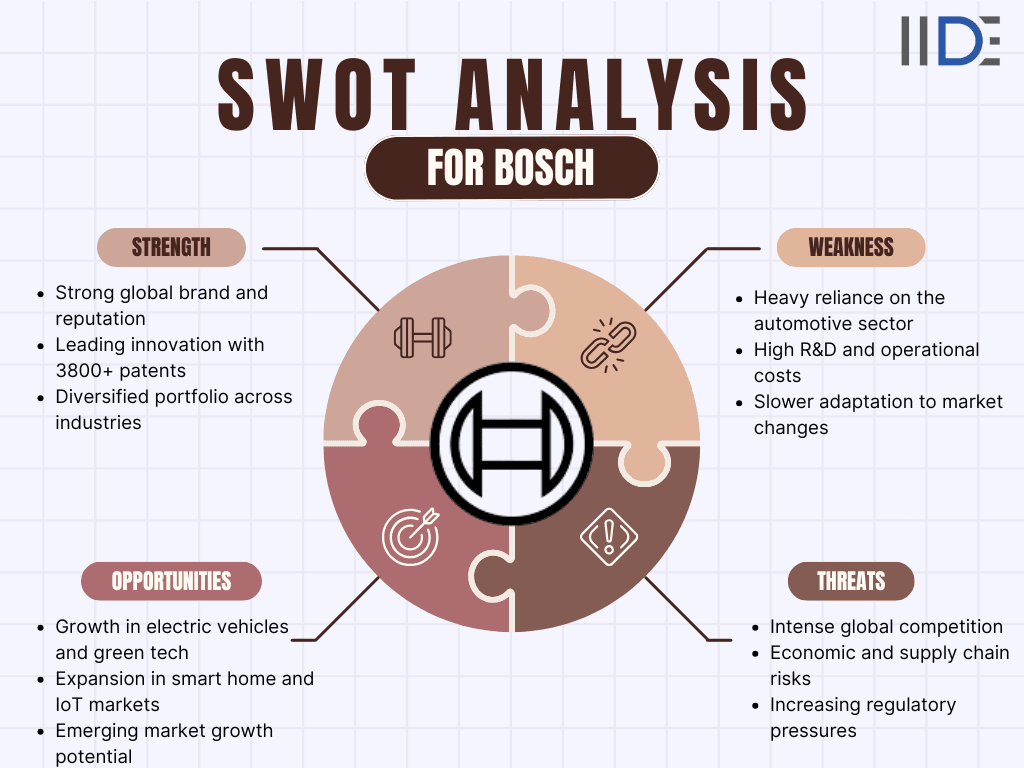
The SWOT analysis of Bosch provides a clear snapshot of the company’s current market position by examining its strengths, weaknesses, opportunities, and threats. This analysis highlights how Bosch is navigating industry trends, technological advancements, and competitive challenges in 2025 to maintain its leadership and drive future growth.
Strengths of Bosch: How the Engineering Giant Leads in 2025
Bosch’s strengths form the foundation of its success, driving growth, innovation, and industry leadership. Recognizing these strengths allows the company to leverage its core capabilities, maintain a competitive edge, and capitalize on emerging opportunities in a rapidly evolving market.
1. Brand Recognition & Reputation
- Founded in 1886, Bosch is globally recognized as a pioneer in engineering and innovation.
- Strong reputation built on reliable automotive solutions, smart home technology, and power tools.
- Its slogan “Invented for Life” reflects Bosch’s focus on quality, sustainability, and long-term impact.
- Consistently ranked among the top global industrial brands.
2. Market Leadership
- Bosch generated over €91.6 billion in revenue in 2024, showcasing its scale and financial strength.
- Leading supplier of automotive components worldwide, with a strong presence in electrification and mobility solutions.
- Major player in consumer appliances and power tools, competing successfully with brands like Siemens and Philips.
- Global operations across 60+ countries, giving Bosch a robust international footprint.
3. Innovation & R&D Focus
- Annual R&D investment exceeding €7 billion, driving breakthroughs in AI, IoT, and Industry 4.0.
- Leader in smart mobility, hydrogen fuel cells, and autonomous driving solutions.
- A strong patent portfolio ensures Bosch maintains a technological edge over competitors.
- Pioneering smart home solutions that integrate sustainability with digitalisation.
Siemens is a direct competitor in industrial tech see the SWOT Analysis of Siemens.
4. Sustainability & Green Leadership
- Bosch became the first global industrial company to achieve carbon neutrality across 400+ locations in 2020.
- Active investments in hydrogen technology and EV charging infrastructure.
- Focused on reducing emissions and supporting circular economy initiatives.
- Aligns closely with global sustainability regulations, strengthening its brand trust.
5. Global Independence & Long-Term Vision
- Unlike many competitors, Bosch is privately owned, allowing it to reinvest profits into innovation rather than short-term shareholder gains.
- This unique structure supports long-term strategies in sustainability and technological leadership.
- Strong employee culture with over 400,000 associates worldwide driving innovation.
Weaknesses of Bosch: Challenges in a Shifting Market
While Bosch remains a global leader in engineering and technology, it faces several weaknesses that could limit growth and competitiveness in 2025. These issues are important to consider as they expose the brand’s vulnerabilities in an industry rapidly evolving toward electrification, digitalisation, and sustainability.
1. Heavy Dependence on Automotive Sector
- A large portion of Bosch’s revenue comes from automotive components.
- This dependence makes Bosch vulnerable to downturns in the auto industry.
- Shifting demand to EVs puts added pressure as rivals like Tesla and BYD scale faster.
- Any slowdown in car production directly impacts Bosch’s profitability.
2. High R&D and Operational Costs
- Bosch invests heavily in innovation, with R&D costs often surpassing €7 billion annually.
- While this fuels long-term growth, it squeezes short-term margins.
- Competitors with leaner cost structures can undercut Bosch in pricing.
- Rising costs may slow expansion into emerging markets.
3. Slower Adaptation Compared to Rivals
- Global competitors in EV and AI, such as Tesla and Siemens, have moved faster in scaling advanced solutions.
- Bosch risks being perceived as a follower rather than an industry disruptor.
- Delayed execution can weaken its market share in high-growth tech segments.
4. Exposure to Economic and Regulatory Pressures
- Economic downturns reduce consumer spending on cars and appliances, impacting Bosch’s sales.
- Increasing regulatory demands around emissions, sustainability, and compliance add financial strain.
- Competitors with niche focus (e.g., EV-only players) may adapt faster to these changes.
If you’re interested in how other global innovators tackle industry challenges, check out our SWOT analysis of Panasonic. It’s a great way to see how both Bosch and Panasonic drive progress in technology, sustainability, and smart solutions for the future.
Opportunities for Bosch: Embracing Innovation and Market Trends in 2025
Bosch has several opportunities to capitalize on in 2025, as global trends and evolving consumer preferences reshape the technology, automotive, and industrial sectors. Leveraging its strong brand recognition and global presence can help Bosch drive growth and innovation.
1. Electrification and EV Market Expansion
- The global shift toward electric vehicles (EVs) presents a major opportunity for Bosch’s automotive division.
- Bosch can expand its EV components, battery management systems, and charging infrastructure solutions to meet rising demand.
- Collaborations with automakers and government initiatives for clean mobility can strengthen its market position.
2. Smart Home & IoT Technologies
- Increasing consumer adoption of smart home devices and IoT-enabled solutions offers growth potential for Bosch’s connected appliances and security systems.
- Pilot launches of AI-driven smart appliances, sensors, and energy-efficient devices can position Bosch as a leader in intelligent living.
- Gen Z and tech-savvy consumers favor convenience, sustainability, and automation, aligning with Bosch’s innovative solutions.
3. Sustainable and Energy-Efficient Solutions
- Global trends toward sustainability and energy efficiency open avenues for Bosch in renewable energy, industrial automation, and eco-friendly products.
- Investments in green technologies, low-energy appliances, and smart mobility solutions can enhance brand reputation.
- Sustainability initiatives also resonate with environmentally conscious customers and industrial partners.
4. Emerging Market Growth
- Expanding in Asia, Africa, and Latin America can help Bosch tap into under-served regions with growing industrial, automotive, and consumer demand.
- Localized products and services tailored to regional needs can strengthen Bosch’s competitive edge.
IBM’s enterprise solutions provide a useful comparison. Learn more in the Business Model of IBM.
Threats to Bosch: Navigating Industry Challenges in 2025
Bosch faces several external threats that could affect its growth, market share, and technological leadership. Understanding these threats helps the company identify vulnerabilities and plan strategic responses.
1. Intense Industry Competition
- Competing with global giants like Siemens, Honeywell, ABB, and Schneider Electric pressures Bosch’s market share in automotive, industrial, and consumer products.
- Emerging startups in smart home tech, EV components, and automation are agile competitors capturing niche markets.
- Competitors leveraging innovative digital solutions may outpace Bosch in key sectors.
2. Shifting Consumer and Market Preferences
- Growing demand for sustainable, energy-efficient, and smart technologies requires constant innovation.
- Customers increasingly prefer digital-first solutions, IoT-enabled devices, and eco-friendly products.
- Delay in adapting could reduce Bosch’s appeal among environmentally conscious and tech-savvy consumers.
3. Economic and Supply Chain Risks
- Raw material cost fluctuations, semiconductor shortages, and logistics disruptions can impact production and profitability.
- Global economic slowdowns may reduce demand in automotive, industrial, and consumer segments.
- Competitors with leaner, more agile supply chains may gain a market advantage.
4. Regulatory & Compliance Challenges
- Stricter environmental, safety, and energy regulations in the automotive and industrial sectors increase operational complexity.
- Changes in international trade policies, tariffs, and sustainability requirements can affect production and global expansion.
- Non-compliance risks legal penalties and damages Bosch’s reputation as a reliable technology leader.
IIDE Student Takeaway & Recommendations
Bosch’s SWOT analysis highlights its position as a global technology leader, with strengths in diversified operations, robust R&D, and sustainability leadership. Its long-term vision and innovation in AI, IoT, and Industry 4.0 reinforce its competitive edge.
Core Tension: Bosch’s reliance on the automotive sector exposes it to market volatility, while rising costs and faster-moving competitors in EVs and AI threaten its leadership position.
Future Outlook: Bosch is well-placed to thrive by expanding into EVs, hydrogen technology, and smart connected solutions. However, its success will depend on reducing dependence on the auto sector and leveraging sustainability as a growth driver.
LG competes in electronics and appliances to learn about LG SWOT Analysis.
Recommendations:
- Diversify Beyond Automotive: Strengthen revenue streams in consumer appliances, smart homes, and industrial technology to reduce sector reliance.
- Accelerate Digitalisation: Invest further in AI, IoT, and automation to stay ahead of rivals like Siemens and Tesla.
- Sustainability Branding: Highlight carbon-neutral achievements and green innovations in marketing campaigns to build consumer trust.
- Strategic Partnerships: Collaborate with EV manufacturers, governments, and tech firms to scale green and digital solutions faster.
Bosch’s strong innovation pipeline, sustainability initiatives, and global brand recognition position it to remain a leader in shaping mobility and smart technologies.
By balancing its portfolio and embracing emerging opportunities, Bosch can overcome current challenges and secure long-term growth in a shifting global market.
Conclusion
PlayStation’s SWOT analysis in 2025 highlights a brand that remains a leader in the gaming industry, thanks to its powerful global presence, exclusive titles, and innovative technology.
However, ongoing challenges such as high hardware costs, limited backward compatibility, and increasing competition from digital-first and cloud gaming platforms require PlayStation to adapt quickly.
By leveraging its strengths, expanding into emerging markets, embracing new gaming trends, and prioritizing sustainability, PlayStation is well-positioned to maintain its dominance and redefine the future of gaming for the next generation of players.
Want to Know Why 2,50,000+ Students Trust Us?
Dive into the numbers that make us the #1 choice for career success


MBA - Level
Post Graduate in Digital Marketing & Business Strategy

Best For
Fresh Graduates

Mode of Learning
On Campus (Mumbai & Delhi)

Starts from
May 29, 2026

Duration
11 Months
Live & Online
Advanced Online Digital Marketing Course
Best For
Working Professionals
Mode of Learning
Online
Starts from
Apr 6, 2026
Duration
4-6 Months

Online
Professional Certification in AI Strategy
Best For
AI Enthusiasts
Mode of Learning
Online
Duration
5 Months

Offline
Undergraduate Program in Digital Business & Entrepreneurship
Best For
12th Passouts
Mode of Learning
On Campus (Mumbai)
Duration
3 Years
Recent Post

Aditya Shastri

Lead Trainer & Business Development Head at IIDE
Aditya Shastri leads the Business Development segment at IIDE and is a seasoned Content Marketing expert. With over a decade of experience, Aditya has trained more than 20,000 students and professionals in digital marketing, collaborating with prestigious institutions and corporations such as Jet Airways, Godrej Professionals, Pfizer, Mahindra Group, Publicis Worldwide, and many others. His ability to simplify complex marketing concepts, combined with his engaging teaching style, has earned him widespread admiration from students and professionals alike.
Aditya has spearheaded IIDE’s B2B growth, forging partnerships with over 40 higher education institutions across India to upskill students in digital marketing and business skills. As a visiting faculty member at top institutions like IIT Bhilai, Mithibai College, Amity University, and SRCC, he continues to influence the next generation of marketers.
Apart from his marketing expertise, Aditya is also a spiritual speaker, often traveling internationally to share insights on spirituality. His unique blend of digital marketing proficiency and spiritual wisdom makes him a highly respected figure in both fields.