
Students Centric
Placements Report
Trackable results, real numbers
Reviews
Proven success, real voices
Trainers
Expert-led, Industry-Driven Training
Life at IIDE
Vibrant Spirit student life
Alumni
Successful Journeys, Inspiring Stories
Learning Centre
Webinars
Blogs
Case studies
Live, Interactive Masterclasses
Fresh Insights, quick reads
Real-life, Industry relevant
More
Hire from us
Hire Top Digital Marketing Talent
Work with us
Join Our Team, Make an Impact
Customised Training
Personalised digital marketing training for your company
Refer & earn
Simple, easy rewards
Contact us
Get the answers you need
About us
Know more about IIDE
Explore all course options

FOR FRESH GRADUATES
Post Graduation Program in Digital Marketing & Business Strategy- Ideal for Age: 20–25 Years

Can’t decide? Explore all our
Digital Marketing Courses
COMPARE BOTH OUR PROGRAMSOffline
Explore Top AI CoursesIndustry-Aligned TRACKMost Popular
UG Program in Digital Business & Entrepreneurship- Ideal for 12th Pass out / FY Degree Student

PARTNER PROGRAMS






Can’t decide? Explore all
BBA In Digital Marketing Colleges
Orginally Written by Aditya Shastri
Updated on Feb 17, 2026
Share on:


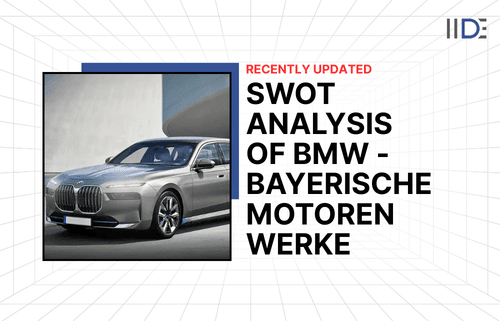
BMW, the German luxury automotive icon, commands a prestigious position with €155.5 billion in revenue and 2.55 million vehicles sold globally in 2025, dominating the premium mobility segment. As the automotive industry pivots toward electrification and autonomous driving, can BMW maintain its "Ultimate Driving Machine" heritage while competing against Tesla's EV dominance and Chinese manufacturers' rapid innovation?
This comprehensive SWOT analysis of BMW reveals strategic insights essential for automotive enthusiasts, business strategists, and management students navigating the electrified future of luxury mobility.
About BMW
Founded in 1916 as an aircraft engine manufacturer, Bayerische Motoren Werke AG (BMW) evolved into one of the world's most prestigious automotive brands, spanning luxury vehicles, motorcycles, and mobility services.
The brand's legendary slogan "The Ultimate Driving Machine" (North America) and "Sheer Driving Pleasure" (global) embodies BMW's commitment to performance engineering, driving dynamics, and premium craftsmanship.
In 2026, BMW unveiled its revolutionary Neue Klasse electric platform at the Munich headquarters, promising 30% longer range and 30% faster charging than current models, while achieving carbon-neutral production across all European facilities.
SWOT Analysis examines a brand's Strengths, Weaknesses, Opportunities, and Threats to evaluate competitive positioning and strategic direction.
BMW Overview Table
| Category | Details |
|---|---|
| Official Company Name | Bayerische Motoren Werke AG (BMW Group) |
| Founded | March 7, 1916 (Munich, Germany) |
| Website | www.bmwgroup.com |
| Industries Served | Automotive Manufacturing, Luxury Vehicles, Motorcycles, Financial Services, Mobility Solutions |
| Geographic Presence | 140+ countries; Manufacturing in Germany, USA, China, UK, Brazil, South Africa, Mexico, India, Thailand |
| Annual Revenue (2025) | €155.5 billion |
| Net Income (2025) | €17.1 billion |
| Employees | 154,950 (global workforce, 2025) |
| Main Competitors | Mercedes-Benz, Audi, Tesla, Lexus, Porsche, Genesis, Lucid, BYD, NIO, Volvo |

Is Digital Marketing the Right Career for You?
Find out in a free 45-min masterclass · Career paths, roles and growth explained · By Karan Shah, Founder & CEO, IIDE

Is Digital Marketing the Right Career for You?
Find out in a free 45-min masterclass · Career paths, roles and growth explained · By Karan Shah, Founder & CEO, IIDE
SWOT Analysis of BMW
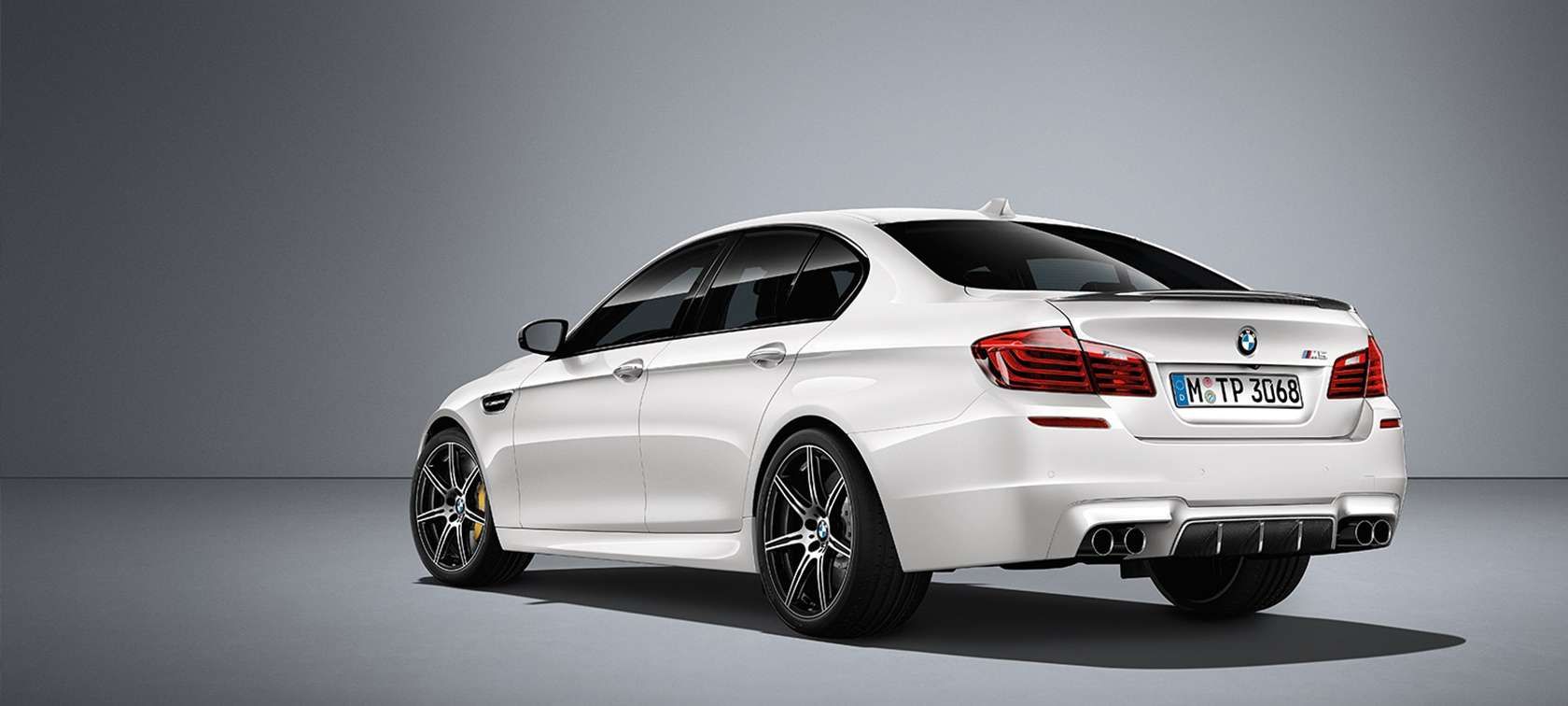
BMW's Strengths: The Ultimate Driving Machine's Competitive Advantages in 2026
1. Unparalleled Brand Equity and Premium Positioning
BMW ranks #7 in Interbrand's 2025 Best Global Brands valuation at $60.4 billion, maintaining its position as the world's most valuable automotive luxury brand. The BMW badge represents engineering excellence, driving pleasure, and aspirational lifestyle across global markets. Brand consideration among high-net-worth individuals reaches 87% in key markets (US, Germany, China), demonstrating exceptional premium equity.
The brand's Net Promoter Score of 68 (automotive luxury average: 52) indicates extraordinary customer advocacy, with BMW owners demonstrating 71% brand loyalty in repeat purchases, the highest retention rate in the premium segment.
2. Engineering Excellence and Performance Heritage
BMW's 100+ year legacy in precision engineering creates unmatched technical credibility. The brand pioneered innovations including turbocharging, lightweight construction, electric power steering, and advanced driver assistance systems (ADAS). BMW's M Division high-performance sub-brand generates €3.2 billion annually, representing pure driving dynamics that competitors struggle to replicate.
The iconic inline-6 and V8 engines, xDrive all-wheel-drive system, and adaptive M suspension technology deliver the signature BMW driving experience that differentiates the brand from luxury competitors focused primarily on comfort.
3. Comprehensive Product Portfolio Across Segments
BMW Group's multi-brand strategy spans luxury, performance, and ultra-luxury segments:
- BMW: Core luxury brand (3/4/5/7/8 Series, X models, i electric lineup)
- MINI: Premium small car segment
- Rolls-Royce: Ultra-luxury pinnacle ($450,000-$500,000+ vehicles)
- BMW Motorrad: Premium motorcycle division (#1 globally in luxury motorcycles)
This portfolio diversification generates €155.5 billion revenue across 120+ model variants, mitigating risk from single-segment downturns while enabling technology sharing and economies of scale.
4. Electric Vehicle Leadership Among Legacy Automakers
BMW sold 376,000 battery electric vehicles in 2025 (+85% YoY), representing 14.7% of total deliveries, the highest EV penetration among German luxury manufacturers. The BMW iX, i4, i5, and i7 electric lineup demonstrates that electrification doesn't sacrifice driving pleasure, countering perceptions that EVs are merely appliances.
The upcoming Neue Klasse platform (launching 2026-2027) will deliver 800V architecture, 500+ mile range, and sub-18-minute 10-80% charging, positioning BMW ahead of Mercedes-Benz EQ and Audi e-tron technological capabilities. BMW invests €30 billion through 2025 in electrification R&D, more than any European competitor.
5. Manufacturing Excellence and Production Flexibility
BMW operates 31 production facilities across 15 countries with industry-leading 98.7% quality ratings (J.D. Power). The brand's flexible manufacturing architecture enables building electric, hybrid, and combustion vehicles on the same production lines, maximizing capital efficiency during the transition period.
BMW's Dingolfing, Spartanburg, and Shenyang plants rank among the world's most advanced automotive facilities, integrating AI-driven quality control, collaborative robotics, and sustainable manufacturing processes achieving 80% renewable energy utilization.
6. Strong Financial Performance and Investment Capacity
BMW generated €17.1 billion net profit on €155.5 billion revenue in 2025, delivering 11% net margin, exceptional for automotive manufacturing. The company maintains €52.4 billion in liquidity and investment-grade credit ratings (A/A2), enabling aggressive R&D spending on electrification, autonomous driving, and digitalization without financial constraints.
Return on equity of 23.7% surpasses Mercedes-Benz (19.3%) and Volkswagen Group (15.8%), demonstrating superior capital allocation and operational efficiency.
7. Digital Innovation and Connected Services
BMW's Operating System 9 (launched 2024) integrates AI-powered voice control, 5G connectivity, over-the-air updates, and seamless smartphone integration across the vehicle lineup. The My BMW App enables remote vehicle control, digital key functionality, and predictive maintenance, with 8.2 million active users in 2025.
BMW ConnectedDrive services generate €2.8 billion annually through subscriptions (remote parking, comfort access, augmented reality navigation), creating recurring revenue streams beyond vehicle sales. The brand's digital services attach rate reaches 64% of new vehicle sales.
8. Chinese Market Dominance Through Joint Venture Strategy
BMW sold 824,000 vehicles in China during 2025, representing 32% of global deliveries. The BMW Brilliance Automotive joint venture operates state-of-the-art manufacturing in Shenyang with 83% localization, enabling competitive pricing and rapid response to Chinese consumer preferences.
BMW's Chinese success contrasts sharply with competitors struggling in the world's largest premium market, where local EV brands (BYD, NIO, Li Auto) capture market share from Western manufacturers.
BMW's Weaknesses: Challenges Facing the Bavarian Giant
1. Electrification Lag Behind Tesla and Chinese EVs
Despite industry-leading legacy automaker EV sales, BMW's electric vehicle lineup trails Tesla's 1.84 million deliveries and Chinese manufacturers' rapid innovation pace. Tesla's Supercharger network, battery efficiency, and software integration create customer experiences BMW's current generation EVs struggle to match.
Chinese competitors (BYD, NIO, Xpeng) offer comparable or superior electric technology at 30-40% lower price points, threatening BMW's premium positioning in crucial Asian markets. BMW's EV average transaction price of €68,400 faces pressure as Chinese brands elevate quality perceptions.
2. Complex Product Portfolio and Confusing Nomenclature
BMW's model lineup expanded to 120+ variants including coupes, sedans, SUVs, crossovers, and electric versions of existing models. The nomenclature system (i3, iX3, i4, iX, etc.) creates consumer confusion about vehicle positioning, technology, and value proposition.
Critics argue BMW diluted brand focus through excessive model proliferation, producing X1 through X7 SUVs, 2/3/4/5/6/7/8 Series sedans, and i electric variants, confusing dealers and customers while increasing development costs and cannibalization risks.
3. Controversial Design Language and Styling Polarization
BMW's enlarged kidney grille design (XM, M3/M4, iX) generated significant controversy, with design polls indicating 62% of enthusiasts find recent styling "unappealing" or "excessive." The dramatic departure from classic BMW proportions alienates traditional customers while failing to attract younger demographics at anticipated rates.
The BMW XM plug-in hybrid SUV received particularly harsh criticism for design excess and unclear market positioning, selling only 15,300 units in its first full year versus 25,000 projections, a rare product misstep for the brand.
4. High Pricing Limiting Market Accessibility
BMW's average transaction price reached €58,700 in 2025 (+€4,200 vs 2023), pricing the brand beyond middle-class accessibility in most markets. While premium positioning generates margin, it limits total addressable market and makes BMW increasingly vulnerable to economic downturns.
Electric model pricing exacerbates this challenge, the BMW i5 eDrive40 starts at €69,500 while comparable Tesla Model S begins at €94,990, creating perception that BMW EVs offer inferior technology at premium prices despite superior driving dynamics.
5. Slower Software Development Versus Tech-First Competitors
BMW's software capabilities lag Tesla, Chinese EV manufacturers, and emerging tech competitors entering automotive. Over-the-air update functionality remains limited compared to Tesla's continuous improvement model, autonomous driving development trails Waymo/Cruise technology, and infotainment responsiveness doesn't match smartphone-like experiences consumers expect.
The company acknowledged this weakness by investing €2.1 billion in software development centers and hiring 2,000+ software engineers in 2024-2025, but catching technology-native competitors requires multi-year efforts.
6. Dependence on Chinese Market Amid Geopolitical Tensions
32% of BMW's global sales originate from China, creating dangerous concentration risk as US-China tensions intensify and European Commission investigates Chinese EV subsidies. Potential tariffs, regulatory restrictions, or nationalist consumer sentiment could severely impact BMW's most profitable market.
The joint venture structure, while enabling local manufacturing, requires technology sharing with Chinese partner Brilliance, potentially strengthening future local competitors. BMW's Chinese revenue dependence exceeds Mercedes-Benz (28%) and Audi (24%), amplifying vulnerability.
7. Sustainability Perception Gap Versus Pure EV Brands
Despite €30 billion electrification investments, BMW faces criticism for continuing combustion engine development (including new V8 and inline-6 platforms) and slower transition timelines than competitors. Environmental activists target BMW's continued performance vehicle production and relatively low EV sales mix (14.7% vs Volvo's 26% or Tesla's 100%).
The brand's positioning as "sustainable performance" creates cognitive dissonance, can ultimate driving machines truly prioritize environmental responsibility? This perception challenge complicates marketing to environmentally-conscious luxury buyers.
BMW's Opportunities: Growth Pathways for Ultimate Mobility
1. Neue Klasse Platform Revolution
BMW's Neue Klasse architecture (launching 2025-2026) represents transformational opportunity, offering 30% improved efficiency, 30% faster charging, completely redesigned software stack, and production cost reductions enabling competitive EV pricing. The platform will underpin 50% of BMW's lineup by 2028, spanning 3 Series through X5-sized vehicles.
First models (electric 3 Series sedan and X3 SAV equivalents) target the highest-volume premium segments, potentially capturing customers from Tesla Model 3/Y, Mercedes EQE/EQS, and Polestar. Successful Neue Klasse execution could establish BMW as the EV era premium leader.
2. Autonomous Driving and Robotaxi Services
BMW's partnership with Qualcomm and Waymo positions the brand for Level 4/5 autonomous capabilities by 2028. While focused initially on highway driving assistance, BMW could launch premium robotaxi services in Munich, Los Angeles, and Shanghai by 2029, generating recurring revenue while showcasing technology leadership.
The autonomous luxury experience, BMW-branded self-driving vehicles offering mobile offices or entertainment lounges, differentiates from commodity robotaxis while monetizing the brand's premium positioning through mobility-as-a-service.
3. Luxury Electric Motorcycle Expansion
BMW Motorrad sold 209,500 motorcycles in 2025 (+8.3% growth), leading global premium motorcycle sales. The brand's electric motorcycle offerings remain limited despite success of competitors like Harley-Davidson LiveWire and Zero Motorcycles. Expanding BMW Motorrad's electric lineup could capture the fast-growing premium electric motorcycle market projected to reach $12.8 billion by 2030.
Urban electric scooters and lightweight electric motorcycles offer BMW entry into sustainable urban mobility while leveraging performance heritage and premium brand equity.
4. Subscription and Flexible Mobility Models
The BMW Luxury Access subscription pilot (launched 2023 in Nashville) demonstrates potential for flexible ownership models appealing to younger, experience-focused consumers. Expanding subscription services globally could generate recurring revenue, improve capital efficiency through fleet management, and attract customers hesitant about traditional ownership commitments.
Monthly subscriptions ($2,000-$3,500) covering insurance, maintenance, and vehicle swaps create predictable revenue while maintaining direct customer relationships that traditional dealership models prevent.
5. Indian and Southeast Asian Market Penetration
India's luxury vehicle market grew 35% in 2025, reaching 48,000 units with projections for 150,000+ by 2030 as the middle class expands. BMW's Indian presence (6.8% market share, 3,200 units) significantly trails Mercedes-Benz (13,400 units, 28% share), representing substantial growth opportunity.
Localizing production beyond the Chennai assembly facility, developing India-specific electric models at accessible price points, and expanding dealer networks could triple BMW's Indian sales by 2028. Similar opportunities exist in Indonesia, Vietnam, Thailand, and Philippines.
6. Hydrogen Fuel Cell Technology Leadership
BMW's iX5 Hydrogen pilot program (100 vehicles in real-world testing) positions the brand as hydrogen mobility leader among premium manufacturers. While battery-electric vehicles dominate passenger car discussions, hydrogen offers compelling advantages for long-distance travel, cold climates, and rapid refueling.
If hydrogen infrastructure develops faster than projected, BMW's early investment could create significant competitive advantage, particularly in commercial vehicles, where the brand could leverage hydrogen technology for premium vans and light trucks.
7. Digital Revenue Streams and Software Monetization
BMW's connected services subscription penetration (64%) creates the foundation for expanded digital revenue. Opportunities include:
- Advanced driver assistance subscriptions (automated lane changing, traffic jam pilot)
- Performance upgrades (unlock additional horsepower, suspension settings)
- Entertainment and productivity services (gaming, streaming, mobile office)
- Predictive maintenance and concierge services
If BMW achieves €5,000 lifetime digital revenue per vehicle (currently €2,400), this would add €12.75 billion to annual revenue by 2030 at current production levels, nearly doubling software-related income.
BMW's Threats: Navigating an Industry in Disruption
1. Tesla's Technology and Brand Appeal to Younger Buyers
Tesla's 1.84 million vehicle deliveries in 2025 and category-defining brand status among tech-forward consumers pose existential threat to BMW's premium positioning. Tesla's Supercharger network, software updates, battery technology, and autonomous driving capabilities set customer expectations BMW struggles to meet.
Most critically, Tesla captured 41% of luxury buyers under age 40 in the US market, BMW's future customer base. If younger buyers perceive Tesla (and Chinese EVs) as superior technology despite BMW's driving dynamics advantages, the brand risks becoming associated with older demographics and outdated combustion heritage.
2. Chinese EV Manufacturers' Quality and Price Disruption
BYD, NIO, Xpeng, Li Auto, and Zeekr demonstrate that Chinese manufacturers no longer compete solely on price, they offer compelling technology, design, and quality at 30-40% discounts to German luxury brands. BYD's 3.02 million EV sales in 2025 (surpassing Tesla) and NIO's premium positioning in China directly challenge BMW's market share.
As Chinese brands expand to Europe (BYD, NIO, MG), Middle East, and Southeast Asia with sophisticated EVs priced between mass-market and premium segments, they threaten BMW's volume and margin structure. The competitive threat intensifies if Chinese quality perceptions continue improving while Western brands' pricing remains premium.
3. Economic Recession and Luxury Spending Volatility
Global economic indicators point toward potential recession in 2026-2027, European GDP growth forecasts revised downward to 0.8%, US consumer confidence declining, and China's property market creating wealth effects. Luxury vehicle sales typically decline 25-35% during recessions as discretionary spending contracts.
BMW's premium positioning makes the brand particularly vulnerable, buyers can delay purchases, trade down to mass-market brands, or extend ownership cycles. The company's 32% China revenue dependence amplifies risk if Chinese economic slowdown accelerates.
4. Raw Material Costs and Battery Supply Chain Constraints
Lithium, cobalt, and nickel prices remain volatile despite recent declines, with long-term supply concerns as EV production scales globally. BMW's electric vehicle ambitions require securing battery supply chains, but faces competition from Tesla's vertical integration, Chinese manufacturers' domestic supply advantages, and limited European battery production capacity.
Battery costs represent 35-40% of electric vehicle manufacturing expenses. Sustained raw material inflation or supply disruptions could compress BMW's EV margins or force pricing increases that reduce competitiveness against better-positioned rivals.
5. Regulatory Emissions Standards and Transition Costs
European Union's 2035 combustion engine ban, California's Advanced Clean Cars II regulation, and tightening emissions standards globally force accelerated electrification while BMW's combustion engine business remains highly profitable. The transition requires €30+ billion investment while cannibalizing profitable internal combustion models.
Potential compliance fines for missing CO2 targets (BMW paid €1.4 billion in 2024) and uncertainty around synthetic fuel regulations create financial risks. If BMW's electrification timeline lags regulatory requirements, the brand faces substantial penalties impacting profitability.
6. Cybersecurity Vulnerabilities and Connected Vehicle Risks
BMW's connected vehicle fleet of 8.2 million vehicles with remote access capabilities, over-the-air updates, and digital key functionality creates cybersecurity attack surface. High-profile hacking incidents could devastate brand reputation, trigger recalls, and expose BMW to liability claims.
The automotive industry's cybersecurity maturity lags financial services and tech sectors. As vehicles become "smartphones on wheels," BMW must defend against nation-state actors, criminal organizations, and hackers targeting premium brands for ransom or espionage.
7. Dealer Network Conflicts and Direct Sales Disruption
Tesla's direct-to-consumer sales model and Chinese manufacturers' agency models challenge BMW's traditional franchise dealership structure. Younger buyers prefer online purchasing, transparent pricing, and eliminating dealership negotiations, but BMW's dealer network (representing billions in independent capital investment) resists disintermediation.
This conflict could slow BMW's digital transformation, reduce customer experience quality compared to direct-sales competitors, and create legal/regulatory battles if BMW attempts dealer network restructuring similar to Genesis's wholesale transition.
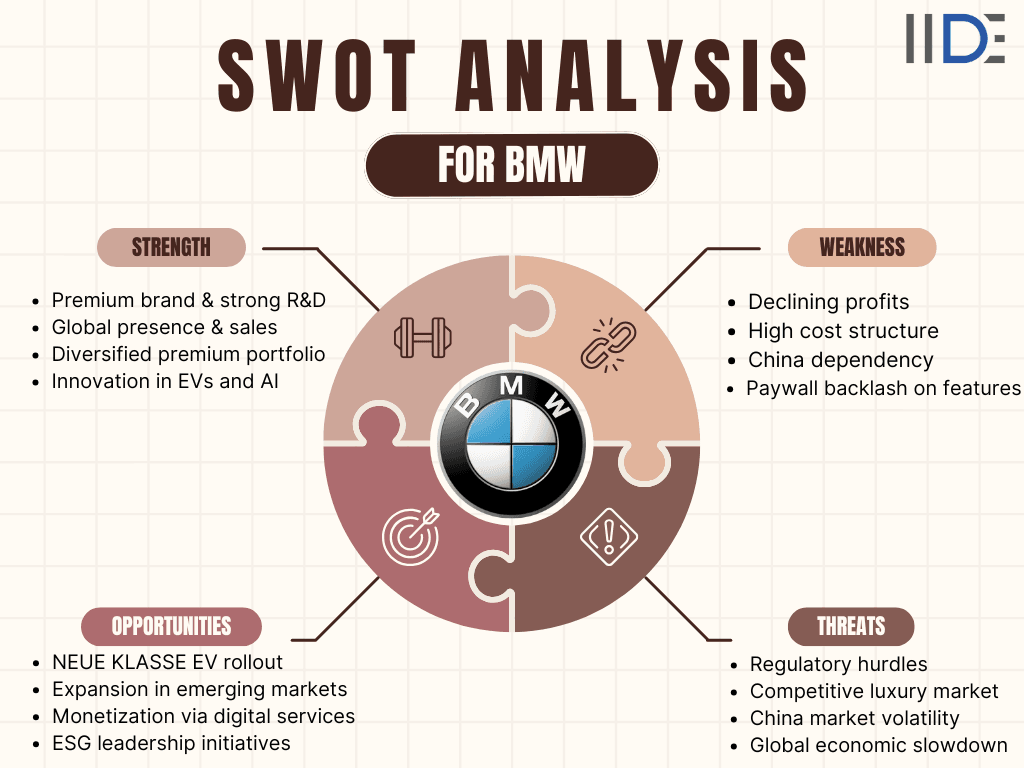
Summary Table - SWOT of BMW
IIDE Student Takeaway, Recommendations & Conclusion
This BMW SWOT analysis for 2026 reveals a brand at a critical inflection point, commanding unmatched premium automotive equity and engineering credibility while confronting existential questions about electrification competitiveness, software capabilities, and relevance to digitally-native younger buyers. The core strategic tension centers on preserving "Ultimate Driving Machine" heritage while transforming into a technology-driven electric mobility leader, all while Tesla and Chinese manufacturers redefine premium automotive value propositions.
BMW SWOT Analysis Shows us that, it's greatest strength is its Performance Engineering Legacy, simultaneously represents vulnerability if the brand cannot translate internal combustion driving pleasure into compelling electric vehicle experiences. The upcoming Neue Klasse platform represents a pivotal moment: successful execution could establish BMW as the premium EV era leader, while failure would accelerate market share losses to tech-first competitors unburdened by legacy manufacturing complexity.
Recommendations:
- Accelerate Neue Klasse to market aggressively with 24-month timeline (versus planned 30 months) by prioritizing 3 Series and X3 electric equivalents that represent highest-volume segments and directly counter Tesla Model 3/Y competitive threat.
- Acquire or deeply partner with autonomous driving technology leader (Waymo, Mobileye, or emerging Chinese AV company) rather than developing in-house, recognizing BMW's software development capabilities lag tech-native competitors by 3-5 years.
- Simplify product portfolio by 30% through aggressive SKU rationalization, eliminating slow-selling variants and clarifying nomenclature to reduce consumer confusion while improving manufacturing efficiency and focusing R&D resources.
- Launch aggressive India-Southeast Asia expansion with locally-manufactured, region-specific electric models priced 20-25% below European equivalents, capturing fast-growing Asian luxury markets before Chinese competitors establish unassailable advantages.
- Restructure dealer network toward agency model in key markets (China, US, Germany) by 2028, enabling direct customer relationships, transparent pricing, and seamless online-offline experiences that match Tesla's convenience while preserving dealer service capabilities.
Future Outlook:
BMW must prioritize transforming from internal combustion performance leader into electric technology powerhouse, where "Sheer Driving Pleasure" means instant torque, silent power delivery, and software-defined driving experiences rather than engine note and manual transmissions. By executing Neue Klasse flawlessly, embracing software-first development culture through external partnerships, and maintaining manufacturing excellence during industry transformation, BMW can dominate 2030s premium mobility and continue inspiring automotive enthusiasts.
The alternative is gradual premium share erosion to Tesla's technology cachet and Chinese manufacturers' value innovation, relegating BMW to a heritage brand serving older demographics unwilling to embrace electrification. The brand possesses financial resources, manufacturing capabilities, and dealer infrastructure to lead the premium EV transition, but only if it accelerates transformation velocity to match disruptive competitors' pace.
Want to Know Why 5,00,000+ Students Trust Us?
Dive into the numbers that make us the #1 choice for career success


MBA - Level
Post Graduate in Digital Marketing & Business Strategy

Best For
Fresh Graduates

Mode of Learning
On Campus (Mumbai & Delhi)

Starts from
Oct 1, 2026

Duration
11 Months

Live & Online
Advanced Online Digital Marketing Course
Best For
Working Professionals
Mode of Learning
Online
Starts from
Oct 9, 2026
Duration
4-6 Months

Offline
Top AI Courses to Make You Future Ready!
Best For
AI Enthusiasts
Mode of Learning
2–5 Month Program
Starts from
Sep 29, 2026
Duration
Flexiable

On Campus
Advanced Certification in Artificial Intelligence
Best For
AI Enthusiasts
Mode of Learning
On Campus (Mumbai)
Starts from
Sep 29, 2026
Duration
3 Months
Offline
Undergraduate Program in Digital Business & Entrepreneurship
Best For
12th Passouts
Mode of Learning
On Campus (Mumbai)
Starts from
-
Duration
3 Years
Offline
Degree In 2026 ≠ Enough Degree + Digital Skills = Future-Ready
Best For
12th Passouts
Mode of Learning
At IIDE Campus
Starts from
-
Duration
3 Years
Recent Post
More SWOT Analysis
BMW SWOT analysis evaluates the strengths, weaknesses, opportunities, and threats of BMW in 2025. It highlights strong brand equity, global sales, and innovation in EVs, while addressing challenges like profit decline and dependence on China.
BMW’s brand strength lies in its premium market positioning, innovation in electric vehicles, and global recognition. Valued at US$52 billion in 2025, BMW is a leader in luxury and performance.
The 5 points of SWOT analysis are:
- Strengths – Advantages like brand value or innovation.
- Weaknesses – Limitations such as high costs or market dependency.
- Opportunities – External growth prospects, such as new markets or technological advancements.
- Threats – Risks from competition or regulations.
- Brand Reputation – How a company is perceived in the market.
BMW’s weaknesses include a profit decline in 2024, high operational costs, dependence on China for sales, and a backlash over digital monetisation of paid features like heated seats.

Lead Trainer & Business Development Head at IIDE
Aditya Shastri leads the Business Development segment at IIDE and is a seasoned Content Marketing expert. With over a decade of experience, Aditya has trained more than 20,000 students and professionals in digital marketing, collaborating with prestigious institutions and corporations such as Jet Airways, Godrej Professionals, Pfizer, Mahindra Group, Publicis Worldwide, and many others. His ability to simplify complex marketing concepts, combined with his engaging teaching style, has earned him widespread admiration from students and professionals alike.
Aditya has spearheaded IIDE’s B2B growth, forging partnerships with over 40 higher education institutions across India to upskill students in digital marketing and business skills. As a visiting faculty member at top institutions like IIT Bhilai, Mithibai College, Amity University, and SRCC, he continues to influence the next generation of marketers.
Apart from his marketing expertise, Aditya is also a spiritual speaker, often traveling internationally to share insights on spirituality. His unique blend of digital marketing proficiency and spiritual wisdom makes him a highly respected figure in both fields.