
Students Centric
Placements Report
Trackable results, real numbers
Reviews
Proven success, real voices
Trainers
Expert-led, Industry-Driven Training
Life at IIDE
Vibrant Spirit student life
Alumni
Successful Journeys, Inspiring Stories
Learning Centre
Webinars
Blogs
Case studies
Live, Interactive Masterclasses
Fresh Insights, quick reads
Real-life, Industry relevant
More
Hire from us
Hire Top Digital Marketing Talent
Work with us
Join Our Team, Make an Impact
Customised Training
Personalised digital marketing training for your company
Refer & earn
Simple, easy rewards
Contact us
Get the answers you need
About us
Know more about IIDE
Explore all course options

FOR FRESH GRADUATES
Post Graduation Program in Digital Marketing & Business Strategy- Ideal for Age: 20–25 Years

Can’t decide? Explore all our
Digital Marketing Courses
COMPARE ALL 3 PROGRAMSOnline & Offline
Explore Top AI CoursesIndustry-Aligned TRACKMost Popular
UG Program in Digital Business & Entrepreneurship- Ideal for 12th Pass out / FY Degree Student

PARTNER PROGRAMS





Can’t decide? Explore all
BBA In Digital Marketing Colleges

Orginally Written by Aditya Shastri
Updated on Dec 11, 2025
Share on:


The brand's approach is a highly effective system driven by viral social media content, an unwavering focus on direct-to-consumer sales, and high-impact performance SEO, all of which combine to build brand awareness, reinforce its low-fare promise, and drive its financial success.
This case study delves into the core components of Ryanair's marketing, telling you how the airline leverages simplicity, controversy, and digital savviness to dominate the budget travel market.
Before diving into the article, I’d like to inform you that the research and initial analysis for this piece were conducted by Teerth Makwana, a current student in IIDE’s PG Digital Marketing Course (March 2025 Batch).
If you find this case study on Ryanair’s marketing strategy helpful, feel free to reach out to Teerth to send a quick note of appreciation for their fantastic research - they’ll appreciate the kudos!
About the Brand
Founded in 1984 in Dublin, Ryanair began with a single 15-seater aircraft. Today, it’s a global leader in the low-cost airline segment. Its business model is famously "no-frills," focusing on offering the lowest possible fares by minimising operational costs. This core philosophy is not just a business strategy; it is the very foundation of its marketing.
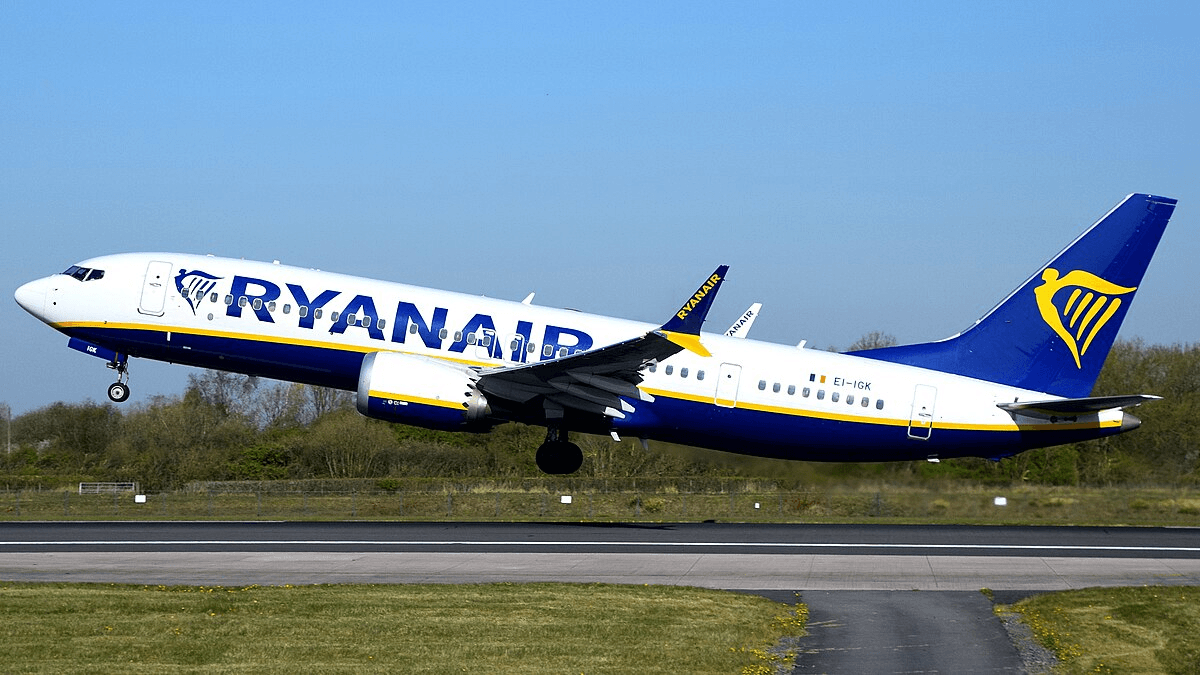
Ryanair’s branding focuses on being “Europe’s lowest fares, guaranteed.” While competitors try to balance comfort and pricing, Ryanair doubled down on affordability, making it the largest budget airline in Europe by market share.
Its marketing goals are straightforward: maximise passenger volume, maintain cost leadership, and expand market presence across Europe and beyond.

Learn Digital Marketing for FREE

Learn Digital Marketing for FREE
Ryanair Financials
In the fiscal year ending March 31, 2025, Ryanair reported profit after tax (PAT) of €1.61 billion, down about 16% from €1.92 billion the year before. Despite the drop in profits, several positive trends stood out:
- Passenger traffic rose by 9%, reaching a record 200.2 million travellers.
- Ancillary revenues (that is, non-ticket sources such as baggage, priority boarding, onboard sales etc.) rose modestly, by around 1-10%, depending on how measured.
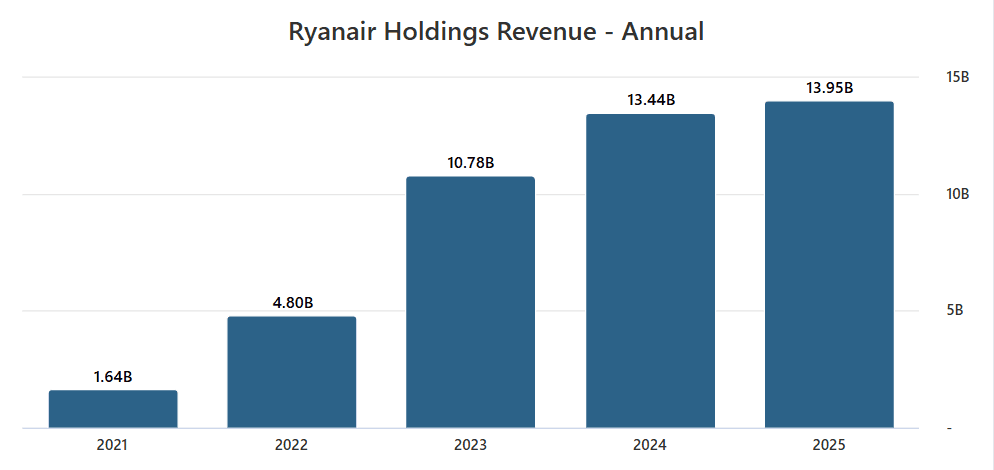
Total revenue for the group was approximately €13.95 billion (up ~4% from FY24’s €13.44 billion), while operating costs increased around 9%, rising to about €12.39 billion.
Marketing Objectives & Business Challenges
Ryanair's business challenges and marketing objectives are deeply interconnected, with its marketing acting as a direct response to operational hurdles.
The airline's focus on cost-cutting has led to labor disputes and a reputation for minimal service. The marketing objective to reinforce its low-fare image and improve brand perception directly counters this negative image.
Furthermore, as the business faces the challenge of increasing operating costs (like fuel), its marketing shifts its focus. The objective to boost ancillary revenue becomes a critical way to maintain profitability.
In essence, the marketing functions as a proactive shield, constantly working to rebuild trust and prove its value in the face of internal and external challenges.
Buyers Persona:

Mohit Raina
Mumbai
Occupation: Web-Developer
Age: 45 years
Motivation
Interest & Hobbies
- Frequent travel across Europe
- Value deals, discounts, and loyalty rewards
- Use of online booking platforms and travel apps
Pain Points
- Limited luggage allowance and additional charges
- Concerns over flight delays and customer service
- Desire for better mobile and online booking experiences
Social Media Presence
Highly active on Twitter/X, Instagram, and TikTok for memes, announcements, and customer interaction
The Ryanair Marketing Model
Ryanair's marketing strategy is a masterclass in getting maximum impact from minimal spending, focusing on a few powerful and unconventional channels to build a dominant brand.
The airline's approach centers on a few core pillars:
- Viral Social Media: Ryanair uses a witty, meme-based approach on platforms like TikTok and X to generate massive organic reach and build its brand
- Controversial PR: The airline leverages provocative stunts and public statements to consistently earn significant "free" media attention without paying for advertising
- Direct-to-Consumer (DTC) Focus: Ryanair relies on its own website and app for all bookings, cutting out third-party commissions and maintaining full control over sales
- High-Impact Performance SEO: The brand's website is optimized to rank first for transactional keywords like "cheap flights," capturing customers at the point of booking
This multi-faceted strategy allows Ryanair to cut through the noise of a crowded market, making its brand unforgettable and converting a high volume of traffic into loyal customers.
Breakdown Of Marketing Strategy of Ryanair
1. Digital Marketing Channels
Ryanair primarily uses its own digital platforms to reduce distribution costs and maximize direct sales.
Social Media:
- This is arguably their most impactful channel. Ryanair has a highly successful, unconventional strategy on platforms like TikTok, X (formerly Twitter), and Instagram
- They've built a strong brand personality using humor, self-deprecation, and memes
- Their social media content is designed to be highly shareable and viral, generating massive organic reach without a large advertising budget
- They engage directly with users, often with witty and sarcastic responses, which further boosts their visibility
Official Website and Mobile App:
- Ryanair's website is the central hub of their marketing and sales strateg
- By driving all bookings to their own platform, they eliminate travel agent fees and have full control over the customer experience
- The site's design is highly functional, prioritizing conversions over aesthetics
- They also use the site for a variety of ancillary revenue streams, such as selling car rentals, hotel stays, and insurance
Email Marketing:
- They maintain a solid email marketing strategy, using it for promotional deals and to send transactional emails
- They have been noted for their high email open rates, often achieved by using short, emoji-filled subject lines that stand out in an inbox
2. Performance SEO Strategy
Ryanair's performance SEO strategy is focused on high visibility and conversion, not just for branding. Their approach can be summarized as follows:
Strong Domain Authority:
- Ryanair has a very high domain authority score (around 85 on a scale of 100)
- This is a result of years of consistent online presence, which gives their website a strong advantage in search engine rankings
Transaction-Focused SEO:
- Their SEO is highly aligned with commercial intent
- They rank well for transactional keywords like "cheap flights to" and "flights from [city]to [city]"
- Their website architecture is structured to support effective indexing of destination-based pages, making them highly visible for users ready to book
Minimalist Content Strategy:
- Unlike many other brands, Ryanair’s website is not filled with a large volume of blog posts or inspirational travel guides
- Instead, their SEO focuses on direct, functional content and landing pages that facilitate quick bookings
- They prioritize efficiency over content-driven storytelling
Paid Ads Integration:
- Ryanair runs extensive and well-targeted paid search campaigns (SEM) that appear for a wide range of searches related to budget European flights
- This works in tandem with their organic SEO efforts to capture users at various stages of the travel planning journey
Looking to explore another airline's marketing success? Check out the Marketing Strategy of Air India and uncover key strategies that have shaped its growth.
Results and Impact
Ryanair's marketing strategies have had a profound impact on its business, allowing it to dominate the European low-cost travel market. The results are evident in its financial performance, market leadership, and unparalleled brand recognition.
Based on the results and impact of Ryanair's marketing strategies, here is a breakdown into 7-8 key pointers:
Market Leadership & Passenger Volume
- Ryanair’s marketing has directly driven its passenger volume, making it Europe's largest airline
- The airline reported a record-breaking 183.7 million passengers for its fiscal year 2024
- This number grew to a rolling 12-month total of 203.1 million passengers in July 2025, solidifying its position as a market leader
High Ancillary Revenue
- Ryanair's focus on direct sales has made ancillary revenue a critical component of its financial success
- Ancillary revenues, which include fees for baggage, seat selection, and priority boarding, accounted for over 30% of Ryanair's total operating revenues in both fiscal years 2023 and 2024
- In the first quarter of fiscal year 2025, ancillary revenue was 32% of the total, reaching €1.39 billion
Cost-Effective Advertising
- Ryanair's controversial and viral marketing strategy has saved the company from expensive ad campaigns
- Industry analysis highlights that Ryanair's cost per available seat kilometer (CASK) is approximately 50% lower than its closest competitors, a metric directly tied to its operational efficiency and minimal marketing spend on traditional channels
Unmatched Brand Awareness
- Ryanair has one of the most recognizable brands in the industry, with a distinct, no-nonsense personality that is instantly recognizable to consumers.
Strong Social Media Engagement
- The brand has built a cult-like following on platforms like TikTok and X (formerly Twitter), leading to high organic reach and a powerful, direct line of communication with its audience
Widespread Customer Acceptance
- The marketing has created a clear understanding among consumers that low fares come with minimal service, which has led to widespread acceptance of their no-frills model
What worked and why
What has worked for Ryanair’s marketing is that they’ve taken all the things people complain about the baggage fees, the lack of frills and turned them into a point of pride.
Instead of trying to be something they're not, they lean into it.strategy of leaning into their "no-frills" identity has made their brand message authentic, relatable, and highly effective.
When you look at what has worked for Ryanair, the real insight isn't just about their strategies, it's about how every single one of those strategies is perfectly aligned with their low-cost business model.
This video provides an interview with a Ryanair marketing leader who explains the simple, effective strategy behind their world-famous marketing success.
What hasn’t worked and why
In my view, what hasn't worked for Ryanair is the complete breakdown of its ruthless efficiency when faced with external challenges. The brand's "no-frills" marketing, which works perfectly on a normal day, can backfire spectacularly in a crisis.
When a flight is cancelled or delayed, their unapologetic, "you get what you pay for" attitude can feel less like honest branding and more like outright arrogance, alienating customers who are looking for empathy.
This same controversial PR, while effective for free publicity, has a hidden cost, contributing to a reputation that has fueled labor disputes and regulatory scrutiny.
Essentially, the very strategy that makes Ryanair a marketing powerhouse is also the source of its greatest vulnerability, as it leaves the brand with no goodwill to fall back on when things go wrong.
IIDE Student Recommendations
Based on the research, Ryanair has built an incredibly effective brand that is both loved and hated for being unapologetically themselves. However, this strategy is also a ticking time bomb. These recommendations would focus on evolving the brand without losing its core identity.
Humanize the Brand Beyond Humor:
- While their witty social media is great for marketing, the brand needs to show a more human side in moments of crisis
- Make a dedicated "Customer Compassion" team for social media, who can respond with empathy, not just sass, when a customer is genuinely upset about a lost bag or a canceled flight
Make Sustainability a Core Brand Story:
- Ryanair already has an impressive fleet of fuel-efficient planes and a commitment to using Sustainable Aviation Fuel (SAF)
- However, their marketing rarely, if ever, talks about it. A key recommendation would be to make "Europe's greenest airline" a major brand pillar
Invest in Brand Ambassadors:
- Ryanair's employees, particularly cabin crew and pilots, are on the front line. Improving their working conditions and empowering them to be brand ambassadors (not just service providers) could transform the brand's reputation from the inside out
- Their happiness would be a genuine, positive brand story that no amount of marketing could buy
Introduce a "Status" Tier for Business Travelers:
- Ryanair could partner with a credit card company to offer a co-branded card. Customers who spend a certain amount on the card or fly a number of times per year would achieve a "Business Flyer" status
- This status could offer perks like priority boarding and free lounge access for an added fee, appealing to business travelers who might otherwise choose a legacy carrier
Implement a Discount Club-style model:
- Ryanair should launch a "Ryanair Plus" or "Ryanair Club" annual subscription
- For a small yearly fee, members could get benefits like a set discount on every fare, a free carry-on bag per flight, and a percentage off ancillary fees like seat selection
- This creates a new, predictable revenue stream and locks in a customer for a full year
Want to Know Why 2,50,000+ Students Trust Us?
Dive into the numbers that make us the #1 choice for career success



MBA - Level
Post Graduate in Digital Marketing & Business Strategy

Best For
Fresh Graduates

Mode of Learning
On Campus (Mumbai & Delhi)

Starts from
Oct 1, 2026

Duration
11 Months

Live & Online
Advanced Online Digital Marketing Course
Best For
Working Professionals
Mode of Learning
Online
Starts from
Aug 7, 2026
Duration
4-6 Months

Online
Professional Certification in AI Strategy
Best For
AI Enthusiasts
Mode of Learning
Online
Starts from
Sep 8, 2026
Duration
5 Months

On Campus
Advanced Certification in Artificial Intelligence
Best For
AI Enthusiasts
Mode of Learning
On Campus (Mumbai)
Starts from
Sep 1, 2026
Duration
3 Months

Online or Offline
Top AI Courses to Make You Future Ready!
Best For
AI Enthusiasts
Mode of Learning
2–5 Month Program
Starts from
Sep 8, 2026
Duration
Flexiable
Offline
Undergraduate Program in Digital Business & Entrepreneurship
Best For
12th Passouts
Mode of Learning
On Campus (Mumbai)
Starts from
Aug 19, 2026
Duration
3 Years
Offline
Degree In 2026 ≠ Enough Degree + Digital Skills = Future-Ready
Best For
12th Passouts
Mode of Learning
At IIDE Campus
Starts from
Aug 6, 2026
Duration
3 Years
Recent Post

Lead Trainer & Business Development Head at IIDE
Aditya Shastri leads the Business Development segment at IIDE and is a seasoned Content Marketing expert. With over a decade of experience, Aditya has trained more than 20,000 students and professionals in digital marketing, collaborating with prestigious institutions and corporations such as Jet Airways, Godrej Professionals, Pfizer, Mahindra Group, Publicis Worldwide, and many others. His ability to simplify complex marketing concepts, combined with his engaging teaching style, has earned him widespread admiration from students and professionals alike.
Aditya has spearheaded IIDE’s B2B growth, forging partnerships with over 40 higher education institutions across India to upskill students in digital marketing and business skills. As a visiting faculty member at top institutions like IIT Bhilai, Mithibai College, Amity University, and SRCC, he continues to influence the next generation of marketers.
Apart from his marketing expertise, Aditya is also a spiritual speaker, often traveling internationally to share insights on spirituality. His unique blend of digital marketing proficiency and spiritual wisdom makes him a highly respected figure in both fields.