Application Deadline for 3-Year UG Program closes on 31st Aug. Book a Counselling to know more

Students Centric
Placements Report
Trackable results, real numbers
Reviews
Proven success, real voices
Trainers
Expert-led, Industry-Driven Training
Life at IIDE
Vibrant Spirit student life
Alumni
Successful Journeys, Inspiring Stories
Learning Centre
Webinars
Blogs
Case studies
Live, Interactive Masterclasses
Fresh Insights, quick reads
Real-life, Industry relevant
More
Hire from us
Hire Top Digital Marketing Talent
Work with us
Join Our Team, Make an Impact
Customised Training
Personalised digital marketing training for your company
Refer & earn
Simple, easy rewards
Contact us
Get the answers you need
About us
Know more about IIDE
Explore all course options

FOR FRESH GRADUATES
Post Graduation Program in Digital Marketing & Business Strategy- Ideal for Age: 20–25 Years

Can’t decide? Explore all our
Digital Marketing Courses
COMPARE ALL 3 PROGRAMSOnline & Offline
Explore Top AI CoursesIndustry-Aligned TRACKMost Popular
UG Program in Digital Business & Entrepreneurship- Ideal for 12th Pass out / FY Degree Student

PARTNER PROGRAMS







Can’t decide? Explore all
BBA In Digital Marketing Colleges
Orginally Written by Aditya Shastri
Updated on Dec 11, 2025
Share on:


Netflix’s business model is built on a hybrid subscription and ad-supported strategy. This approach allows for affordable access while maintaining profitability. Netflix achieves scale through global content production, strategic price hikes, and ad innovations. It uses data-driven personalization and its Open Connect network to optimize operations. But what’s the secret behind its dominance? Netflix’s diversified approach streaming, ads, and live events drives continuous growth and engagement. Dive deeper and unlock the full story.
About Netflix
Netflix was founded in 1997 by Reed Hastings and Marc Randolph as a DVD-by-mail service, before transitioning to streaming in 2007. Its core USP lies in offering unlimited on-demand content via a subscription model, later elevated by exclusive original programming such as Stranger Things and Squid Game. By early 2025, Netflix had over 301.6 million paid memberships globally, spanning 190+ countries.
In 2024, Netflix achieved $39 billion in annual revenue, marking a 16% year-over-year growth, with operating income surpassing $10 billion, yielding a 27% margin. The brand’s ethos focuses on innovation, customer experience, and storytelling at scale. Netflix’s recommendation algorithms, global originals, and strategic price management enhance its personalized approach and value for customers. The service ensures seamless access across devices and tailored viewing experiences.
Netflix’s secret to success lies in its recurring subscription revenues, bolstered by strategic diversification into ads, live events, gaming, and global distribution. This combination has helped Netflix sustain its leadership position in the global streaming market.
Summary Table
| Feature | Details |
|---|---|
| Founded | 1997 |
| Founder | Reed Hastings, Marc Randolph |
| Headquarters | Los Gatos, California, USA |
| Industry | Media & Entertainment (Streaming) |
| Revenue (2024) | $39.0 billion |
| Presence | 190+ countries, 301.6 million members |
| Employees | ~12,800 (2024 annual report) |
| Popular for | Original series, global reach, subscriber growth |

Is Digital Marketing the Right Career for You?
Find out in a free 45-min masterclass · Career paths, roles and growth explained · By Karan Shah, Founder & CEO, IIDE

Is Digital Marketing the Right Career for You?
Find out in a free 45-min masterclass · Career paths, roles and growth explained · By Karan Shah, Founder & CEO, IIDE
How does Netflix make money?
Revenue Stream Breakdown:
- Subscription Fees: Netflix’s primary source of revenue, generated through ad-free and ad-supported tiers. The ad-free plan provides uninterrupted access to content, while the ad-supported tier offers lower pricing with ads, making Netflix accessible to a broader audience.
- Advertising Revenue: Netflix earns substantial revenue from its ad-supported plan through its in-house ad tech. This revenue stream has seen rapid growth, particularly in 2025, with the ad-supported plan expected to double its ad revenue by the end of the year.
- Licensing & Partnerships: Netflix generates income from content licensing deals with other platforms, merchandising, and live events. This revenue stream is secondary but growing, contributing to overall diversification.
- Gaming & IP: Netflix’s venture into interactive mobile games and its Netflix.shop merchandise store provide additional revenue. This segment is expanding as Netflix continues to grow its IP beyond streaming content.
Revenue Contribution:
- Streaming Subscriptions make up nearly 100% of Netflix’s primary $39 billion revenue in 2024. Subscriptions have remained the cornerstone of the company’s income.
- The ad-supported plan has seen rapid growth in early 2025, representing ~50% of new sign-ups, and it is projected to double ad revenue by the end of the year. U.S. ad revenue alone is expected to surpass $2.15 billion in 2025.
- Licensing, Merchandising, and Live-Event income remains a secondary revenue stream but is growing as Netflix expands its global reach and IP.
Pricing Strategy:
- Netflix uses a value-based pricing strategy to cater to different customer segments:
- The premium, non-ad tier is priced at $17.99/month, targeting high-income customers who value an ad-free experience.
- The ad-supported tier is priced between $6.99–7.99/month, attracting cost-sensitive users while maintaining a sustainable revenue model.
Netflix periodically increases subscription rates, leveraging the strength of its content library without experiencing major churn. This pricing strategy enables Netflix to balance premium pricing for high-income users with affordable pricing for mass-market audiences, enhancing its market positioning while maintaining profitability.
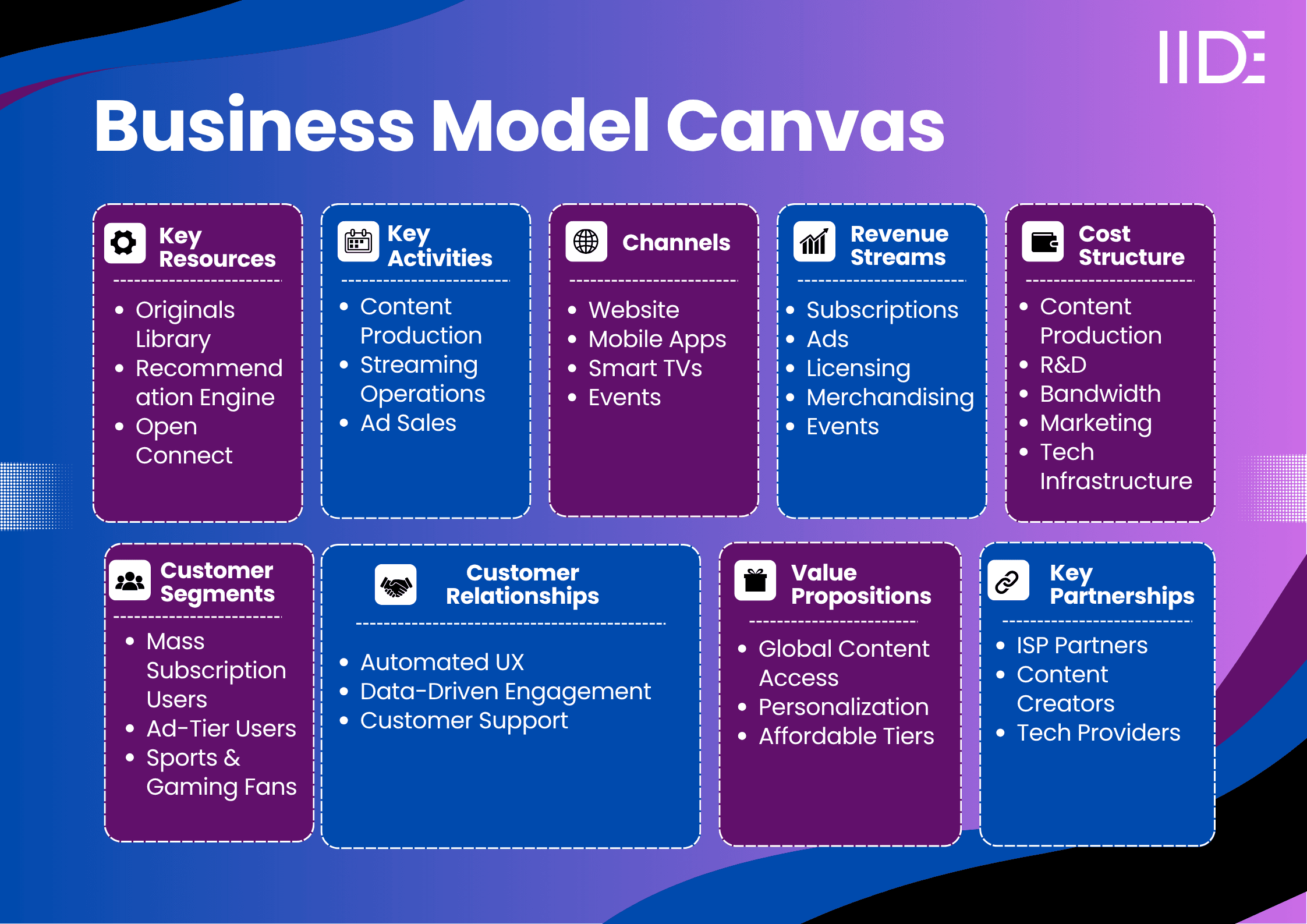
Netflix Business Model Canvas
Netflix Value Proposition
Netflix delivers unmatched global access to high-quality entertainment through its hybrid subscription and ad-supported model, enabling flexibility and affordability.
It addresses customer needs such as convenience (on-demand streaming across devices), affordability (lower-cost ad-supported tier), and premium content access (blockbuster originals and global releases).
Emotional benefits include pride in experiencing global hits and belonging to cultural phenomena, and confidence in reliable, curated recommendations powered by its personalization engine.
Functionally, it ensures speed (instant playback), efficiency (seamless content discovery), and durability (consistent quality streaming supported by Open Connect infrastructure).
Netflix’s competitive advantage lies in its scale: once content is created, it can be streamed repeatedly at minimal marginal cost, while its proprietary recommendation algorithms and global production capabilities are hard for competitors to replicate.
This combination creates long-term engagement and recurring revenue, positioning Netflix as both a content leader and technology innovator.
Netflix Revenue Model
Netflix’s primary revenue comes from streaming subscriptions, accounting for nearly all of its $39 billion 2024 revenue.
Within subscriptions, the ad-free tier contributes stable recurring fees, while the growing ad-supported plan began generating meaningful ad revenue in 2025 estimated at over $2 billion US alone and rapidly expanding.
Additional income comes from licensing, merchandising (via Netflix.shop), and live-event initiatives.
The model balances value-based pricing with high-margin subscription income supported by scalable global digital delivery.
Netflix expects $43.5 – 44.5 billion in total revenue for 2025, driven by price hikes, ad growth, and member expansion.
Netflix Cost Structure
Major expenses for Netflix include content production and licensing, technology infrastructure (Open Connect, data centers), marketing, R&D, and employee compensation.
Cost-saving strategies include automated content delivery via Open Connect, bulk production of in-house originals, and in-house ad tech to reduce third-party dependencies.
By integrating production, delivery, and personalization at scale, Netflix maintains healthy operating margins (~27% in 2024), while ensuring efficient customer acquisition and content utilization.
Netflix Customer Segment
Netflix operates a B2C, mass-market model, serving over 300 million customers globally, aged primarily 18–50, across urban and suburban areas.
Core users are tech-savvy, internationally minded, seeking entertainment variety on-demand.
The ad-supported tier appeals to budget-conscious segments; the premium tier attracts high-income users craving ad-free, top-tier content.
Niche segments include sports fans and gamers via live content and mobile games.
Customers are motivated by content breadth, convenience, and value-driven pricing.
Distribution Channels of Netflix
Netflix is fundamentally digital-first, streaming content via its own website, mobile apps, and smart TV platforms.
It does not operate physical stores for subscriptions, though its merchandise store sells Netflix-themed products.
The service operates omnichannel digital outreach through email, push notifications, and social engagement.
It also hosts global fan events like Tudum and in-person “Netflix House” locations launching in 2025. Innovations include interactive games, personalized recommendations, and direct delivery via Open Connect network.
Netflix Key Partnerships
Netflix partners with global content creators and studios for original and licensed productions; collaborates with ISPs through its Open Connect CDN; works with ad-tech partners and in-house ad teams to serve advertisers; licenses IP for merchandising; partners with sports leagues (e.g., NFL) and local networks for live events; and engages in sustainability and diversity initiatives globally.
These partnerships support Netflix’s content scale, distribution efficiency, monetization capabilities, and global reach.
SWOT Analysis of Netflix
| Strengths | Weaknesses | Opportunities | Threats |
|---|---|---|---|
| Scale | Price sensitivity | Live sports growth | Competition intensity |
| Brand equity | Margins pressure | Ad monetization | Economic downturns |
| Tech platform | Subscriber plateau | Gaming/IP expansion | Regulatory risk |
Netflix Competitor Comparison
| Brand | Pricing | Customer Experience | Channel Strategy | Market Focus | Innovation |
|---|---|---|---|---|---|
| Netflix | Value-based | Personalized | Digital-first | Global mass-market | Ad-tier, live sports |
| Disney+ | Premium | Brand franchises | Bundled platforms | Family & franchise fans | IP leverage |
| Prime Video | Subscription‑incl. | Shopping integration | Omni digital & retail | Broad entertainment plus ecommerce | Bundled services |
What’s New With Netflix?
In 2025 Netflix launched ad‑supported subscription, live sports streaming (e.g. NFL, boxing events), interactive Tudum fan events, and expanded into mobile gaming and merchandise (Netflix.shop).
Its in-house ad tech, use of generative AI for ads, and global content personalization continue to evolve.
Sustainability and diversity efforts tie into content production across 50+ countries.
Automation via Open Connect and data-driven personalization remain central.
Key Takeaways for Students / Marketers & Conclusion
Key Takeaways:
- Scalability: Recurring revenue from subscriptions and ads leverages low marginal delivery cost.
- Diversification: Expanding into ads, live sports, and IP monetization offsets subscription slowdowns.
- Data-driven personalization: Keeps engagement high and churn low through recommendation engines.
- Global-first content strategy: Produces local originals at scale to drive international growth.
- Strategic pricing flexibility: Dual-tier pricing balances revenue capture with affordability.
Conclusion:
Netflix’s model now combines subscription stability with emerging ad and live‑event revenue, positioning it as a diversified entertainment giant. Its global scale, content investment, and technology backbone reinforce its leadership. As Netflix becomes more than a streaming service, will it truly rival legacy media conglomerates like Disney in the entertainment ecosystem?
Want to Know Why 2,50,000+ Students Trust Us?
Dive into the numbers that make us the #1 choice for career success



MBA - Level
Post Graduate in Digital Marketing & Business Strategy

Best For
Fresh Graduates

Mode of Learning
On Campus (Mumbai & Delhi)

Starts from
Oct 1, 2026

Duration
11 Months

Live & Online
Advanced Online Digital Marketing Course
Best For
Working Professionals
Mode of Learning
Online
Starts from
Sep 4, 2026
Duration
4-6 Months

Online
Professional Certification in AI Strategy
Best For
AI Enthusiasts
Mode of Learning
Online
Starts from
Sep 8, 2026
Duration
5 Months

Online or Offline
Top AI Courses to Make You Future Ready!
Best For
AI Enthusiasts
Mode of Learning
2–5 Month Program
Starts from
Sep 8, 2026
Duration
Flexiable

On Campus
Advanced Certification in Artificial Intelligence
Best For
AI Enthusiasts
Mode of Learning
On Campus (Mumbai)
Starts from
Sep 1, 2026
Duration
3 Months

Offline
Undergraduate Program in Digital Business & Entrepreneurship
Best For
12th Passouts
Mode of Learning
On Campus (Mumbai)
Starts from
Aug 19, 2026
Duration
3 Years

Offline
Degree In 2026 ≠ Enough Degree + Digital Skills = Future-Ready
Best For
12th Passouts
Mode of Learning
At IIDE Campus
Starts from
Aug 19, 2026
Duration
3 Years
Recent Post
The Netflix business model is all about subscription-based streaming service offering on-demand access to movies, TV shows, and original content.
Netflix makes money primarily through subscription fees, with multiple tiers catering to different user preferences.
Netflix’s main products include movies, TV series, documentaries, and exclusive Netflix Originals.
Netflix’s top competitors include Amazon Prime Video, Disney+, Hulu, HBO Max, and Apple TV+.
Netflix uses AI, machine learning, and data analytics for personalised recommendations, content creation, and streaming optimisation.
Netflix Originals are exclusive content produced or commissioned by Netflix, including series, movies, and documentaries.
Netflix targets a broad audience through diverse content offerings, personalised recommendations, and multilingual programming.
Netflix holds approximately 23% of the global streaming market share.
Netflix’s CSR initiatives include sustainability efforts, promoting diversity and inclusion, and supporting community programmes.
Netflix uses a subscription-based e-business model, providing on-demand streaming services to its subscribers.

Lead Trainer & Business Development Head at IIDE
Aditya Shastri leads the Business Development segment at IIDE and is a seasoned Content Marketing expert. With over a decade of experience, Aditya has trained more than 20,000 students and professionals in digital marketing, collaborating with prestigious institutions and corporations such as Jet Airways, Godrej Professionals, Pfizer, Mahindra Group, Publicis Worldwide, and many others. His ability to simplify complex marketing concepts, combined with his engaging teaching style, has earned him widespread admiration from students and professionals alike.
Aditya has spearheaded IIDE’s B2B growth, forging partnerships with over 40 higher education institutions across India to upskill students in digital marketing and business skills. As a visiting faculty member at top institutions like IIT Bhilai, Mithibai College, Amity University, and SRCC, he continues to influence the next generation of marketers.
Apart from his marketing expertise, Aditya is also a spiritual speaker, often traveling internationally to share insights on spirituality. His unique blend of digital marketing proficiency and spiritual wisdom makes him a highly respected figure in both fields.