
Students Centric
Placements Report
Trackable results, real numbers
Reviews
Proven success, real voices
Trainers
Expert-led, Industry-Driven Training
Life at IIDE
Vibrant Spirit student life
Alumni
Successful Journeys, Inspiring Stories
Learning Centre
Webinars
Blogs
Case studies
Live, Interactive Masterclasses
Fresh Insights, quick reads
Real-life, Industry relevant
More
Hire from us
Hire Top Digital Marketing Talent
Work with us
Join Our Team, Make an Impact
Customised Training
Personalised digital marketing training for your company
Refer & earn
Simple, easy rewards
Contact us
Get the answers you need
About us
Know more about IIDE
Explore all course options

FOR FRESH GRADUATES
Post Graduation Program in Digital Marketing & Business Strategy- Ideal for Age: 20–25 Years

Can’t decide? Explore all our
Digital Marketing Courses
COMPARE BOTH OUR PROGRAMSOffline
Offline AI Courses with Dual CertificationsIndustry-Aligned TRACKMost Popular
UG Program in Digital Business & Entrepreneurship- Ideal for 12th Pass out / FY Degree Student

PARTNER PROGRAMS






Can’t decide? Explore all
BBA In Digital Marketing Colleges
Orginally Written by Aditya Shastri
Updated on Feb 12, 2026
Share on:


Sainsbury is a leading UK supermarket and multi-format retailer, serving millions every week. In 2026, Sainsbury leverages quality, innovation, and digital growth to fight fierce competition and inflation pressures.
Can Sainsbury defend its market position as consumer habits shift and discounters rise?
This sainsburys swot analysis equips entrepreneurs and students with critical lessons from one of the UK's most resilient, evolving brands.
Before diving into the article, I would like to inform you that the research and initial analysis for this piece were conducted by Pradip Biswal. He is a current student in IIDE's Advanced Certification in Digital Marketing, May Batch 2025.
If you found this helpful, feel free to reach out to Pradip Biswal to send a quick note of appreciation for his fantastic research, he will appreciate the kudos!
About Sainsbury’s
Founded in 1869, Sainsbury's is now Britain's second-largest supermarket chain, known for a wide range of food, general merchandise, and financial services. Its mission, "Helping Everyone Eat Better", drives its focus on value, quality, and sustainability. In 2026, Sainsbury grows through innovation in convenience, online shopping, and food leadership. SWOT stands for strengths, weaknesses, opportunities, and threats essential for tracking its strategic future.

Overview Table
| Attribute | Data (2025) |
|---|---|
| Official Company Name | J Sainsbury plc |
| Founded Year | 1869 |
| Website URL | www.sainsburys.co.uk |
| Industries Served | Grocery, General Merchandise, Clothing, Finance |
| Geographic Areas | UK, Ireland (largest market: UK) |
| Revenue | ~£31.5 billion (estimated FY2025) |
| Net Income | ~£531 million (2025 interim results) |
| Employees | ~189,000 (2025) |
| Main Competitors | Tesco, Asda, Morrisons, Aldi, Lidl |

Is Digital Marketing the Right Career for You?
Find out in a free 45-min masterclass · Career paths, roles and growth explained · By Karan Shah, Founder & CEO, IIDE

Is Digital Marketing the Right Career for You?
Find out in a free 45-min masterclass · Career paths, roles and growth explained · By Karan Shah, Founder & CEO, IIDE
What Does SWOT Stand For in Sainsbury’s Case?
SWOT stands for Strengths, Weaknesses, Opportunities, and Threats. In this article, we will dive deep into each of these aspects to uncover how Sainsbury's navigates the competitive beverage industry and positions itself for continued growth in 2026.
Why SWOT Analysis of Sainsbury’s Matter in 2026?
In 2026, Sainsbury's is in a strong position, having successfully gained market share for the third year in a row. The company's strategy, "Next Level Sainsbury's," is centered on improving value, quality, and service to remain competitive in the UK's dynamic grocery market. This sainsbury's swot analysis provides valuable insights into how the brand maintains its competitive edge.
Competitive Landscape
Sainsbury's is a fierce competitor against major rivals like Tesco, Asda, and discount chains like Aldi and Lidl. The company has been effective in attracting and retaining customers with its Aldi Price Match program, which now includes around 800 everyday products. This focus on value has helped Sainsbury's achieve its highest market share in nearly a decade.
If you're interested in understanding how other top Retail brands perform, check out our detailed Asda SWOT Analysis of 2025 to compare strategies, strengths, and opportunities in the Supermarket industry.
Sainsbury's is a fierce competitor against major rivals like Tesco, Asda, and discount chains like Aldi and Lidl. The company has been effective in attracting and retaining customers with its Aldi Price Match program, which now includes around 800 everyday products. This focus on value has helped Sainsbury's achieve its highest market share in nearly a decade.
Just as businesses study swot honda frameworks to understand competitive advantages in manufacturing, retail analysts examine Sainsbury's strategic positioning.
Shifts in Customer Preferences
Customers are looking for a blend of quality, value, and convenience. Sainsbury's is responding by expanding its popular Taste the Difference range, which saw sales grow by 20% in the first quarter of 2025. The company is also enhancing its in-store offerings by reallocating space from general merchandise to fresh food. Its online and convenience sales have also seen strong growth, with both up by 6%.
Technology and Innovation
Sainsbury's is leveraging technology to improve efficiency and enhance the customer experience. A key focus is on using data and analytics to personalize the Nectar loyalty program, offering customers more tailored promotions. They are also investing in technology and automation to streamline operations and improve productivity, as part of a £1 billion cost-saving plan.
Economic Impact
Sainsbury's is navigating a tough economic climate characterized by inflation and rising costs. To combat this, the company has invested over £1 billion in lowering prices over the last four years. Despite these challenges, it has reported strong financial performance, with an underlying operating profit of over £1 billion, reflecting a focus on efficient operations and cost management.
Regulations and Sustainability
Sainsbury's has integrated sustainability into its core business strategy through its "Plan for Better" initiative. The company is committed to reducing its environmental impact, which is shown by a 52.8% reduction in greenhouse gas emissions from its own operations. It is also actively reducing plastic waste, having cut its own-brand plastic packaging by 21% from its baseline.
Furthermore, Sainsbury's has enhanced its human rights due diligence in its supply chain, earning top marks in the CCLA's Modern Slavery Benchmark.
SWOT Analysis Of Sainsbury’s 2026
Sainsbury’s, a cornerstone of the UK grocery sector, has been adapting to evolving market dynamics. Let's delve into its strengths, weaknesses, opportunities, and threats as of 2025.
Strengths
1. Established Brand Reputation
Sainsbury’s is a household name in the UK, known for its commitment to quality and customer service. The company's long-standing presence has fostered strong brand loyalty among consumers.
2. Diverse Product Portfolio
Beyond groceries, Sainsbury’s offers a variety of products and services, including clothing through its TU brand and financial services.
This diversification helps mitigate risks associated with market fluctuations in any single segment.
3. Robust Online Presence
The company has made significant investments in its online shopping platform, catering to the growing demand for convenient shopping options. Sainsbury’s online grocery services have seen increased usage, especially during the COVID-19 pandemic.
4. Loyal Customer Base
Sainsbury’s Nectar loyalty program rewards customers for their purchases, encouraging repeat business and providing valuable consumer data to tailor marketing strategies.
5. Sustainability Initiatives
The company has committed to reducing its carbon footprint and has implemented various sustainability initiatives, such as reducing plastic packaging and sourcing products responsibly.
Weaknesses
1. Price Perception
Sainsbury's is often perceived as more expensive compared to discount retailers like Aldi and Lidl. This perception can deter price-sensitive customers, as revealed in this swot analysis of sainsbury.
2. Limited International Presence
Unlike some of its competitors, Sainsbury’s primarily operates within the UK, limiting its exposure to international markets and growth opportunities.
3. Operational Costs
High operating expenses, including labor costs and supply chain logistics, can impact profitability. The company has undertaken measures to streamline operations, such as closing hot food counters and cafes to reduce costs.
4. Integration Challenges
The acquisition of Argos presented integration challenges, including aligning corporate cultures and operational systems. While efforts have been made to address these issues, they continue to pose challenges .
Opportunities
1. Expansion into Emerging Markets
Exploring international markets, particularly in Asia and Africa, presents opportunities for growth. Adapting products to local tastes and preferences can help Sainsbury’s establish a presence in these regions.
2. Health-Conscious Product Lines
With increasing consumer demand for healthier options, Sainsbury’s can expand its range of organic and low-sugar products to cater to health-conscious shoppers. This swot analysis for sainsburys highlights the potential in this growing segment.
3. Technological Advancements
Investing in technology, such as automation and artificial intelligence, can enhance operational efficiency and improve customer experience. The company has been testing facial recognition technology to combat shoplifting, though this has raised privacy concerns.
4. Strategic Partnerships
Collaborations with other retailers or technology companies can provide new avenues for growth. For instance, partnerships with delivery platforms can expand Sainsbury’s reach to a broader customer base.
Threats
1. Intense Competition
The UK supermarket sector is highly competitive, with players like Tesco, Asda, and discount chains such as Aldi and Lidl vying for market share. Asda's recent price cuts have intensified the competition, affecting Sainsbury’s market position. This swot analysis of sainsbury's underscores the competitive pressure facing the retailer.
Economic downturns and fluctuations in consumer spending can impact sales. Factors such as inflation and changes in disposable income influence consumer behavior and purchasing decisions.
2. Regulatory Challenges
Compliance with evolving regulations, particularly in areas like sustainability and labor laws, requires continuous adaptation. Failure to comply can result in legal issues and reputational damage.
3. Supply Chain Disruptions
Global events, such as the COVID-19 pandemic, have highlighted vulnerabilities in supply chains. Disruptions can lead to product shortages and increased costs, affecting profitability.
Discover how Sainsbury’s adapts to changing trends, similar to the insights in a SWOT Analysis of Tesco.
Buyers Persona:

Sarah
UK
Occupation: Teacher
Age: 35 years
Motivation
Interest & Hobbies
Pain Points
Social Media Presence
Summary Analysis of Sainsbury
IIDE Student Takeaway, Conclusion & Recommendations
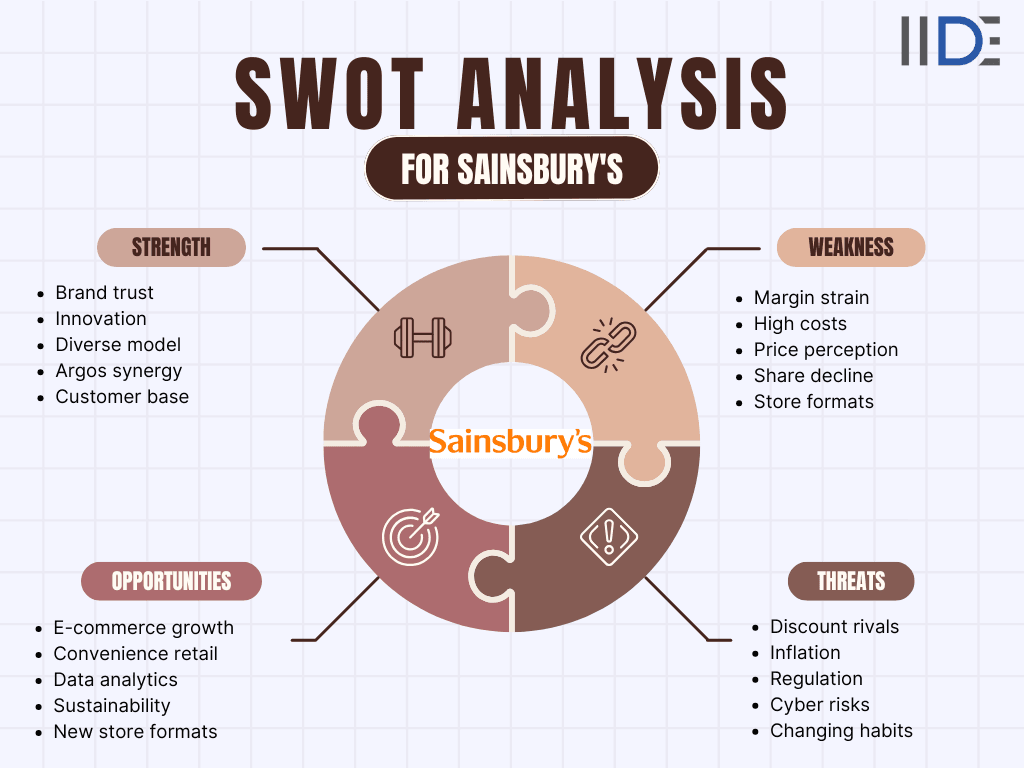
Sainsburys SWOT analysis 2026 reveals a resilient retailer with trusted brand equity, innovative products, and a solid digital presence. Its strengths in diversified business lines and strategic supplier partnerships create a stable foundation, but mounting pressure from discounters and inflation means Sainsbury must sharpen its value and efficiency. The brand faces a strategic dilemma: maintaining quality and service while driving affordability and digital transformation.
Actionable recommendations:
- Accelerate omnichannel strategy, investing in seamless online, convenience, and in-store experiences.
- Enhance data-driven personalization through Nectar360, tailoring offers and communications.
- Streamline cost structures via automation and smart supply chain tech to boost margins.
- Broaden value-oriented product ranges to attract price-conscious shoppers.
- Deepen sustainability efforts as UK consumers demand ethical food sourcing and packaging.
Looking ahead, Sainsbury must balance innovation with financial discipline, staying agile to seize opportunities in the evolving grocery sector while overcoming the threats posed by discounters and shifting consumer habits.
Want to Know Why 5,00,000+ Students Trust Us?
Dive into the numbers that make us the #1 choice for career success



MBA - Level
Post Graduate in Digital Marketing & Business Strategy

Best For
Fresh Graduates

Mode of Learning
On Campus (Mumbai & Delhi)

Starts from
Nov 27, 2026

Duration
11 Months

Live & Online
Advanced Online Digital Marketing Course
Best For
Working Professionals
Mode of Learning
Online
Starts from
Nov 2, 2026
Duration
4-6 Months

Offline
Top AI Courses to Make You Future Ready!
Best For
AI Enthusiasts
Mode of Learning
2–5 Month Program
Starts from
-
Duration
Flexiable

Offline
Undergraduate Program in Digital Business & Entrepreneurship
Best For
12th Passouts
Mode of Learning
On Campus (Mumbai)
Duration
3 Years
Offline
Degree In 2026 ≠ Enough Degree + Digital Skills = Future-Ready
Best For
12th Passouts
Mode of Learning
At IIDE Campus
Duration
3 Years
Recent Post

Lead Trainer & Business Development Head at IIDE
Aditya Shastri leads the Business Development segment at IIDE and is a seasoned Content Marketing expert. With over a decade of experience, Aditya has trained more than 20,000 students and professionals in digital marketing, collaborating with prestigious institutions and corporations such as Jet Airways, Godrej Professionals, Pfizer, Mahindra Group, Publicis Worldwide, and many others. His ability to simplify complex marketing concepts, combined with his engaging teaching style, has earned him widespread admiration from students and professionals alike.
Aditya has spearheaded IIDE’s B2B growth, forging partnerships with over 40 higher education institutions across India to upskill students in digital marketing and business skills. As a visiting faculty member at top institutions like IIT Bhilai, Mithibai College, Amity University, and SRCC, he continues to influence the next generation of marketers.
Apart from his marketing expertise, Aditya is also a spiritual speaker, often traveling internationally to share insights on spirituality. His unique blend of digital marketing proficiency and spiritual wisdom makes him a highly respected figure in both fields.