
Students Centric
Placements Report
Trackable results, real numbers
Reviews
Proven success, real voices
Trainers
Expert-led, Industry-Driven Training
Life at IIDE
Vibrant Spirit student life
Alumni
Successful Journeys, Inspiring Stories
Learning Centre
Webinars
Blogs
Case studies
Live, Interactive Masterclasses
Fresh Insights, quick reads
Real-life, Industry relevant
More
Hire from us
Hire Top Digital Marketing Talent
Work with us
Join Our Team, Make an Impact
Customised Training
Personalised digital marketing training for your company
Refer & earn
Simple, easy rewards
Contact us
Get the answers you need
About us
Know more about IIDE
Explore all course options

FOR FRESH GRADUATES
Post Graduation Program in Digital Marketing & Business Strategy- Ideal for Age: 20–25 Years

Can’t decide? Explore all our
Digital Marketing Courses
COMPARE BOTH OUR PROGRAMSOffline
Offline AI Courses with Dual CertificationsIndustry-Aligned TRACKMost Popular
UG Program in Digital Business & Entrepreneurship- Ideal for 12th Pass out / FY Degree Student

PARTNER PROGRAMS





Can’t decide? Explore all
BBA In Digital Marketing Colleges
Orginally Written by Aditya Shastri
Updated on May 13, 2026
Share on:


redBus is one of India's most recognised travel-tech brands. For millions of users, online bus booking still begins and ends with redBus. What started as a straightforward solution to a deeply frustrating offline ticketing experience has grown into a category leader serving over 223 million travellers every year in India alone, and 466 million tickets sold globally.
But the market is shifting fast. Consumers now expect faster apps, smarter pricing, real-time support, loyalty rewards, and seamless end-to-end travel experiences not just a seat on a bus.
So the real question for 2026 is this: Can redBus continue leading the category it created, or is the competition finally closing the gap?
Before diving into the article, I would like to acknowledge that the research and initial analysis for this piece were conducted by Dinesh Kumar, a current student of IIDE’s PG Program in Digital Marketing and Business Strategy, August Batch 2025. His effort and in-depth research played an important role in shaping this analysis.
If you found this helpful, feel free to reach out to Dinesh Kumar to send a quick note of appreciation for his fantastic research, he will appreciate the kudos!
About redBus
redBus has one of the most relatable startup origin stories in India. Its roots go back to a frustrating Diwali season in 2005, when the three founders were unable to find bus tickets to travel home during peak holiday demand.
Instead of accepting the problem, they saw an opportunity to solve a pain point faced by millions of travellers across India.
The founders, Phanindra Sama, Charan Padmaraju, and Sudhakar Pasupunuri, were alumni of BITS Pilani and were working at companies like Texas Instruments and other Bengaluru-based tech firms.
They officially started operations in August 2006 with just one bus operator, five available seats, and an initial investment of ₹5 lakh pooled from their personal savings.
Interestingly, the name "redBus" was inspired by Richard Branson and the bold identity of the Virgin Group, which prominently uses the colour red. The founders wanted a memorable and impactful brand identity.
In the early days, the team first tried selling software to bus operators, but that model did not work. They later joined the TiE Bangalore acceleration program, where mentors advised them to build a complete customer-facing business instead of only selling backend software. That shift changed everything.
Today, redBus is the world's largest online bus ticketing platform by volume, serving over 56 million users globally across 8 international markets including India, Singapore, Malaysia, Indonesia, Peru, Colombia, Cambodia, and Vietnam.
Why This SWOT Matters in 2026
India's travel industry is evolving quickly. Earlier, convenience alone was enough.
Today users also expect:
- Real-time updates
- Better offers
- Easy cancellations
- Faster customer support
- Loyalty rewards
- Multi-service travel apps
At the same time:
- Competition is rising from AbhiBus, Zingbus, and Rapido (which added bus bookings in October 2025)
- Switching apps is easy
- Discounts impact margins
- Regulations can affect operators
- Consumers compare everything instantly
That makes 2026 an important year for category leaders like redBus.

Is Digital Marketing the Right Career for You?
Find out in a free 45-min masterclass · Career paths, roles and growth explained · By Karan Shah, Founder & CEO, IIDE

Is Digital Marketing the Right Career for You?
Find out in a free 45-min masterclass · Career paths, roles and growth explained · By Karan Shah, Founder & CEO, IIDE
SWOT Analysis of redBus
1. Strengths
If you had to describe redBus in one line, it would be this: it made bus travel digital for India. Being an early mover gave the company trust, scale, and brand familiarity that many competitors still chase.
For many travellers, redBus is not just a platform, it is the default option.
Key Strengths:
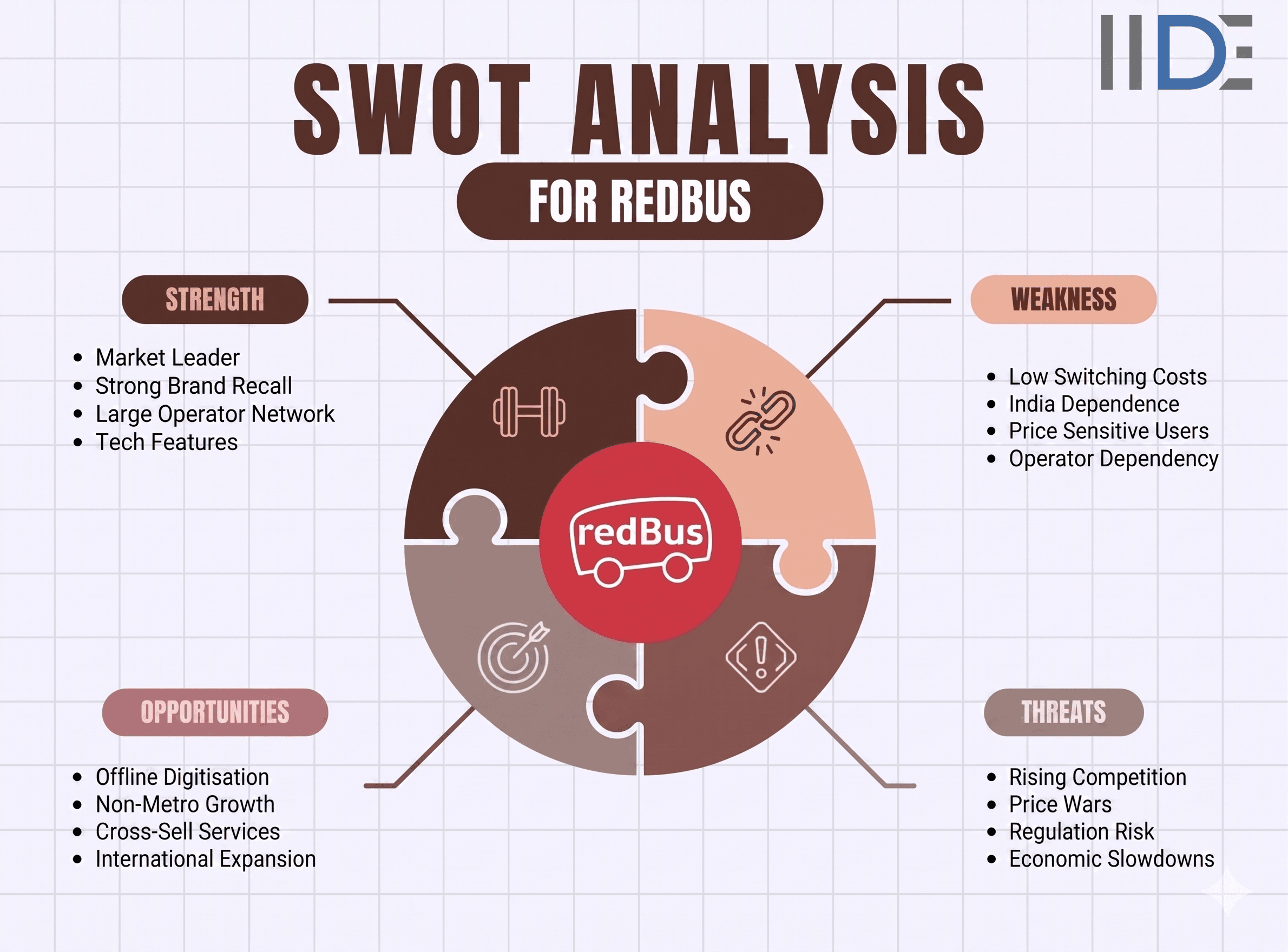
- Strong market leadership: redBus holds approximately 70% of India's online bus-ticketing market share, facilitating 223 million journeys in FY2025 alone.
- First-mover advantage: Early entry in 2006 helped build trust before serious competitors emerged.
- Massive operator network: redBus works with 4,500+ private bus operators and 26 State RTCs, covering 6.7 lakh unique routes across India.
- Strong brand recognition: Over 56 million users worldwide trust the platform, which holds a 4.6 rating on app stores.
- Tech-enabled experience: The AI-powered revMax tool adjusts bus prices 15,000 times a day. Features like live tracking, multilingual support, and WhatsApp booking updates make the experience smoother for travellers.
- Multiple revenue streams: redBus earns through commissions of 10 to 20% per ticket, SaaS products like BOSS and SeatSeller, advertising, and convenience fees. In FY25, the company posted revenue of ₹1,010 crore, which is 32% higher than the previous year.
- Backed by MakeMyTrip: redBus is part of the MakeMyTrip Group, which is listed on Nasdaq under the ticker MMYT. This gives redBus access to a larger travel ecosystem and cross-sell opportunities across flights, hotels, and holidays.
2. Weaknesses
Now this is where the challenge begins. Leading a category is one thing. Defending it every day is another.
Since users can compare apps instantly, loyalty in travel-tech is difficult to maintain.
Key Weaknesses:
- India revenue dependency: Despite presence in 8 markets, the bulk of revenue still comes from India, leaving the business exposed to domestic economic shifts.
- Low switching costs: Users can move to another platform within seconds.
- Price-sensitive customer base: Discounts often influence buying decisions heavily.
- Operator dependency: Service quality depends partly on thousands of third-party bus operators running average fleets of just 10–12 buses.
- Limited category perception: Many users still view redBus only as a bus-booking app, limiting cross-sell potential for hotels, rail, and insurance.
- Reputation risk: Delays, cancellations, or operator issues can affect trust at scale.
- Competitive offer pressure: Constant discount cycles may reduce profitability over time.
3. Opportunities
Now here's the exciting part redBus still has room to grow. India's travel market is digitising deeper, especially in tier-2 and tier-3 cities where bus travel remains highly relevant.
That gives redBus a natural growth runway.
Key Opportunities:
- Offline-to-online shift: A large share of bus bookings still happens offline; over 72,000 new intercity routes were launched in 2025, widening the digitisation opportunity.
- Non-metro growth: Smaller cities are contributing rising travel demand; redBus already connects nearly 10,000 towns across India.
- Pilgrimage travel boom: Religious and seasonal routes are growing strongly, with November 1, 2025 (day after Diwali) recording a single-day high of 9.7 lakh passengers on the move.
- B2B expansion via NOVA: Launched in January 2026, NOVA is India's first integrated B2B marketplace connecting 6,000+ bus operators with verified vendors, offering 20–40% discounts on safety and operational products.
- AI personalization: revMax and AI-driven recommendations can improve repeat bookings and operator yield simultaneously.
- International expansion: redBus CEO Prakash Sangam has stated that international revenue could grow to 35%+ of total; Vietnam and Cambodia were added as recently as 2023–24.
- EV expansion: The platform already supports 760 active electric bus schedules, signaling strong progress in sustainable mobility. With newer EV buses offering an improved range of 350–370 km, long-distance green travel is becoming increasingly practical and commercially viable..
4. Threats
Of course, not everything is in redBus's control. Travel is a highly competitive and price-driven category.
Even strong brands can lose share quickly if customer experience slips.
Key Threats:
- Rising competition from AbhiBus: Rivals are growing aggressively; AbhiBus is redBus's top competitor by monthly visits and is known for more competitive base fares.
- New entrants disrupting the model: Rapido expanded into bus, flight, and train bookings in October 2025; Zingbus (funded, own-fleet model) is redefining safety and quality standards on popular corridors.
- OTA competition: Larger travel apps can attract bus users through bundles, even though redBus is part of the same group.
- Outstation cab alternatives: Taxi platforms compete on convenience for point-to-point routes where bus travel is less attractive.
- Regulatory uncertainty: Permit and compliance changes can impact operators, especially the 4,500+ small MSME operators on the platform.
- Economic slowdowns: Lower discretionary spending can reduce travel demand.
- Price wars: Heavy discounting can pressure revenue and margins across the platform.
SWOT Summary Chart
Key Insight, Final Thoughts and Conclusion
2026 Insight
redBus has already won the awareness battle. Most travellers know the brand when they think of bus bookings.
Today users expect more than just tickets. They want last-minute deals, live updates, rewards, hotel add-ons, smoother support, and personalised recommendations throughout the journey.
With revMax adjusting prices 15,000 times a day and NOVA connecting 6,000+ operators in a B2B marketplace, redBus is actively building the infrastructure for this but the platform story is not yet visible to end consumers.
If redBus continues marketing itself only as a place to book buses, growth may slow as competition rises from Rapido, Zingbus, and AbhiBus.
But if the Marketing Strategy of redBus positions it as the smartest and most convenient way to travel backed by ₹1,010 crore in annual revenue, 466 million tickets sold globally, and 8 active international markets it can unlock stronger loyalty and higher lifetime value.
To understand how the platform is evolving in today’s market, read the Marketing Strategy of redBus for deeper insights into its positioning, customer journey, and growth approach.
That is the difference between getting downloads and building dependence.
Final Thoughts
redBus remains one of India's strongest travel-tech brands by category leadership and consumer familiarity.
Its biggest strength is trust.
Its biggest risk is becoming just another comparison app especially as Zingbus challenges it on service quality with an owned-fleet model, and Rapido bundles bus travel with rides.
If the company keeps innovating while expanding user value through AI, EV fleet growth, NOVA, and international markets growth can continue strongly.
If not, users may still know the brand but choose competitors more often.
And in digital businesses, usage matters more than awareness.
Final Question: Can redBus remain the default choice while travel habits evolve?
Want to Know Why 2,50,000+ Students Trust Us?
Dive into the numbers that make us the #1 choice for career success



MBA - Level
Post Graduate in Digital Marketing & Business Strategy

Best For
Fresh Graduates

Mode of Learning
On Campus (Mumbai & Delhi)

Starts from
Nov 27, 2026

Duration
11 Months

Live & Online
Advanced Online Digital Marketing Course
Best For
Working Professionals
Mode of Learning
Online
Starts from
Nov 2, 2026
Duration
4-6 Months

Offline
Top AI Courses to Make You Future Ready!
Best For
AI Enthusiasts
Mode of Learning
2–5 Month Program
Starts from
Nov 24, 2026
Duration
Flexiable

Offline
Undergraduate Program in Digital Business & Entrepreneurship
Best For
12th Passouts
Mode of Learning
On Campus (Mumbai)
Duration
3 Years
Offline
Degree In 2026 ≠ Enough Degree + Digital Skills = Future-Ready
Best For
12th Passouts
Mode of Learning
At IIDE Campus
Duration
3 Years
Recent Post
A SWOT analysis is basically an honest check-in on where a business truly stands. It looks at what redBus is getting right, where it is falling short, what opportunities it can grab, and what threats it needs to watch. For a category creator like redBus, it helps answer one simple question — are they still leading, or just living off their reputation?
The main engine is a 10–20% commission charged to bus operators for every ticket booked through the platform, making up roughly 70–80% of revenue. Operators also pay annual subscription fees for redBus's BOSS and SeatSeller tools that manage their inventory and seat operations. Advertising, featured listings, and the new B2B marketplace NOVA are adding fresh revenue streams on top of the core model.
redBus is steadily building toward being a full intercity travel ecosystem rather than a single-purpose booking app. NOVA handles B2B operator needs, the Acko partnership covers travel insurance, and AI personalisation is making every user's experience sharper over time. The ambition is clear own the entire journey, not just the ticket.
redBus made GPS tracking mandatory across its platform, and over 90% of listed buses now have it active enabling features like wake-up alarms 20 minutes before arrival and navigation to pick-up points. This focus on service quality has helped push the average customer rating on the platform from 3.45 a few years ago to nearly 4 today. It is a good example of redBus using technology to fix problems that happen long after the booking is made.
A SWOT analysis usually focuses on four core areas: Strengths, Weaknesses, Opportunities, and Threats. The fifth point is often the action plan, where businesses decide what to improve, protect, or grow based on the findings. It helps turn insights into practical business moves. SWOT is mainly used to understand where a company stands in the market.
For a travel company, strengths could be strong customer trust, good packages, or wide destination options. Weaknesses may include seasonal demand, dependency on partners, or high cancellation rates. Opportunities can come from growing domestic tourism, customized trips, or digital bookings. Threats include competition, economic slowdowns, visa issues, and global disruptions.
The four types of SWOT analysis are Strengths, Weaknesses, Opportunities, and Threats. Strengths and weaknesses are internal factors that the business can control. Opportunities and threats are external factors influenced by the market, competition, trends, or economy. Together, they help businesses make smarter decisions.
redBus works as an online ticket booking marketplace that connects travelers with bus operators. It earns revenue through commissions on every ticket sold, advertising partnerships, and premium listing fees from operators. The platform also benefits from convenience, route discovery, and digital payment integration. Its scale grows as more users and operators join the network.

Lead Trainer & Business Development Head at IIDE
Aditya Shastri leads the Business Development segment at IIDE and is a seasoned Content Marketing expert. With over a decade of experience, Aditya has trained more than 20,000 students and professionals in digital marketing, collaborating with prestigious institutions and corporations such as Jet Airways, Godrej Professionals, Pfizer, Mahindra Group, Publicis Worldwide, and many others. His ability to simplify complex marketing concepts, combined with his engaging teaching style, has earned him widespread admiration from students and professionals alike.
Aditya has spearheaded IIDE’s B2B growth, forging partnerships with over 40 higher education institutions across India to upskill students in digital marketing and business skills. As a visiting faculty member at top institutions like IIT Bhilai, Mithibai College, Amity University, and SRCC, he continues to influence the next generation of marketers.
Apart from his marketing expertise, Aditya is also a spiritual speaker, often traveling internationally to share insights on spirituality. His unique blend of digital marketing proficiency and spiritual wisdom makes him a highly respected figure in both fields.