Application Deadline for 3-Year UG Program closes on 31st Aug. Book a Counselling to know more

Students Centric
Placements Report
Trackable results, real numbers
Reviews
Proven success, real voices
Trainers
Expert-led, Industry-Driven Training
Life at IIDE
Vibrant Spirit student life
Alumni
Successful Journeys, Inspiring Stories
Learning Centre
Webinars
Blogs
Case studies
Live, Interactive Masterclasses
Fresh Insights, quick reads
Real-life, Industry relevant
More
Hire from us
Hire Top Digital Marketing Talent
Work with us
Join Our Team, Make an Impact
Customised Training
Personalised digital marketing training for your company
Refer & earn
Simple, easy rewards
Contact us
Get the answers you need
About us
Know more about IIDE
Explore all course options

FOR FRESH GRADUATES
Post Graduation Program in Digital Marketing & Business Strategy- Ideal for Age: 20–25 Years

Can’t decide? Explore all our
Digital Marketing Courses
COMPARE ALL 3 PROGRAMSOnline & Offline
Explore Top AI CoursesIndustry-Aligned TRACKMost Popular
UG Program in Digital Business & Entrepreneurship- Ideal for 12th Pass out / FY Degree Student

PARTNER PROGRAMS






Can’t decide? Explore all
BBA In Digital Marketing Colleges
Orginally Written by Aditya Shastri
Updated on Aug 9, 2025
Share on:


redBus’s business model is built on technology‑driven convenience and strong operator partnerships. This strategy allows them to offer seamless online ticketing across thousands of routes while maintaining high commission margins. redBus achieves this by leveraging its proprietary Bus‑Operators Software System and wide operator networks.
It uses economies of scale and automation to streamline operations. But what’s the secret behind its ~70% market dominance?
In this blog, we decode redBus’s revenue model and strategy, shedding light on how it has achieved industry leadership and consistent growth.
About RedBus

redBus was founded in 2006 by engineers Phanindra Sama, Charan Padmaraju, and Sudhakar Pasupunuri from BITS-Pilani in Bengaluru, to solve the problem of bus ticket availability during peak travel seasons. Its unique selling proposition (USP) was bringing offline bus ticketing online via a streamlined digital platform.
As of the financial year ending March 31, 2024, Redbus India Pvt Ltd reported a revenue of ₹763 crore (approximately USD 95 million). With over 70% of India's online bus-ticketing market share, it connects travelers to more than 2,500 bus operators across 80,000+ routes in India and Southeast Asia. The company employs around 800–1,000 people.
redBus’s ethos emphasizes customer convenience, transparency, and operator empowerment. Customers benefit from features such as real-time seat selection, the lowest fares, Safety+ hygiene protocols, and reliable support. For bus operators, proprietary tools like BOSS and SeatSeller enhance inventory management and bookings.
The secret to redBus’s success lies in its tech-enabled aggregator model that seamlessly connects demand and supply while scaling efficiently.
| Feature | Details |
|---|---|
| Founded | 2006 |
| Founder | Phanindra Sama, Charan Padmaraju, Sudhakar Pasupunuri |
| Headquarters | Bengaluru, India |
| Industry | Online Travel – Bus Ticketing |
| Revenue (2023) | ₹763 crore (~USD 95M as of March 2024) |
| Presence | India, Malaysia, Indonesia, Singapore, Peru, Colombia |
| Employees | ~800–1,000 employees |
| Popular for | Online bus ticket aggregator with widest operator network & routes |
Business Model of RedBus

RedBus started with just INR 500000 rupees which was the saving of their 3 co-founders. They had to face several challenges, in the beginning, like, payment gateway issues and propagate the ideal culture, working environment and value system.
To meet these challenges and overcome them, they designed this amazing business model that helped them to reach a 70% share in the Indian online bus ticketing segment.
-
Operations of redBus
Redbus is developing a software called BOSS “Bus Operators Software System” used by most travel agents and operators.
The way it works is that the bus operators who use this software use it to manage the seats of their buses in their fleet. They pay an annual premium for the software. All data is stored on AWS on a custom SQL database.
Travel agents have access to an online agent portal or to the software itself.
To provide great benefits and offers for their valuable customers, they are dedicated to providing great customer service. In this way, the company offers the most superior advantage to its customers and that too at a very reasonable.
Now, let’s move to the key services provided to the customers by redBus.
-
Key Services Provided by RedBus
RedBus is the leading bus ticket company that gives an incredible fraction of offerings to its clients, offerings which you can not deny however pick RedBus. And to this result, RedBus has millions of glad and loyal clients throughout the globe.
-
SAFETY+
With Safety+ they have brought in a set of measures like Sanitized buses, mandatory masks etc. to ensure that their customers travel safely.
-
SUPERIOR CUSTOMER SERVICE
They put their experience and relationships to good use and are available to solve their travel issues.
-
LOWEST PRICES
They always try to give their customers the lowest price with the best partner offers.
-
UNMATCHED BENEFITS
They take care of travel beyond ticketing by providing you with innovative and unique benefits.
redBus has a very classified target audience, to know about them better. Let’s move to the next aspect.
-
Target Audience of RedBus
RedBus in particular targets the literate middle-magnificence people throughout the country, who’re really dependable on net services and get to tour a lot.
However, in the beginning, RedBus’s important goal becomes to get as many bus operators as possible. But their concept was rejected by the bus operators due to the fact that they were well in their comfort zone of traditional methods. Then, the founders went for the customer’s pool to drive greater travellers’ site visitors towards their website. This become a tremendous achievement and the organization skilled a large boom graph.
It’s the uniqueness only which drives the venture to extreme success. This unique quality in the business model of redBus highlighted them amongst the top players.
-
The Uniqueness of redBus Business Model

The quality which separates RedBus from others is that it provides an opportunity to the customers to select their favourable route for their destination. Not only this, RedBus provides its customers with tons of different offers to its customers to get better customer engagements.
Their social media strategies are designed so well that it always finds great proposals for its audiences. Its approach to social media is quite different from others.
In the very next segment, we have the money-making process of redBus. Let’s quickly move to that.
-
Money-Making process of redBus

RedBus makes its money from the most effective way of work. It costs a few charges as the fee from the bus operators on every booked ticket on RedBus. The fee comes as 10-20% of the whole ticket value.
The founders commenced the organisation with a quantity of Rs. 500,000 from their savings. When the organisation was built, it did not make any income withinside the first 12 months however in 2009, it acquired a brilliant deal of fulfilment with a turnover really well worth INR 5 crore. Then in 2005, RedBus income grew by 6 times its last.
And now, RedBus has over 18 million users from 24 states, 30,000+ outlets along 80,000 routes, and 2500 bus operators. And known as the largest online bus ticket company.
redBus offers a variety of ticket booking offers. Let’s go through them one by one.
Redbus Ticket Booking Offers
RedBus definitely makes it more convenient and comfortable for its customers by providing multiple travel Bookings offers such as
- Thousands of routes across multiple travel options.
- Efficient customer service
- Low fare of tickets
- Pilgrimage tours
- Discounts, deals and festival offers, etc
- Mobile ticketing App
- Bus hirings
Their revenue model contains a very interesting fact about them. Let’s go through that to find it out.
RedBus Revenue Structure
As we know that their primary revenue model is very simple. redBus charges commission from the bus operator on every ticket booked through their platform. The commission is around 10-20% of the value of the ticket being sold.
But, what we don’t know is that they have another source of income too.
redBus also sells its ticket booking software to bus operators. This software is easy to comprehend and operators can book tickets, manage to book and optimise.
So, even if you buy tickets directly from the operators offline, they will most probably use the software provided by redBus.
Not their business model but also their implementation, has made them one of the biggest acquisitions in the Indian startup scene.

Is Digital Marketing the Right Career for You?
Find out in a free 45-min masterclass · Career paths, roles and growth explained · By Karan Shah, Founder & CEO, IIDE

Is Digital Marketing the Right Career for You?
Find out in a free 45-min masterclass · Career paths, roles and growth explained · By Karan Shah, Founder & CEO, IIDE
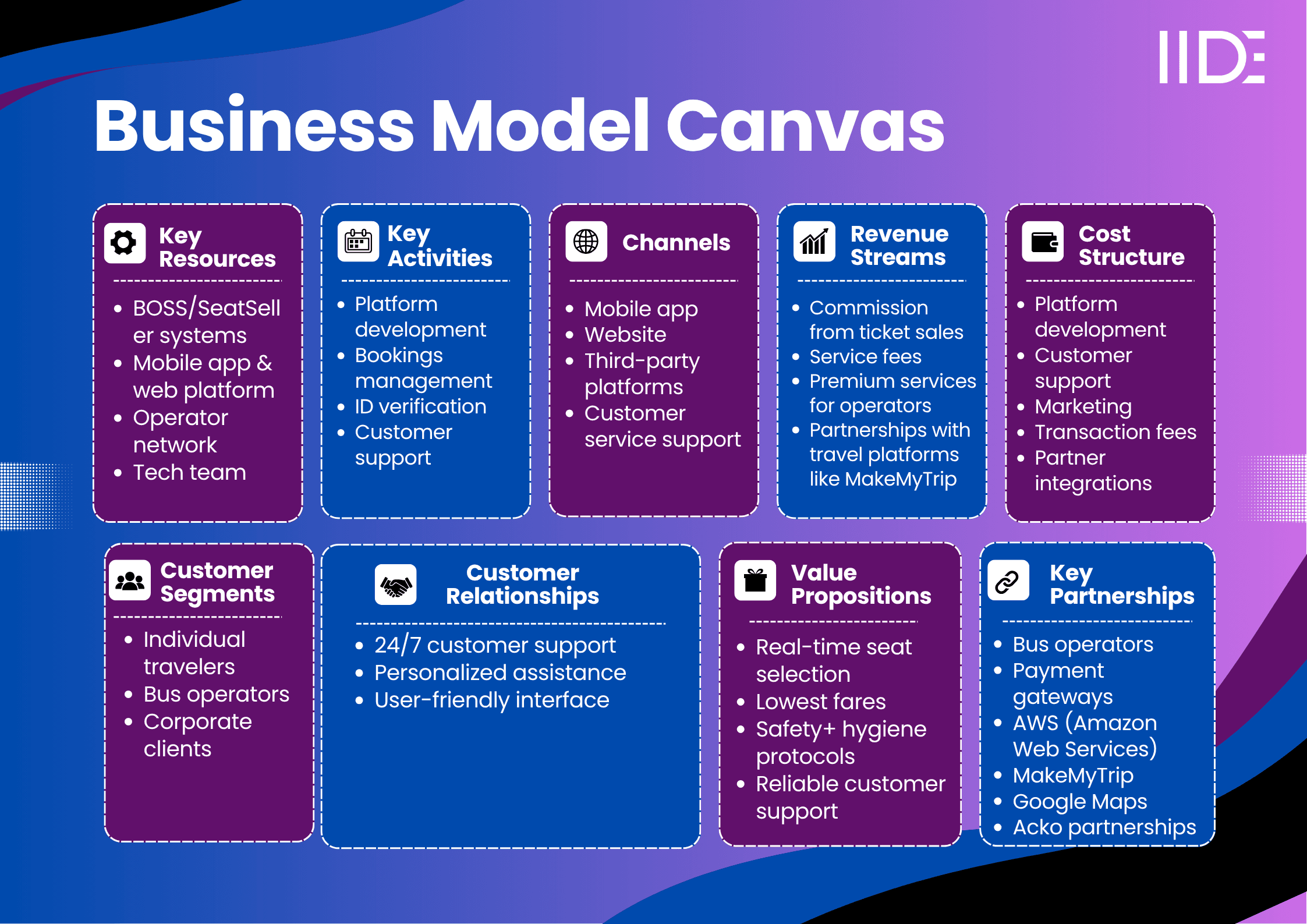
redBus Business Model Canvas
redBus Value Proposition
redBus offers a user-centric digital platform that simplifies bus ticket booking by connecting passengers with verified bus operators across thousands of routes in India and Southeast Asia. Unlike traditional offline ticketing systems, redBus enables real-time seat availability, seat selection, and transparent pricing, empowering customers with full control over their bookings. The platform effectively solves pain points like long queues, last-minute unavailability, and unreliable information, providing a seamless experience.
Emotionally, users benefit from the relief of travel anxiety, the confidence of booking with a secure, trusted platform, and the pride of using an industry-leading service. Functionally, the platform offers speed, reliability, and consistent pricing, reducing time wasted on uncertainty. For bus operators, redBus offers proprietary SaaS tools like BOSS and SeatSeller, which simplify inventory management and booking processes, increasing operational efficiency.
The competitive edge of redBus lies in its tech-enabled aggregator model, which integrates network effects and long-standing relationships with bus operators, making it a dominant player in the bus ticketing market across South Asia and Latin America.
redBus Revenue Model
redBus now generates approximately 70–80% of its revenue from commission fees (10–20% per ticket) charged to bus operators for each booking.
Another 20–30% comes from annual subscription fees for its proprietary BOSS/SeatSeller software used by operators.
A smaller share is earned via advertising and featured listings on its platform.
The most recent available financials show redBus India reported ₹763 crore (~USD 95 million) revenue for FY 2023–24; newer estimates for FY 2024–25 remain undisclosed as of August 2025.
redBus Cost Structure
redBus’s major expenses include platform development and maintenance, customer support, marketing, server and payment gateway fees, and staff salaries.
The company uses economies of scale, outsourcing, and automation (e.g., customer service, payment processing) to manage costs effectively.
Despite high logistics and support costs, redBus’s platform-based business model and the large-scale deployment of its SaaS tools enable it to maintain healthy profit margins while scaling operations.
redBus Customer Segment
redBus operates primarily in a B2C model, targeting digitally active, budget-conscious travelers aged 18–50 across urban and semi-urban regions in India and Southeast Asia.
These customers seek affordable, transparent, and reliable bus travel options.
Additionally, redBus caters to bus operators through a B2B model, offering SaaS tools like BOSS and SeatSeller.
Initially popular among tech-savvy urban users, the platform now appeals to a broader, more diverse audience due to its accessible and scalable solutions.
Distribution Channels of redBus
redBus follows a digital-first strategy, offering services through its website and mobile app.
The company also integrates with third-party platforms like Amazon India, Truecaller, and Google Maps, enhancing visibility and access.
Offline, ticketing agents in smaller towns extend the reach.
redBus operates an omnichannel model, combining online and offline channels to maximize accessibility.
Innovations include a multilingual interface, WhatsApp booking, and click-to-book features that further enhance user convenience.
redBus Key Partnerships
Key partners for redBus include bus operators (over 2,500), payment gateways like PayU, UPI, and wallets, and cloud providers such as AWS.
The company collaborates with MakeMyTrip to enhance travel ecosystem integration and Acko to provide travel insurance options.
Google Maps offers route information, and partnerships with Truecaller and Amazon India expand customer access.
These strategic alliances enable operational efficiency, broaden distribution, and improve customer trust.
SWOT Analysis of redBus
| Strengths | Weaknesses | Opportunities | Threats |
|---|---|---|---|
| Market Share | Operator loyalty | Geo‑expansion | Regulatory risk |
| Tech Platform | Commission sensitivity | New SaaS tools | Competition |
| SaaS Network | Price pressure | Travel‑adjacent services | Price wars |
redBus Competitor Comparison
| Competitor | Pricing | Customer Experience | Channel Strategy | Market Focus | Innovation |
|---|---|---|---|---|---|
| Goibibo | Similar commission | Integrated travel mall | Multimodal (flights, hotels, bus) | India-wide domestic | Travel packages |
| Busbud | Higher fees | International support | Third-party web & app | Global intercity bus | Multi-currency support |
| FlixBus | Low-cost dynamic | Intercity coach + comfort | Physical plus digital | EU & LATAM expansion | Real-time tracking |
What’s New With redBus?
In 2025, redBus rolled out dynamic pricing pilots (e.g. Ahmedabad), introduced enhanced AI‑driven personalization, and expanded travel insurance & safety features under Safety+. It has deepened its data analytics for route optimization and launched multilingual interfaces and regional language support. Sustainability efforts include promoting digital tickets to reduce paper waste.
The platform also leverages automation for customer queries, self‑service cancellations, and post‑booking updates via WhatsApp.
Key Takeaways for Students / Marketers & Conclusion
- Solve real pain points: redBus identified inefficiencies in offline ticketing and built a scalable solution.
- Platform leverage: its aggregator and SaaS model creates value for both operators and users.
- Scalable through partnerships: operator network, MakeMyTrip, and tech allies grew reach cost‑efficiently.
- Tech‑powered efficiency: automated systems and data insights kept margins healthy.
- Small businesses can replicate by building simple digital marketplaces and charging commission + subscription.
- Mindset: customer‑centric innovation, operator empowerment, and transparency drive adoption and loyalty.
Conclusion:
redBus’s business model thrives on a tech‑enabled platform that seamlessly connects supply and demand, powered by strong operator partnerships and user trust. As it explores dynamic pricing, deeper SaaS adoption and global expansion, the future looks promising. Will this model continue to shape the future of digital travel?
Want to Know Why 5,00,000+ Students Trust Us?
Dive into the numbers that make us the #1 choice for career success



MBA - Level
Post Graduate in Digital Marketing & Business Strategy

Best For
Fresh Graduates

Mode of Learning
On Campus (Mumbai & Delhi)

Starts from
Oct 1, 2026

Duration
11 Months

Live & Online
Advanced Online Digital Marketing Course
Best For
Working Professionals
Mode of Learning
Online
Starts from
Sep 4, 2026
Duration
4-6 Months

Online
Professional Certification in AI Strategy
Best For
AI Enthusiasts
Mode of Learning
Online
Starts from
Sep 8, 2026
Duration
5 Months

Online or Offline
Top AI Courses to Make You Future Ready!
Best For
AI Enthusiasts
Mode of Learning
2–5 Month Program
Starts from
Sep 8, 2026
Duration
Flexiable

On Campus
Advanced Certification in Artificial Intelligence
Best For
AI Enthusiasts
Mode of Learning
On Campus (Mumbai)
Starts from
Sep 1, 2026
Duration
3 Months

Offline
Undergraduate Program in Digital Business & Entrepreneurship
Best For
12th Passouts
Mode of Learning
On Campus (Mumbai)
Starts from
Aug 19, 2026
Duration
3 Years

Offline
Degree In 2026 ≠ Enough Degree + Digital Skills = Future-Ready
Best For
12th Passouts
Mode of Learning
At IIDE Campus
Starts from
Aug 19, 2026
Duration
3 Years
Recent Post

Lead Trainer & Business Development Head at IIDE
Aditya Shastri leads the Business Development segment at IIDE and is a seasoned Content Marketing expert. With over a decade of experience, Aditya has trained more than 20,000 students and professionals in digital marketing, collaborating with prestigious institutions and corporations such as Jet Airways, Godrej Professionals, Pfizer, Mahindra Group, Publicis Worldwide, and many others. His ability to simplify complex marketing concepts, combined with his engaging teaching style, has earned him widespread admiration from students and professionals alike.
Aditya has spearheaded IIDE’s B2B growth, forging partnerships with over 40 higher education institutions across India to upskill students in digital marketing and business skills. As a visiting faculty member at top institutions like IIT Bhilai, Mithibai College, Amity University, and SRCC, he continues to influence the next generation of marketers.
Apart from his marketing expertise, Aditya is also a spiritual speaker, often traveling internationally to share insights on spirituality. His unique blend of digital marketing proficiency and spiritual wisdom makes him a highly respected figure in both fields.