
Students Centric
Placements Report
Trackable results, real numbers
Reviews
Proven success, real voices
Trainers
Expert-led, Industry-Driven Training
Life at IIDE
Vibrant Spirit student life
Alumni
Successful Journeys, Inspiring Stories
Learning Centre
Webinars
Blogs
Case studies
Live, Interactive Masterclasses
Fresh Insights, quick reads
Real-life, Industry relevant
More
Hire from us
Hire Top Digital Marketing Talent
Work with us
Join Our Team, Make an Impact
Customised Training
Personalised digital marketing training for your company
Refer & earn
Simple, easy rewards
Contact us
Get the answers you need
About us
Know more about IIDE
Explore all course options

FOR FRESH GRADUATES
Post Graduation Program in Digital Marketing & Business Strategy- Ideal for Age: 20–25 Years

Can’t decide? Explore all our
Digital Marketing Courses
COMPARE BOTH OUR PROGRAMSOffline
Offline AI Courses with Dual CertificationsIndustry-Aligned TRACKMost Popular
UG Program in Digital Business & Entrepreneurship- Ideal for 12th Pass out / FY Degree Student

PARTNER PROGRAMS






Can’t decide? Explore all
BBA In Digital Marketing Colleges
Orginally Written by Aditya Shastri
Updated on Dec 12, 2025
Share on:


About Lidl
Operated over 12,000 stores across Europe and the United States, Lidl – the part of Schwarz group is one of the international discount retail chains that originated in Germany. Founded in 1932 with the name Schwarz-Markt by Josef Schwarz it partnered with Lidl & Co. with the purpose of developing the company into a general food wholesaler which was previously a fruit wholesaler.
Later on, in 1977, Josef Schwarz’s son Dieter Schwarz did not agree to use the name Schwarz-Markt because of the meaning of the name which is “Black Market”. So, he decided to use the name of his father’s former business partner. This is how Lidl got the name Lidl.
| CEO | Ryan McDonnell |
|---|---|
| CMO | Kristina Mažeikytė |
| Area Served | European, United States, United Kingdom, Switzerland, Serbia |
| Industry | Retail Chain Company |
| Market Share/ Revenue | U.K.: 6.4%, Europe: 7.5% |
| Vision | To enhance the lives of our customers, by providing quality products at a market-leading value, whilst ensuring that customer satisfaction is at the heart of everything we do. |
| Tagline | High quality. Low prices. It’s quite simple. Big on quality, Lidl on price. |
What’s new with ‘brand’
- A Swiss court has ruled in favor of Lindt, ordering Lidl to cease production of chocolate bunnies. The Federal Supreme Court found that the rabbits in Lidl’s products were too similar to those in Lindt and Sprüngli’s products, whether wrapped in gold or in a different color aluminum foil.
- Lidl recalls popular Paw Patrol snacks because of the inappropriate message: All Paw Patrol packs come with a website address that directs parents to go to the website so that parents can relax while their children play with their favorite Paw Patrol characters.
- Lidl shows level to United Kingdom’s biggest grocers: opens £300m super warehouse. Lidl has unveiled its new £300 million distribution center in Luton, making it the UK’s biggest distribution center (DC).
- Lidl’s new regional distribution center (RDC), based in Bedfordshire, will cover an area of 1.2 million sq ft and will be half a kilometer long. The new RDC will be able to handle 150 of Lidl’s stores and is expected to create a further 1,500 jobs.
- Lidl achieves ‘new record’ market share: Lidl reported a 22% rise in sales year-on-year, with both discount grocers, opening new stores across the UK.
User persona
Marketing Strategy of Lidl
Lidl’s marketing strategy is a low-price strategy that aims to provide a hassle-free shopping experience to its customers, with an extremely simple store layout.
Segmentation:
The market of Lidl has been segmented using the psychographic segmentation strategy or psychological segmentation technique. It means it focuses on customers who are price-conscious, have a limited budget, and choose to buy products of poor/mediocre quality.
Lidl knows that in this sector which is based on quality and brands, the segment is not loyal and is only attracted by promotions, new products, and offers which makes it difficult to retain them in the long run. They only contribute to the sale of products for the short term.
Target:
The targeting strategy used by Lidl is an undifferentiated strategy that plans to take over the market globally. The procedure of making the product is the differentiator for Lidl. The low-cost pricing strategy along with quality products helps in attracting customers to its stores. The approach of Lidl toward Its target audience is of zero waste, no-frills “pass-the-savings-to-the-consumer” by displaying most of its products in their original delivery cartons, which allows the customers to take the product directly from the carton.
Positioning:
The store Lidl can be found at almost all the popular places for grocery shopping. The strategy of Lidl to keep low prices and quality products is a good ELDP. In this way, it ensures that the demand is steady. It has been proven that positioning strategy has a significant impact on business performance. It’s good to have your business positioned at places where your target audience is active and it has been proven by Lidl.
Digital Marketing Strategy of LIDL
Lidl uses digital marketing as an integral part of its strategy to engage with customers, promote its products, and enhance its brand presence.
- Engagement on Social Media: Lidl actively maintains a strong presence on popular social media platforms like Facebook, Twitter, Instagram, and LinkedIn. Through these channels, the company does more than just advertise products; it interacts with its audience, responds to inquiries, and encourages discussions. By fostering a sense of community and engagement, Lidl keeps customers informed and involved.
- Email Marketing: Lidl employs email marketing campaigns to directly connect with its customers. Subscribers receive regular newsletters containing updates on upcoming sales events, new product launches, and exclusive discounts. This approach helps keep Lidl at the forefront of customers’ minds and encourages them to visit stores or shop online.
- Mobile Apps for Convenience: Lidl offers dedicated mobile applications for both iOS and Android users. These apps serve as a digital extension of the in-store experience. Customers can use them to access a variety of features, such as browsing weekly specials, creating shopping lists, and accessing digital coupons. The apps enhance convenience and encourage repeat business.
- Strategic Online Advertising: Lidl invests in various online advertising channels. This includes paid search advertising (such as Google Ads), display ads on relevant websites, and partnerships with digital platforms. By strategically placing its ads online, Lidl increases its online visibility and attracts potential customers to its website and physical stores.
Marketing and advertising Campaigns
Big on quality
TV Ad | Big On Quality For All | Lidl GB
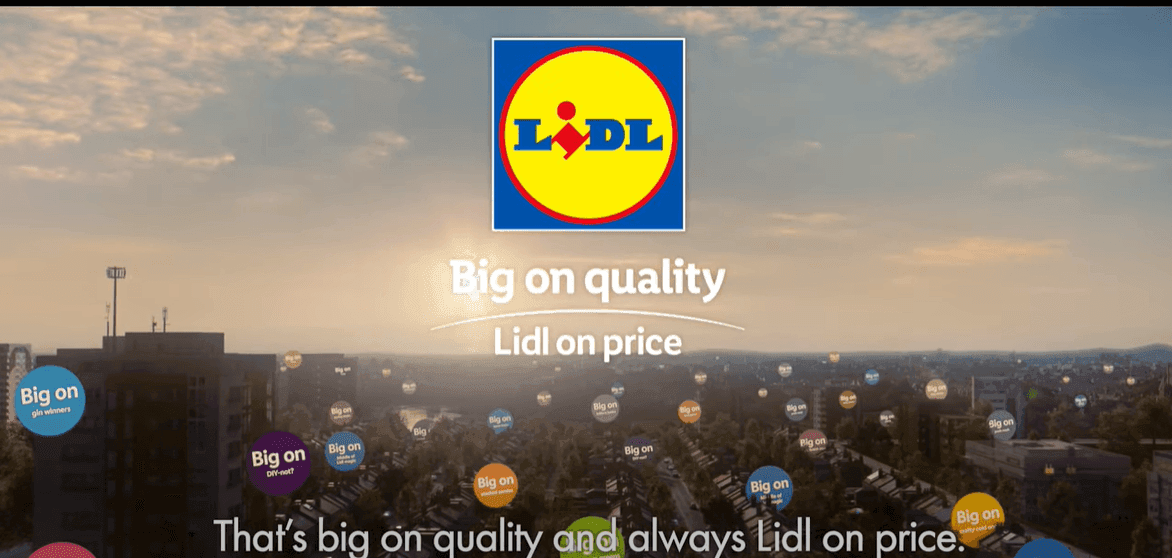
It is about the quality of products offered at a low price by LIDL. This ad was successful for its eye-catching tagline “Big on Quality” and “LIDL on price”. Lidl from this advertisement is trying to express that the products from different categories they sell are big on quality and Lidl on price or price effective. The advertisement appealed to the Youtube audience and the video got more than 48k+ views.
#Lidl Christmas
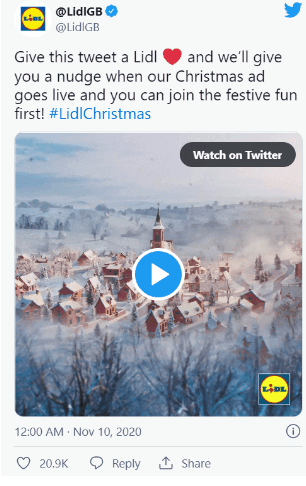
Lidl launched its campaign for the first time on digital platforms rather than on TV due to the pandemic in 2022. The campaign was launched on Twitter which created a sensation in the market.
The campaign became successful because Lidl fostered exclusivity by sending reminder tweets the day before the campaign was launched which made the users of Twitter curious to know about the campaign.
#LidlSurprises
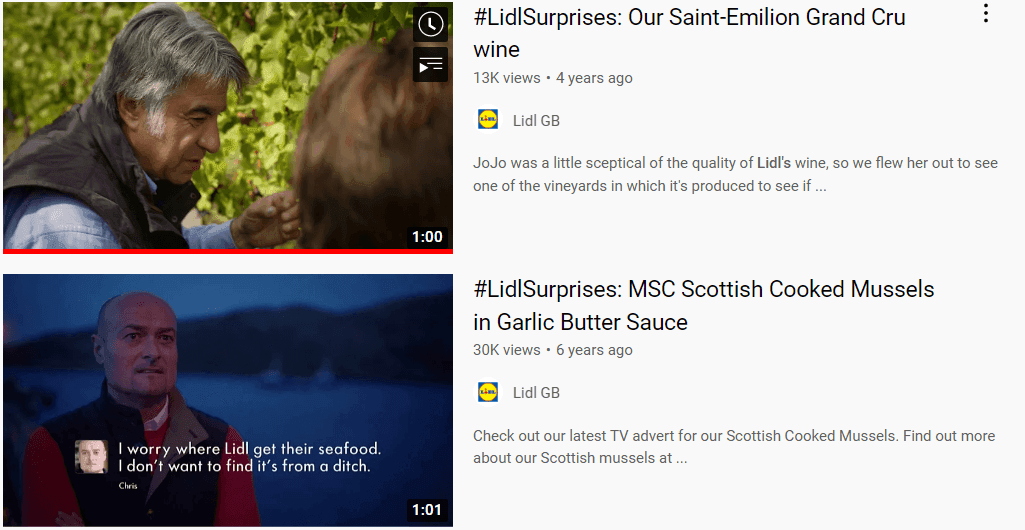
#LidlSurprises: Our Saint-Emilion Grand Cru wine
4-6 years ago Lidl conducted a series of campaigns in which the brand was seen promoting various food and beverage items that are sold under the brand name Lidl. The hashtag used to make the advertising campaign popular was #Lidlsurprises.
#Lidlsurprises campaign became popular due to its authenticity, consistency, human factor, and experiential marketing. And it continues to surprise us with its every campaign.
Top 5 Competing Companies
- ALDI: It is a Germany-based company, that operates a supermarket chain offering a wide range of products including fruits, vegetables, and electronic appliances. ALDI is headquartered in Mulheim an der Ruhr, Berlin, and boasts a revenue of $120 billion, with a workforce of 201,361 employees. ALDI has garnered 4,783 followers on Owler.
- M&S (Marks and Spencer): It is headquartered in England, and is an in-store and online retailer specializing in clothing, bags, footwear, and accessories for individuals of all ages. It is a publicly traded company led by CEO Stuart Machin, who enjoys a commendable 77% approval rating among Owler members. Marks and Spencer recently acquired Thread, Inc. for an undisclosed amount in December 2022 and has 697 followers on Owler.
- Waitrose: It is an England-based company, that owns and operates a chain of supermarkets that offer groceries, packaged foods, home furnishings, and related products. The company’s headquarters are in London, England, with James Bailey serving as the Managing Director. Waitrose has made one acquisition, the most recent being The Good Food Guide for an undisclosed amount in August 2013.
- Wal-Mart: It is a US-based company, that is renowned for offering a vast array of products at competitive retail prices. It is a discount store with a widespread presence across the United States, providing household items, electronics, and general grocery items.
- Leclerc Group and Carrefour Group: In the fiercely competitive grocery market in France, the Leclerc Group and Carrefour Group vie for the top position. They are neck and neck in the battle for market leadership, with Lidl also making notable strides, although it lags behind the leading contenders in the market.
Example of a Failed Campaign Or Backlash from Viewers
Lidl in Norway Campaign:
When talking to a Norwegian about Lidl, most people will have a strong opinion about the company. Some will tell you that Lidl was a positive contributor to the Norwegian grocery market, because of their low prices and “exotic” products.
Some will tell you that they never shopped there, because they didn’t want to support a foreign company that ignored the labor unions, built large and unattractive buildings in their towns, only had unfamiliar food on the shelves, and sent the profit out of the country. If you ask Norwegians why Lidl failed in Norway, many will argue that Lidl did not fulfill the Norwegian shoppers’ needs and did not fit in with their values.
Reasons for failure:
Inadequate market analysis: Lidl’s failure to identify and react to the most critical pitfalls in an effective way. All the Norwegian import regulations are publicly available, and they should have been able to foresee the effects on their business. A thorough analysis of the effects of these regulations could have given Lidl an indication to focus on other European areas.
Government regulations affect product strategy: The first, and probably most significant factor is the fact that Norway and Norwegians in many ways differ from the other cultures where Lidl operates. Norwegians not only seem to have a different mindset when it comes to buying behavior, but they also tend to protect their own resources as well as their way of life through governmental import regulations.
This ends the elaborative marketing strategy of Lidl. Let us conclude our learning below from the marketing strategy of Lidl.

Is Digital Marketing the Right Career for You?
Find out in a free 45-min masterclass · Career paths, roles and growth explained · By Karan Shah, Founder & CEO, IIDE

Is Digital Marketing the Right Career for You?
Find out in a free 45-min masterclass · Career paths, roles and growth explained · By Karan Shah, Founder & CEO, IIDE
Buyers Persona:

Saquib Raza
Ranchi
Occupation: Student
Age: 22 years
Motivation
Interest & Hobbies
Pain Points
Social Media Presence
Want to Know Why 2,50,000+ Students Trust Us?
Dive into the numbers that make us the #1 choice for career success



MBA - Level
Post Graduate in Digital Marketing & Business Strategy

Best For
Fresh Graduates

Mode of Learning
On Campus (Mumbai & Delhi)

Starts from
Nov 27, 2026

Duration
11 Months

Live & Online
Advanced Online Digital Marketing Course
Best For
Working Professionals
Mode of Learning
Online
Starts from
Nov 2, 2026
Duration
4-6 Months

Offline
Top AI Courses to Make You Future Ready!
Best For
AI Enthusiasts
Mode of Learning
2–5 Month Program
Starts from
Nov 24, 2026
Duration
Flexiable
Offline
Undergraduate Program in Digital Business & Entrepreneurship
Best For
12th Passouts
Mode of Learning
On Campus (Mumbai)
Duration
3 Years
Offline
Degree In 2026 ≠ Enough Degree + Digital Skills = Future-Ready
Best For
12th Passouts
Mode of Learning
At IIDE Campus
Duration
3 Years
Recent Post

Lead Trainer & Business Development Head at IIDE
Aditya Shastri leads the Business Development segment at IIDE and is a seasoned Content Marketing expert. With over a decade of experience, Aditya has trained more than 20,000 students and professionals in digital marketing, collaborating with prestigious institutions and corporations such as Jet Airways, Godrej Professionals, Pfizer, Mahindra Group, Publicis Worldwide, and many others. His ability to simplify complex marketing concepts, combined with his engaging teaching style, has earned him widespread admiration from students and professionals alike.
Aditya has spearheaded IIDE’s B2B growth, forging partnerships with over 40 higher education institutions across India to upskill students in digital marketing and business skills. As a visiting faculty member at top institutions like IIT Bhilai, Mithibai College, Amity University, and SRCC, he continues to influence the next generation of marketers.
Apart from his marketing expertise, Aditya is also a spiritual speaker, often traveling internationally to share insights on spirituality. His unique blend of digital marketing proficiency and spiritual wisdom makes him a highly respected figure in both fields.